Page 311 of 374
WARNING!
Overfilling the brake fluid reservoir can result in
spilling brake fluid on hot engine parts and the
brake fluid catching fire.
Use only brake fluid that has been in a tightly closed
container to avoid contamination from foreign matter. Do
not allow petroleum base fluid to contaminate the brake
fluid as seal damage will result.
Automatic Transmission
Selection of Lubricant
It is important that the proper lubricant is used in the
transmission to assure optimum transmission perfor-
mance. Use only manufacturer's recommended transmis-
sion fluid, refer to Recommended Fluids, Lubricants, and
Genuine Parts for correct fluid type. It is important that
the transmission fluid be maintained at the prescribed
level using the recommended fluid.
CAUTION!
Using a transmission fluid other than the manufac-
turer's recommended fluid may cause deterioration
in transmission shift quality and/or torque converter
shudder. Using a transmission fluid other than the
manufacturer's recommended fluid will result in
more frequent fluid and filter changes. Refer to
Recommended Fluids, Lubricants, and Genuine
Parts for correct fluid type.
Fluid Level Check ± 3.7L 42RLE
This fluid level should be checked when the engine is
fully warmed up and the fluid in the transmission is
heated to its normal operating temperature. Operation of
the transmission with an improper fluid level will greatly
reduce the life of the transmission and of the fluid.
MAINTAINING YOUR VEHICLE 311
7
Page 312 of 374

To check the automatic transmission fluid level properly,
the following procedure must be used:
1. The vehicle must be on level ground.
2. The engine should be running at curb idle speed for a
minimum of 60 seconds.
3. Fully apply parking brake.
4. Apply the brakes and shift the transmission into P
(Park).
5. The fluidMUSTbe checked with the transmission in
P (Park) to be sure that the fluid level is accurate.
6. Wipe the dipstick clean and reinsert until seated.
Remove dipstick and note reading.
At normal operating temperature (approximately 180É F
(82É C), the fluid level is correct if it is in the HOT region(cross-hatched area) on the oil level indicator. The fluid
level indicator should be in the COLD region at 70É F (21É
C) fluid temperature.
If the fluid level is low, add sufficient fluid to bring to the
proper level. Refer to Recommended Fluids, Lubricants
and Genuine Parts for correct fluid type.
Fluid is added through the dipstick tube.
NOTE:To prevent dirt and water from entering the
transmission after checking or replenishing fluid, make
certain that the dipstick cap is properly reseated.
Special Additives
The manufacturer recommends against the addition of
any additives to the transmission. Exception to this
policy is the use of special dyes to aid in detecting fluid
leaks.
312 MAINTAINING YOUR VEHICLE
Page 321 of 374
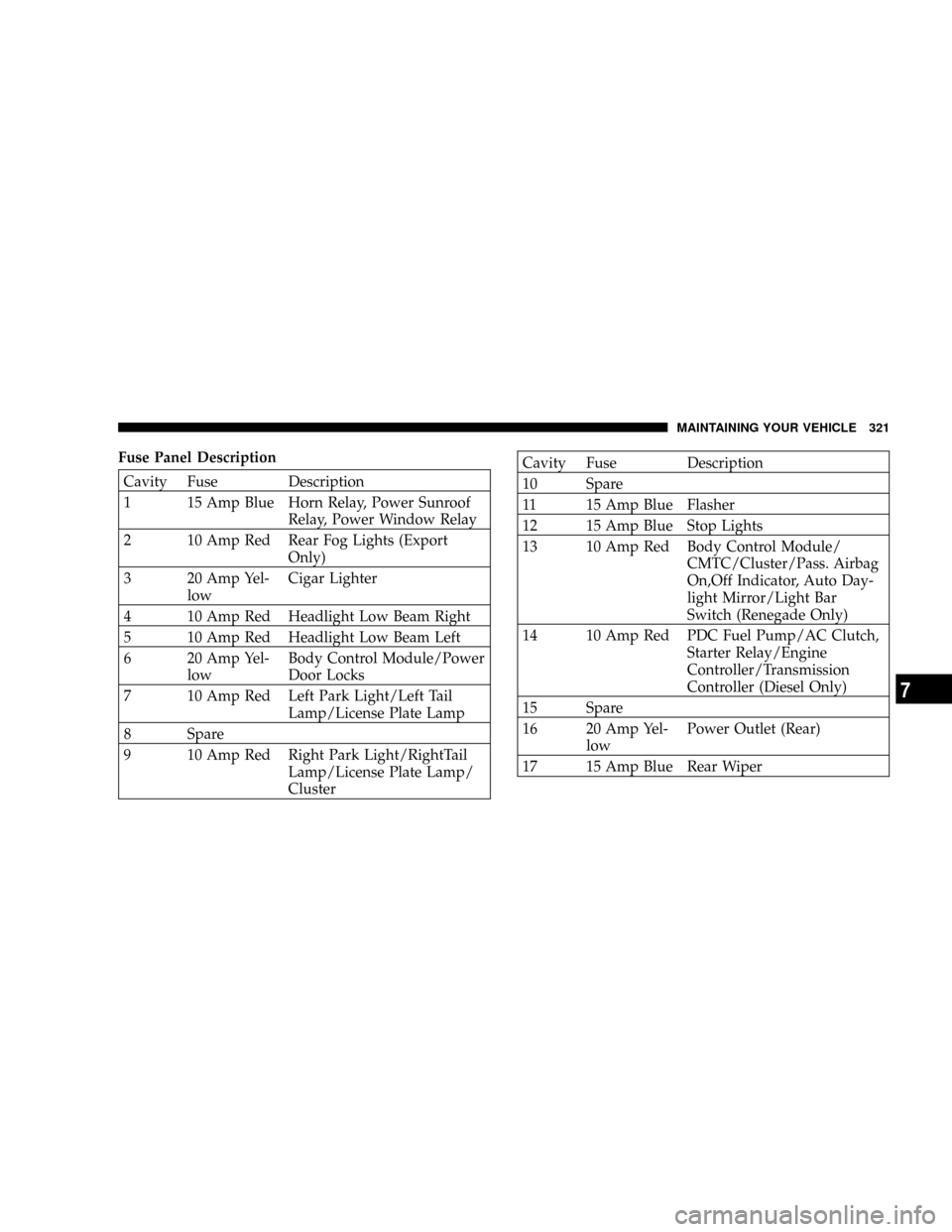
Fuse Panel Description
Cavity Fuse Description
1 15 Amp Blue Horn Relay, Power Sunroof
Relay, Power Window Relay
2 10 Amp Red Rear Fog Lights (Export
Only)
3 20 Amp Yel-
lowCigar Lighter
4 10 Amp Red Headlight Low Beam Right
5 10 Amp Red Headlight Low Beam Left
6 20 Amp Yel-
lowBody Control Module/Power
Door Locks
7 10 Amp Red Left Park Light/Left Tail
Lamp/License Plate Lamp
8 Spare
9 10 Amp Red Right Park Light/RightTail
Lamp/License Plate Lamp/
Cluster
Cavity Fuse Description
10 Spare
11 15 Amp Blue Flasher
12 15 Amp Blue Stop Lights
13 10 Amp Red Body Control Module/
CMTC/Cluster/Pass. Airbag
On,Off Indicator, Auto Day-
light Mirror/Light Bar
Switch (Renegade Only)
14 10 Amp Red PDC Fuel Pump/AC Clutch,
Starter Relay/Engine
Controller/Transmission
Controller (Diesel Only)
15 Spare
16 20 Amp Yel-
lowPower Outlet (Rear)
17 15 Amp Blue Rear Wiper
MAINTAINING YOUR VEHICLE 321
7
Page 323 of 374
Cavity Fuse Description
37 10 Amp Red Airbag Control Module
38 10 Amp Red ABS Controller/Shifter As-
sembly
39 10 Amp Red Hazard Flasher (Turn
Signals)/Backup Lamp
Switch (Manual Transmission
Only)/Transmission Range
Switch (Automatic Transmis-
sion Only)
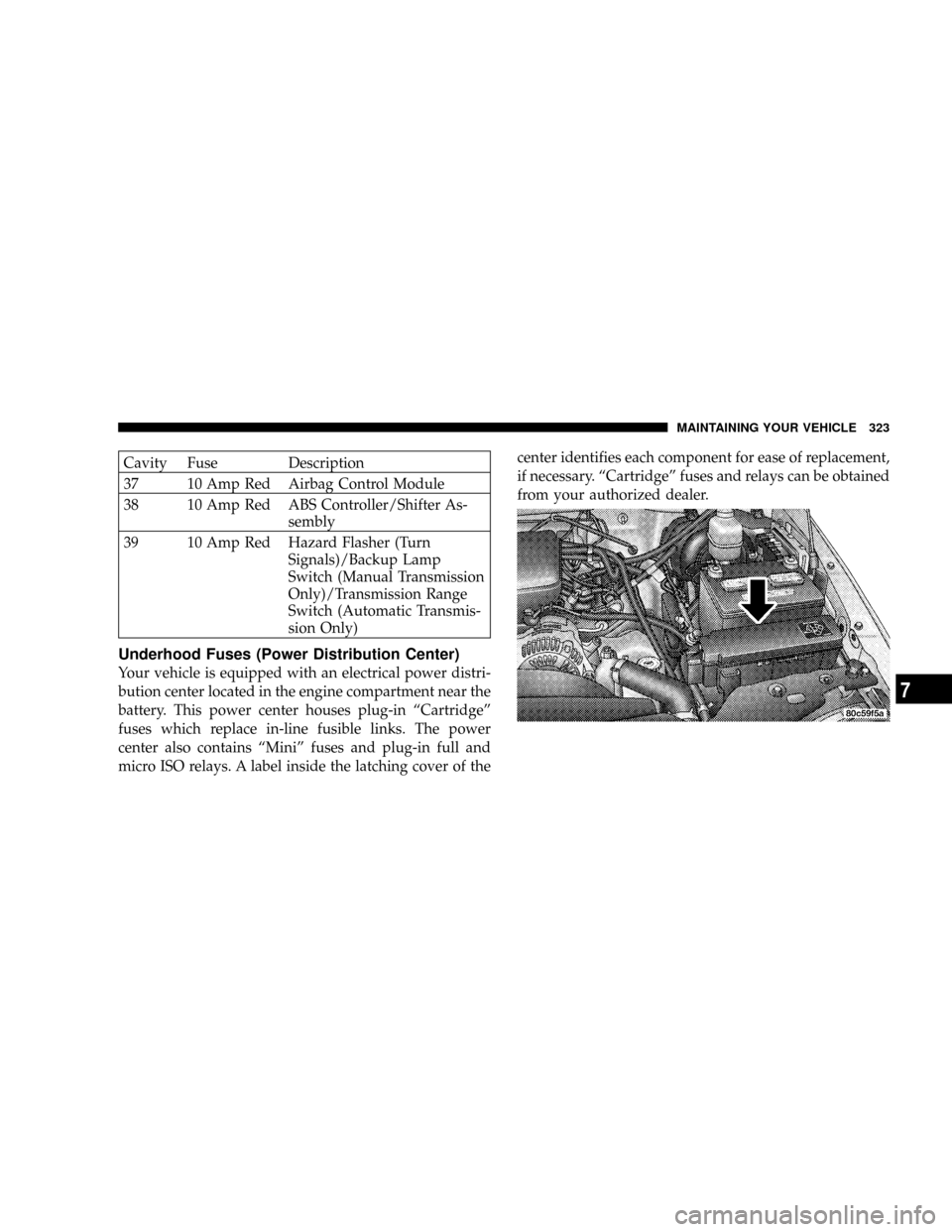
Underhood Fuses (Power Distribution Center)
Your vehicle is equipped with an electrical power distri-
bution center located in the engine compartment near the
battery. This power center houses plug-in ªCartridgeº
fuses which replace in-line fusible links. The power
center also contains ªMiniº fuses and plug-in full and
micro ISO relays. A label inside the latching cover of thecenter identifies each component for ease of replacement,
if necessary. ªCartridgeº fuses and relays can be obtained
from your authorized dealer.
MAINTAINING YOUR VEHICLE 323
7
Page 326 of 374
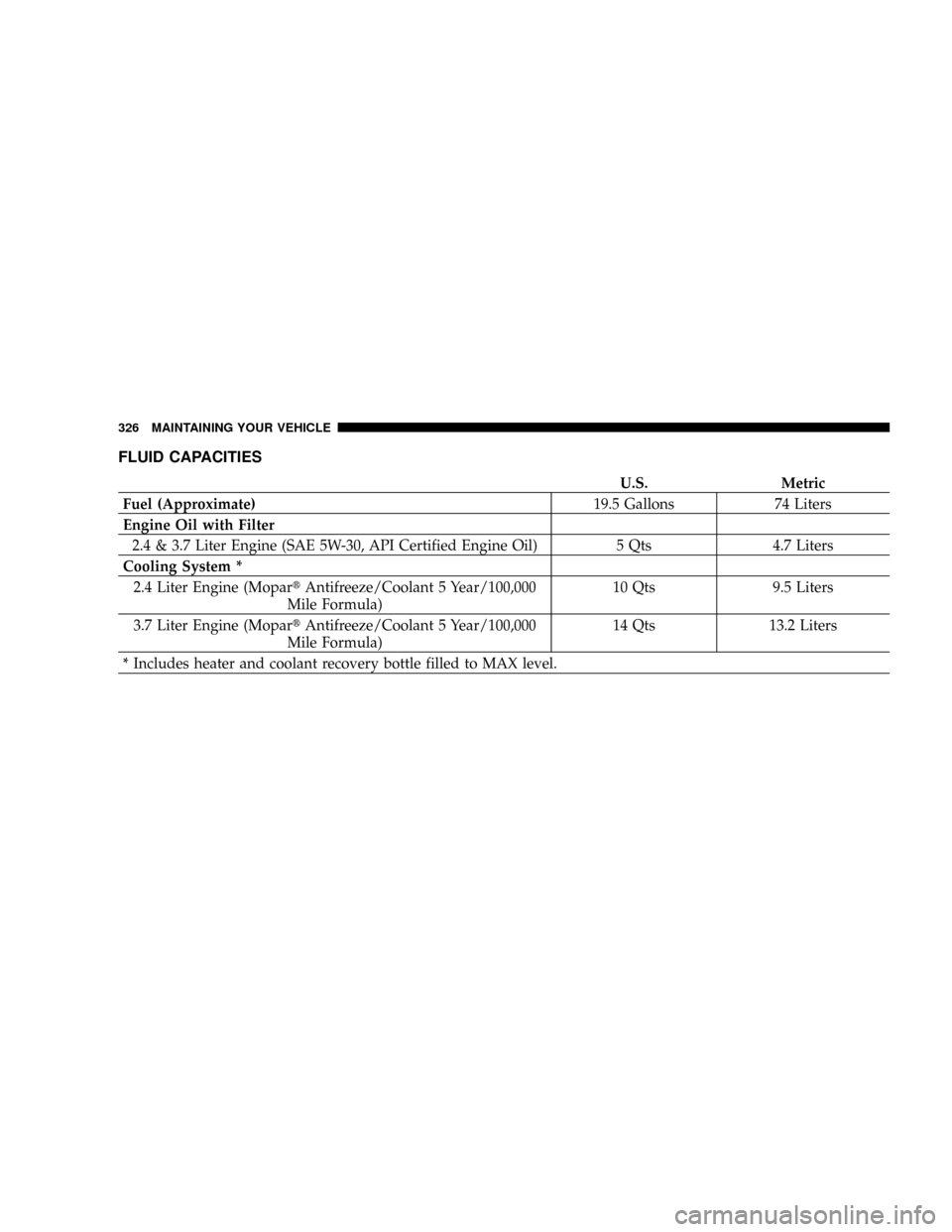
FLUID CAPACITIES
U.S. Metric
Fuel (Approximate)19.5 Gallons 74 Liters
Engine Oil with Filter
2.4 & 3.7 Liter Engine (SAE 5W-30, API Certified Engine Oil) 5 Qts 4.7 Liters
Cooling System *
2.4 Liter Engine (MopartAntifreeze/Coolant 5 Year/100,000
Mile Formula)10 Qts 9.5 Liters
3.7 Liter Engine (MopartAntifreeze/Coolant 5 Year/100,000
Mile Formula)14 Qts 13.2 Liters
* Includes heater and coolant recovery bottle filled to MAX level.
326 MAINTAINING YOUR VEHICLE
Page 327 of 374
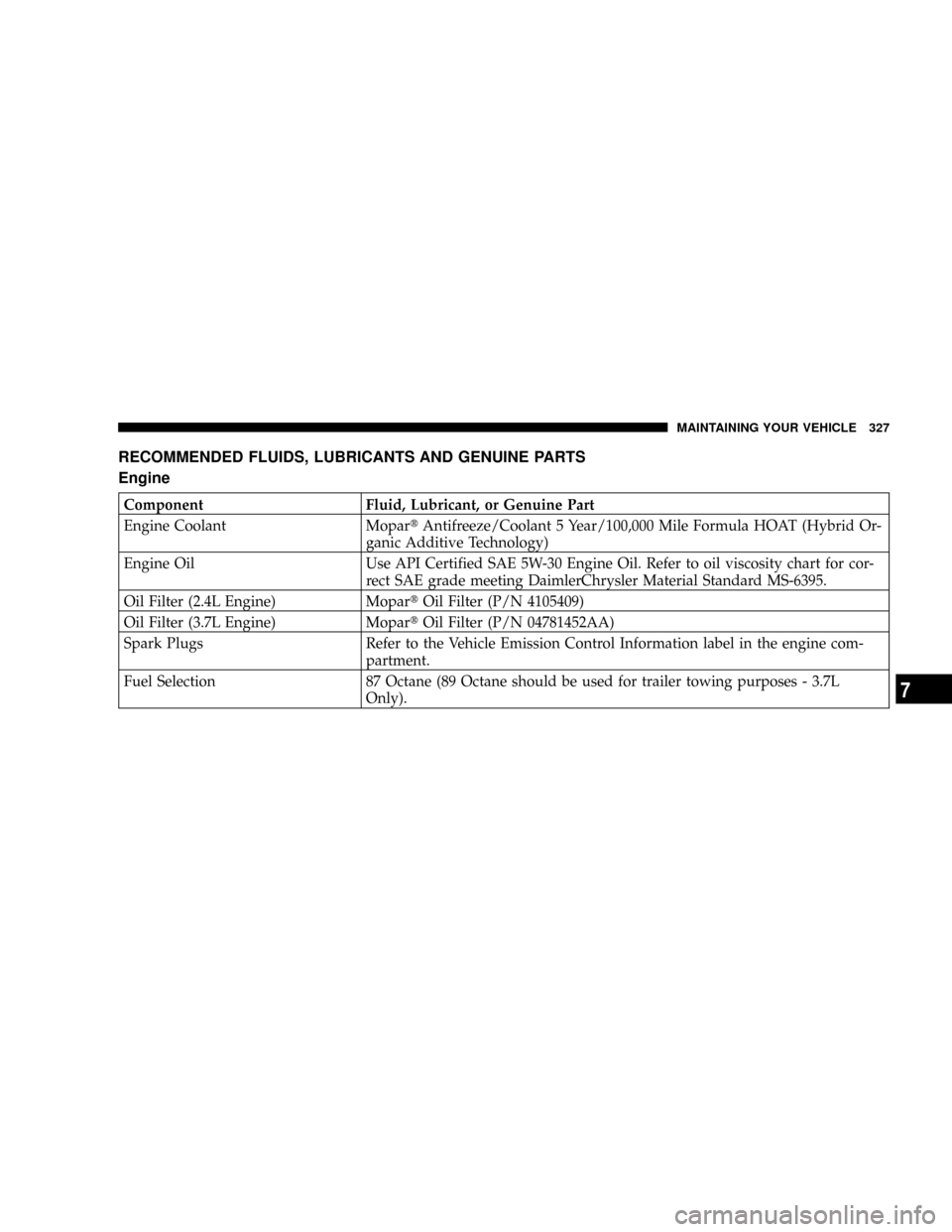
RECOMMENDED FLUIDS, LUBRICANTS AND GENUINE PARTS
Engine
Component Fluid, Lubricant, or Genuine Part
Engine Coolant MopartAntifreeze/Coolant 5 Year/100,000 Mile Formula HOAT (Hybrid Or-
ganic Additive Technology)
Engine Oil Use API Certified SAE 5W-30 Engine Oil. Refer to oil viscosity chart for cor-
rect SAE grade meeting DaimlerChrysler Material Standard MS-6395.
Oil Filter (2.4L Engine) MopartOil Filter (P/N 4105409)
Oil Filter (3.7L Engine) MopartOil Filter (P/N 04781452AA)
Spark Plugs Refer to the Vehicle Emission Control Information label in the engine com-
partment.
Fuel Selection 87 Octane (89 Octane should be used for trailer towing purposes - 3.7L
Only).
MAINTAINING YOUR VEHICLE 327
7
Page 330 of 374
EMISSION CONTROL SYSTEM MAINTENANCE
The ªScheduledº maintenance services, listed inbold
typemust be done at the times or mileages specified to
assure the continued proper functioning of the emission
control system. These, and all other maintenance services
included in this manual, should be done to provide best
vehicle performance and reliability. More frequent main-
tenance may be needed for vehicles in severe operating
conditions such as dusty areas and very short trip
driving.
Inspection and service also should be done any time a
malfunction is suspected.
NOTE:Maintenance, replacement, or repair of the emis-
sion control devices and systems on your vehicle may be
performed by any automotive repair establishment or
individual using any automotive part which has been
certified pursuant to U.S. EPA or, in the State of Califor-
nia, California Air Resources Board regulations.
MAINTENANCE SCHEDULES
There are two maintenance schedules that show the
requiredservice for your vehicle.
First is Schedule(B(. It is for vehicles that are operated
under the conditions that are listed below and at the
beginning of the schedule.
²Day or night temperatures are below 32ÉF (0ÉC).
²Stop and go driving.
²Extensive engine idling.
²Driving in dusty conditions.
²Short trips of less than 10 miles (16.2 km).
²More than 50% of your driving is at sustained high
speeds during hot weather, above 90ÉF (32ÉC).
²Trailer towing.
²Taxi, police, or delivery service (commercial service).
330 MAINTENANCE SCHEDULES
8
M
A
I
N
T
E
N
A
N
C
E
S
C
H
E
D
U
L
E
S
Page 331 of 374
²Off-road or desert driving.
NOTE:Most vehicles are operated under the conditions
listed for Schedule ªB.º
Second is ScheduleªAº. It is for vehicles that are not
operated under any of the conditions listed under Sched-
ule ªB.º
Use the schedule that best describes your driving condi-
tions. Where time and mileage are listed, follow the
interval that occurs first.
CAUTION!
Failure to perform the required maintenance items
may result in damage to the vehicle.
At Each Stop for Fuel
²Check the engine oil level about 5 minutes after a fully
warmed engine is shut off. Checking the oil level while
the vehicle is on level ground will improve the accu-
racy of the oil level reading. Add oil only when the
level is at or below the ADD or MIN mark.
²Check the windshield washer solvent, add as required.
Once a Month
²Check the tire pressure and look for unusual wear or
damage.
²Inspect the battery, and clean and tighten the terminals
as required.
²Check the fluid levels of the coolant reservoir, brake
master cylinder, and transmission, and add as needed.
²Check all lights and all other electrical items for correct
operation.
MAINTENANCE SCHEDULES 331
8
M
A
I
N
T
E
N
A
N
C
E
S
C
H
E
D
U
L
E
S