Page 2096 of 4264
6E-100 3.5L ENGINE DRIVEABILITY AND EMISSIONS
Step Action Value (s) Yes No
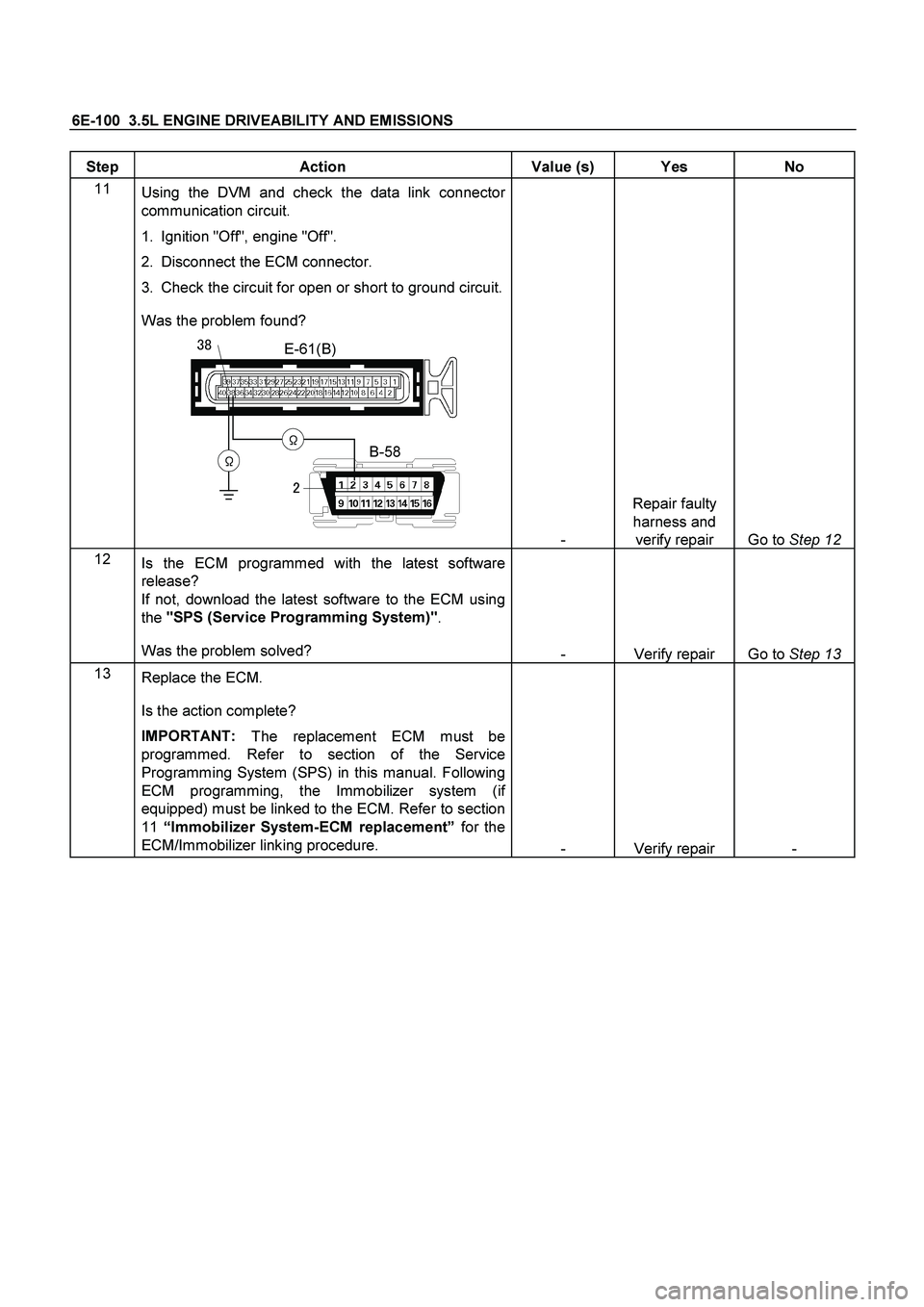
11
Using the DVM and check the data link connector
communication circuit.
1. Ignition "Off", engine "Off".
2. Disconnect the ECM connector.
3. Check the circuit for open or short to ground circuit.
Was the problem found?
�
�
��
E-61(B)
B-58
�
-
Repair faulty
harness and
verify repair
Go to Step 12
12
Is the ECM programmed with the latest software
release?
If not, download the latest software to the ECM using
the "SPS (Service Programming System)"
.
Was the problem solved?
-
Verify repair
Go to Step 13
13
Replace the ECM.
Is the action complete?
IMPORTANT:
The replacement ECM must be
programmed. Refer to section of the Service
Programming System (SPS) in this manual. Following
ECM programming, the Immobilizer system (if
equipped) must be linked to the ECM. Refer to section
11 “Immobilizer System-ECM replacement”
for the
ECM/Immobilizer linking procedure.
-
Verify repair
-
Page 2097 of 4264
3.5L ENGINE DRIVEABILITY AND EMISSIONS 6E -101
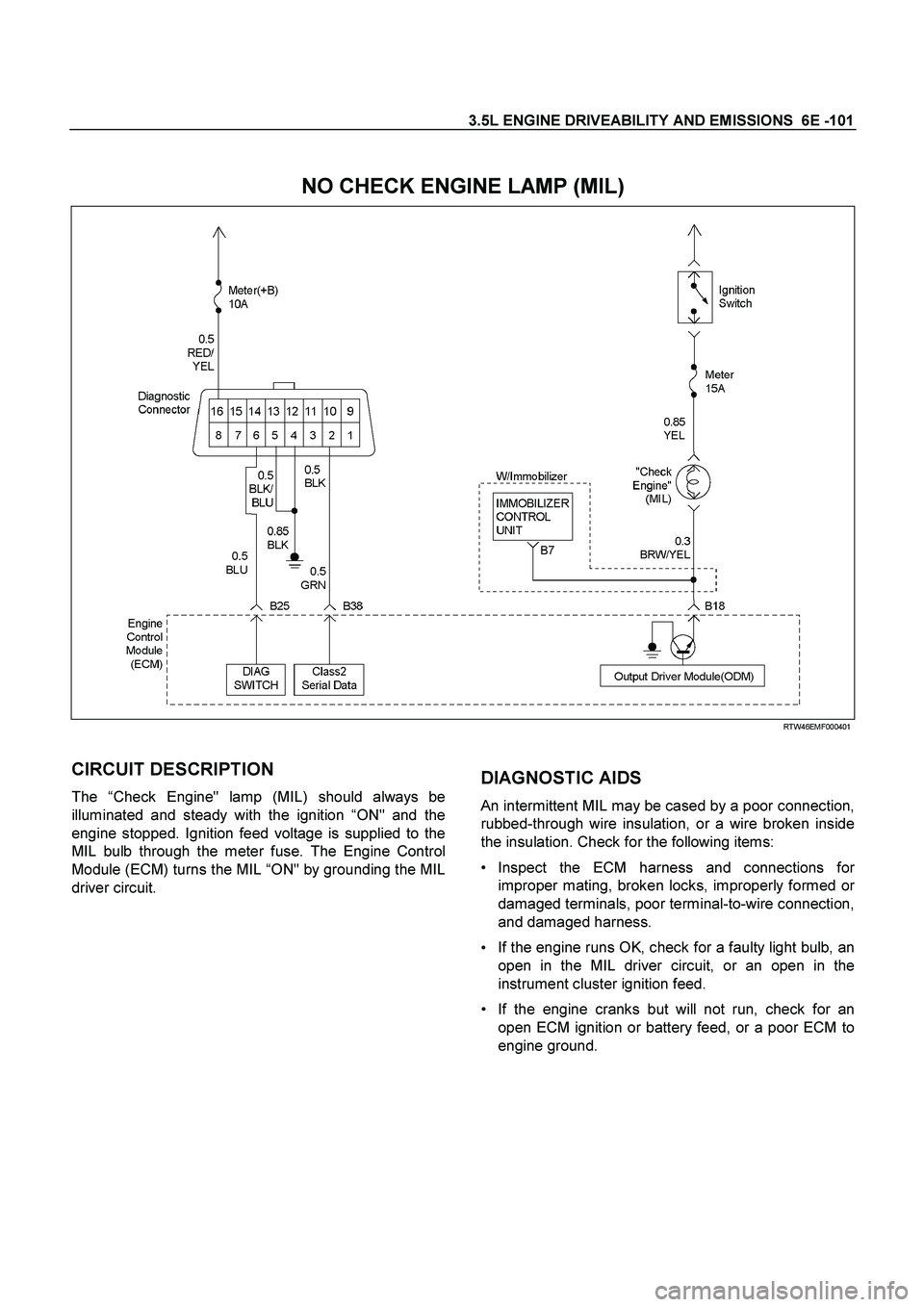
NO CHECK ENGINE LAMP (MIL)
RTW46EM F000401
CIRCUIT DESCRIPTION
The “Check Engine" lamp (MIL) should always be
illuminated and steady with the ignition “ON" and the
engine stopped. Ignition feed voltage is supplied to the
MIL bulb through the meter fuse. The Engine Control
Module (ECM) turns the MIL “ON" by grounding the MIL
driver circuit.
DIAGNOSTIC AIDS
An intermittent MIL may be cased by a poor connection,
rubbed-through wire insulation, or a wire broken inside
the insulation. Check for the following items:
Inspect the ECM harness and connections fo
r
improper mating, broken locks, improperly formed o
r
damaged terminals, poor terminal-to-wire connection,
and damaged harness.
If the engine runs OK, check for a faulty light bulb, an
open in the MIL driver circuit, or an open in the
instrument cluster ignition feed.
If the engine cranks but will not run, check for an
open ECM ignition or battery feed, or a poor ECM to
engine ground.
Page 2098 of 4264
6E-102 3.5L ENGINE DRIVEABILITY AND EMISSIONS
No Check Engine Lamp (MIL)
Step
Action Value (s) Yes No
1
Check the meter fuse (15A). If the fuse is burnt out,
repair as necessary.
Was the problem found?
- Verify repair Go to Step 2
2
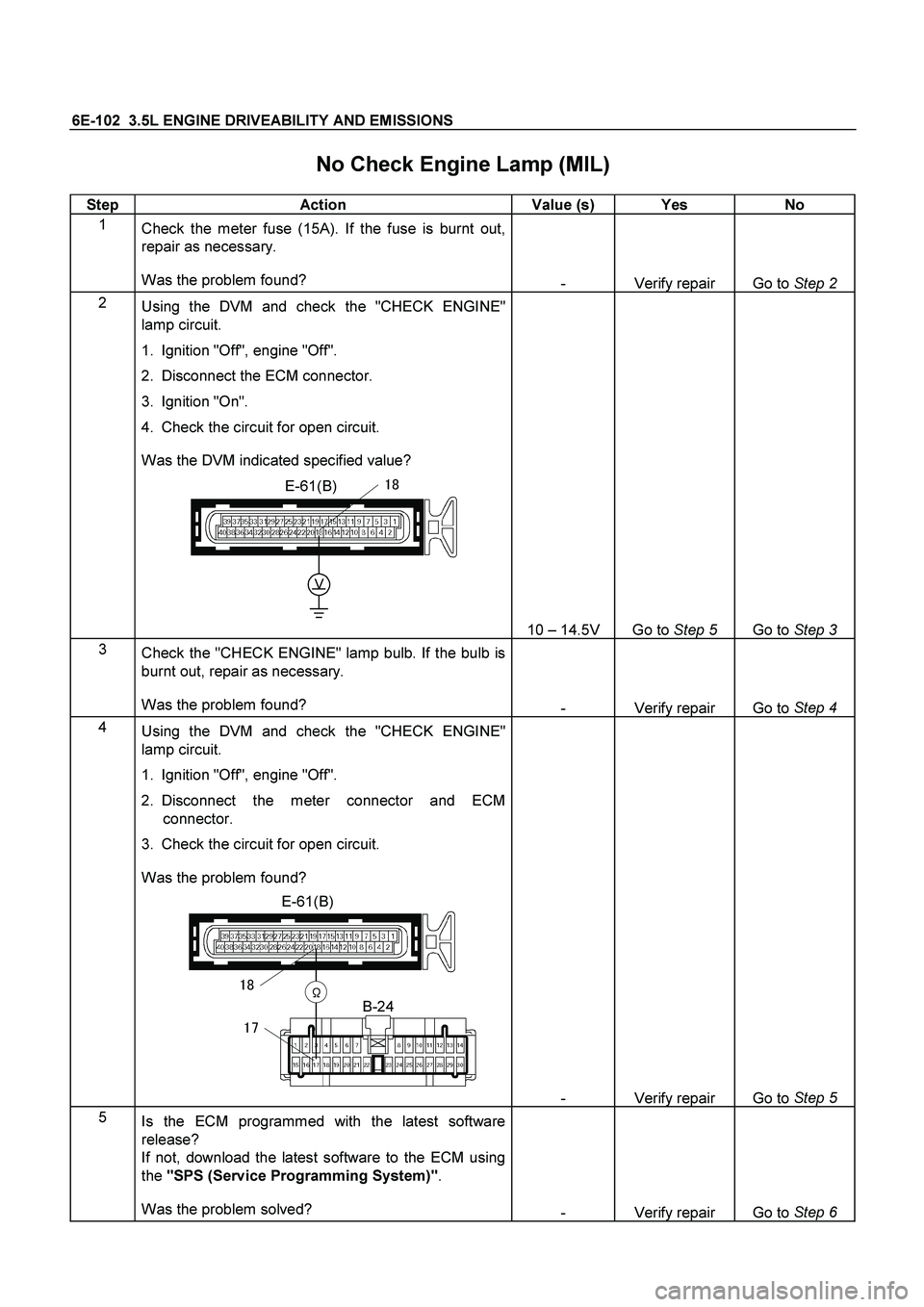
Using the DVM and check the "CHECK ENGINE"
lamp circuit.
1. Ignition "Off", engine "Off".
2. Disconnect the ECM connector.
3. Ignition "On".
4. Check the circuit for open circuit.
Was the DVM indicated specified value?
V
E-61(B)��
10 – 14.5V
Go to Step 5
Go to Step 3
3
Check the "CHECK ENGINE" lamp bulb. If the bulb is
burnt out, repair as necessary.
Was the problem found?
- Verify repair Go to Step 4
4
Using the DVM and check the "CHECK ENGINE"
lamp circuit.
1. Ignition "Off", engine "Off".
2. Disconnect the meter connector and ECM
connector.
3. Check the circuit for open circuit.
Was the problem found?
���
��E-61(B)
B-24
-
Verify repair
Go to Step 5
5
Is the ECM programmed with the latest software
release?
If not, download the latest software to the ECM using
the "SPS (Service Programming System)"
.
Was the problem solved?
-
Verify repair
Go to Step 6
Page 2099 of 4264
3.5L ENGINE DRIVEABILITY AND EMISSIONS 6E -103
Step
Action Value (s) Yes No
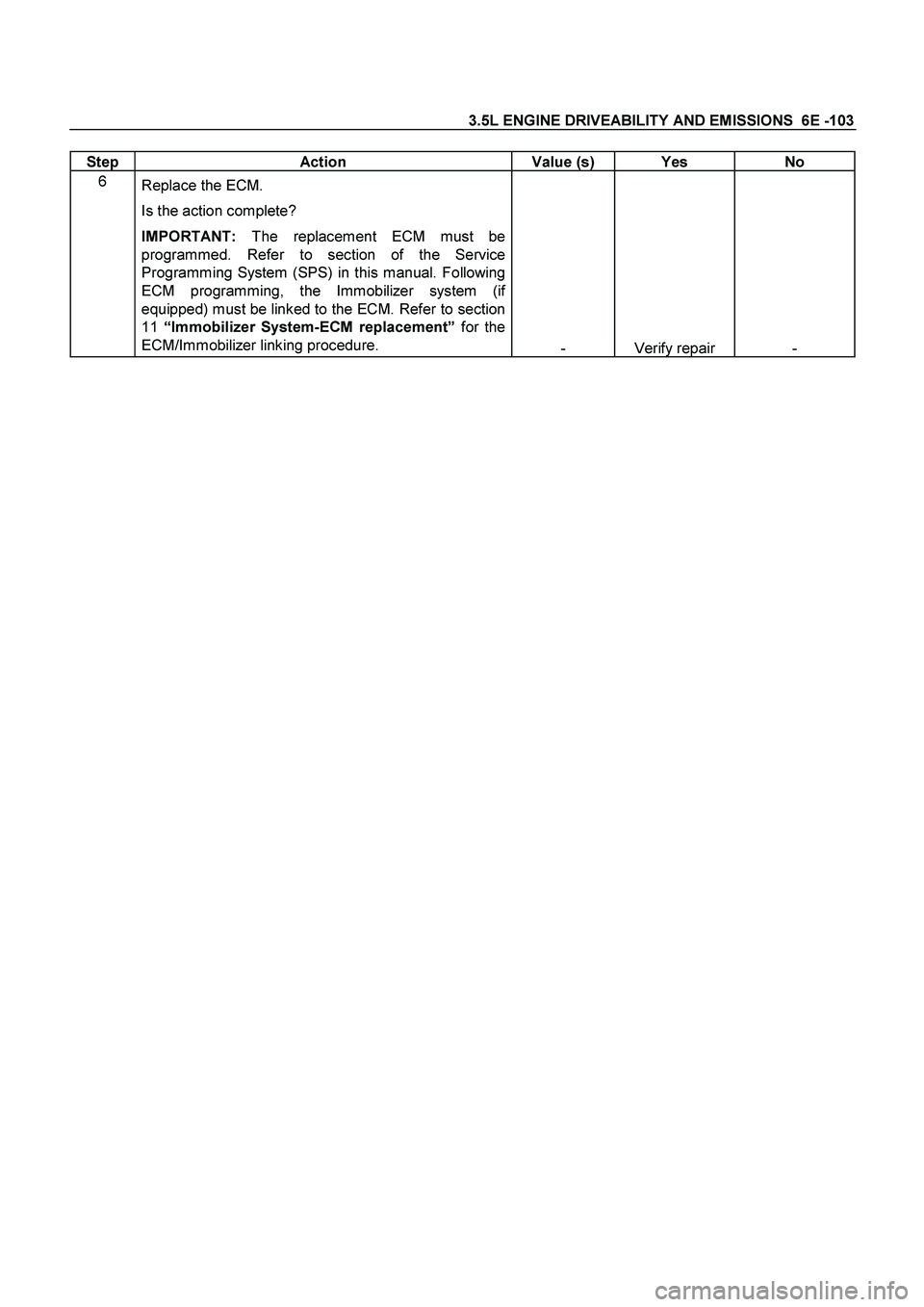
6
Replace the ECM.
Is the action complete?
IMPORTANT:
The replacement ECM must be
programmed. Refer to section of the Service
Programming System (SPS) in this manual. Following
ECM programming, the Immobilizer system (if
equipped) must be linked to the ECM. Refer to section
11 “Immobilizer System-ECM replacement”
for the
ECM/Immobilizer linking procedure.
-
Verify repair
-
Page 2100 of 4264
6E-104 3.5L ENGINE DRIVEABILITY AND EMISSIONS
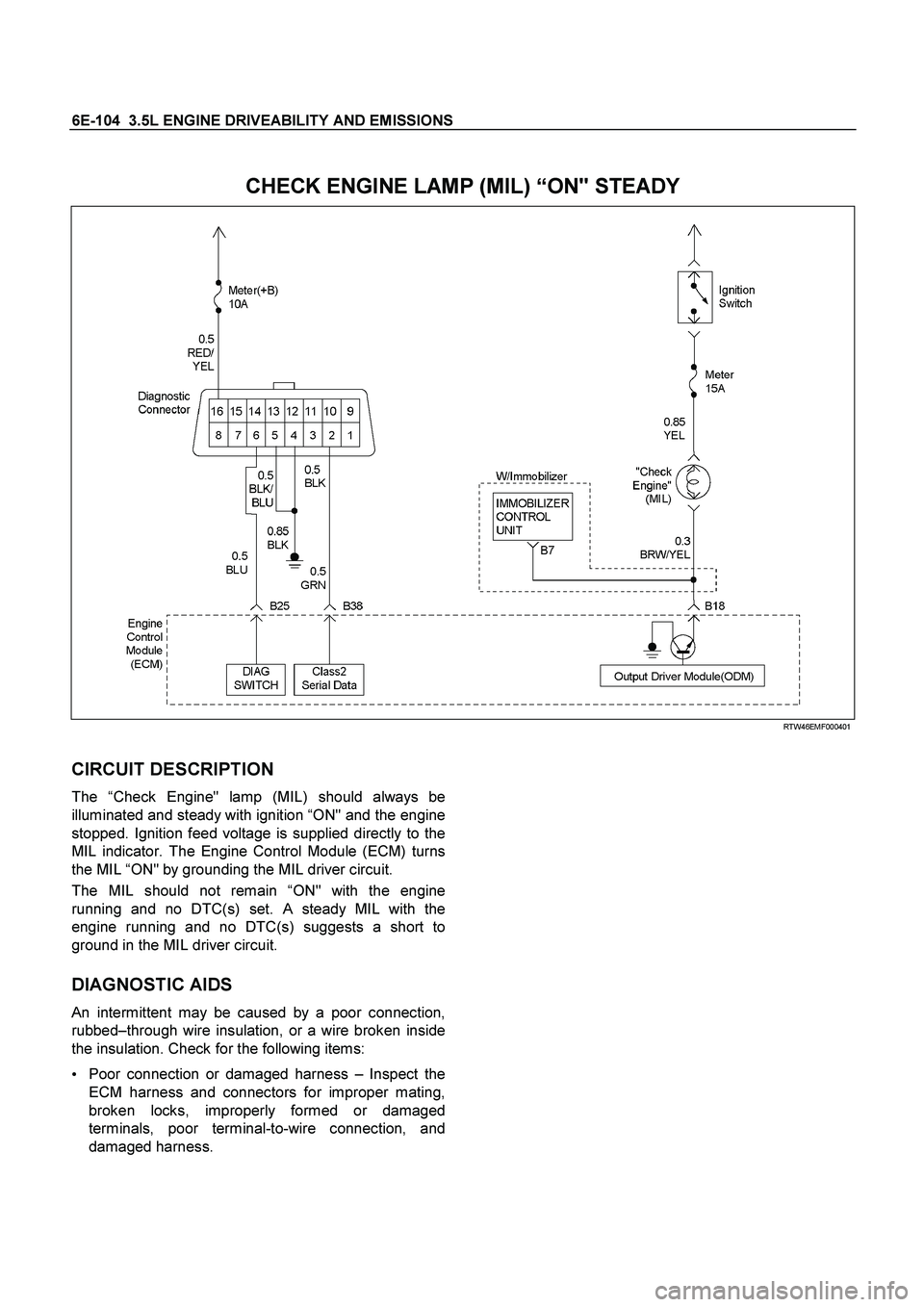
CHECK ENGINE LAMP (MIL) “ON" STEADY
RTW46EM F000401
CIRCUIT DESCRIPTION
The “Check Engine" lamp (MIL) should always be
illuminated and steady with ignition “ON" and the engine
stopped. Ignition feed voltage is supplied directly to the
MIL indicator. The Engine Control Module (ECM) turns
the MIL “ON" by grounding the MIL driver circuit.
The MIL should not remain “ON" with the engine
running and no DTC(s) set. A steady MIL with the
engine running and no DTC(s) suggests a short to
ground in the MIL driver circuit.
DIAGNOSTIC AIDS
An intermittent may be caused by a poor connection,
rubbed–through wire insulation, or a wire broken inside
the insulation. Check for the following items:
Poor connection or damaged harness – Inspect the
ECM harness and connectors for improper mating,
broken locks, improperly formed or damaged
terminals, poor terminal-to-wire connection, and
damaged harness.
Page 2101 of 4264
3.5L ENGINE DRIVEABILITY AND EMISSIONS 6E -105
Check Engine Lamp (MIL) “ON" Steady
Step Action Value (s) Yes No
1
1. Ignition "Off", engine "Off".
2. Disconnect the ECM connector.
3. Ignition "On".
Was the "CHECK ENGINE" lamp turned on?
- Go to Step 2
Go to Step 4
2
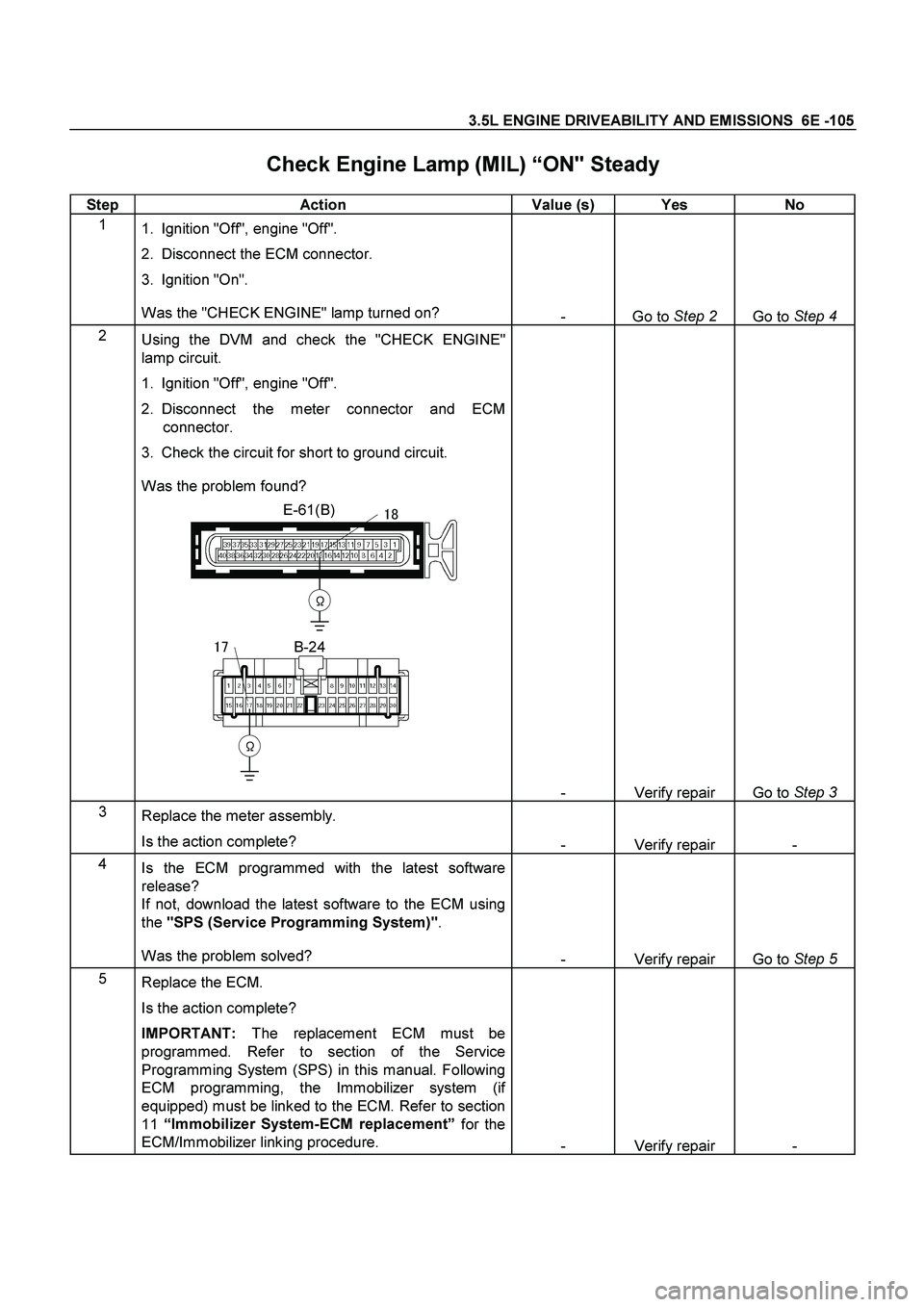
Using the DVM and check the "CHECK ENGINE"
lamp circuit.
1. Ignition "Off", engine "Off".
2. Disconnect the meter connector and ECM
connector.
3. Check the circuit for short to ground circuit.
Was the problem found?
�
B-24��
�
E-61(B)��
- Verify repair Go to Step 3
3
Replace the meter assembly.
Is the action complete?
- Verify repair -
4
Is the ECM programmed with the latest software
release?
If not, download the latest software to the ECM using
the "SPS (Service Programming System)"
.
Was the problem solved?
-
Verify repair
Go to Step 5
5
Replace the ECM.
Is the action complete?
IMPORTANT: The replacement ECM must be
programmed. Refer to section of the Service
Programming System (SPS) in this manual. Following
ECM programming, the Immobilizer system (if
equipped) must be linked to the ECM. Refer to section
11 “Immobilizer System-ECM replacement”
for the
ECM/Immobilizer linking procedure.
-
Verify repair
-
Page 2102 of 4264
6E-106 3.5L ENGINE DRIVEABILITY AND EMISSIONS
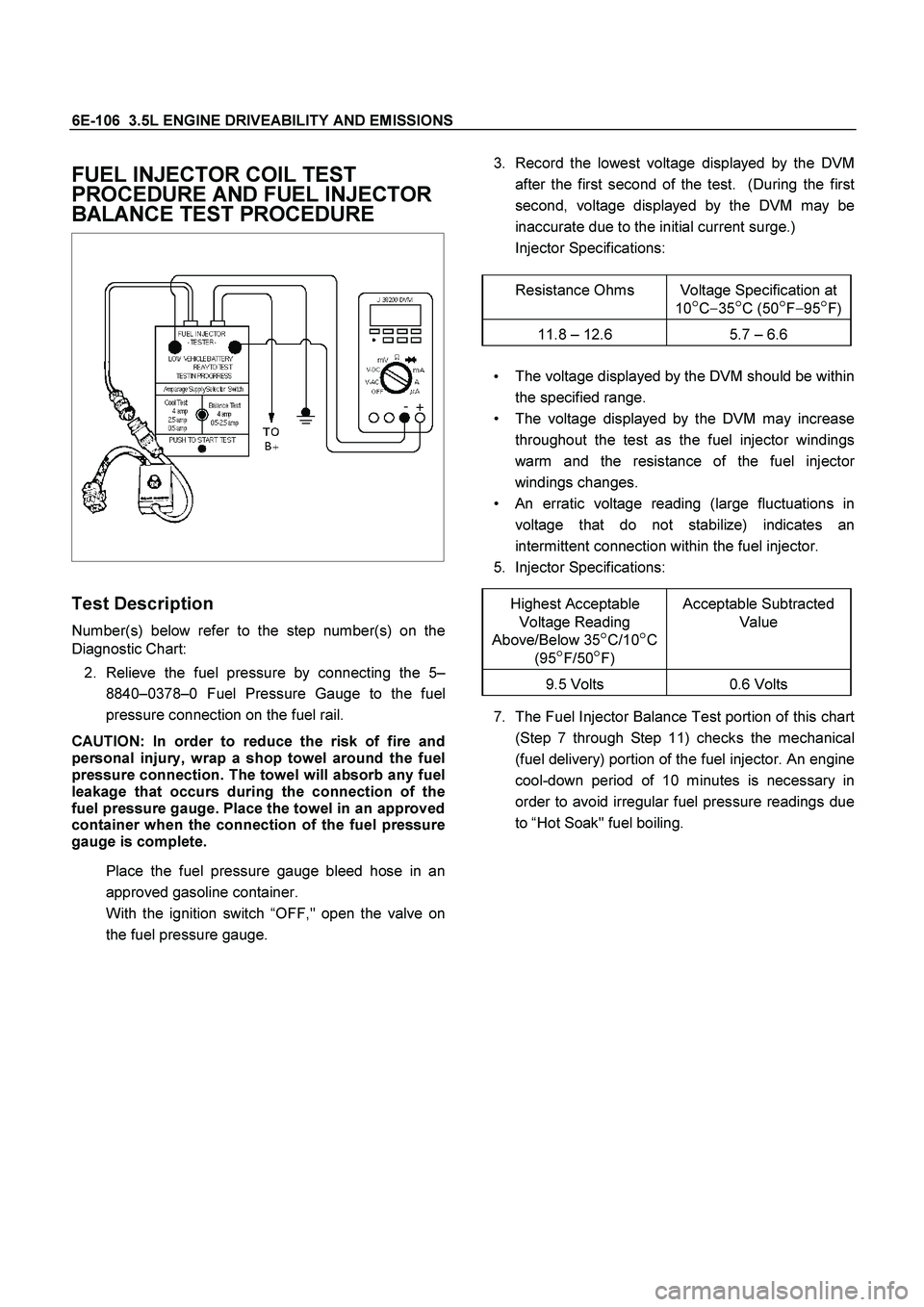
FUEL INJECTOR COIL TEST
PROCEDURE AND FUEL INJECTOR
BALANCE TEST PROCEDURE
Test Description
Number(s) below refer to the step number(s) on the
Diagnostic Chart:
2.
Relieve the fuel pressure by connecting the 5–
8840–0378–0 Fuel Pressure Gauge to the fuel
pressure connection on the fuel rail.
CAUTION: In order to reduce the risk of fire and
personal injury, wrap a shop towel around the fuel
pressure connection. The towel will absorb any fuel
leakage that occurs during the connection of the
fuel pressure gauge. Place the towel in an approved
container when the connection of the fuel pressure
gauge is complete.
Place the fuel pressure gauge bleed hose in an
approved gasoline container.
With the ignition switch “OFF," open the valve on
the fuel pressure gauge.
3.
Record the lowest voltage displayed by the DVM
after the first second of the test. (During the first
second, voltage displayed by the DVM may be
inaccurate due to the initial current surge.)
Injector Specifications:
Resistance Ohms Voltage Specification at
10
�C�
35�C (50�F�
95�F)
11.8 – 12.6 5.7 – 6.6
The voltage displayed by the DVM should be within
the specified range.
The voltage displayed by the DVM may increase
throughout the test as the fuel injector windings
warm and the resistance of the fuel injecto
r
windings changes.
An erratic voltage reading (large fluctuations in
voltage that do not stabilize) indicates an
intermittent connection within the fuel injector.
5.
Injector Specifications:
Highest Acceptable
Voltage Reading
Above/Below 35
�C/10�C
(95
�F/50�F) Acceptable Subtracted
Value
9.5 Volts 0.6 Volts
7.
The Fuel Injector Balance Test portion of this chart
(Step 7 through Step 11) checks the mechanical
(fuel delivery) portion of the fuel injector. An engine
cool-down period of 10 minutes is necessary in
order to avoid irregular fuel pressure readings due
to “Hot Soak" fuel boiling.
Page 2103 of 4264
3.5L ENGINE DRIVEABILITY AND EMISSIONS 6E -107
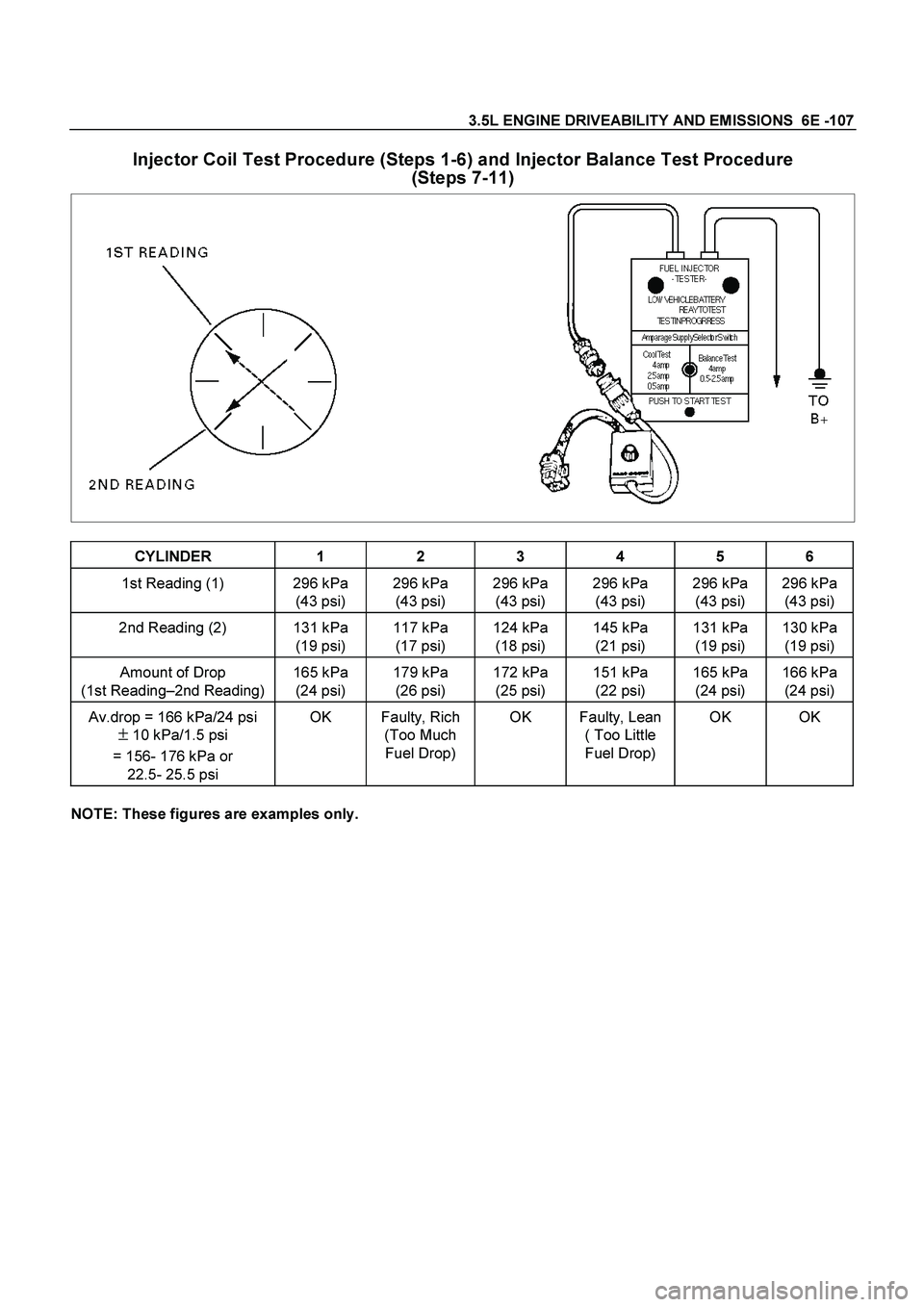
Injector Coil Test Procedure (Steps 1-6) and Injector Balance Test Procedure
(Steps 7-11)
CYLINDER 1 2 3 4 5 6
1st Reading (1) 296 kPa
(43 psi) 296 kPa
(43 psi) 296 kPa
(43 psi) 296 kPa
(43 psi) 296 kPa
(43 psi) 296 kPa
(43 psi)
2nd Reading (2) 131 kPa
(19 psi) 117 kPa
(17 psi) 124 kPa
(18 psi) 145 kPa
(21 psi) 131 kPa
(19 psi) 130 kPa
(19 psi)
Amount of Drop
(1st Reading–2nd Reading) 165 kPa
(24 psi) 179 kPa
(26 psi) 172 kPa
(25 psi) 151 kPa
(22 psi) 165 kPa
(24 psi) 166 kPa
(24 psi)
Av.drop = 166 kPa/24 psi
��10 kPa/1.5 psi
= 156- 176 kPa or
22.5- 25.5 psi OK Faulty, Rich
(Too Much
Fuel Drop) OK Faulty, Lean
( Too Little
Fuel Drop) OK OK
NOTE: These figures are examples only.