Page 22 of 4449
![INFINITI FX35 2004 Service Manual LASER BEAM AIMING ADJUSTMENT
ACS-13
[ICC]
C
D
E
F
G
H
I
J
L
MA
B
ACS
Revision: 2004 November 2004 FX35/FX45
2. Adjust the height of the target stand so that the point of the trian-
gle aims the center](/manual-img/42/57021/w960_57021-21.png "INFINITI FX35 2004 Service Manual LASER BEAM AIMING ADJUSTMENT
ACS-13
[ICC]
C
D
E
F
G
H
I
J
L
MA
B
ACS
Revision: 2004 November 2004 FX35/FX45
2. Adjust the height of the target stand so that the point of the trian-
gle aims the center")
LASER BEAM AIMING ADJUSTMENT
ACS-13
[ICC]
C
D
E
F
G
H
I
J
L
MA
B
ACS
Revision: 2004 November 2004 FX35/FX45
2. Adjust the height of the target stand so that the point of the trian-
gle aims the center of the ICC sensor.
ADJUSTING THE RIGHT-LEFT POSITION OF THE TARGET
1. Attach a scale (at least 350 mm [14 in] or longer) or stick as
shown in the figure.
2. Suspend a thread with weight on the tip of the thread to 310 mm
(12.2 in) left side of the target board from the center of the tar-
get board on top.
SETTING THE TARGET
1. Suspend a thread with weight on tip to splice the center of the front and back bumpers. Then, mark the
center point on the ground as each weight points.
2. Link the front and back bumpers center points marked on the ground, and mark a point 5 m ahead of the
sensor, on the extended line of the previous link line of the bumper center points. Then, adjust the position
of the target board so that the weight come on the top of the marked point (5 m ahead of the sensor) and
face to the vehicle.
3. Adjust the position of the target board so that the extended line
that links the center of the rear window (the center of the rear
window defogger pattern) and the center of the front windshield
(the setting part of the room mirror) align with the weight sus-
pended from the board.
4. Remove the thread suspended to the left side of board and suspend a thread with weight on tip on the
center of the target board.Then mark the point of weight on the ground.
SKIA6180E
SKIA1211E
SKIA5975E
SKIA1213E
Page 586 of 4449

REFRIGERANT LINES
ATC-157
C
D
E
F
G
H
I
K
L
MA
B
AT C
Revision: 2004 November 2004 FX35/FX45
Checking for Refrigerant LeaksAJS00163
Perform a visual inspection of all refrigeration parts, fittings, hoses and components for signs of A/C lubricant
leakage, damage and corrosion. A/C lubricant leakage may indicate an area of refrigerant leakage. Allow
extra inspection time in these areas when using either an electronic refrigerant leak detector or fluorescent
dye leak detector.
If dye is observed, confirm the leak with an electronic refrigerant leak detector. It is possible a prior leak was
repaired and not properly cleaned.
When searching for leaks, do not stop when one leak is found but continue to check for additional leaks at all
system components and connections.
When searching for refrigerant leaks using an electronic leak detector, move the probe along the suspected
leak area at 1 to 2 inches per second and no further than 1/4 inch from the component.
CAUTION:
Moving the electronic leak detector probe slower and closer to the suspected leak area will improve
the chances of finding a leak.
Checking System for Leaks Using the Fluorescent Leak DetectorAJS00164
1. Check A/C system for leaks using the UV lamp and safety goggles (J-42220) in a low sunlight area (area
without windows preferable). Illuminate all components, fittings and lines. The dye will appear as a bright
green/yellow area at the point of leakage. Fluorescent dye observed at the evaporator drain opening indi-
cates an evaporator core assembly (tubes, core or expansion valve) leak.
2. If the suspected area is difficult to see, use an adjustable mirror or wipe the area with a clean shop rag or
cloth, with the UV lamp for dye residue.
3. After the leak is repaired, remove any residual dye using dye cleaner (J-43872) to prevent future misdiag-
nosis.
4. Perform a system performance check and verify the leak repair with an approved electronic refrigerant
leak detector.
NOTE:
Other gases in the work area or substances on the A/C components, for example, anti-freeze, windshield
washer fluid, solvents and lubricants, may falsely trigger the leak detector. Make sure the surfaces to be
checked are clean.
Clean with a dry cloth or blow off with shop air.
Do not allow the sensor tip of the detector to contact with any substance. This can also cause false readings
and may damage the detector.
Dye InjectionAJS00165
(This procedure is only necessary when recharging the system or when the compressor has seized and was
replaced.)
1. Check A/C system static (at rest) pressure. Pressure must be at least 345 kPa (3.52 kg/cm
2 , 50 psi).
2. Pour one bottle (1/4 ounce / 7.4 cc) of the A/C refrigerant dye into the injector tool (J-41459).
3. Connect the injector tool to the A/C Low-pressure side service fitting.
4. Start engine and switch A/C ON.
5. When the A/C operating (compressor running), inject one bottle (1/4 ounce / 7.4 cc) of fluorescent dye
through the low-pressure service valve using dye injector tool J-41459 (refer to the manufacture′s operat-
ing instructions).
6. With the engine still running, disconnect the injector tool from the service fitting.
CAUTION:
Be careful the A/C system or replacing a component, pour the dye directly into the open system
connection and proceed with the service procedures.
7. Operate the A/C system for a minimum of 20 minutes to mix the dye with the system oil. Depending on the
leak size, operating conditions and location of the leak, it may take from minutes to days for the dye to
penetrate a leak and become visible.
Page 943 of 4449
BL-136
INTELLIGENT KEY SYSTEM
Revision: 2004 November 2004 FX35/FX45
2. OUTSIDE KEY ANTENNA OPERATION INSPECTION
1. Disconnect each outside key antenna connector.
2. Check the following.
–Check continuity between door mirror (outside key antenna) connector D2 (driver side), D32 (passenger
side) terminals 6 and 7
–Check continuity between outside key antenna D62 (rear door LH), D82 (rear door RH), D116 (back door)
terminals 1 and 2
OK or NG
OK >> GO TO 3.
NG >> Replace outside key antenna.Driver side, Passenger side
6 - 7 : Continuity should exist.
Back door, Rear door
1 - 2 : Continuity should exist.
PIIA9931E
Page 1036 of 4449
INTEGRATED HOMELINK TRANSMITTER
BL-229
C
D
E
F
G
H
J
K
L
MA
B
BL
Revision: 2004 November 2004 FX35/FX45
Trouble DiagnosesAIS004PV
DIAGNOSTIC PROCEDURE
SYMPTOM: Transmitter Does Not Activate Receiver.
Before conducting the procedure given below, make sure that system receiver (garage door opener, etc.)
operates with original, hand-held transmitter. If NG, receiver or hand-held transmitter is malfunctioning, not
vehicle related.
1. CHECK ILLUMINATION
1. Turn ignition switch “OFF”.
2. Does red light (LED) of transmitter illuminate when any transmit-
ter button is pressed?
YES or NO
YES >> GO TO 2.
NO >> GO TO 3.
2. CHECK TRANSMITTER
Check transmitter with Tool*.
*:For details, refer to Technical Service Bulletin.
OK or NG
OK >> Receiver or hand-held transmitter malfunction, not vehicle related.
NG >> Replace inside mirror assembly.
3. CHECK BCM OUTPUT POWER SUPPLY
Does room lamp come on when driver side door opened. Refer to LT- 1 5 7
.
Does room lamp illumination?
YES >> GO TO 4.
NO >> Repair or replace the malfunction part.
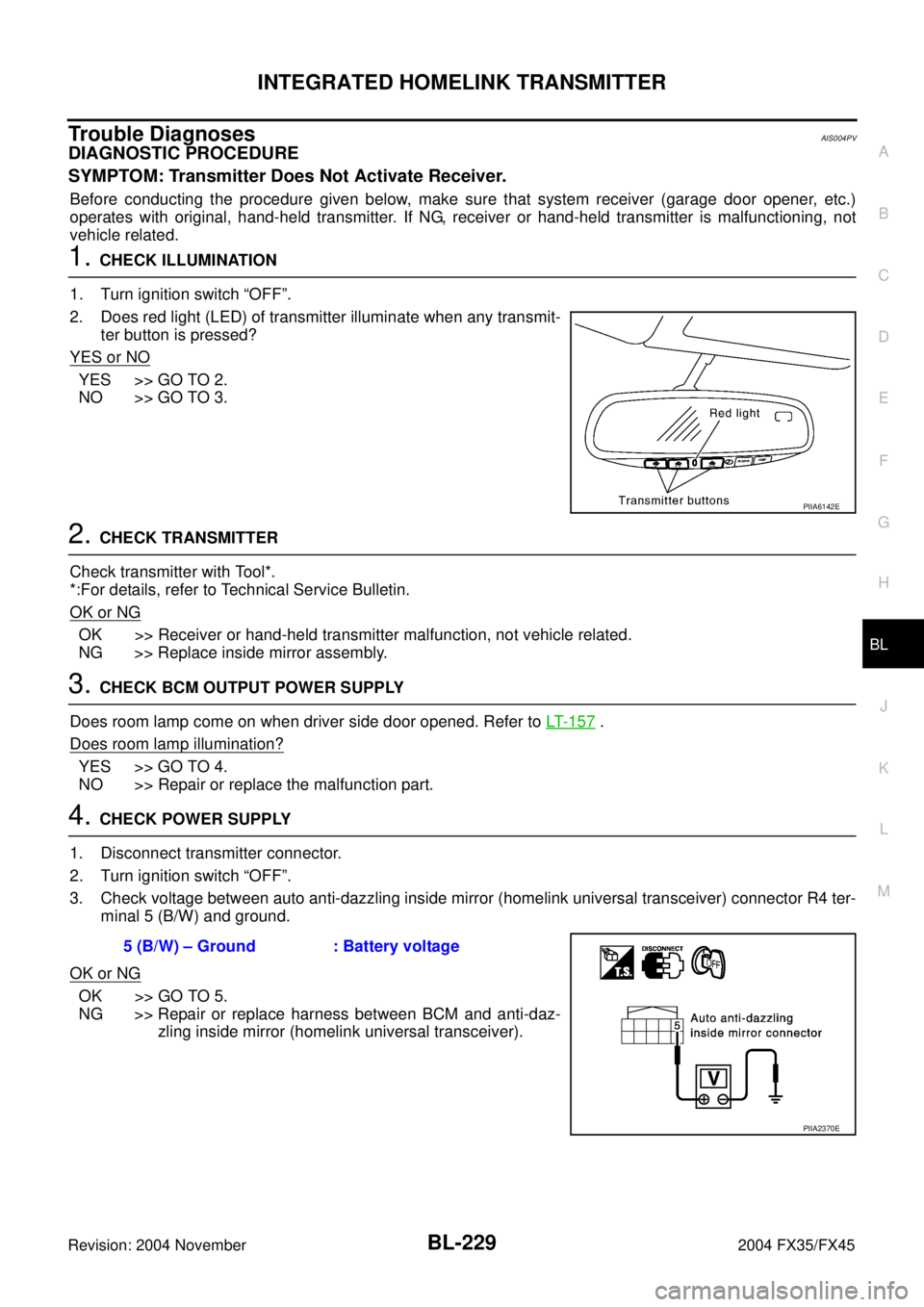
4. CHECK POWER SUPPLY
1. Disconnect transmitter connector.
2. Turn ignition switch “OFF”.
3. Check voltage between auto anti-dazzling inside mirror (homelink universal transceiver) connector R4 ter-
minal 5 (B/W) and ground.
OK or NG
OK >> GO TO 5.
NG >> Repair or replace harness between BCM and anti-daz-
zling inside mirror (homelink universal transceiver).
PIIA6142E
5 (B/W) – Ground : Battery voltage
PIIA2370E
Page 1037 of 4449
BL-230
INTEGRATED HOMELINK TRANSMITTER
Revision: 2004 November 2004 FX35/FX45
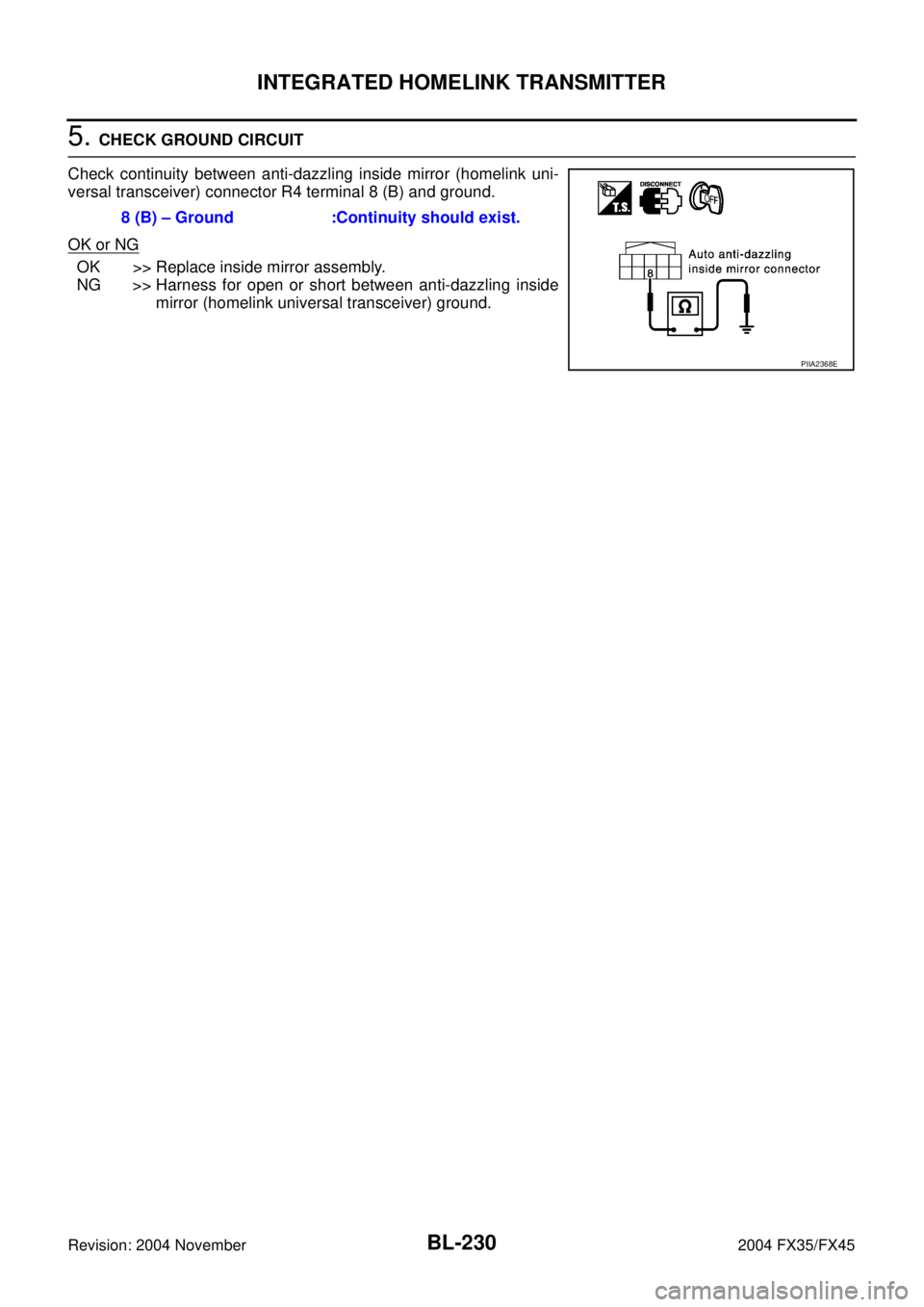
5. CHECK GROUND CIRCUIT
Check continuity between anti-dazzling inside mirror (homelink uni-
versal transceiver) connector R4 terminal 8 (B) and ground.
OK or NG
OK >> Replace inside mirror assembly.
NG >> Harness for open or short between anti-dazzling inside
mirror (homelink universal transceiver) ground. 8 (B) – Ground :Continuity should exist.
PIIA2368E
Page 1038 of 4449
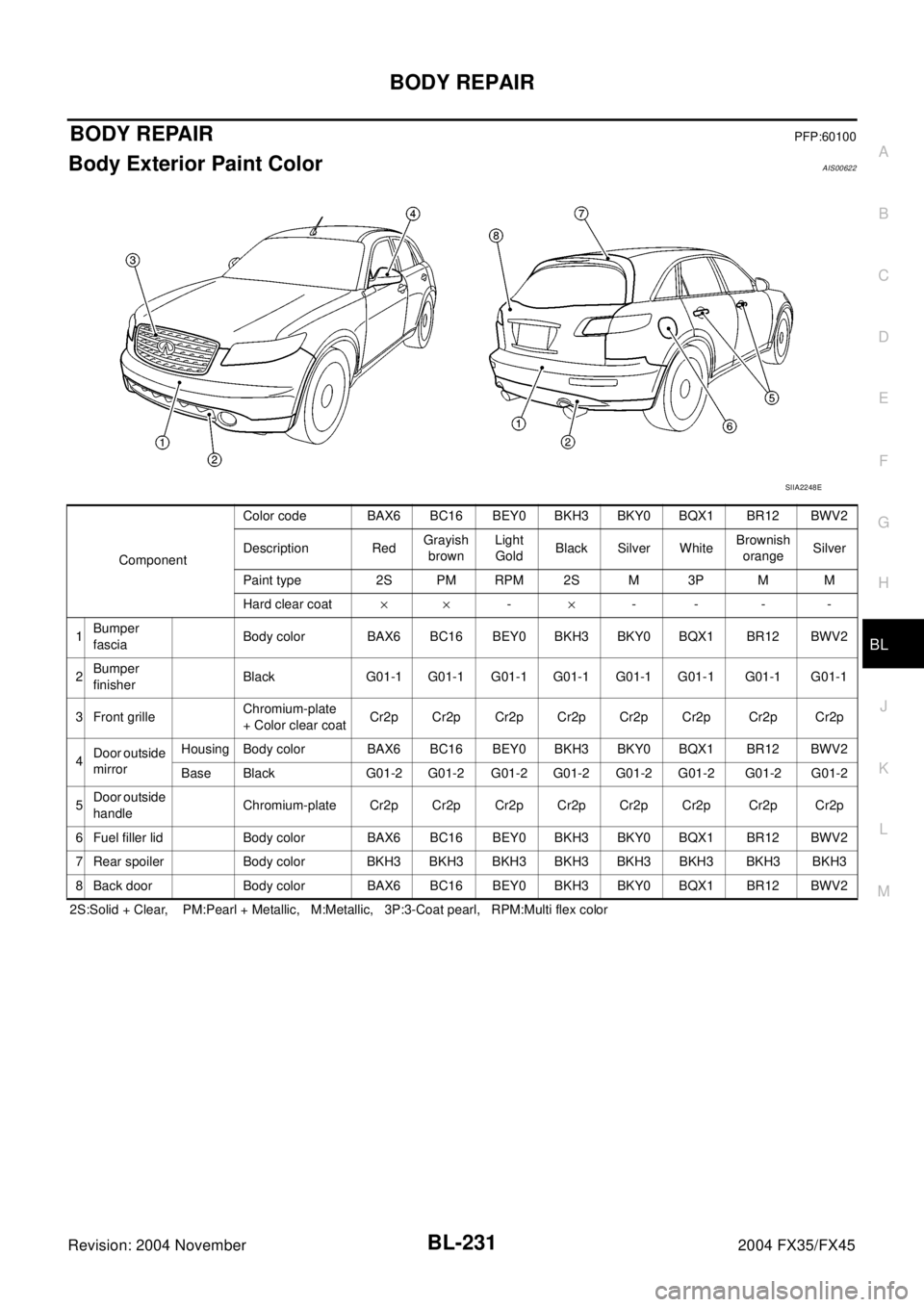
BODY REPAIR
BL-231
C
D
E
F
G
H
J
K
L
MA
B
BL
Revision: 2004 November2004 FX35/FX45
BODY REPAIRPFP:60100
Body Exterior Paint ColorAIS00622
2S:Solid + Clear, PM:Pearl + Metallic, M:Metallic, 3P:3-Coat pearl, RPM:Multi flex color
SIIA2248E
ComponentColor code BAX6 BC16 BEY0 BKH3 BKY0 BQX1 BR12 BWV2
Description RedGrayish
brownLight
GoldBlack Silver WhiteBrownish
orangeSilver
Paint type 2S PM RPM 2S M 3P M M
Hard clear coat´´-´-- - -
1Bumper
fasciaBody color BAX6 BC16 BEY0 BKH3 BKY0 BQX1 BR12 BWV2
2Bumper
finisherBlack G01-1 G01-1 G01-1 G01-1 G01-1 G01-1 G01-1 G01-1
3 Front grilleChromium-plate
+ Color clear coatCr2p Cr2p Cr2p Cr2p Cr2p Cr2p Cr2p Cr2p
4Door outside
mirrorHousing Body color BAX6 BC16 BEY0 BKH3 BKY0 BQX1 BR12 BWV2
Base Black G01-2 G01-2 G01-2 G01-2 G01-2 G01-2 G01-2 G01-2
5Door outside
handleChromium-plate Cr2p Cr2p Cr2p Cr2p Cr2p Cr2p Cr2p Cr2p
6 Fuel filler lid Body color BAX6 BC16 BEY0 BKH3 BKY0 BQX1 BR12 BWV2
7 Rear spoiler Body color BKH3 BKH3 BKH3 BKH3 BKH3 BKH3 BKH3 BKH3
8 Back door Body color BAX6 BC16 BEY0 BKH3 BKY0 BQX1 BR12 BWV2
Page 2705 of 4449
EI-26
DOOR OUTSIDE MOLDING
Revision: 2004 November 2004 FX35/FX45
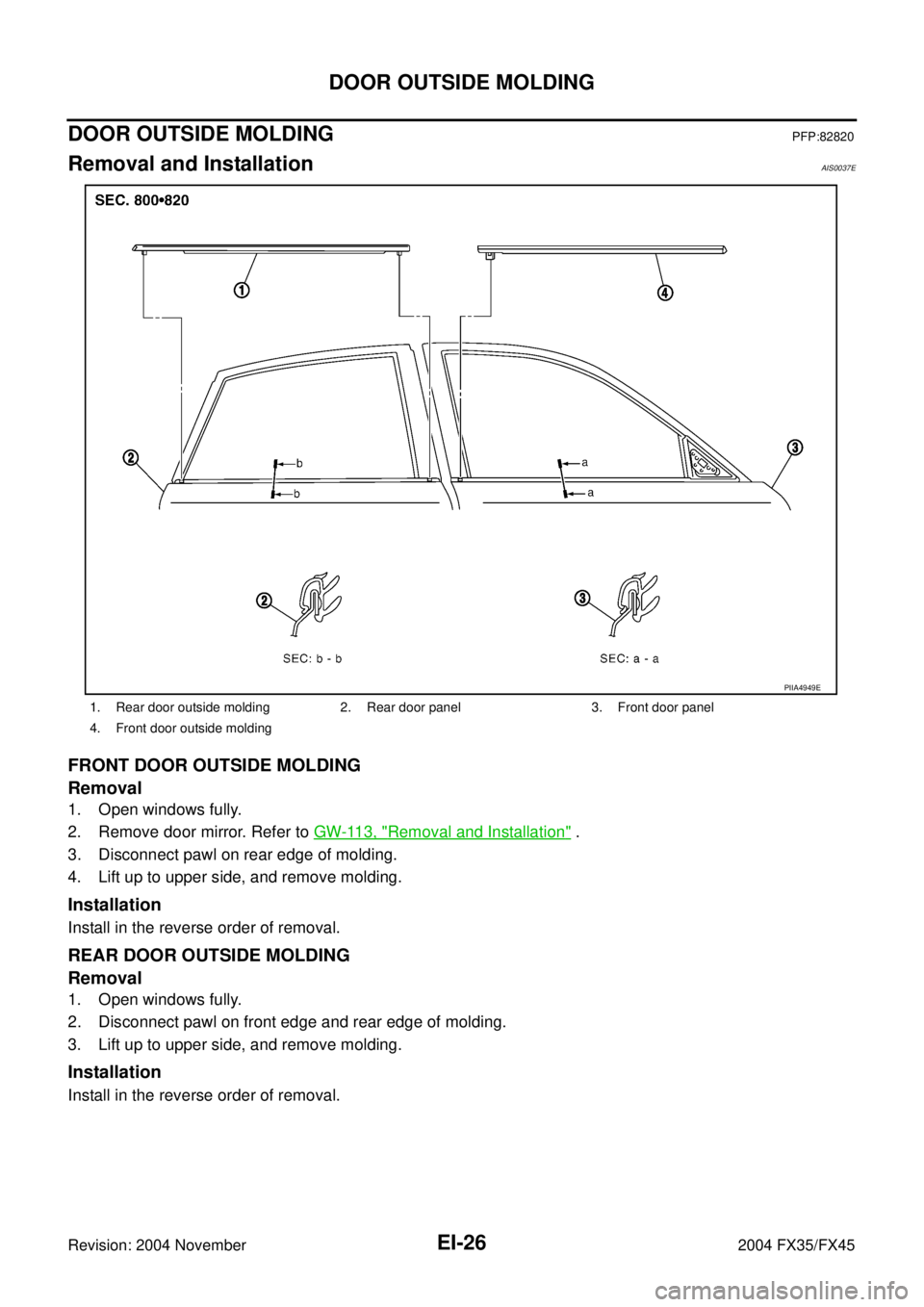
DOOR OUTSIDE MOLDING PFP:82820
Removal and InstallationAIS0037E
FRONT DOOR OUTSIDE MOLDING
Removal
1. Open windows fully.
2. Remove door mirror. Refer to GW-113, "
Removal and Installation" .
3. Disconnect pawl on rear edge of molding.
4. Lift up to upper side, and remove molding.
Installation
Install in the reverse order of removal.
REAR DOOR OUTSIDE MOLDING
Removal
1. Open windows fully.
2. Disconnect pawl on front edge and rear edge of molding.
3. Lift up to upper side, and remove molding.
Installation
Install in the reverse order of removal.
1. Rear door outside molding 2. Rear door panel 3. Front door panel
4. Front door outside molding
PIIA4949E
Page 2709 of 4449
EI-30
WINDSHIELD MOLDING
Revision: 2004 November 2004 FX35/FX45
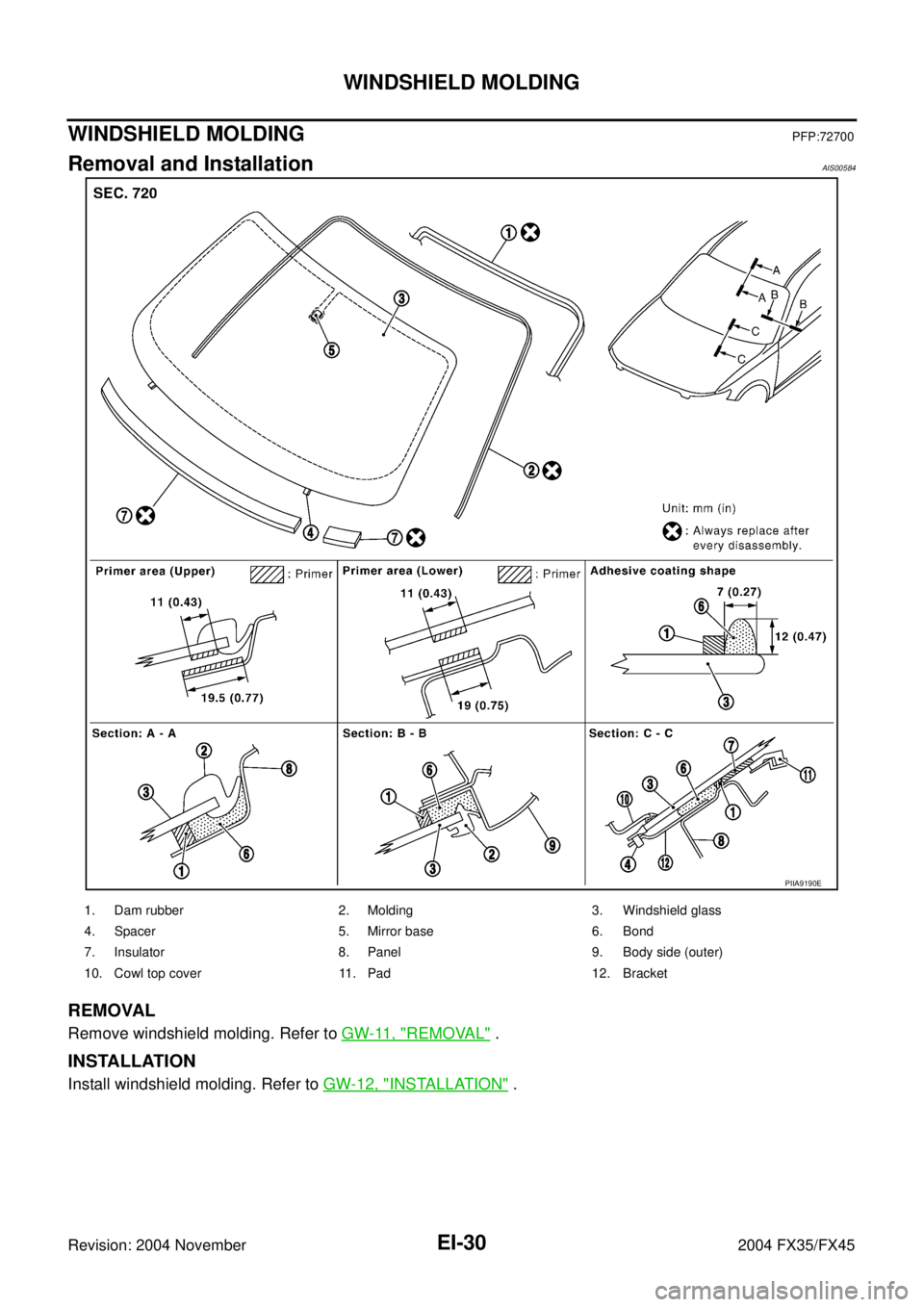
WINDSHIELD MOLDINGPFP:72700
Removal and InstallationAIS00584
REMOVAL
Remove windshield molding. Refer to GW-11, "REMOVAL" .
INSTALLATION
Install windshield molding. Refer to GW-12, "INSTALLATION" .
PIIA9190E
1. Dam rubber 2. Molding 3. Windshield glass
4. Spacer 5. Mirror base 6. Bond
7. Insulator 8. Panel 9. Body side (outer)
10. Cowl top cover 11. Pad 12. Bracket