2004 Hyundai Getz engine
[x] Cancel search: enginePage 403 of 445

6- 12 DO-IT-YOURSELF MAINTENANCE
!
HTB172
HTB171
1. Park the vehicle on level ground and
ensure that the parking brake is firmly
applied, and the engine allowed to
cool.
Do not attempt this operation whilst
the engine is hot since burning or
scalding may result.
2. Prepare a suitable receptacle to col-
lect the displaced coolant and posi-
tion this under the radiator drain tap.
3. With the heater temperature control
set to the "HOT" position, remove
the radiator cap and open the radiator
drain tap. 5. Prepare a suitable quantity of new
engine coolant (refer to section 9)
and pour this into the radiator.
6. Start the engine with the radiator cap
still removed and continue to add
coolant as the level decreases as air
is expelled from the system. When
the level remains constant, replace
the radiator cap and replenish the
coolant reservoir.
7. When the engine is hot, check to ensure that no coolant leaks are
present.
4. When the engine coolant has drained completely, close the drain tap en-
suring that this is not over tightened. WARNING:
The cooling fan is controlled by en-
gine coolant temperature and may
sometimes operate even when the
engine is not running. Use extreme
caution when working near the
blades of the cooling fan so that you
are not injured by a rotating fan
blade. As the engine coolant tem-
perature decreases, the fan will auto-
matically shut off. This is a normal
condition.
tbuk-6.p65 3/23/04, 4:26 PM
12
Page 404 of 445

DO-IT-YOURSELF MAINTENANCE 6- 13
SG060A1-E
SPARKING PLUG REPLACE-
MENT
G060A01L
0.039 ~ 0.043 in.
(1.0 ~ 1.1 mm )
This operation should only be performed
when the engine is cold.
1. Remove the centre cover from the engine rocker cover.
2. Remove plug lead from the sparking plug to be replaced, pulling the lead
by the rubber cap. (Pulling the lead
may damage the carbon conductor).
3. Clean around the base of the plug to be removed, and install the plug
socket ensuring that the ceramic
insulator does not become damaged.
Turn the socket counterclockwise to
remove the plug. CAUTION:
Sparking plugs must only be cleaned
using purpose designed equipment.
Wire brushing may damage the cen-
tre electrodein-sulator causing mis-
firing to occur. Only the correct grade
of sparking plug should be used.
Use of an incorrect grade may result
in serious engine damage.
Prior to installing a sparking plug, the
gap between the centre and outer elec-
trodes must be checked and adjusted
as necessary.
Adjustment is facilitated by bending the
outer electrode towards or away from
the centre electrode. Under no circum-
stances should attempts be made to
adjust the position of the centre elec-
trode.
4. Insert the sparking plug into the cyl- inder head and screw by the wrench
and until the plug contacts the seat-
ing area. Tighten the plug with the
socket by a further 1/2 to 3/4 of a turn
only. 5. Replace the plug lead ensuring that
the cap is pushed firmly into place.
Confirm that the cap is correctly
seated by lightly pulling upon it.
NOTE:
When replacing the spark plug, al-
ways use the genuine parts recom-
mended.
Recommended Spark Plugs
CHAMPION
NGK RC10YC
BKR5ES
Unleaded
engine Leaded
engine
RC10YC4
BKR5ES-11
!
tbuk-6.p65 3/23/04, 4:26 PM
13
Page 405 of 445

6- 14 DO-IT-YOURSELF MAINTENANCE
Petrol engine
HTB168
HTB168A
G070A01TB-EAT
CHANGING THE AIR CLEANER
FILTER
1. Remove the engine cover (Not all
models).
2. Unsnap the clips around the cover.
3. Lift the cover off.
4. Remove the old filter and replace to the new one. Genuine Hyundai Re-
placement Parts are recommended.
CAUTION:
Operating your vehicle without a
proper air filter in place can result
in excessive engine wear.
!
G080A01A-EAT
WINDSCREEN WIPER BLADES The wiper blades should be carefully
inspected from time to time and cleaned
to remove accumulations of road film or
other debris. To clean the wiper blades
and arms, use a clean sponge or cloth
with a mild soap or detergent and water.
If the wipers continue to streak or smear
the glass, replace them with genuine
Hyundai replacement.
HEF119
Diesel engine
CAUTION:
o Do not operate the wipers on dry glass since rapid wear and dam-
age to the windscreen glass may
result.
o Keep the blade rubber out of con- tact with petroleum products such
as engine oil, gasoline, etc.
!
tbuk-6.p65 3/23/04, 4:26 PM
14
Page 406 of 445
DO-IT-YOURSELF MAINTENANCE 6- 15
!
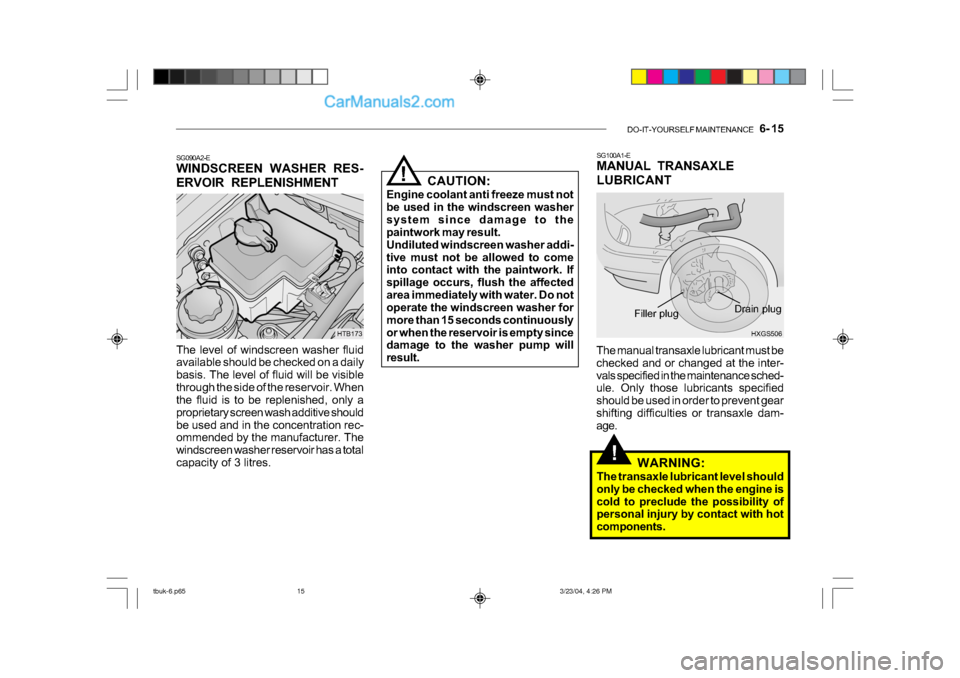
SG100A1-E
MANUAL TRANSAXLE
LUBRICANT
SG090A2-E
WINDSCREEN WASHER RES-
ERVOIR REPLENISHMENT
The level of windscreen washer fluid
available should be checked on a daily
basis. The level of fluid will be visible
through the side of the reservoir. When
the fluid is to be replenished, only a
proprietary screen wash additive should
be used and in the concentration rec-
ommended by the manufacturer. The
windscreen washer reservoir has a total
capacity of 3 litres. CAUTION:
Engine coolant anti freeze must not
be used in the windscreen washer
system since damage to the
paintwork may result.
Undiluted windscreen washer addi-
tive must not be allowed to come
into contact with the paintwork. If
spillage occurs, flush the affected
area immediately with water. Do not
operate the windscreen washer for
more than 15 seconds continuously
or when the reservoir is empty since
damage to the washer pump will
result.
!
HTB173
HXGS506
Drain plug
Filler plug
The manual transaxle lubricant must be
checked and or changed at the inter-
vals specified in the maintenance sched-
ule. Only those lubricants specified
should be used in order to prevent gear
shifting difficulties or transaxle dam-
age.
WARNING:
The transaxle lubricant level should
only be checked when the engine is
cold to preclude the possibility of
personal injury by contact with hot
components.
tbuk-6.p65 3/23/04, 4:26 PM
15
Page 407 of 445

6- 16 DO-IT-YOURSELF MAINTENANCE
G100B01L
Recommended Oil
Use only the approved transaxle lubri-
cant. The recommended lubricants are
complete in themselves and the use of
additives is neither required nor recom-
mended. The use of additives may
invalidate the vehicle warranty.
Transaxle Lubricant Level
Checking
Ensure that the vehicle is parked on
level ground with the parking brake
firmly applied and the engine cool. Re-
move the level plug from the transaxle
when lubricant should begin to drip from
the level hole. If the level is low and no
lubricant is seen to drip, add the re-
G100B02A-EAT
TRANSAXLE FLUID LEVEL
CHECKING
The vehicle must be parked on level
ground with the parking brake firmly
applied and the engine at normal oper-
ating temperature. (Normal operating
temperature will only be achieved when
the vehicle has been driven for 6 miles
or more).
SG110A1-E
AUTOMATIC TRANSAXLE
FLUID
The automatic transaxle fluid level
should be checked and changed at
those intervals prescribed in the main-
tenance schedule. It is of paramount
importance that only the specified fluid
is used when replenishing or changing
the fluid. The use of other fluids may
irreparably damage the transaxle and
invalidate the manufacturers warranty.
In addition the ingress of dirt or lint may
prevent correct functioning of the
transaxle and care must be exercised
to prevent the ingress of such matter.
CAUTION:
The transaxle on fluid level must be
checked with the engine running and
at normal operating temperature and
therefore care must be exercised to
prevent injury occurring through
contact with rotating or hot parts of
the engine.
! G110B03A-AAT
Recommended Fluid
Your Hyundai automatic transaxle is
specially designed to operate with DIA-
MOND ATF SP-III or SK ATF SP-III.
Damage caused by a nonspecified fluid
is not covered by your new vehicle
limited warranty.
tbuk-6.p65
3/23/04, 4:26 PM
16
Page 408 of 445

DO-IT-YOURSELF MAINTENANCE 6- 17
!
!
With the engine idling and the footbrake
applied, the transaxle selector should
be moved from the "P" or "N" position
through to the "L" position and back to
the "N" or "P" position.
Open the bonnet and remove the
transaxle dipstick, remembering that
care must be exercised to prevent in-
jury occurring through contact with hot
or rotating parts of the engine.
C090A03FC
Fluid level should be within
"HOT" range
HTB164 Wipe the dipstick, replace it fully and
promptly remove it again. The fluid
level should be between the upper and
lower marks. Fluid need only be added
if the level is at or below the lower mark
and must never be increased above the
higher mark. If additional fluid is re-
quired, this should be poured into the
transmission through the dipstick tube
with the aid of a suitable funnel. WARNING:
The cooling fan is controlled by en-
gine coolant temperature and may
sometimes operate even when the
engine is not running. Use extreme
caution when working near the
blades of the cooling fan so that you
are not injured by a rotating fan
blade. As the engine coolant tem-
perature decreases, the fan will auto-
matically shut off. This is a normal
condition.
WARNING (Diesel only):
Never work on injection system with
engine running or within 30 seconds
after shutting off engine. High pres-
sure pump, rail, injectors and high
pressure pipes are subject to high
pressure even after the engine
stopped. The fuel jet produced by
fuel leaks may cause serious injury,
if it touch the body. People using
pacemakers should not move than
30cm closer to the ECU or wiring
harness within the engine room while
engine is running, since the high
tbuk-6.p65 3/23/04, 4:26 PM
17
Page 409 of 445

6- 18 DO-IT-YOURSELF MAINTENANCE
G120E01TB-EAT
Brake Fluid Level
SG120A1-E
BRAKE SYSTEM CHECKINGcurrents in the Common Rail system
produce considerable magnetic
fields.
!
CAUTION:
The automatic transaxle unit is a
precision engineered assembly and
correct operation is dependant upon
the exclusion of dirt and lint from the
unit. Therefore, it is imperative that
only lint free cloth (eg nylon) is used
for wiping the dipstick and that the
area around the dipstick is thor-
oughly clean prior to level checking
or adding fluid.
Fluid Capacity
Fluid Capacity
The total fluid capacity of the transaxle
unit is 6.1 litres. SG120C2-E
Brake Fluid Recommendations
Only brake fluid conforming to DOT 3 or
DOT 4 specifications or higher may be
used in the braking system. Care should
be taken to observe the instructions
and precautions printed upon the con-
tainer.
!
CAUTION:
Correct operation of the braking sys-
tem is essential to the safe operation
of the vehicle and therefore, any main-
tenance operations other than those
listed below should be entrusted to a
Hyundai dealer.
The fluid level in the brake fluid reser-
voir should be checked periodically.
The level should be between the "MIN"
and "MAX" marks on the side of the
reservoir. If the level is at or below the
"MIN" mark, fluid should be added. It
should be borne in mind that the brake
fluid level will decrease slightly as the
friction linings of the pads and shoes
become worn and that this is a normal
condition.
HTB166
tbuk-6.p65 3/23/04, 4:26 PM
18
Page 411 of 445

6- 20 DO-IT-YOURSELF MAINTENANCE
B145A01TB-EAT
CHANGING THE POLLEN FIL-
TER (In Front of evaporator unit)
(Not all models)
The pollen filter is located in front of the
evaporator unit behind the glove box.
It operates to decrease pollutants from
entering the car and to filter the air.
1. Remove the adjusting pins on both
sides of the glove box to open half
the glove box.
HTB290-D
SG140D1-E
Off Season Maintenance
The air conditioning must be run for ten
minutes or so weekly during periods
when the system would not normally be
used to ensure that the compressor and
seals are lubricated. If this precaution
is not observed the compressor seals
may become stuck to the compressor
shaft and damaged when the system is
next used resulting in a loss of refriger-
ant and damage to the compressor.
SG140C1-E
Checking the Refrigerant
1. Start the engine and run at idle for
several minutes with the refrigera-
tion system running at the coldest
setting.
2. Open the bonnet and inspect the sight glass on the top of the receiver
dryer.
3. If the refrigerant charge is insuffi- cient, a flow of bubbles will be ob-
served through the sight glass.
4. If the refrigerant charge is satisfac- tory, no bubbles will be observed
through the sight glass. CAUTION:
Running the air conditioning system
with a low refrigerant level may dam-
age the compressor.
!
The air conditioning compressor drive
belt should be checked to ensure free-
dom from damage or excessive wear
and correct tension. The belt tension is
correct when the belt deflects by about
0.3 inches (8 mm) (1.1L: 5 ~ 5.5 mm)
when a force of 98 N is applied to the
belt halfway between the compressor
and crankshaft pulleys. Adjustment of
the belt should be entrusted to a Hyundai
dealer.
tbuk-6.p65
3/23/04, 4:26 PM
20