2004 Hyundai Getz engine
[x] Cancel search: enginePage 413 of 445

6- 22 DO-IT-YOURSELF MAINTENANCE
G180A01A-GAT
CHECKING BRAKE PEDAL
CLEARANCE
G180A01L
1.78 in. (45.1 mm)
You need a helper to check the brake
pedal clearance. With the engine run-
ning, have your helper press down on
the brake pedal several times and then
hold it down with a force of about 490
N (50 Kg, 110 lbs). The brake pedal
clearance is the distance from the top
surface of the brake pedal to the as-
phalt sheeting under the floor mat.
If the brake pedal clearance is not
within the limits specified in the illustra-
tion, have it inspected by your Hyundai
dealer and adjusted or repaired if nec-
essary.SG170A1-E
BRAKE PEDAL FREEPLAY
HXGS508
0.12 ~ 0.31 in.
(3 ~ 8 mm)
The brake pedal freeplay should be
checked with the engine turned off. The
pedal to floor clearance should be
checked with the engine running and a
load of 490 N applied to the pedal. If
either value is incorrect, the necessary
adjustment should be performed by a
Hyundai dealer. Pedal to floor clear-
ance: 1.97 in. (50 mm)SG160A1-E
CLUTCH PEDAL FREEPLAY
G160A01E
0.24 ~ 0.51 in.
(6 ~ 13 mm)
The clutch pedal freeplay should be
checked against the specified value. If
the freeplay is not correct, the clutch
should be adjusted by a Hyundai dealer.
tbuk-6.p65 3/23/04, 4:27 PM
22
Page 414 of 445

DO-IT-YOURSELF MAINTENANCE 6- 23
The various engine drive belts must be
checked for condition, tension and free-
dom from damage and excessive wear.
The tension of a new belt must be
checked after thirty minutes running
following fitment of the new belt to allow
for the initial belt stretch. G190B01TB-GAT
CHECKING DRIVE BELTS
(Diesel)
A/C comp.
Auto tensioner
Pulley
G190B01TB
AlternatorPower
steering
pump
At the scheduled maintenance inspec-
tion, belts should be examined for
cracks, wear, fraying or other evidence
of deterioration and replaced if neces-
sary.
Belt routing should also be checked to
be sure there is no interference be-
tween the belts and other parts of the
engine.
Crankshaft Pulley
SG190A1-E
DRIVE BELTS (Gasoline)
1.1L
1.3L/1.6L Alternator
0.37 ~ 0.43 in.
(9.5 ~11.0 mm)
Water Pump Pulley
Alternator
Pulley
0.2~0.24 in.
(5.1~6 mm)
HTB186
Crankshaft pulley
HTB220
Water Pump Pulley
tbuk-6.p65 3/23/04, 4:27 PM
23
Page 416 of 445
DO-IT-YOURSELF MAINTENANCE 6- 25
!
!
o If battery electrolyte is spilled onto
skin or into eyes, the effected area
must be flushed with copious
amounts of water and medical assis-
tance sought.
o If battery electrolyte is ingested, copious amounts of water or milk
followed by an ant-acid (raw egg or
milk of magnesia) must be drunk.
Vomiting should not be induced and
medical assistance must be sought.
o Batteries must only be charged in well venti-lated areas from which
naked lights or sources of sparks are
excluded.
o Ensure that children, pets or other unauthorized persons are kept away
from batteries.
o Do not allow anything to bridge the positive (+) and negative (-) termi-
nals of the battery.
o Never invert the battery.
The battery fitted during production is of
the "Maintenance Free" type.
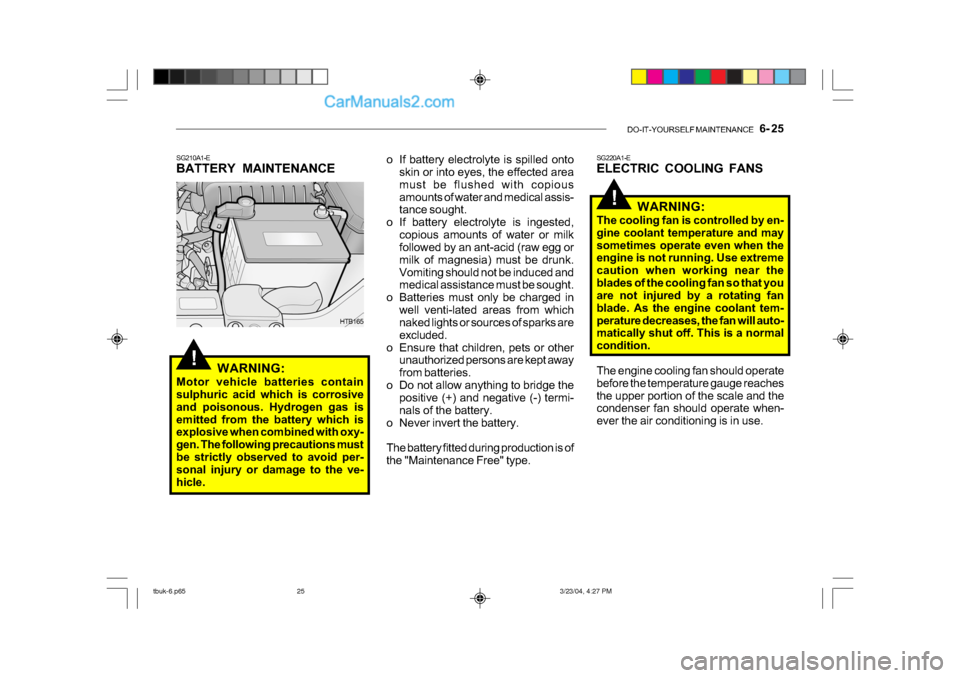
SG210A1-E
BATTERY MAINTENANCE
WARNING:
Motor vehicle batteries contain
sulphuric acid which is corrosive
and poisonous. Hydrogen gas is
emitted from the battery which is
explosive when combined with oxy-
gen. The following precautions must
be strictly observed to avoid per-
sonal injury or damage to the ve-
hicle.
HTB165 SG220A1-E
ELECTRIC COOLING FANS
WARNING:
The cooling fan is controlled by en-
gine coolant temperature and may
sometimes operate even when the
engine is not running. Use extreme
caution when working near the
blades of the cooling fan so that you
are not injured by a rotating fan
blade. As the engine coolant tem-
perature decreases, the fan will auto-
matically shut off. This is a normal
condition.
The engine cooling fan should operate
before the temperature gauge reaches
the upper portion of the scale and the
condenser fan should operate when-
ever the air conditioning is in use.
tbuk-6.p65 3/23/04, 4:27 PM
25
Page 417 of 445

6- 26 DO-IT-YOURSELF MAINTENANCE
HTB287
SG230B1-E
POWER STEERING HOSES
Power steering hoses should be
checked for damage, deterioration and
leakage at each service.
steering fluid level is between the "MAX"
and "MIN" level markings on the fluid
reservoir.
NOTE:
Grinding noise from power steering
pump may be heard immediately
after the engine is started in extremely
cold condition (below -4
Page 418 of 445

DO-IT-YOURSELF MAINTENANCE 6- 27
!
5. Open the bonnet.
6. Draw the vertical line (through the
center of each headlight beam pat-
tern) and the horizontal line (through
the center of each headlight beam
pattern) on the aiming screen.
And then, draw the horizontal paral-
lel line at 1.18 in. (30 mm ) under the
horizontal line.
7. Adjust each cut-off line of the low beam to the parallel line with a phillips
screwdriver - VERTICAL AIMING.
8. Adjust each cut-off line of the low
beam to each vertical line with a
phillips screwdriver - HORIZONTAL
AIMING. HTB269
Horizontal Aiming
Vertical
Aiming
G290A01FC-EAT
HEADLIGHT AIMING ADJUST-
MENT
Before performing aiming adjustment,
make sure of the following.
1. Keep all tires inflated to the correct pressure.
2. Place the vehicle on level ground
and press the front bumper and rear
bumper down several times. Place
the vehicle at a distance of 118 in.
(3,000 mm) from the test wall.
3. See that the vehicle is unloaded (except for full levels of coolant,
engine oil and fuel, and spare tire,
jack, and tools).
4. Clean the head lights lens and turn
on the headlight (low beam). WARNING:
Be sure to carefully wipe away any
water drained out in this manner,
because the fuel mixed in the water
might be ignited and result in a fire.
1. Remove the engine cover.
2. Disconnect the air intake hose from air cleaner cover.
3. Loosen the drain plug at the bottom
of the fuel filter.
4. Tighten the drain plug when water no longer comes out.
5. Check to be sure that the warning lamp illuminates when the ignition
key is turned to "ON", and that it
goes off when the engine is started.
If in doubt, consult your nearest au-
thorized HYUNDAI dealer.
G300B01FC
tbuk-6.p65 3/23/04, 4:27 PM
27
Page 425 of 445

6- 34 DO-IT-YOURSELF MAINTENANCE
G200C01TB-GAT
FUSE PANEL DESCRIPTION
Engine Compartment
HTB261-EPROTECTED COMPONENTS
Ignition Switch
Ignition Switch, Start Relay
Fuel pump, Alternator, ECM
Auto Fuel Cut Switch
Radiator Fan
Headlight, Defogger Relay
ABS
ECM
A/CON, Fuel Pump
Injector
A/Conditioner
Horn
ABS
ABS
Blower, Blower Motor
Power Window
Electronic power steering
Alternator
Spare Fuse
Spare Fuse
Spare Fuse
FUSE RATING
30A
30A
30A
20A
30A
50A
10A
10A
10A
15A
10A
10A
20A
40A
30A
30A
50A
15A
10A
10A
DESCRIPTION
IGN 2
IGN 1ECU
F/PUMP RAD
BATT ABS
ECU
SNSR INJ
A/CON HORN ABS1
ABS2 BLW
P/WDW EPS
BATT( ) SPARE
SPARE
SPARE
NOTE:
Not all fuse panel descriptions in this manual may be applicable to your vehicle. It is accurate at the time of printing.
When you inspect the fuse box on your vehicle, refe r to the fuse box label.
1.1L
1.3/1.6L100A
120A
tbuk-6.p65
3/23/04, 4:27 PM
34
Page 428 of 445

7- 2 EMISSION CONTROL SYSTEMS
SH010A1-E EMISSION CONTROL SYSTEMS (Not all models) Depending upon the market for which the vehicle is destined, the emissioncontrol system will comprise one or more of the following emission con- trol devices. 1) Crankcase emission control sys-
tem
2) Evaporative emission control sys-
tem
z3) Exhaust emission control systemIn order that the proper functioning of the emission control systems may be ensured, it is recommended that the vehicle is inspected and maintainedby an authorized Hyundai dealer in accordance with the maintenance schedule in this manual. SH010B1-E
1. CRANKCASE EMISSION
CONTROLSYSTEM
The positive crankcase ventilation
system is employed to prevent airpollution caused by blow-by gasesbeing emitted from the crankcase by introducing fresh air to the crankcase through the air cleaner where thismixes with blow-by gases and then passes through the PCV valve into the intake manifold from where it sub-sequently enters the combustion chamber and is burned.
SH010C1-E
2. EVAPORATIVE EMISSION
CONTROL SYSTEM
The Evaporative Emission Control
System is designed to prevent fuel vapours from escaping into the atmo- sphere through the fuel tank ventila- tion system.
Whilst the engine is not running, fuel
vapours generated inside the fuel tankare absorbed and stored in a char-coal canister. When the engine is started, the vapours stored in the canister are drawn into the induction SH010D1-E
3. EXHAUST EMISSION CON
TROL SYSTEM
The exhaust emission control system
is a highly effective system whichcontrols exhaust emission while main- taining good vehicle performance.
system through the purge control so-lenoid valve and are subsequently burned.
The purge control solenoid valve is
controlled by the ECU; when the en-gine coolant temperature is low or the engine is idling, the purge control valve is closed and fuel vapours re-main stored in the canister. Under normal running conditions when the engine is warm, the valve opens andthe vapours are drawn into the inlet tract and subsequently burned in the combustion chamber.
tbuk-7.p65 7/3/2008, 4:10 PM
2
Page 429 of 445

EMISSION CONTROL SYSTEMS 7- 3
H020A01TB-EAT
CATALYTIC CONVERTOR OP- ERATION PRECAUTIONS ; For a Petrol engine
Hyundai Getz models are fitted with
catalytic convertors which require special operating considerations. Thecatalytic convertor serves to oxidize certain noxious elements of the ex- haust gases leaving the engine toreduce the level of pollutants emitted from the vehicle and, provided that care is exercised to prevent damage,the catalyst will operate efficiently for the life of the vehicle.
It is of the utmost importance that the
following information is read and un-derstood by the vehicle operator in
HTB178Catalytic Converter order to prevent operational problems arising from damage to the catalyst.
Damage to the catalyst will result if
contamination occurs through the use of leaded fuel. Whilst the vehicle isfitted with a reduced diameter filler neck to prevent charging of the fuel tank with a leaded fuel pump nozzle,it is possible that the use of funnels or jerry cans will permit leaded fuel to be introduced into the fuel tank.
The catalyst is intolerant of unburnt
fuel and therefore if an engine misfirecondition exists, damage to the cata-lyst will occur. It is imperative that if a misfire condition develops, the ve- hicle is immediately presented to aHyundai dealer for rectification. Simi- larly, the practice of certain ignition system diagnosis procedures whichinvolve inducing a misfire (cylinder power balance tests for example) may result in catalyst damage.
For these reasons, it is advisable that
the exhaust gas emission be testedat each routine service with a gas analyzer having a Hydrocarbon mea- suring facility to ensure continuedreliability of the catalyst. Push or tow starting of the vehicle is to be avoided since unburnt fuel may be enter the catalyst and result indamage. (Note, it is impossible to push or tow start a Hyundai model equipped with fuel injection since thefuel pump safety interlock will prevent the pump from operating under these conditions).Operation of the catalyst involvesextremely high temperatures beingattained within the catalytic conver- tor, and although the convertor is fitted with heat shields, it is importantthat the vehicle is not parked over combustible or volatile material which may result in fire. If the above precautions are not ad- hered to and the catalyst becomes inoperative, the resultant increase incore temperature will result in a "melt down" where the catalyst core will melt and subsequently may block theexhaust system.Due to the fragile nature of the cata-lyst element, it is important that dam- age does not occur when the vehicle is raised by means of a garage jack.Care must also be exercised to avoid driving over road hazards or debris which may cause damage to the cata-lyst element.
tbuk-7.p65
7/3/2008, 4:10 PM
3