2004 Hyundai Getz engine
[x] Cancel search: enginePage 365 of 445

3- 2 WHAT TO DO IN AN EMERGENCY
HTB165
SD020B1-E
IF THE ENGINE CANNOT BE
CRANKED
1. If the vehicle is fitted with manual
transaxle, ensure that the clutch
pedal is depressed whilst cranking
the engine. If the vehicle is fitted
with automatic transaxle, ensure
that the transaxle selector is at the
"P" or"N" position.
2. Check the battery terminals and
connections to ensure that these
are clean and also tight.
3. If the ignition warning lights dim
when the engine is cranked and the
battery terminals have been
checked, a discharged battery is
indicated. SD020C1-F
If Engine Turns Over Normally
but Does Not Start
SD020A1-E
IF THE ENGINE WILL NOT START
Seek assistance from the nearest
Hyundai dealer with regard to the
method of ignition and fuel system
diagnosis.
!
HTB221
CAUTION:
If the engine refuses to start, no
attempt should be made to push or
tow start the vehicle. Vehicles with
automatic transaxle or fuel injec-
tion will not be able to be started in
this manner since no drive is trans-
mitted through the automatic
transaxle whilst the engine is not
running, and in the case of fuel
injected derivatives, the fuel pump
will not operate under tow start
conditions. In addition, if the ve-
hicle is equipped with an exhaust
catalyst, damage to the catalyst may
result if the vehicle is tow started. 4. Do not attempt to push or tow start
the vehicle, refer to "Jump Starting"
for information regarding engine
starting when the battery is dis-
charged.
1. Check fuel Level
2. Check all connectors at ignition coil and spark plugs.
Replace any that may be discon-
nected or loose.
3. Check fuel line in the engine com- partment.
4. If engine still refuses to start, call a
Hyundai dealer or seek other quali-
fied assistance.
tbuk-3.p65 3/23/04, 4:24 PM
2
Page 366 of 445

WHAT TO DO IN AN EMERGENCY 3- 3
!
HTB218
Discharged
battery
Booster
battery
CAUTION:
Personal injury and damage to the
vehicle may occur if jump starting
is not performed correctly. If any
doubt exists as to how this opera-
tion should be performed, seek as-
sistance from qualified personnel.
SD030A1-E
JUMP STARTING
AD020D1-A
If Engine Stalls While Driving
1. Reduce your speed gradually, keep-
ing a straight line. Move cautiously
off the road to a safe place.
2. Turn on your emergency flashers.
3. Try starting the engine again. If your
vehicle will not start, see "IF THE
ENGINE WILL NOT START"!
WARNING:
Motor vehicle batteries contain
sulphuric acid and emit hydrogen
gas. Protective clothing should be
worn and care exercised to prevent
the acid from coming into contact
with skin or clothing and the ve-
hicle. Naked lights should not be
permitted in the vicinity of the bat-
tery. Care should be exercised to
prevent sparks occurring during
connection. If acid accidentally
comes into contact with skin or
eyes, the affected area should im-
mediately be flushed with copious
amounts of water and medical as-
sistance sought. 1. Ensure that the booster battery is
12 volt type. If the booster battery is
installed in another vehicle, ensure
that the two vehicles are not touch-
ing.
2. Turn off all unnecessary electrical equipment in both vehicles.
3. Ensure that the engine of the ve-
hicle providing the jump start is run-
ning prior to connection of the jump
cables.
4. Connect the red jump cable to the positive (+) terminal of the booster
battery and the other end to the
positive (+) terminal of the dis-
charged battery.
5. Attach the black jump cable to the
negative (-) terminal of the booster
battery, and the other end to a ground
point within the engine compart-
ment of the vehicle with the flat
battery. Do not connect to the nega-
tive battery terminal of the flat bat-
tery since sparks may be generated
with the subsequent risk of explo-
sion.
6. Raise the booster vehicle engine speed to 2,000 r.p.m. and start the
engine of the vehicle with the flat
battery.
tbuk-3.p65 3/23/04, 4:24 PM
3
Page 367 of 445

3- 4 WHAT TO DO IN AN EMERGENCY
!
!
D030A01TB-EAT
IF THE ENGINE OVERHEATS
If the temperature gauge indicates
overheating:
1. Pull off the road and stop as soon as
it is safe to do so.
2. Place the gear selector lever in "P" (automatic), or neutral (manual
transaxle) and set the parking brake.
If the air conditioning is on, turn it off.
3. If coolant is running out under the car
or steam is coming out from under
the bonnet stop the engine. Do not
open the bonnet until the coolant has
stopped running or the steaming has
stopped. If there is no visible loss of
coolant and no steam, leave the
engine running and check to be sure
the engine cooling fan is operating.
If the fan is not running, turn the
engine off.
4. Check to see if the water pump drive belt is missing. If it is not missing,
check to see that it is tight. If the
drive belt seems to be satisfactory,
check for coolant leaking from the
radiator, hoses or under the car. (If
the air conditioning had been in use,
it is normal for cold water to be
draining from it). WARNING:
Whilst the engine is running, keep
hands and clothing away from mov-
ing parts such as the fan and drive
belts to prevent injury.
7. Switch ON the main beam
headlamps before carefully remov-
ing the jumper cables in the reverse
order of attachment. Once the
jumper cables have been removed,
switch "OFF" the main beam
headlamps.
CAUTION:
If the jump cable is incorrectly in-
stalled, damage to the vehicle elec-
trical system may occur, in particu-
lar the electronic components such
as the Fuel Injection system com-
puter and the Automatic transaxle
computer. The battery must never
be disconnected whilst the engine
is running.
!
WARNING (Diesel only):
Never work on injection system with
engine running or within 30 sec-
onds after shutting off engine. High
pressure pump, rail, injectors and
high pressure pipes are subject to
high pressure even after the engine
stopped. The fuel jet produced by
fuel leaks may cause serious in-
jury, if it touch the body. People
using pacemakers should not move
than 30cm closer to the ECU or
wiring harness within the engine
room while engine is running, since
the high currents in the Common
Rail system produce considerable
magnetic fields.
tbuk-3.p65 3/23/04, 4:24 PM
4
Page 368 of 445

WHAT TO DO IN AN EMERGENCY 3- 5
!
D040A01TB-EAT
TEMPORARY SPARE TYRE
(Not all models)
The following instructions for the tem-
porary spare tyre should be observed:
1. Check inflation pressure as soon as
practical after installing the spare
tyre, and adjust to the specified
pressure. The tyre pressure should
be periodically checked and main-
tained at the specified pressure
while the tyre is stored.
6. If the cause of the overheating can- not be found, wait until the engine
temperature has returned to nor-
mal. Then, if coolant has been lost,
carefully remove the radiator cap
and add water to bring the fluid level
in the reservoir up to the base of the
radiator fill opening. Fill the coolant
expansion tank to the halfway mark.
7. Proceed with caution until it is es-
tablished that the engine is operat-
ing normally. If the engine over-
heats repeatedly, the advice of a
Hyundai dealer should be sought. WARNING:
Do not remove the radiator cap when
the engine is hot since steam and
boiling water may be ejected from
the radiator resulting in burns or
scalding.
Inflation Pressure
Tyre Size
T105/70D14
420 kPa (60 psi)
2. The spare tyre should only be used temporarily and should be returned
to the luggage compartment as soon
as the original tyre can be repaired
or replaced.
3. Continuous use at speeds of over 50 mph(80 km/h) is not recom-
mended.
4. As the temporary spare tyre is spe- cifically designed for your car, it
should not be used on any other
vehicle.
Spare Tyre Pressure
YD050A1-E
SPARE TYRE
For Full Size (Not all models)
The following instructions for the FULL
SIZE spare tyre should be observed:
Check inflation pressure as soon as
possible after installing the spare tyre,
and adjust to the specified pressure.
The tyre pressure should be periodi-
cally checked and maintained at the
specified pressure while the tyre is
stored.
Spare Tyre Pressure
Tyre Size
Inflation Pressure
FULL SIZE
30 psi (210 kPa)
5. If the water pump drive belt is bro-
ken or coolant is leaking out, stop
the engine immediately and call the
nearest Hyundai dealer for assis-
tance.
! CAUTION:
Serious loss of coolant indicates
there is a leak in the cooling system
and this should be checked as soon
as possible by a Hyundai dealer.
tbuk-3.p65 3/23/04, 4:24 PM
5
Page 375 of 445
3- 12 WHAT TO DO IN AN EMERGENCY
!
CAUTION:
The following restriction must be
observed in order to avoid serious
damage to the transaxle .
The vehicle must never be towed
from the rear with the front wheels
on the ground.
The vehicle must not be towed until
transaxle fluid has been added to
bring the level up to the "HOT"
marking on the dipstick. (The level
will need to be reduced again after
towing).
The vehicle must not be towed at
speeds faster than 25 mph. or dis-
tances greater than fifty miles. The
general points regarding the steer-
ing lock etc. described in the pre-
ceding section (Manual transaxle
vehicle) should be observed.
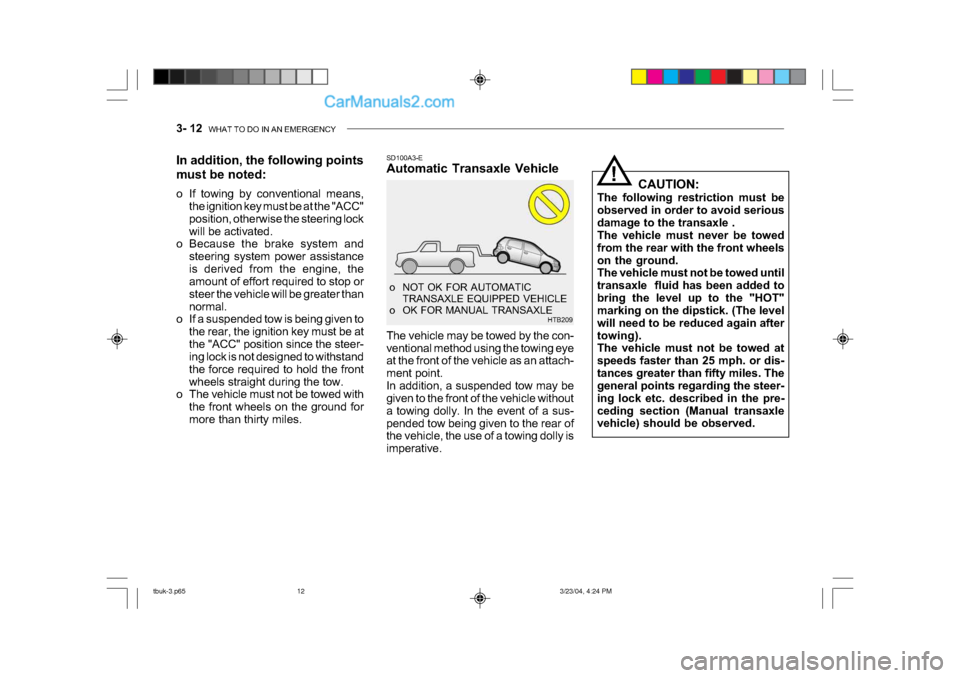
SD100A3-E
Automatic Transaxle Vehicle
The vehicle may be towed by the con-
ventional method using the towing eye
at the front of the vehicle as an attach-
ment point.
In addition, a suspended tow may be
given to the front of the vehicle without
a towing dolly. In the event of a sus-
pended tow being given to the rear of
the vehicle, the use of a towing dolly is
imperative.
o NOT OK FOR AUTOMATIC
TRANSAXLE EQUIPPED VEHICLE
o OK FOR MANUAL TRANSAXLE HTB209
In addition, the following points
must be noted:
o If towing by conventional means,
the ignition key must be at the "ACC"
position, otherwise the steering lock
will be activated.
o Because the brake system and
steering system power assistance
is derived from the engine, the
amount of effort required to stop or
steer the vehicle will be greater than
normal.
o If a suspended tow is being given to
the rear, the ignition key must be at
the "ACC" position since the steer-
ing lock is not designed to withstand
the force required to hold the front
wheels straight during the tow.
o The vehicle must not be towed with
the front wheels on the ground for
more than thirty miles.
tbuk-3.p65 3/23/04, 4:24 PM
12
Page 376 of 445
WHAT TO DO IN AN EMERGENCY 3- 13
D120A01A-EAT
IF YOU LOSE YOUR KEYS
Information about the key of immobi-
lizer system will be found on page 1-4.CAUTION:
If the car is being towed with all
four wheels on the ground, it can
be towed only from the front. Be
sure that the transaxle is in neu-
tral. Do not tow at speeds greater
than 30 mph (50 km/h) and for more
than 15 miles(25 km).
Be sure the steering is unlocked by
placing the key in the "ACC" posi-
tion. A driver must be in the towed
vehicle to operate the steering and
brakes.
!
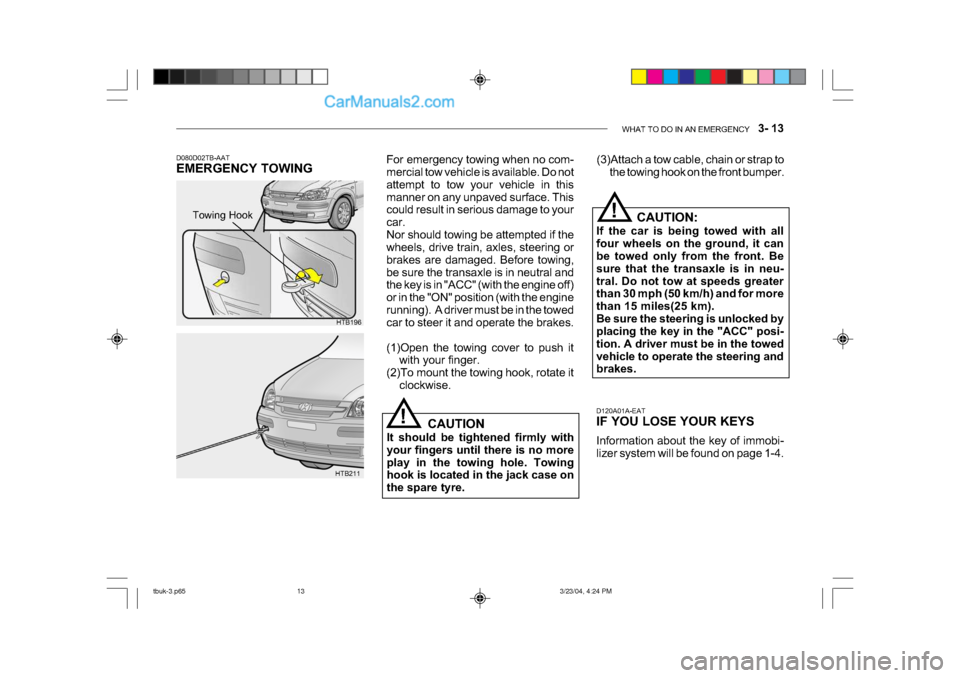
(3)Attach a tow cable, chain or strap to
the towing hook on the front bumper.
D080D02TB-AAT
EMERGENCY TOWING For emergency towing when no com-
mercial tow vehicle is available. Do not
attempt to tow your vehicle in this
manner on any unpaved surface. This
could result in serious damage to your
car.
Nor should towing be attempted if the
wheels, drive train, axles, steering or
brakes are damaged. Before towing,
be sure the transaxle is in neutral and
the key is in "ACC" (with the engine off)
or in the "ON" position (with the engine
running). A driver must be in the towed
car to steer it and operate the brakes.
(1)Open the towing cover to push it
with your finger.
(2)To mount the towing hook, rotate it clockwise.
HTB196
HTB211 CAUTION
It should be tightened firmly with
your fingers until there is no more
play in the towing hole. Towing
hook is located in the jack case on
the spare tyre.
!
Towing Hook
tbuk-3.p65
3/23/04, 4:24 PM
13
Page 383 of 445

5- 2 VEHICLE MAINTENANCE REQUIREMENTS
SF020A1-E MAINTENANCE AND SERVICING REQUIREMENTS To ensure the continued reliability and safety of the vehicle, certain routinemaintenance operations are required at specific mileage or time intervals. It is the responsibility of the vehicle owner to ensure that the maintenance schedules shown in both this OwnersManual and the Warranty and Service Passport are adhered to. The new vehicle warranty may be invalidated if the routine maintenance operations are not performed in line with the recommendations outlinedand the safety and durability of the vehicle adversely affected. It is recommended that all mainte- nance operations with the exception of the daily operating checks are en-trusted to a Hyundai dealer to ensure that the latest repair and maintenance procedures and specialized servicingtools are employed. In addition, the use of genuine Hyundai replacement parts will ensure that the vehicle safetyand performance will not be compro- mised. NOTE:
The inspection and testing of cer-
tain electronic fuel injection/engine management and automatic trans- mission control systems require specialised electronic equipmentspecifically designed for Hyundai vehicles. The use of general pur- pose electrical test equipment mayresult in damage to the control unit microprocessors.
SF020C1-E
Specified Scheduled Procedures
The Specified scheduled procedures
are listed in the maintenance charts beginning at page 5-3. The opera- tions specified must be performed at the time or mileage intervals shownirrespective of whether the mileage interval has been reached before the specified time interval. Certain lubricants and components
degrade with both time and mileage(e.g. engine oil and brake fluid) and therefore it is not permissable to base the maintenance schedule upon mile-age alone. It is strongly recommended that the maintenance operations are performed by the factory-trained ordistributor-trained technicians at your Hyundai dealer because of the needfor specialized knowledge and tooling and to ensure that no possibility of invalidating the manufacturers war-ranty exists.
The maintenance schedules relate to
vehicles operated under normal con- ditions, vehicles which are operated under adverse conditions will requiremore frequent maintenance which is described at page 5-6.
SF030B1-E
SERVICE HISTORY
It is important that all scheduled main-
tenance services are recorded in thewarranty and service passport to en- sure that proof of maintenance is avail-able when warranty service is required.
tbuk-5.p65 7/3/2008, 4:10 PM
2
Page 384 of 445

VEHICLE MAINTENANCE REQUIREMENTS 5- 3
ENGINE CONTROL SYSTEM MAINTENANCE (PETROL)
1 ENGINE OIL & FILTER (SG OR ABOVE) See Note (1)
2 DRIVE BELT (WATER PUMP, ALTERNATOR & A/CON)
3 FUEL FILTER (MFI)
4 FLUID LEAKS
5 TIMING BELT
6 VENTILATION HOSES
7 AIR CLEANER FILTER
8 SPARK PLUGS
9 VALVE CLEARANCE (1.1L)
AF040C4-E
SCHEDULED MAINTENANCE
In order to ensure the continued safety, reliability and longevity of the vehicle, the following maintenance service operations should be performed at the time or mileage intervals specified. It is recommended that all routine maintenance services are entrusted to a Hyundai dealer to ensure that the manufacturers recommended procedures are employed and that only genuine Hyundai replacement parts are used. Incorrect mainte- nance techniques or the use of non genuine replacement parts may invalidate the vehicle warranty. F030B02TB-EAT R : REPLACE I : INSPECT AND, AFTER INSPECTION, CLEAN, ADJUST, REPAIR OR REPLACE IF NECESSARY
Note : (1) SF OR LOWER: EVERY 6,000 MILES OR 6 MONTHS : "R" (2) FOR EVERY 25,000 MILES : "R"
NO. DESCRIPTION60 72
5060
4048
3036
2024
1012
MILES X 1000 MONTHS
R
I II
R
I
R
I
R
I
R
I
R
I
I
R
I
R
I I I
R
III
R
I
R
I I
See Note (2)
tbuk-5.p65 7/3/2008, 4:10 PM
3