2004 Hyundai Getz Brake
[x] Cancel search: BrakePage 355 of 445
2- 12 DRIVING YOUR HYUNDAI
HTB217-D
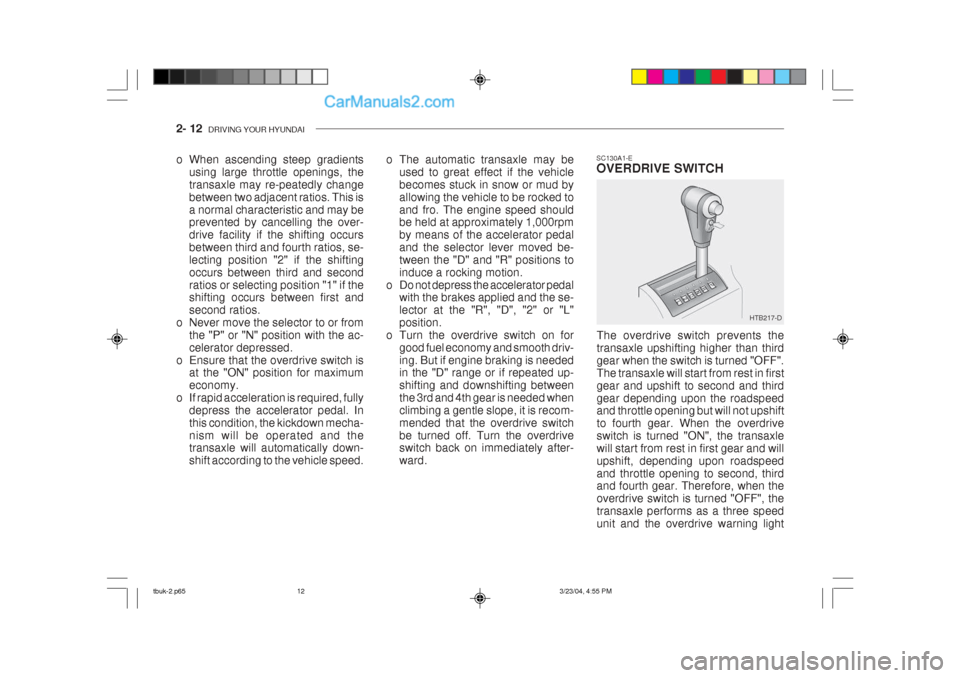
SC130A1-E OVERDRIVE SWITCH
The overdrive switch prevents the transaxle upshifting higher than thirdgear when the switch is turned "OFF".The transaxle will start from rest in firstgear and upshift to second and thirdgear depending upon the roadspeed and throttle opening but will not upshift to fourth gear. When the overdriveswitch is turned "ON", the transaxlewill start from rest in first gear and willupshift, depending upon roadspeedand throttle opening to second, third and fourth gear. Therefore, when the overdrive switch is turned "OFF", thetransaxle performs as a three speedunit and the overdrive warning light
o When ascending steep gradients
using large throttle openings, thetransaxle may re-peatedly changebetween two adjacent ratios. This isa normal characteristic and may be prevented by cancelling the over- drive facility if the shifting occursbetween third and fourth ratios, se-lecting position "2" if the shiftingoccurs between third and secondratios or selecting position "1" if the shifting occurs between first and second ratios.
o Never move the selector to or from
the "P" or "N" position with the ac-celerator depressed.
o Ensure that the overdrive switch is at the "ON" position for maximumeconomy.
o If rapid acceleration is required, fully
depress the accelerator pedal. Inthis condition, the kickdown mecha-nism will be operated and the transaxle will automatically down- shift according to the vehicle speed. o The automatic transaxle may be
used to great effect if the vehiclebecomes stuck in snow or mud byallowing the vehicle to be rocked toand fro. The engine speed should be held at approximately 1,000rpm by means of the accelerator pedaland the selector lever moved be-tween the "D" and "R" positions toinduce a rocking motion.
o Do not depress the accelerator pedal with the brakes applied and the se-lector at the "R", "D", "2" or "L"position.
o Turn the overdrive switch on for good fuel economy and smooth driv-ing. But if engine braking is needed in the "D" range or if repeated up- shifting and downshifting betweenthe 3rd and 4th gear is needed whenclimbing a gentle slope, it is recom-mended that the overdrive switchbe turned off. Turn the overdrive switch back on immediately after- ward.
tbuk-2.p65 3/23/04, 4:55 PM
12
Page 356 of 445

DRIVING YOUR HYUNDAI 2- 13
SC140B1-E ANTI-LOCK BRAKE SYSTEM (Not all models) The Anti-Lock Brake System (ABS) is designed to prevent wheel lock-upduring sudden braking or on hazard-ous road surfaces. The ABS controlmodule monitors the wheel speed and controls the pressure applied to each brake. Thus, in emergency situationsor on slick roads, ABS will increasevehicle control during braking. NOTE: During ABS operation, a slight pul- sation may be felt in the brake pedal when the brakes are applied. Also, a noise may be heard in the enginecompartment whilst braking. Theseconditions are normal and indicatethat the anti-lock brake system isfunctioning properly.
located in the instrument cluster will beilluminated. When the overdrive switchis turned "ON", the transaxle functionsas a fully automatic four speed unitwith the maximum fuel economy po- tential of the vehicle being realized. SC140A1-E EFFECTIVE BRAKING Braking system performance and fric- tion material life are greatly affected by the driving style adopted. The follow-ing suggestions are made to assist inachieving the best results from thebraking system.
o Anticipate the road and conditions
ahead in order that heavy braking may be avoided.
o When descending long gradients,
use the engine to assist in retardingthe vehicle to minimize the possibil- ity of brake fade occurring.
o When trailer towing, ensure that the
trailer brakes function correctly and use engine braking to assist thevehicle braking system. o Use only genuine Hyundai replace-
ment brake pads and shoes to en-sure consistent friction characteris-tics and wear rates.
o After driving through deep water (e.g. fording), the brakes may be-come wet and performance reduced.Always check brake efficiency afteremerging from the water and dry thebrakes by lightly depressing thebrake pedal several times whilst driving slowly.
o Apply the parking brake only when the vehicle is at rest.
o Since the power assistance pro- vided by the brake servo is derived from the engine, coasting with the engine turned off or towing of the vehicle with the engine turned offwill result in greatly increased pedalpressures being required to stop thevehicle.
o Do not hold the vehicle on the up- grade with the accelerator pedal.This can cause the transmission tooverheat. Always use the brakepedal or parking brake.
tbuk-2.p65 3/23/04, 4:55 PM
13
Page 357 of 445

2- 14 DRIVING YOUR HYUNDAI
!WARNING:
ABS will not prevent accidents due to improper or dangerous drivingmaneuvers. Even though vehicle control is improved during emer- gency braking, always maintain asafe distance between you and ob-jects ahead. Vehicle speeds shouldalways be reduced during extremeroad conditions. The braking distance for cars equipped with an anti-lock brakingsystem may be longer than for thosewithout it in the following road con-ditions.
o Driving on rough, gravel or snow- covered roads.
o Driving with tyre chains installed.
o Driving on roads where the road
surface is pitted or has differentsurface height. These roads should be driven at reduced speeds. The safety features of an ABS equipped vehicle shouldnot be tested by high speed drivingor cornering. This could endangerthe safety of yourself or others. SC150A1-F DRIVING FOR ECONOMY You can save fuel and get more miles from your car if you follow these sug-gestions:
o Drive smoothly. Accelerate at a
moderate rate. Don't make "jack- rabbit" starts or full-throttle shiftsand maintain a steady cruisingspeed. Don't race between stop-lights. Try to adjust your speed tothat of the other traffic so you don't have to change speeds unneces- sarily.Avoid heavy traffic whenever pos-sible. Al-ways maintain a safe dis-tance from other vehicles so youcan avoid unnecessary braking. This also reduces brake wear. o Drive at a moderate speed. The
faster you drive, the more fuel your car uses. Driving at a moderatespeed, especially on the highway, isone of the most effective ways to reduce fuel consumption.
o Don't "ride" the brake or clutch pedal. This can increase fuel consumption and also increase wear on thesecomponents. In addition, driving withyour foot resting on the brake pedal may cause the brakes to overheat, which reduces their effectivenessand may lead to more serious con-sequences.
o Take care of your tyres. Keep them inflated to the recommended pres- sure. Incorrect infla-tion, either too much or too little, results in unnec-essary tyre wear. Check the tyrepres-sures at least once a month.
o Be sure that the wheels are aligned correctly. Improper alignment can result from hitting curbs or driving too fast over irregular surfaces. Pooralignment causes faster tyre wearand may also result in other prob-lems as well as greater fuel con-sumption.
tbuk-2.p65 3/23/04, 4:55 PM
14
Page 362 of 445

DRIVING YOUR HYUNDAI 2- 19
Coupling point
Nose
weight
97
(44)
Without Brake Type Trailer
1,543 (700)
2,204 (1,000) 2,425 (1,100) 2,425(1,100)
1,984 (900)
2,425 (1,100)
992(450)
MANUAL
TRANSAXLE
AUTO
TRANSAXLE
1.1L 1.3L 1.6L
Diesel 1.3L 1.6L
With
Brake Type Lbs (kg.)
Maximum Towable
Weight
Type
NOTE:
o The total gross vehicle weight with trailer must not exceed the Gross Vehicle Weight Rating(GVWR) shown on the vehicleidentification plate (see page 8- 2). The total gross vehicle weight is the combined weight of thevehicle, driver, all passengersand their luggage, cargo, towbarhitch, trailer nose weight andother optional equipment. o The front or rear axle weight must
not exceed the Gross Axle Weight Rating (GAWR) shown on the ve- hicle identification plate (seepage 8-2). it is possible that yourtowing package does not exceedthe GVWR but exceeds theGAWR. Improper trailer loading and/or too much luggage in the trunk can overload the rear axle.Redistribute the load and checkthe axle weight again.
o The maximum permissible static vertical load on the coupling de- vice : 44kg
o The maximum permissible over-
hang of the coupling point : 690 mm. YC200E3-E Trailer or Vehicle Towing Tips
1. Before towing, check towbar hitch
and safety cable connections as well as proper operation of the trailerrunning lights, brake lights, and turnsignals.
2. Always drive your vehicle at a mod-
erate speed (Less than 60 mph(max.))
3. Trailer towing requires more fuel than normal conditions.
4. To maintain engine braking effi- ciency and electrical charging per-formance, do not use fifth gear(manual transaxle) or overdrive (au-tomatic transaxle).
5. Always secure items in the trailer to
prevent load shift while driving.
6. Check the condition and air pres-
sure of all tyres on the trailer andyour car. Low tyre pressure canseriously affect the handling. Alsocheck the spare tyre.
7. The vehicle/trailer combination is more affected by crosswind andbuffeting.
HTB312
tbuk-2.p65 3/23/04, 4:55 PM
19
Page 363 of 445

2- 20 DRIVING YOUR HYUNDAI
When being passed by a large ve- hicle, keep a constant speed andsteer straight ahead. If there is toomuch wind buffeting slow down toget out of the other vehicle's air turbulence.
8. When parking your car and trailer, especially on a hill, be sure to follow all the normal precautions. Turn yourfront wheel into the curb, set theparking brake firmly, and put the transaxle in 1st or Reverse (manual) or Park (automatic). In addition,place wheel chocks at each of thetrailer's tyres.
9. If the trailer has electric brakes,
start your vehicle and trailer mov- ing, and then apply the trailer brake controller by hand to be sure thebrakes are working. This lets youcheck your electrical connection atthe same time.
10. During your trip, check occasion- ally to be sure that the load issecure, and that the lights andany trailer brakes are still working.
11. Avoid jerky starts, sudden accel- eration or sudden stops.
12. Avoid sharp turns and rapid lane changes. 13. Avoid holding the brake pedal
down too long or too frequently.This could cause the brakes tooverheat, resulting in reduced brak-ing efficiency.
14. When going down a hill, shift into
a lower gear and use the enginebraking effect.When ascending a long grade,
downshift the transaxle to a lowergear and reduce speed to reduce chances of engine overloading and/ or overheating.
15. If you have to stop while going
uphill, do not hold the vehicle inplace by pressing on the accelera-tor. This can cause the automatic transaxle to overheat. Use the park- ing brake or footbrake.
NOTE: When towing check transaxle fluid more frequently. CAUTION:
If overheating should occur whentowing, (temperature gauge reads near red zone), taking the following action may reduce or eliminate theproblem.
1. Turn off the air conditioner.
2. Reduce highway speed.
3. Select a lower gear when going uphill.
4. While in stop and go traffic, place the gear selection in park or neu- tral and idle the engine at a higherspeed.
!
tbuk-2.p65 3/23/04, 4:55 PM
20
Page 367 of 445

3- 4 WHAT TO DO IN AN EMERGENCY
!
!
D030A01TB-EAT
IF THE ENGINE OVERHEATS
If the temperature gauge indicates
overheating:
1. Pull off the road and stop as soon as
it is safe to do so.
2. Place the gear selector lever in "P" (automatic), or neutral (manual
transaxle) and set the parking brake.
If the air conditioning is on, turn it off.
3. If coolant is running out under the car
or steam is coming out from under
the bonnet stop the engine. Do not
open the bonnet until the coolant has
stopped running or the steaming has
stopped. If there is no visible loss of
coolant and no steam, leave the
engine running and check to be sure
the engine cooling fan is operating.
If the fan is not running, turn the
engine off.
4. Check to see if the water pump drive belt is missing. If it is not missing,
check to see that it is tight. If the
drive belt seems to be satisfactory,
check for coolant leaking from the
radiator, hoses or under the car. (If
the air conditioning had been in use,
it is normal for cold water to be
draining from it). WARNING:
Whilst the engine is running, keep
hands and clothing away from mov-
ing parts such as the fan and drive
belts to prevent injury.
7. Switch ON the main beam
headlamps before carefully remov-
ing the jumper cables in the reverse
order of attachment. Once the
jumper cables have been removed,
switch "OFF" the main beam
headlamps.
CAUTION:
If the jump cable is incorrectly in-
stalled, damage to the vehicle elec-
trical system may occur, in particu-
lar the electronic components such
as the Fuel Injection system com-
puter and the Automatic transaxle
computer. The battery must never
be disconnected whilst the engine
is running.
!
WARNING (Diesel only):
Never work on injection system with
engine running or within 30 sec-
onds after shutting off engine. High
pressure pump, rail, injectors and
high pressure pipes are subject to
high pressure even after the engine
stopped. The fuel jet produced by
fuel leaks may cause serious in-
jury, if it touch the body. People
using pacemakers should not move
than 30cm closer to the ECU or
wiring harness within the engine
room while engine is running, since
the high currents in the Common
Rail system produce considerable
magnetic fields.
tbuk-3.p65 3/23/04, 4:24 PM
4
Page 370 of 445
WHAT TO DO IN AN EMERGENCY 3- 7
HTB153
HTB152
Groove
D060K01FC-EAT
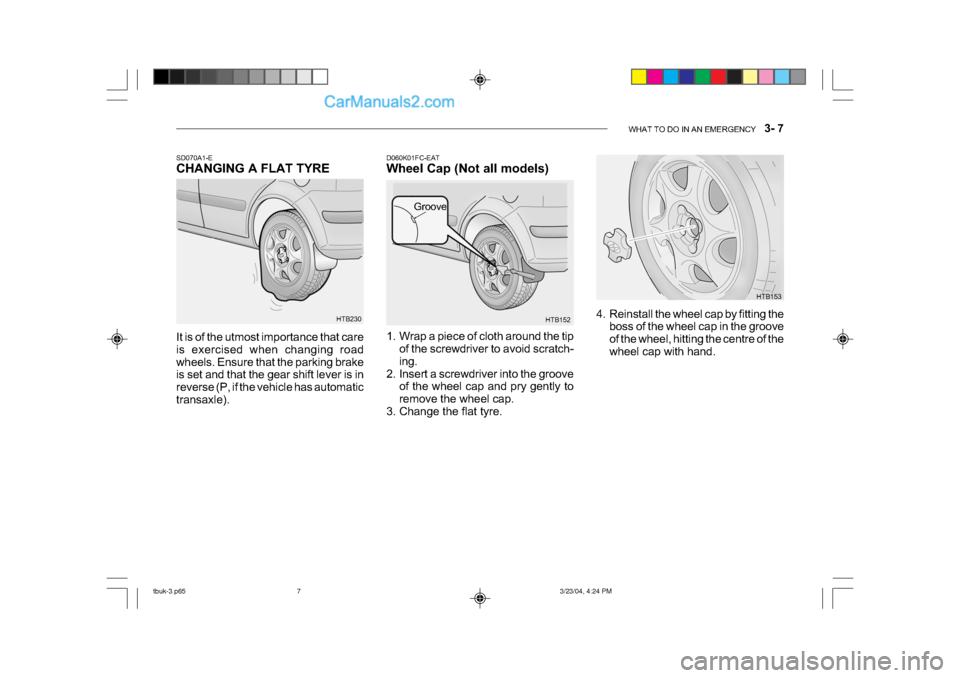
Wheel Cap (Not all models)
1. Wrap a piece of cloth around the tip
of the screwdriver to avoid scratch-
ing.
2. Insert a screwdriver into the groove of the wheel cap and pry gently to
remove the wheel cap.
3. Change the flat tyre. 4. Reinstall the wheel cap by fitting the
boss of the wheel cap in the groove
of the wheel, hitting the centre of the
wheel cap with hand.
HTB230
SD070A1-E
CHANGING A FLAT TYRE
It is of the utmost importance that care
is exercised when changing road
wheels. Ensure that the parking brake
is set and that the gear shift lever is in
reverse (P, if the vehicle has automatic
transaxle).
tbuk-3.p65
3/23/04, 4:24 PM
7
Page 375 of 445
3- 12 WHAT TO DO IN AN EMERGENCY
!
CAUTION:
The following restriction must be
observed in order to avoid serious
damage to the transaxle .
The vehicle must never be towed
from the rear with the front wheels
on the ground.
The vehicle must not be towed until
transaxle fluid has been added to
bring the level up to the "HOT"
marking on the dipstick. (The level
will need to be reduced again after
towing).
The vehicle must not be towed at
speeds faster than 25 mph. or dis-
tances greater than fifty miles. The
general points regarding the steer-
ing lock etc. described in the pre-
ceding section (Manual transaxle
vehicle) should be observed.
SD100A3-E
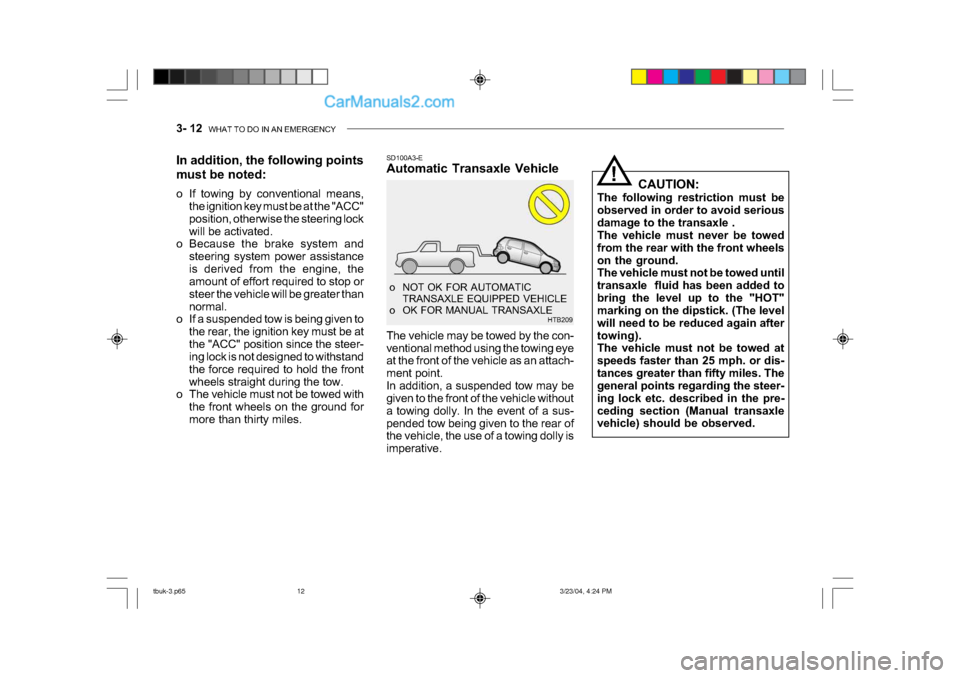
Automatic Transaxle Vehicle
The vehicle may be towed by the con-
ventional method using the towing eye
at the front of the vehicle as an attach-
ment point.
In addition, a suspended tow may be
given to the front of the vehicle without
a towing dolly. In the event of a sus-
pended tow being given to the rear of
the vehicle, the use of a towing dolly is
imperative.
o NOT OK FOR AUTOMATIC
TRANSAXLE EQUIPPED VEHICLE
o OK FOR MANUAL TRANSAXLE HTB209
In addition, the following points
must be noted:
o If towing by conventional means,
the ignition key must be at the "ACC"
position, otherwise the steering lock
will be activated.
o Because the brake system and
steering system power assistance
is derived from the engine, the
amount of effort required to stop or
steer the vehicle will be greater than
normal.
o If a suspended tow is being given to
the rear, the ignition key must be at
the "ACC" position since the steer-
ing lock is not designed to withstand
the force required to hold the front
wheels straight during the tow.
o The vehicle must not be towed with
the front wheels on the ground for
more than thirty miles.
tbuk-3.p65 3/23/04, 4:24 PM
12