Page 340 of 389
6OWNER MAINTENANCE
14
!
HGK5066 4. When preparing to remove the old
spark plug, guide the socket down over the spark plug, being careful not to damage the ceramic insula-tor.
5. To remove the old spark plug, turn
the wrench handle in a counter-clockwise direction.
6. To install the new spark plug, guide the socket down over the spark plug, being careful not to damage the ceramic insulator.
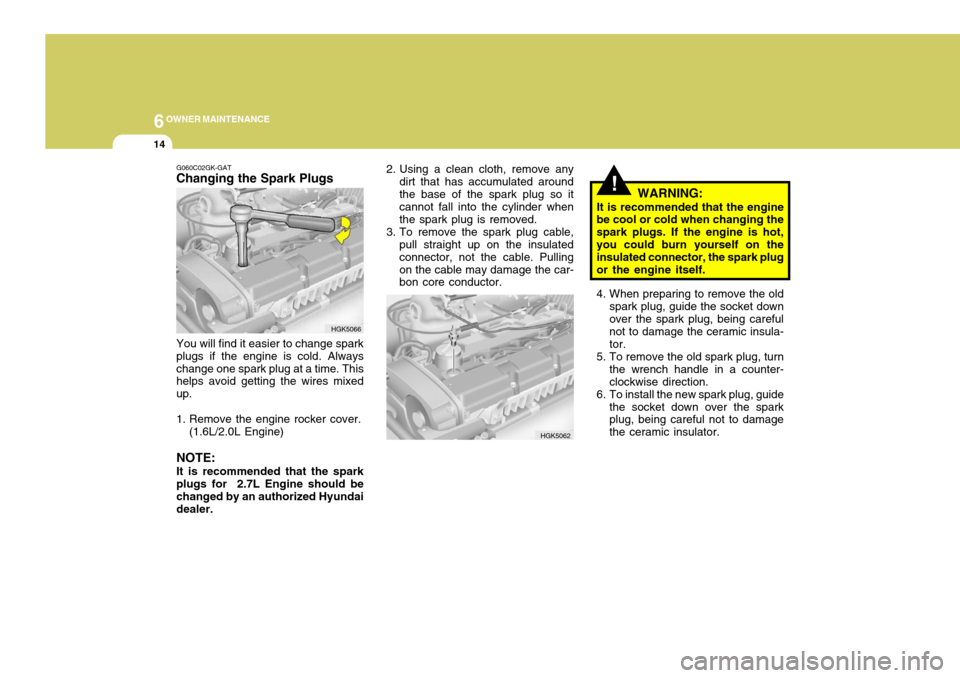
G060C02GK-GAT Changing the Spark Plugs You will find it easier to change spark plugs if the engine is cold. Alwayschange one spark plug at a time. This helps avoid getting the wires mixed up.
1. Remove the engine rocker cover.
(1.6L/2.0L Engine)
NOTE: It is recommended that the spark plugs for 2.7L Engine should be changed by an authorized Hyundaidealer. 2. Using a clean cloth, remove any
dirt that has accumulated aroundthe base of the spark plug so it cannot fall into the cylinder when the spark plug is removed.
3. To remove the spark plug cable, pull straight up on the insulatedconnector, not the cable. Pullingon the cable may damage the car- bon core conductor.
HGK5062 WARNING:
It is recommended that the engine
be cool or cold when changing the spark plugs. If the engine is hot,you could burn yourself on the insulated connector, the spark plug or the engine itself.
Page 346 of 389
6OWNER MAINTENANCE
20
HGK5007
HGK3025-E 1.6/2.0L
2.7L!
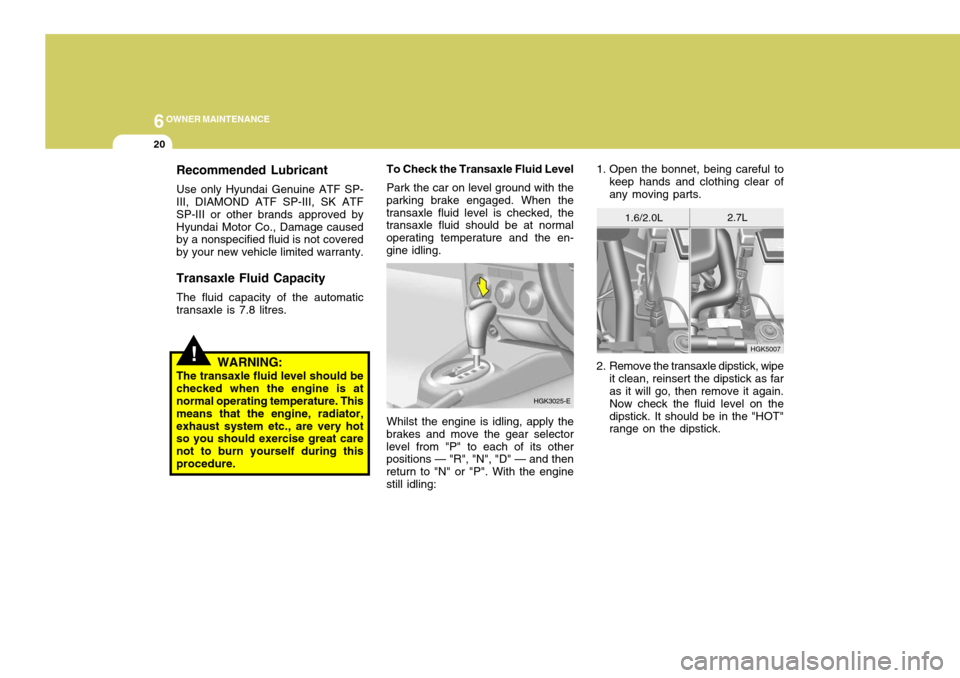
To Check the Transaxle Fluid Level Park the car on level ground with the
parking brake engaged. When the transaxle fluid level is checked, the transaxle fluid should be at normal operating temperature and the en-gine idling.
Whilst the engine is idling, apply the
brakes and move the gear selectorlevel from "P" to each of its other positions — "R", "N", "D" — and then return to "N" or "P". With the enginestill idling:
Recommended Lubricant Use only Hyundai Genuine ATF SP- III, DIAMOND ATF SP-III, SK ATF SP-III or other brands approved byHyundai Motor Co., Damage caused by a nonspecified fluid is not covered by your new vehicle limited warranty. Transaxle Fluid Capacity The fluid capacity of the automatic transaxle is 7.8 litres.
WARNING:
The transaxle fluid level should be checked when the engine is at normal operating temperature. This means that the engine, radiator,exhaust system etc., are very hot so you should exercise great care not to burn yourself during thisprocedure. 1. Open the bonnet, being careful to
keep hands and clothing clear ofany moving parts.
2. Remove the transaxle dipstick, wipe it clean, reinsert the dipstick as far as it will go, then remove it again. Now check the fluid level on thedipstick. It should be in the "HOT" range on the dipstick.
Page 347 of 389
6
OWNER MAINTENANCE
21
HGK5008
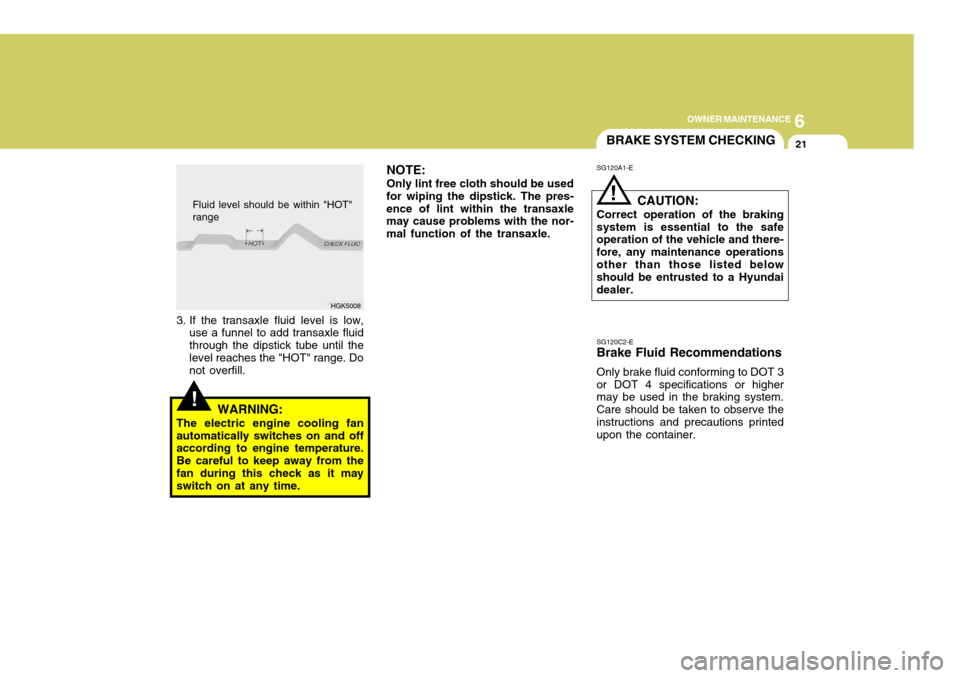
Fluid level should be within "HOT" range
!
SG120A1-E
BRAKE SYSTEM CHECKING
CAUTION:
Correct operation of the braking system is essential to the safe operation of the vehicle and there- fore, any maintenance operationsother than those listed below should be entrusted to a Hyundai dealer.
NOTE: Only lint free cloth should be used
for wiping the dipstick. The pres- ence of lint within the transaxle may cause problems with the nor- mal function of the transaxle.
3. If the transaxle fluid level is low, use a funnel to add transaxle fluidthrough the dipstick tube until thelevel reaches the "HOT" range. Do not overfill.
!WARNING:
The electric engine cooling fan automatically switches on and off according to engine temperature. Be careful to keep away from thefan during this check as it may switch on at any time. SG120C2-E Brake Fluid Recommendations Only brake fluid conforming to DOT 3 or DOT 4 specifications or higher may be used in the braking system. Care should be taken to observe theinstructions and precautions printed upon the container.
Page 348 of 389
6OWNER MAINTENANCE
22
HGK5013-E
CHECKING THE CLUTCH FLUID
SG130A1-C
(Not all models)To Check the Clutch Fluid
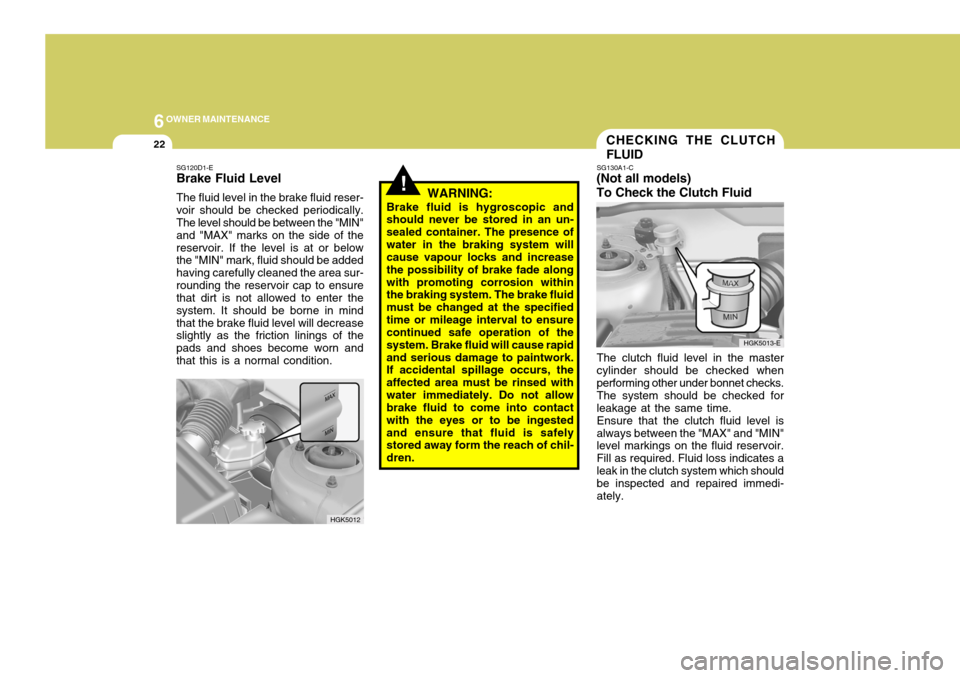
The clutch fluid level in the master cylinder should be checked when performing other under bonnet checks. The system should be checked forleakage at the same time.Ensure that the clutch fluid level isalways between the "MAX" and "MIN" level markings on the fluid reservoir. Fill as required. Fluid loss indicates aleak in the clutch system which should be inspected and repaired immedi- ately.
HGK5012
SG120D1-E Brake Fluid Level The fluid level in the brake fluid reser- voir should be checked periodically. The level should be between the "MIN" and "MAX" marks on the side of thereservoir. If the level is at or below the "MIN" mark, fluid should be added having carefully cleaned the area sur-rounding the reservoir cap to ensure that dirt is not allowed to enter the system. It should be borne in mindthat the brake fluid level will decrease slightly as the friction linings of the pads and shoes become worn andthat this is a normal condition.
WARNING:
Brake fluid is hygroscopic and should never be stored in an un- sealed container. The presence ofwater in the braking system will cause vapour locks and increase the possibility of brake fade alongwith promoting corrosion within the braking system. The brake fluid must be changed at the specifiedtime or mileage interval to ensure continued safe operation of the system. Brake fluid will cause rapidand serious damage to paintwork. If accidental spillage occurs, the affected area must be rinsed withwater immediately. Do not allow brake fluid to come into contact with the eyes or to be ingestedand ensure that fluid is safely stored away form the reach of chil- dren.
!
Page 349 of 389
6
OWNER MAINTENANCE
23
!
SG130B2-E
Adding Fluid
Recommended brake fluid conform-
ing to DOT 3 or DOT 4 should be used. The reservoir cap must be fully tightened to avoid contamination fromforeign matter or moisture.
WARNING:
Brake fluid will cause rapid and
serious damage to paintwork. Ifaccidental spillage occurs, the af-fected area must be rinsed with water immediately. Do not allow brake fluid to come into contactwith the eyes or to be ingested and ensure that fluid is safely stored away form the reach of children. SG140A1-E
Condenser
Ensure that the condenser is periodi-cally inspected and that accumula- tions of dirt, dead insects and leaves etc, are removed to ensure that theefficiency of the system is not im- paired. Care must be exercised to ensure that the condenser fins arenot damaged during cleaning. AIR CONDITIONING SYSTEM MAINTENANCE
!
SG140C2-E
Checking the Refrigerant
1. Start the engine and run at idle for
several minutes with the refrigera- tion system running at the coldest setting.
2. If the air coming out of the in-dash vents is not cold, have the air con-ditioning system inspected by your Hyundai dealer.
CAUTION:
Running the air conditioning sys-
tem for extended periods of time with a low refrigerant level maydamage the compressor.
CAUTION:
Brake fluid is hygroscopic andshould never be stored in an un-sealed container. Do not allow petroleum base fluid to contami- nate the brake fluid since damageto the rubber seals of the system may result.
!
Page 354 of 389

6OWNER MAINTENANCE
28
G200A01E
!
FUSIBLE LINKS
SG200A1-E The fusible link prevents damage to the wiring harness in the event of an electrical system malfunction. Failureof a fusiblelink is indicative of a seri- ous overload condition having oc- curred and therefore the electricalsystem should be checked by a Hyundai dealer before a replacement link is fitted. WARNING:
Under no circumstances should a
fusible link be replaced with any-thing other than a new link of thesame rating. The use of higher rated links or other means of con- necting the circuit will create apotential fire hazard.
Melted SG200B2-E
INDIVIDUAL CIRCUIT FUSES
The fuse box containing the individual
circuit fuses is located on the lowerportion of the dashboard adjacent to the bonnet release. The fuse box cover is removed by pushing lightlyand then releasing the lid. A fuse rating grid will be found on the re- verse side of the cover. In the eventof fuse failure, the fuse should be replaced with one of equivalent rat- ing. A fuse removal tool is providedwithin the fuse box to facilitate re- placement.
Good
HGK4003-E
Page 355 of 389
6
OWNER MAINTENANCE
29
!
In the event of a replacement fuse failing shortly after installation a mal- function within the circuit protected bythat fuse is indicated. The circuit should be checked by a Hyundai dealer at the first available opportu-nity. WARNING:
The use of replacement fuses hav-ing a higher rating than specified or other means of connecting the circuit will create a potential firehazard. Good
HXDFL1026-1
G200B02L
Burned out
NOTE: See page 6-41 for the fuse panel
descriptions.
!
BATTERY MAINTENANCE
SG210A1-E
WARNING:
Motor vehicle batteries contain sulphuric acid which is corrosiveand poisonous. Hydrogen gas is emitted from the battery which is explosive when combined with oxygen. The following precautions must be strictly observed to avoid personal injury or damage to the vehicle. D010B01GK
Page 356 of 389
6OWNER MAINTENANCE
30
o If battery electrolyte is spilled onto
skin or into eyes, the effected area must be flushed with copious amounts of water and medical assis-tance sought.
o If battery electrolyte is ingested, copious amounts of water or milkfollowed by an ant-acid (raw egg ormilk of magnesia) must be drunk. Vomiting should not be induced and medical assistance must besought.
o Batteries must only be charged in well venti-lated areas from which naked lights or sources of sparks are excluded.
o Ensure that children, pets or other unautho-rized persons are keptaway from batteries.
o Do not allow anything to bridge the
positive (+) and negative (-) termi-nals of the battery.
o Never invert the battery.
The battery fitted during production isof the "Maintenance Free" type.
ELECTRIC COOLING FANS
!
YG210A1-E
WARNING:
The cooling fan is controlled by engine coolant temperature and may sometimes operate even whenthe engine is not running. Do not touch the radiator fan until it is completely stopped.As the coolant temperature de-creases the fan will automaticallyshut off. This is a normal condi- tion.
Checking Engine Cooling Fan The engine cooling fan should auto- matically come on if the engine cool-ant temperature is high.
Checking Condenser Cooling Fan The condenser cooling fan (in front of the condenser) should come on auto- matically whenever the air conditioneris in operation.
POWER STEERING HOSES
YG220A1-E It is suggested that you check the power steering hose connections for fluid leakage at those intervals speci- fied in the vehicle maintenance sched-ule in Section 5. The power steering hoses should be replaced if there are severe surface cracking, pulling, scuff-ing or worn spots. Deterioration of the hoses could cause premature failure. NOTE: The power steering pump may be noisy when the engine is firststarted in the extreme cold (-4°F). This noise is not abnormal and will stop as the engine warms up.If the power steering pump contin- ues to be noisy after the engine has warmed up, have it inspectedby your Authorized Hyundai Dealer.
