2004 HONDA CR-V catalytic converter
[x] Cancel search: catalytic converterPage 65 of 256

This shows the total distance your
vehicle has been driven. It measures
miles in U.S. models and kilometers
in the Canadian models.
It is illegal under U.S. f ederal law and
Canadian provincial regulations to
disconnect, reset, or alter the
odometer with the intent to change
the number of miles or kilometers
indicated.
This shows how much f uel you have.
It may show slightly more or less
than the actual amount. The needle
returns to the bottom after you turn
of f the ignition.
There are two trip meters: Trip A
and Trip B. Switch between these
displays and the odometer/outside
temperature display (Canadian
models only) by pressing the Select/
Reset button repeatedly. This shows the number of miles (U.S.)
or kilometers (Canada) driven since
you last reset it.
Each trip meter works independently, so you can keep track of two
dif f erent distances.
To reset a trip meter, display it, and
then press and hold the Select/Reset
button until the number resets to
‘‘0.0’’. Both trip meters will reset if
the vehicle’s battery goes dead or is
disconnected.Odometer
Trip Meter Fuel Gauge
Gauges
Inst rument s and Cont rols61
SELECT/RESET BUTTON
TEMPERATURE GAUGE SPEEDOMETER
ODOMETER/TRIP METER
TACHOMETER
FUEL GAUGE
Avoid driving with an extremely low
f uel level. Running out of f uel could
cause the engine to misf ire, damaging
the catalytic converter.
Page 150 of 256

Always use the parking brake when
you park your vehicle. Make sure
the parking brake is set f irmly or
your vehicle may roll if it is parked
on an incline.
If your vehicle has an automatic
transmission, set the parking brake
bef ore you put the transmission in
Park. This keeps the vehicle f rom
moving and putting pressure on the
parking mechanism in the
transmission.Make sure the moonroof and the
windows are closed.
Turn of f the lights.
Place any packages, valuables, etc.
in the cargo area, or take them
with you.
Lock the doors and the tailgate.
Make sure the hatch glass is
closed securely.
Never park over dry leaves, tall
grass, or other f lammable
materials. The hot three way
catalytic converter could cause
these materials to catch on fire.If the vehicle is f acing uphill, turn
the f ront wheels away f rom the
curb.
If the vehicle is f acing downhill,
turn the front wheels toward the
curb.
Make sure the parking brake is
f ully released bef ore driving away.
Driving with the parking brake
partially set can overheat or
damage the rear brakes.
Parking T ips
Driving
Parking T ips
146
Page 227 of 256

Thediagramsinthissectiongive
you the dimensions and capacities of
your Honda, and the locations of the
identif ication numbers. It also
includes inf ormation you should
know about your vehicle’s tires and
emissions control systems.................
Identif ication Numbers . 224
................................
Specif ications .226
DOT Tire Quality Grading ......................
(U.S. Vehicles) .228
Unif orm Tire Quality ..................................
Grading .228
.................................
Treadwear .228
......................................
Traction .228
.............................
Temperature .229
...........................
Tire Inf ormation .230 .......................
Emissions Controls .231
.....................
The Clean Air Act .231
Crankcase Emissions Control ....................................
System .231
Evaporative Emissions Control ....................................
System .231
Onboard Ref ueling Vapor ................................
Recovery .231
...
Exhaust Emissions Controls . 232
....................
PGM-FI System .232
Ignition Timing Control ................................
System .232
Three Way Catalytic ...........................
Converter .232
....................
Replacement Parts . 232
..
Three Way Catalytic Converter . 233
..............
State Emissions Testing . 234
T echnical Inf ormat ion
T echnical Inf ormation223
Page 236 of 256

The PGM-FI System uses sequential
multiport f uel injection.
It has three subsystems: Air Intake,
Engine Control, and Fuel Control.
The Engine Control Module (ECM)
or the Powertrain Control Module
(PCM) uses various sensors to
determine how much air is going
into the engine. It then controls how
much f uel to inject under all operat-
ing conditions.
This system constantly adjusts the
ignition timing, reducing the amount
of HC, CO, and NOx produced.
The three way catalytic converter is
in the exhaust system. Through
chemical reactions, it converts HC,
CO, and NOx in the engine’s exhaust
to carbon dioxide (CO ), dinitrogen
(N ), and water vapor.The emissions control systems are
designed and certif ied to work to-
gether in reducing emissions to
levels that comply with the Clean Air
Act. To make sure the emissions
remain low, you should use only new
Honda replacement parts or their
equivalent f or repairs. Using lower
qualitypartsmayincreasethe
emissions f rom your vehicle.
The exhaust emissions controls
include three systems: PGM-FI,
Ignition Timing Control, and Three
Way Catalytic Converter. These
three systems work together to
control the engine’s combustion and
minimize the amount of HC, CO, and
NOx that comes out the tailpipe. The
exhaust emissions control systems
are separate from the crankcase and
evaporative emissions control
systems.
The emissions control systems are
covered by warranties separate from
the rest of your vehicle. Read your
warranty manual f or more informa-
tion.
2
2
Exhaust Emissions Controls Replacement PartsPGM-FI Syst em
Ignit ion T iming Cont rol Syst emThree Way Catalytic Converter
Emissions Cont rols
T echnical Inf ormation232
Page 237 of 256
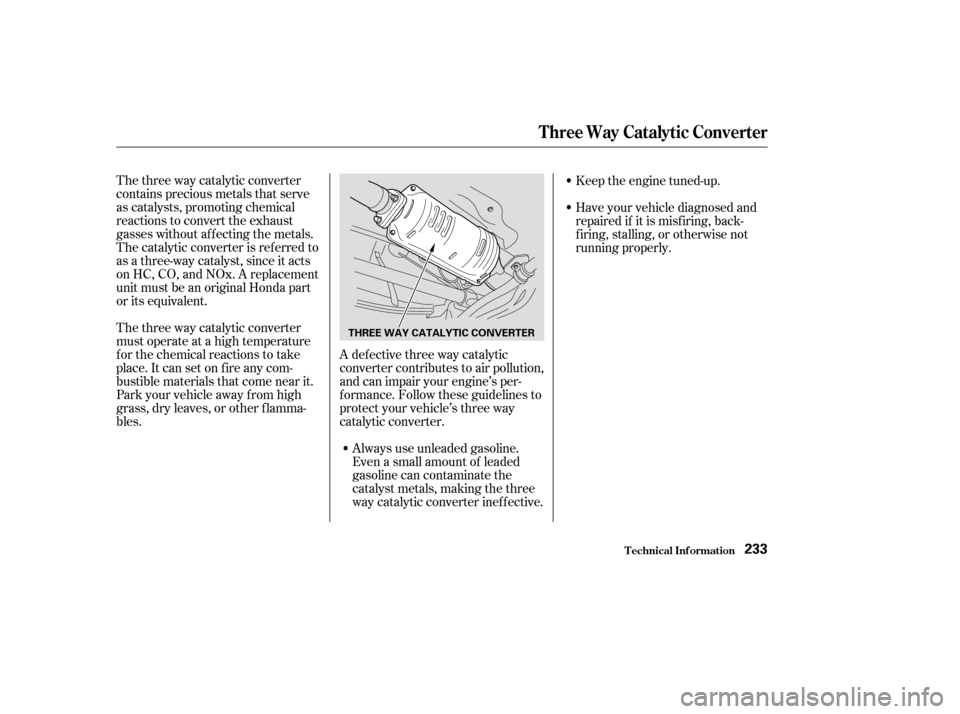
The three way catalytic converter
contains precious metals that serve
as catalysts, promoting chemical
reactions to convert the exhaust
gasses without af f ecting the metals.
The catalytic converter is ref erred to
as a three-way catalyst, since it acts
on HC, CO, and NOx. A replacement
unit must be an original Honda part
or its equivalent.Always use unleaded gasoline.
Even a small amount of leaded
gasoline can contaminate the
catalyst metals, making the three
way catalytic converter inef f ective.Keep the engine tuned-up.
The three way catalytic converter
must operate at a high temperature
for the chemical reactions to take
place. It can set on f ire any com-
bustible materials that come near it.
Parkyourvehicleawayfromhigh
grass, dry leaves, or other f lamma-
bles. A defective three way catalytic
converter contributes to air pollution,
and can impair your engine’s per-
f ormance. Follow these guidelines to
protect your vehicle’s three way
catalytic converter. Have your vehicle diagnosed and
repaired if it is misf iring, back-
f iring, stalling, or otherwise not
running properly.
Three Way Catalytic Converter
T echnical Inf ormation233
THREE WAY CATALYTIC CONVERTER
Page 254 of 256

Supplemental Restraint................................
System .10, 23
......................................
Servicing .28
.........................
SRS Indicator .27 ,57
...................
System Components . 27
..................................
Synthetic Oil .174
Table ..........................................
Built in .92
...........................................
Center .94
.....................................
Tachometer .61
Tailgate .................................
Hatch Glass .73
............................
Open Indicator .59
.................................
Opening the .73
..........
Taillights, Changing Bulbs . 183
.
Taking Care of the Unexpected . 199
....................................
Tape Player .114
Technical Descriptions ......
DOT Tire Quality Grading . 228
.....
Emissions Control Systems . 231
.....................
Oxygenated Fuels .124
Three Way Catalytic ...............................
Converter .233 .......................
Temperature Gauge .62
....................
Temperature, Outside . 62
..............
Tether Anchorage Points . 42
............................
Thef t Protection .117
..
Three Way Catalytic Converter . 233
..................
Tilt the Steering Wheel . 68
..................
Time, Setting the . 118,162
....................................
Tire Chains .194
.........
Tire, How to Change a Flat . 200
...........................
Tire Inf ormation .231
...............................................
Tires .190
..............................
Air Pressure .191
.........................
Checking Wear .193
......
DOT Tire Quality Grading . 228
......................................
Inf lation .190
..................................
Inspection .192
..............................
Maintenance .193
...................................
Replacing .193
......................................
Rotating .193
...........................................
Snow .194
............................
Specif ications .227
................................
Tire Chains .194
...................
Tools, Tire Changing . 200
Towing .....................................
A Trailer .152
...............
Behind a Motorhome . 157................................
Emergency .216
...
Equipment And Accessories . 152
.............................
Weight Limit .150
.............................
Trailer Loading .151
......................
Trailer Towing Tips .155
Transmission Checking Fluid Level, ..............................
Automatic .179
Checking Fluid Level, ...................................
Manual .180
..................
Fluid Selection . 179,180
..............
Identif ication Number . 224
.............
Shif ting the Automatic . 141
..................
Shif ting the Manual . 140
.....................................
Treadwear .228
.......................................
Trip Meter .61
....................................
Turn Signals .65
Unexpected, Taking Care ..........................................
of the .199
....
Unif orm Tire Quality Grading . 228
........................
Unleaded Gasoline .124
.......
Used Oil, How to Dispose of . 175
Index
T
U
VIII