Page 204 of 256
If you have a f lat tire while driving,
stop in a saf e place to change it.
Drive slowly along the shoulder until
you get to an exit or an area to stop
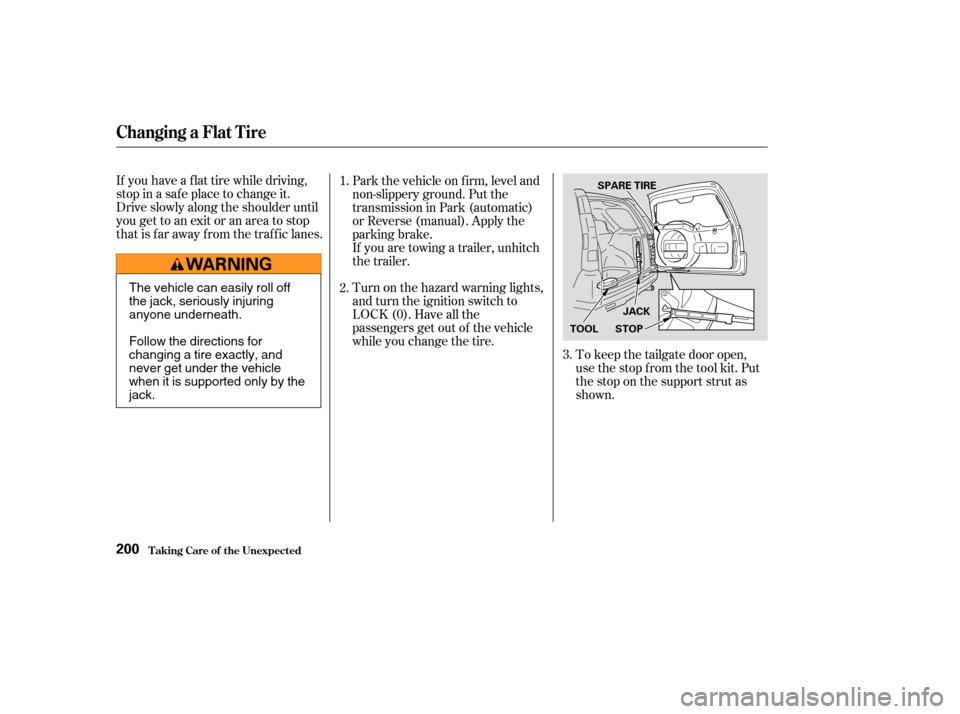
that is far away from the traffic lanes.To keep the tailgate door open,
use the stop f rom the tool kit. Put
the stop on the support strut as
shown.
Park the vehicle on f irm, level and
non-slippery ground. Put the
transmission in Park (automatic)
or Reverse (manual). Apply the
parking brake.
If you are towing a trailer, unhitch
the trailer.
Turn on the hazard warning lights,
and turn the ignition switch to
LOCK (0). Have all the
passengers get out of the vehicle
while you change the tire.
1.
2.
3.
Changing a Flat T ire
T aking Care of t he Unexpect ed200
JACK
STOP
SPARE TIRE
TOOL
The vehicle can easily roll off
the jack, seriously injuring
anyone underneath.
Follow the directions for
changing a tire exactly, and
never get under the vehicle
when it is supported only by the
jack.
Page 211 of 256

Diagnosing why your engine won’t
start f alls into two areas, depending
on what you hear when you turn the
key to START (III):You hear nothing, or almost
nothing. The engine’s starter
motor does not operate at all, or
operates very slowly.
You can hear the starter motor
operating normally, or the starter
motor sounds like it is spinning
f aster than normal, but the engine
does not start up and run. When you turn the ignition switch to
START (III), you do not hear the
normal noise of the engine trying to
start. You may hear a clicking sound
or series of clicks, or nothing at all.
Check the transmission interlock.
If you have a manual transmission,
the clutch pedal must be pushed
all the way to the f loor or the
starter will not operate. With an
automatic transmission, it must be
in Park or Neutral.
Check these things:
Turn the ignition switch to ON (II).
Turn on the headlights and check
their brightness. If the headlights
are very dim or don’t light at all,
the battery is discharged. See on page . Turn the ignition switch to START
(III). If the headlights do not dim,
check the condition of the f uses. If
the f uses are OK, there is
probably something wrong with
the electrical circuit f or the
ignition switch or starter motor.
You will need a qualif ied
technician to determine the
problem (see
on page ).
If the headlights dim noticeably or
go out when you try to start the
engine, either the battery is dis-
charged or the connections are
corroded. Check the condition of the
battery and terminal connections
(see page ). You can then try
jump starting the vehicle from a
booster battery (see page ).
209 216
196 209
Nothing Happens or the Starter
Motor Operates Very Slowly
Jump Starting Emergency T owing
T aking Care of t he Unexpect ed
If theEngineWon’tStart
207
Page 212 of 256
Are you using a properly coded
key? An improperly coded key will
cause the immobilizer system
indicator in the instrument panel
to blink rapidly (see page ).
In this case, the starter motor’s
speed sounds normal, or even f aster
than normal, when you turn the
ignition switch to START (III), but
the engine does not run.
Are you using the proper starting
procedure? Ref er to on page . Do you have f uel? Check the f uel
gauge; the low f uel indicator may
not be working.
There may be an electrical
problem, such as no power to the
f uel pump. Check all the f uses
(see page ).
If youfindnothingwrong,youwill
need a qualif ied technician to f ind
the problem. See on page .
138 218
216
70
T he Starter Operates Normally
Starting the
Engine Emergency
Towing
T aking Care of t he Unexpect ed
If theEngineWon’tStart
208
Page 218 of 256

To check if they are set, turn the
ignition to ON (II), without starting
the engine. The Malf unction
Indicator Lamp will come on f or 20
seconds. If it then goes of f , the
readiness codes are set. If it blinks 5
times, the readiness codes are not
set. If possible, do not take your
vehicle f or a state emissions test
until the readiness codes are set.
Refer to State Emissions Testing for
more inf ormation, on page .
If the indicator comes on
while driving, it means one
of the engine’s emission control
systems may have a problem. Even
though you may f eel no dif f erence in
your vehicle’s perf ormance, it can
reduce your f uel economy and cause
increased emissions. Continued
operation may cause serious damage.
If you have recently ref ueled your
vehicle, the indicator coming on
could be a loose or missing f uel f ill
cap. Tighten the cap until it clicks at
least three times. Tightening the cap
will not turn the indicator turn of f
immediately; it takes at least three
days of normal driving. If the indicator comes on repeatedly,
even though it may turn of f as you
continue driving, have the vehicle
checked by the dealer as soon as
possible.
Your vehicle has certain ‘‘readiness
codes’’ that are part of the on-board
diagnostics f or the emissions
systems. In some states, part of the
emissions testing is to make sure
these codes are set. If they are not
set, the test cannot be completed.If your vehicle battery has been
disconnected or gone dead, these
codes are erased. It takes at least
three days of driving under various
conditions to set the codes again.
234
T aking Care of t he Unexpect ed
Readiness Codes
Malf unction Indicator L amp
214
NOTICE:If you keep driving with the
Malf unction Indicator Lamp on, you
can damage your vehicle’s emission
controls and the engine. Those repairs
may not be covered by your vehicle’s
warranties.
Page 222 of 256
Turn the ignition switch to LOCK
(0). Make sure the headlights and
all other accessories are off.
Remove the cover f rom the f use
box.
If something electrical in your
vehicle stops working, check f or a
blown f use f irst. Determine f rom the
chart on pages and or the
diagram on the f use box lid, which
f use or f uses control that device.
Check those f uses f irst, but check all
the f uses bef ore deciding that a
blown f use is the cause. Replace any
blown f uses and check if the device
works.
The interior f use box is underneath
the steering column. To remove the
f use box lid, pull it toward you and
take the lid out of its hinges. The vehicle’s f uses are located in
two f use boxes. The under-hood f use
box is located in the engine
compartment on the driver’s side. To
open it, push the tabs as shown.1.
2.221 222
Checking and Replacing Fuses
Fuses
T aking Care of t he Unexpect ed218
TAB
INTERIOR
UNDER-HOOD
Page 225 of 256
�µ�µ
�µ
�Î �Î
�Î
No. Amps. Circuits Protected No. Amps. Circuits Protected
1
2
3
4
5
15 A
10 A
10 A
10 A
Ignition Coil
Daytime running lights
ACG
Not Used 6
7
8
9
10
11
12
13
14
15
16
17
18
19
20
21
22
23
24
25 7.5 A
20 A
7.5 A
7.5 A
7.5 A
7.5 A 10 A
10 A
20 A
20 A
15 A
15 A
7.5 A 20 A
20 A
20 A
20 A
20 A Power Window Relay
Moonroof
Accessory, Radio
Rear Wiper
Meter
Not Used
Daytime running lights
SRS
Remote Control Mirrors
LAF Heater
Heated Seat
Fuel Pump
Turn Signal Lights
Front Wiper
Not Used
Front Right Power Window
Front Left Power Window
Rear Lef t Power Window
Rear Right Power Window
: On Canadian models
Rear Accessory Power Socket Front Accessory Power Socket
Fuse Locations
T aking Care of t he Unexpect ed221
INTERIOR FUSE BOX
Page 226 of 256
�µ
�µ
�µ
No. Amps. Circuits Protected
1
2
3
4
5
6
7
8
9
10
11
12
13
14
15
16
17
18
19
20 20 A
15 A
15 A
20 A
15 A
15 A
15 A
10 A
30 A
20 A
40 A
40 A
40 A
15 A
20 A
15 A
30 A
100 A 50 A Condenser Fan
Small Light
Interior Light
Cooling Fan
Hazard
FI ECU
Horn, Stop
Not Used
Back Up
ABS Motor
Rear Defroster
Heater Motor
Power Window
Option
Lef t Headlight
Door Lock
Right Headlight
ABS F/S
Battery
Ignition 1
Spare Fuses
21 257.5A 30A
Fuse Locations
T aking Care of t he Unexpect ed222
UNDER-HOOD FUSE BOX
Page 227 of 256

Thediagramsinthissectiongive
you the dimensions and capacities of
your Honda, and the locations of the
identif ication numbers. It also
includes inf ormation you should
know about your vehicle’s tires and
emissions control systems.................
Identif ication Numbers . 224
................................
Specif ications .226
DOT Tire Quality Grading ......................
(U.S. Vehicles) .228
Unif orm Tire Quality ..................................
Grading .228
.................................
Treadwear .228
......................................
Traction .228
.............................
Temperature .229
...........................
Tire Inf ormation .230 .......................
Emissions Controls .231
.....................
The Clean Air Act .231
Crankcase Emissions Control ....................................
System .231
Evaporative Emissions Control ....................................
System .231
Onboard Ref ueling Vapor ................................
Recovery .231
...
Exhaust Emissions Controls . 232
....................
PGM-FI System .232
Ignition Timing Control ................................
System .232
Three Way Catalytic ...........................
Converter .232
....................
Replacement Parts . 232
..
Three Way Catalytic Converter . 233
..............
State Emissions Testing . 234
T echnical Inf ormat ion
T echnical Inf ormation223