Page 62 of 256

On Canadian models, this indicator
comes on with reduced brightness
when the Daytime Running Lights
(DRL) are on (see page ). This comes on with the high beam
headlights. See page f or
inf ormation on the headlight
controls.
Thiscomesonasareminderthat
you must ref uel soon.
The lef t or right turn signal indicator
blinks when you signal a lane change
or turn. If the indicator does not
blink or blinks rapidly, it usually
means one of the turn signal bulbs is
burned out (see page ). Replace
the bulb as soon as possible, since
other drivers cannot see that you are
signaling.
WhenyouturnontheHazard
Warning switch, both turn signal
indicators blink. All turn signals on
the outside of the vehicle should
flash. This indicator comes on when you
turn the ignition switch to ON (II)
with the headlight switch off and the
parking brake set. It should go of f if
youturnontheheadlightsorrelease
the parking brake. If it comes on at
any other time, it means there is a
problem with the DRL. There may
also be a problem with the high
beam headlights.
Thiscomesonwhenyousetthe
cruise control. See page f or
inf ormation on operating the cruise
control.
184
11965
65
Canadian models only
Inst rument s and Cont rols
Instrument Panel
Turn Signal and Hazard Warning
Indicators
‘‘Daytime Running
Lights’’ Indicator
High Beam Indicator
Low Fuel Indicator
Cruise Control Indicator
58
Page 63 of 256

�µ
Canadian models onlyThis indicator reminds you that it is
time to take your vehicle in for
scheduled maintenance.
Ref er to the Maintenance Schedules
f or Normal and Severe Driving
Conditions on pages.
For the f irst 8,000 miles (12,800 km)
af ter the Maintenance Required
Indicator is reset, it will come on f or
two seconds when you turn the
ignition switch to ON (II). Between 8,000 miles (12,800 km)
and 10,000 miles (16,000 km), it will
light f or two seconds when you f irst
turn the ignition switch to ON (II),
andthenflashfortenseconds.
If you exceed 10,000 miles (16,000
km) without having the scheduled
maintenance perf ormed, this
indicator will remain on as a constant
reminder.
Your dealer will reset this indicator
af ter completing the scheduled
maintenance. If this maintenance is
done by someone other than your
Honda dealer, reset the indicator as
f ollows.
Turn of f the engine.
This indicator comes on if the
tailgate or the hatch glass is not
closed tightly. Thiscomesonwhenthewasher
f luid level is low. Add washer f luid
when you see this light comes on
(see page ).
This indicator comes on if any door
is not closed tightly.
1.
168 169
178
Inst rument s and Cont rols
Washer Level Indicator
Tailgate and Hatch Glass
Open Indicator Maintenance Required
Indicator
Door-open Indicator
Instrument Panel
59
Page 64 of 256
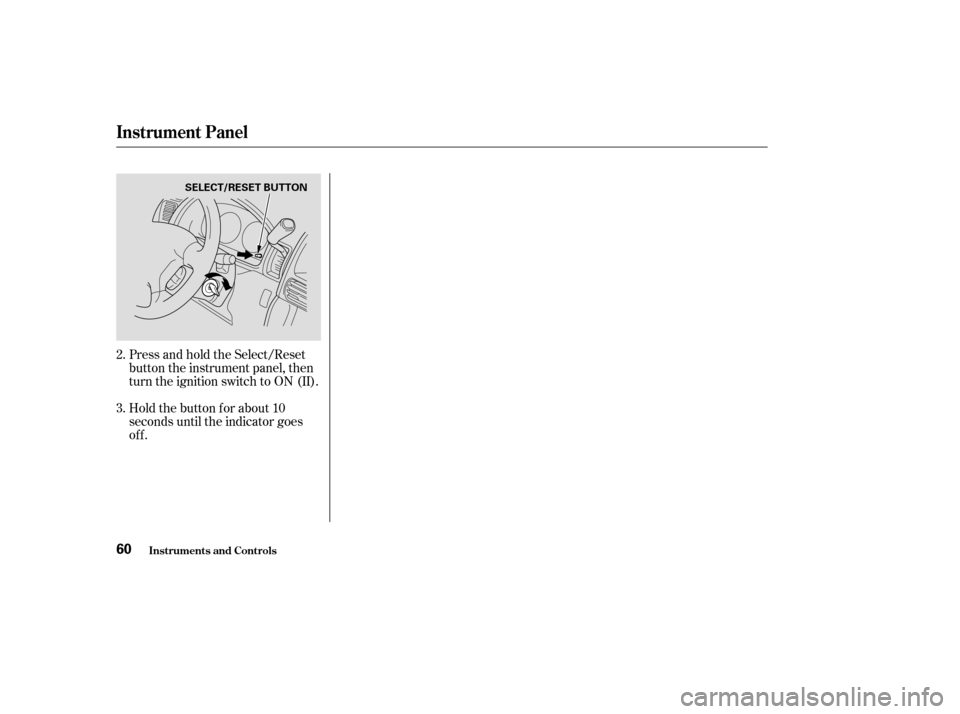
Hold the button for about 10
seconds until the indicator goes
off. Press and hold the Select/Reset
button the instrument panel, then
turn the ignition switch to ON (II).
2.
3.
Inst rument s and Cont rols
Instrument Panel
60
SELECT/RESET BUTTON
Page 65 of 256

This shows the total distance your
vehicle has been driven. It measures
miles in U.S. models and kilometers
in the Canadian models.
It is illegal under U.S. f ederal law and
Canadian provincial regulations to
disconnect, reset, or alter the
odometer with the intent to change
the number of miles or kilometers
indicated.
This shows how much f uel you have.
It may show slightly more or less
than the actual amount. The needle
returns to the bottom after you turn
of f the ignition.
There are two trip meters: Trip A
and Trip B. Switch between these
displays and the odometer/outside
temperature display (Canadian
models only) by pressing the Select/
Reset button repeatedly. This shows the number of miles (U.S.)
or kilometers (Canada) driven since
you last reset it.
Each trip meter works independently, so you can keep track of two
dif f erent distances.
To reset a trip meter, display it, and
then press and hold the Select/Reset
button until the number resets to
‘‘0.0’’. Both trip meters will reset if
the vehicle’s battery goes dead or is
disconnected.Odometer
Trip Meter Fuel Gauge
Gauges
Inst rument s and Cont rols61
SELECT/RESET BUTTON
TEMPERATURE GAUGE SPEEDOMETER
ODOMETER/TRIP METER
TACHOMETER
FUEL GAUGE
Avoid driving with an extremely low
f uel level. Running out of f uel could
cause the engine to misf ire, damaging
the catalytic converter.
Page 69 of 256
�µ�µ �µ
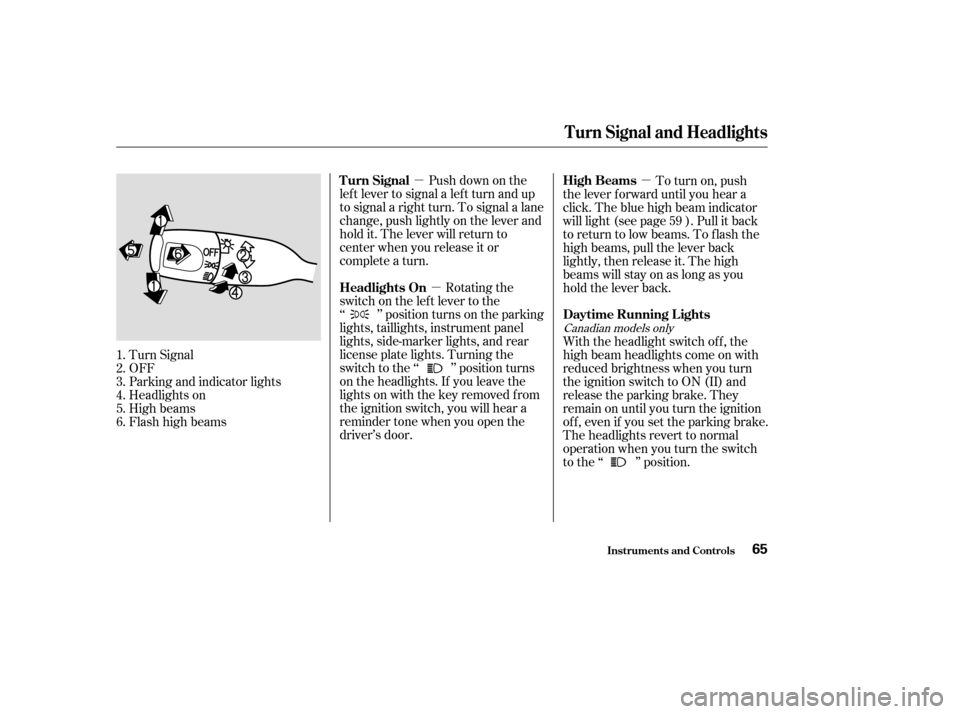
Push down on the
lef t lever to signal a lef t turn and up
to signal a right turn. To signal a lane
change, push lightly on the lever and
hold it. The lever will return to
center when you release it or
complete a turn.
Rotating the
switch on the lef t lever to the
‘‘ ’’ position turns on the parking
lights, taillights, instrument panel
lights, side-marker lights, and rear
license plate lights. Turning the
switch to the ‘‘ ’’ position turns
on the headlights. If you leave the
lights on with the key removed f rom
the ignition switch, you will hear a
reminder tone when you open the
driver’s door. To turn on, push
the lever f orward until you hear a
click. The blue high beam indicator
will light (see page ). Pull it back
to return to low beams. To flash the
high beams, pull the lever back
lightly, then release it. The high
beams will stay on as long as you
hold the lever back.
With the headlight switch off, the
high beam headlights come on with
reduced brightness when you turn
the ignition switch to ON (II) and
release the parking brake. They
remain on until you turn the ignition
of f , even if you set the parking brake.
The headlights revert to normal
operation when you turn the switch
to the ‘‘ ’’ position.
Turn Signal
OFF
Parking and indicator lights
Headlights on
High beams
Flashhighbeams
1.
2.
3.
4.
5.
6. 59
Canadian models only
Turn Signal
Headlights On
High Beams
Daytime Running L ights
Inst rument s and Cont rols
Turn Signal and Headlights
65
Page 73 of 256

The master key fits all the locks on
your vehicle. The valet key works
only in the ignition, the door locks,
and the tailgate. You can keep the
glove box locked when you leave
your vehicle and the valet key at a
parking f acility.
Youshouldhavereceivedakey
number tag with your keys. You will
need this key number if you ever
have to get a lost key replaced. Use
only Honda-approved key blanks.These keys contain electronic
circuits that are activated by the
Immobilizer System. They will not
work to start the engine if the
circuits are damaged.
Protect the keys f rom direct
sunlight, high temperature, and
high humidity.
Donotdropthekeysorsetheavy
objects on them.
Keep the keys away f rom liquids.
If they get wet, dry them
immediately with a sof t cloth.
The keys do not contain batteries.
Do not try to take them apart. Some models also come with two
remote transmitters; see page for
an explanation of their operation.
74
Keys and Locks
Inst rument s and Cont rols69
VALET
KEY
(Gray)
MASTER
KEYS
(Black)
KEY NUMBER
TAG
Page 74 of 256

If the system repeatedly does not
recognize the coding of your key,
contact your Honda dealer.
Do not attempt to alter this system
or add other devices to it. Electrical
problems could result that may make
your vehicle undriveable.
If you have lost your key and cannot
start your engine, contact a Honda
dealer.
The Immobilizer System protects
your vehicle f rom thef t. If an
improperly-coded key (or other
device) is used, the engine’s f uel
system is disabled.
When you turn the ignition switch to
ON (II), the Immobilizer System
indicator should come on f or a f ew
seconds, then go out. If the indicator
starts to blink, it means the system
does not recognize the coding of the
key. Turn the ignition switch to
LOCK (0), remove the key, reinsert
it, and turn the switch to ON (II)
again.
The system may not recognize your
key’s coding if another immobilizer
key or other metal object is near the
ignition switch when you insert the
key.As required by the FCC:
This device complies with Part 15 of theFCC rules. Operation is subject to thef ollowing two conditions: (1) This devicemay not cause harmf ul interf erence, and(2) this device must accept anyinterf erence received, includinginterf erence that may cause undesiredoperation.
Changes or modif ications not expresslyapproved by the party responsible f orcompliance could void the user’sauthority to operate the equipment.
This device complies with IndustryCanada Standard RSS-210.Operation is subject to the f ollowing twoconditions: (1) this device may not causeinterf erence, and (2) this device mustaccept any interf erence that may causeundesired operation of the device.
Immobilizer Syst em
Inst rument s and Cont rols70
Page 75 of 256

�µ�µ�µ
�µ You can insert or
remove the key only in this position.
To turn the key, the shift lever must
be in Park, and you must push the
key in slightly. Use this position
only to start the engine. The switch
returns to ON (II) when you let go of
the key.
You will hear a reminder beeper if
you leave the key in the ignition
switch in the LOCK (0) or
ACCESSORY (I) position and open
the driver’s door. Remove the key to
turn of f the beeper. The shif t lever
must be in Park bef ore you can
remove the key from the ignition
switch.
If the f ront wheels are turned, the
anti-thef t lock may make it dif f icult
to turn the key. Firmly turn the
steering wheel to the lef t or right as
you turn the key.
You can
operate the audio system and the
accessory power sockets in this
position.
This is the normal key
position when driving. Several of the
lights on the instrument panel come
on as a test when you turn the
ignition switch f rom ACCESSORY
(I) to ON (II).
The ignition switch has f our
positions: LOCK (0), ACCESSORY
(I), ON (II), and START (III). L OCK (0)
ST A RT (III)
A CCESSORY (I)
ON (II)
Ignition Switch
Inst rument s and Cont rols71
Removing the key from the
ignition switch while driving
locks the steering. This can
cause you to lose control.
Remove the key from the
ignition switch only when
parked.