Page 232 of 420
Winter Driving
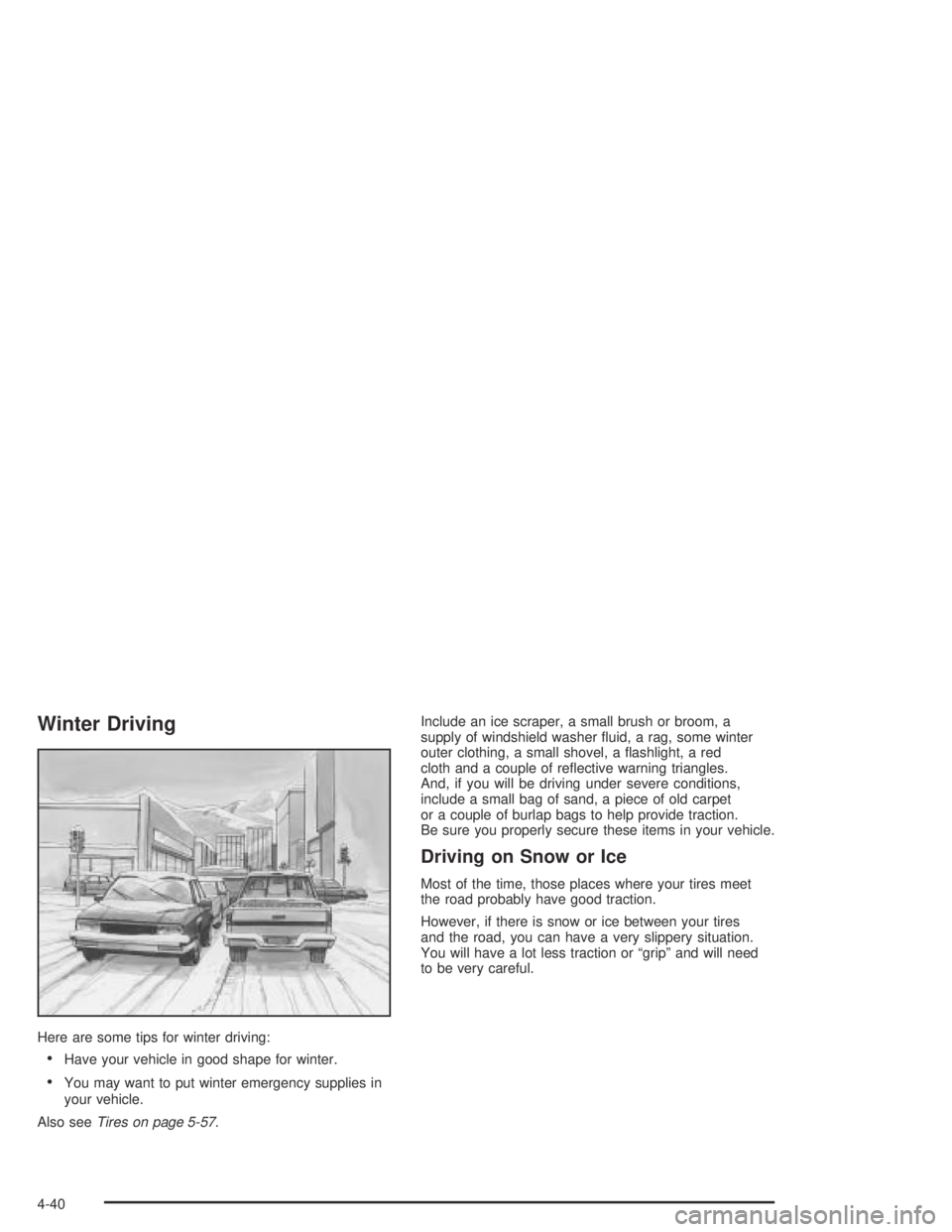
Here are some tips for winter driving:
Have your vehicle in good shape for winter.
You may want to put winter emergency supplies in
your vehicle.
Also seeTires on page 5-57.Include an ice scraper, a small brush or broom, a
supply of windshield washer uid, a rag, some winter
outer clothing, a small shovel, a ashlight, a red
cloth and a couple of reective warning triangles.
And, if you will be driving under severe conditions,
include a small bag of sand, a piece of old carpet
or a couple of burlap bags to help provide traction.
Be sure you properly secure these items in your vehicle.
Driving on Snow or Ice
Most of the time, those places where your tires meet
the road probably have good traction.
However, if there is snow or ice between your tires
and the road, you can have a very slippery situation.
You will have a lot less traction or “grip” and will need
to be very careful.
4-40
Page 240 of 420
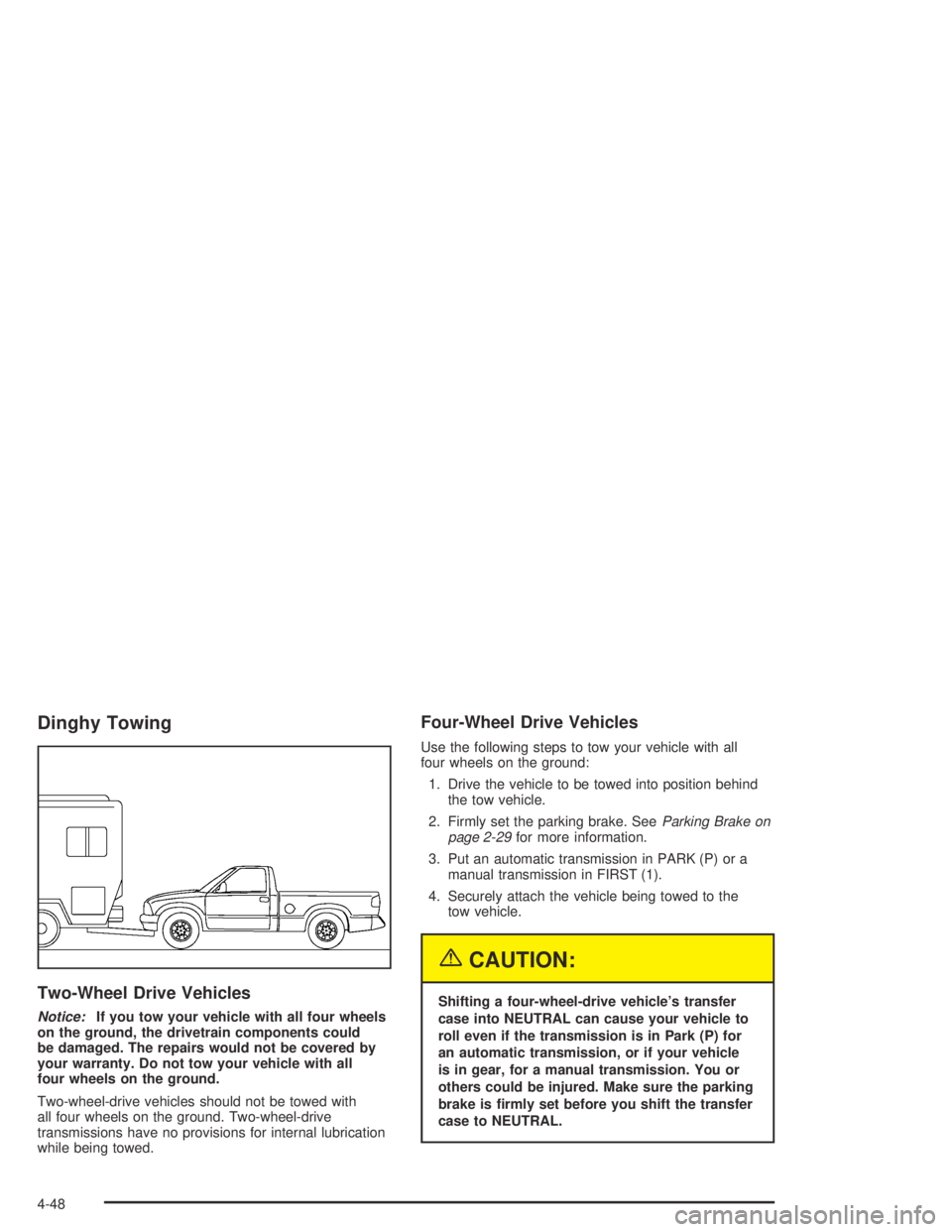
Dinghy Towing
Two-Wheel Drive Vehicles
Notice:If you tow your vehicle with all four wheels
on the ground, the drivetrain components could
be damaged. The repairs would not be covered by
your warranty. Do not tow your vehicle with all
four wheels on the ground.
Two-wheel-drive vehicles should not be towed with
all four wheels on the ground. Two-wheel-drive
transmissions have no provisions for internal lubrication
while being towed.
Four-Wheel Drive Vehicles
Use the following steps to tow your vehicle with all
four wheels on the ground:
1. Drive the vehicle to be towed into position behind
the tow vehicle.
2. Firmly set the parking brake. SeeParking Brake on
page 2-29for more information.
3. Put an automatic transmission in PARK (P) or a
manual transmission in FIRST (1).
4. Securely attach the vehicle being towed to the
tow vehicle.
{CAUTION:
Shifting a four-wheel-drive vehicle’s transfer
case into NEUTRAL can cause your vehicle to
roll even if the transmission is in Park (P) for
an automatic transmission, or if your vehicle
is in gear, for a manual transmission. You or
others could be injured. Make sure the parking
brake is rmly set before you shift the transfer
case to NEUTRAL.
4-48
Page 242 of 420
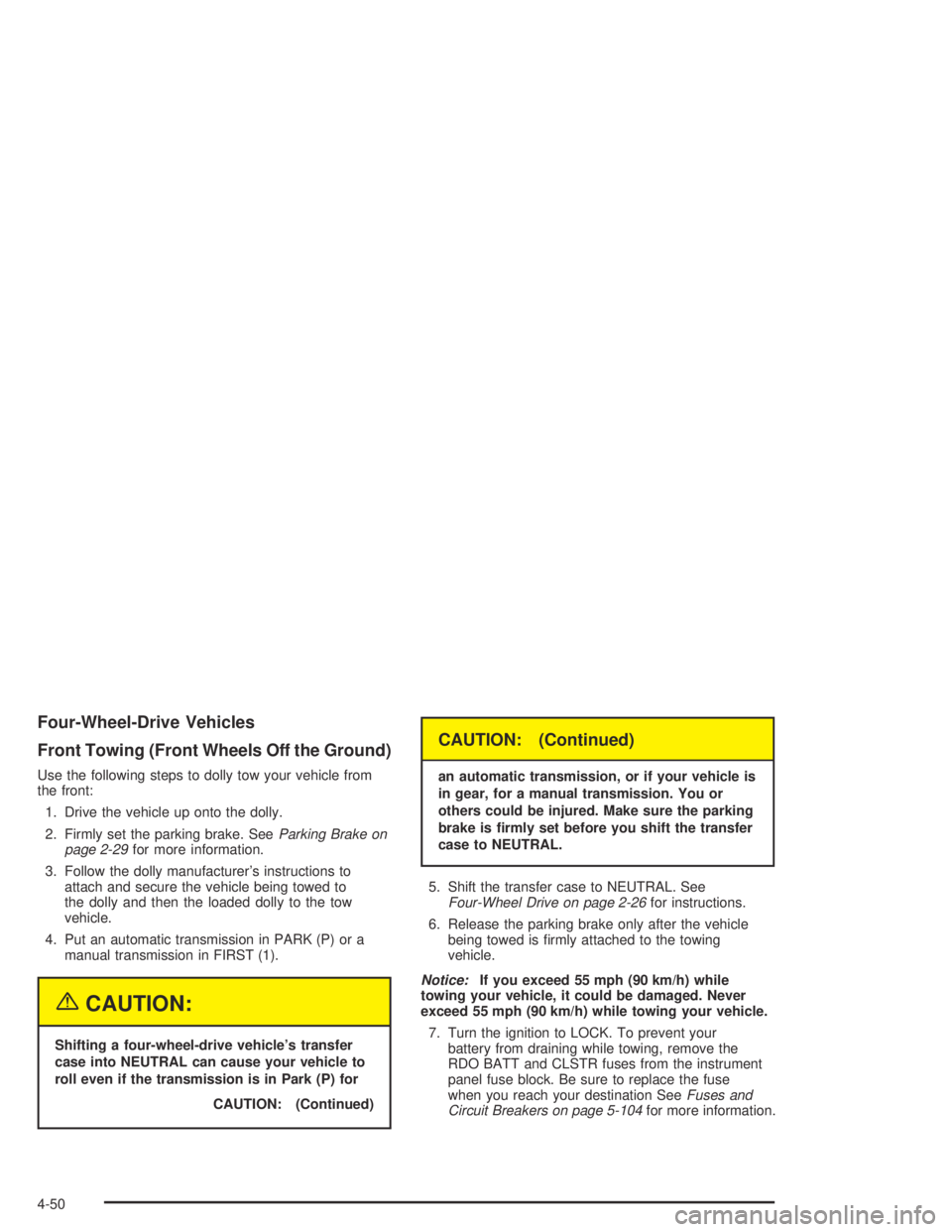
Four-Wheel-Drive Vehicles
Front Towing (Front Wheels Off the Ground)
Use the following steps to dolly tow your vehicle from
the front:
1. Drive the vehicle up onto the dolly.
2. Firmly set the parking brake. SeeParking Brake on
page 2-29for more information.
3. Follow the dolly manufacturer’s instructions to
attach and secure the vehicle being towed to
the dolly and then the loaded dolly to the tow
vehicle.
4. Put an automatic transmission in PARK (P) or a
manual transmission in FIRST (1).
{CAUTION:
Shifting a four-wheel-drive vehicle’s transfer
case into NEUTRAL can cause your vehicle to
roll even if the transmission is in Park (P) for
CAUTION: (Continued)
CAUTION: (Continued)
an automatic transmission, or if your vehicle is
in gear, for a manual transmission. You or
others could be injured. Make sure the parking
brake is rmly set before you shift the transfer
case to NEUTRAL.
5. Shift the transfer case to NEUTRAL. See
Four-Wheel Drive on page 2-26for instructions.
6. Release the parking brake only after the vehicle
being towed is rmly attached to the towing
vehicle.
Notice:If you exceed 55 mph (90 km/h) while
towing your vehicle, it could be damaged. Never
exceed 55 mph (90 km/h) while towing your vehicle.
7. Turn the ignition to LOCK. To prevent your
battery from draining while towing, remove the
RDO BATT and CLSTR fuses from the instrument
panel fuse block. Be sure to replace the fuse
when you reach your destination SeeFuses and
Circuit Breakers on page 5-104for more information.
4-50
Page 243 of 420
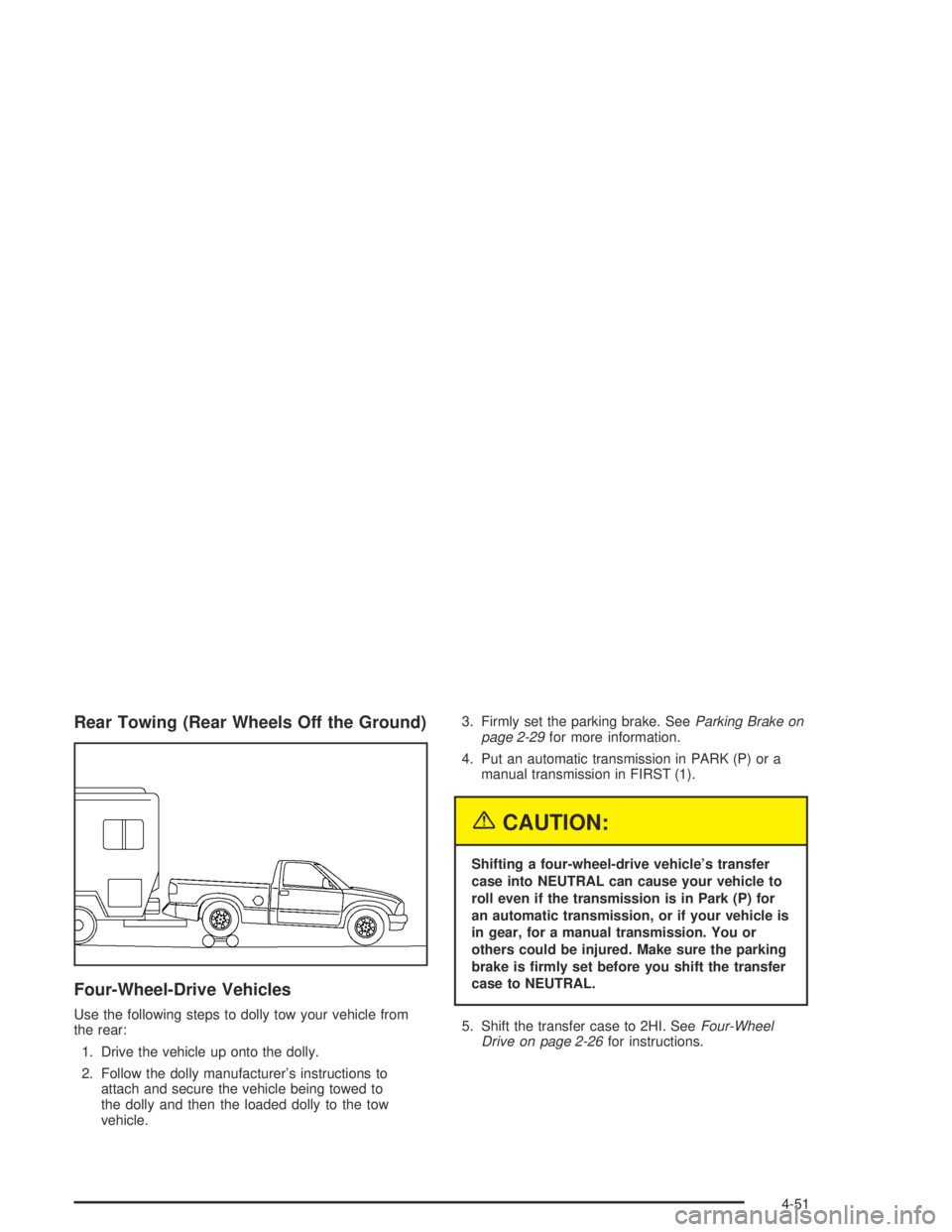
Rear Towing (Rear Wheels Off the Ground)
Four-Wheel-Drive Vehicles
Use the following steps to dolly tow your vehicle from
the rear:
1. Drive the vehicle up onto the dolly.
2. Follow the dolly manufacturer’s instructions to
attach and secure the vehicle being towed to
the dolly and then the loaded dolly to the tow
vehicle.3. Firmly set the parking brake. SeeParking Brake on
page 2-29for more information.
4. Put an automatic transmission in PARK (P) or a
manual transmission in FIRST (1).
{CAUTION:
Shifting a four-wheel-drive vehicle’s transfer
case into NEUTRAL can cause your vehicle to
roll even if the transmission is in Park (P) for
an automatic transmission, or if your vehicle is
in gear, for a manual transmission. You or
others could be injured. Make sure the parking
brake is rmly set before you shift the transfer
case to NEUTRAL.
5. Shift the transfer case to 2HI. SeeFour-Wheel
Drive on page 2-26for instructions.
4-51
Page 249 of 420
Using heavier suspension components to get added
durability might not change your weight ratings. Ask your
dealer to help you load your vehicle the right way.
Notice:Overloading your vehicle may cause
damage. Repairs would not be covered by your
warranty. Do not overload your vehicle.
If you put things inside your vehicle–like suitcases,
tools, packages, or anything else–they will go as fast as
the vehicle goes. If you have to stop or turn quickly,
or if there is a crash, they’ll keep going.
{CAUTION:
Things you put inside your vehicle can strike
and injure people in a sudden stop or turn, or
in a crash.
Put things in the cargo area of your
vehicle. Try to spread the weight evenly.
Never stack heavier things, like suitcases,
inside the vehicle so that some of them
are above the tops of the seats.
CAUTION: (Continued)
CAUTION: (Continued)
Do not leave an unsecured child restraint
in your vehicle.
When you carry something inside the
vehicle, secure it whenever you can.
Do not leave a seat folded down unless
you need to.
There’s also important loading information for off-road
driving in this manual. See“Loading Your Vehicle
for Off-Road Driving”underOff-Road Driving with Your
Four-Wheel-Drive Vehicle on page 4-15.
Payload
This is the maximum load capacity that your vehicle can
carry. Be sure to include the weight of the occupants
as part of your load. If you added any accessories
or equipment after your vehicle left the factory,
remember to subtract the weight of these things from
the payload. Your dealer can help you with this.
Remember not to exceed the Gross Axle Weight rating
(GAWR) of the front or rear axle.
4-57
Page 250 of 420
Two-Tiered Loading
By positioning four 2” X 6” wooden planks across the
width of the pickup box, you can create an upper
load platform. The planks must be inserted in the pickup
box depressions. The length of the planks must allow
for at least a 3/4 inch (2 cm) bearing surface on
each end of the plank.
When using this upper load platform, be sure the load is
securely tied down to prevent it from shifting. The load’s
center of gravity should be positioned in a zone over
the rear axle.
Any load that extends beyond the vehicle’s taillamp
area must be properly marked according to local laws
and regulations.
Remember not to exceed the Gross Axle Weight Rating
(GAWR) of the rear axle.
Add-On Equipment
When you carry removable items, you may need to put
a limit on how many people you carry inside your
vehicle. Be sure to weigh your vehicle before you buy
and install the new equipment.
Notice:Overloading your vehicle may cause
damage. Repairs would not be covered by your
warranty. Do not overload your vehicle.
Remember not to exceed the Gross Axle Weight
Rating (GAWR) of the rear axle.
4-58
Page 251 of 420
Truck-Camper Loading Information
Your vehicle was not designed to carry a slide-in
camper.
Trailer Recommendations
You must subtract your hitch load from the CWR for
your vehicle. Weigh your vehicle with your trailer
attached, so that you won’t go over the GVWR or the
GAWR.
You’ll get the best performance if you spread out the
weight of your load the right way, and if you choose the
correct hitch and trailer brakes.
For more information, seeTowing a Trailer on page 4-60
later in this section.
Pickup Conversion to Chassis Cab
General Motors is aware that some vehicle owners may
consider having the pickup box removed and a
commercial or recreational body installed. However, we
recommend that conversions of this type not be done
to pickups. Owners should be aware that, as
manufactured, there are differences between a chassis
cab and a pickup with the box removed which may
affect vehicle safety. For specic information on
this pickup, contact GM Customer Assistance.
SeeCustomer Assistance Offices on page 7-4.
4-59
Page 261 of 420

Trailer Brakes
If your trailer weighs more than 1,000 lbs. (450 kg)
loaded, then it needs its own brake – and they must be
adequate. Be sure to read and follow the instructions
for the trailer brakes so you’ll be able to install,
adjust and maintain them properly.
Your trailer’s brake system can tap into the vehicle’s
hydraulic brake system only if:
The trailer parts can withstand 3,000 psi
(20 650 kPa) of pressure.
The trailer’s brake system will use less than
0.02 cubic inch (0.3 cc) of uid from your vehicle’s
master cylinder. Otherwise, both braking systems
won’t work well. You could even lose your brakes.
If everything checks out this far, then make the brake
uid tap at the port on the master cylinder that
sends uid to the rear brakes. But don’t use copper
tubing for this. If you do, it will bend and nally break off.
Use steel brake tubing.
Driving with a Trailer
Towing a trailer requires a certain amount of experience.
Before setting out for the open road, you’ll want to get
to know your rig. Acquaint yourself with the feel of
handling and braking with the added weight of the trailer.
And always keep in mind that the vehicle you are
driving is now a good deal longer and not nearly as
responsive as your vehicle is by itself.
Before you start, check all trailer hitch parts and
attachments, safety chains, electrical connector, lamps,
tires and mirror adjustment. If the trailer has electric
brakes, start your vehicle and trailer moving and then
apply the trailer brake controller by hand to be sure
the brakes are working. This lets you check your
electrical connection at the same time.
During your trip, check occasionally to be sure that the
load is secure, and that the lamps and any trailer
brakes are still working.
4-69