Page 105 of 240

Even when the ABS is
disabled, normal
braking is still effective.
(If your BRAKE
warning lamp illuminates with the parking brake
released, have your brake system serviced
immediately.)
Using ABS
When hard braking is required, apply continuous
force on the brake pedal; do not pump the brake
pedal since this will reduce the effectiveness of the
ABS and will increase your vehicle’s stopping
distance. The ABS will be activated immediately,
allowing you to retain full steering control during
hard braking and on slippery surfaces. However, the
ABS does not decrease stopping distance.
Hydraulic brake booster system (Hydroboost)
(if equipped)
The Hydroboost system receives fluid pressure from
the power steering pump to provide power assist
during braking.
For Hydroboost-equipped vehicles operating under
normal conditions, the noise of the fluid flowing
through the booster may be heard whenever the
brake is applied. This condition is normal; vehicle
service is not required.
If braking performance or pedal response becomes
very poor, even when the pedal is strongly
depressed, it may indicate the presence of air in the
hydraulic system or leakage of fluid. Stop the vehicle
safely as soon as possible and seek service
immediately.
P!
BRAKE
2004 Mustang(mus)
Owners Guide (post-2002-fmt)
USA English(fus)
Driving
105
Page 106 of 240

Parking brake
To set the parking
brake (1), pull the
parking brake handle
up as far as possible.
The BRAKE warning
lamp will illuminate and
will remain illuminated
until the parking brake
is released.
To release, press and hold the button (2), pull the
handle up slightly, then push the handle down.
Always set the parking brake fully and make
sure that the gearshift is securely latched in
P (Park) (automatic transmission) or in 1 (First)
(manual transmission).
If the parking brake is fully released, but the
brake warning lamp remains illuminated, the
brakes may not be working properly. See your
dealer or a qualified service technician.
STEERING
To prevent damage to the power steering system:
•Never hold the steering wheel at its furthest
turning points (until it stops) for more than a few
seconds when the engine is running.
•Do not operate the vehicle with a low power
steering pump fluid level (below the MIN mark on
the reservoir).
If the power steering system breaks down (or if the
engine is turned off), you can steer the vehicle
manually, but it takes more effort.
If the steering wanders or pulls, check for:
•an improperly inflated tire
12
P!
BRAKE
2004 Mustang(mus)
Owners Guide (post-2002-fmt)
USA English(fus)
Driving
106
Page 108 of 240

system is off, the indicator will be illuminated. If a
system fault is detected while the traction control
system in on, the indicator lamp on the traction
control switch will be illuminated and your vehicle
should be serviced.
Aggressive driving in any road conditions
can cause you to lose control of your vehicle
increasing the risk of severe personal injury or
property damage. The occurrence of a Traction
Control�event is an indication that at least some
of the tires have exceeded their ability to grip the
road; this may lead to an increased risk of loss of
vehicle control, vehicle rollover, personal injury
and death. If you experience a severe road event,
SLOW DOWN.
TRACTION-LOK AXLE (IF EQUIPPED)
This axle provides added traction on slippery
surfaces, particularly when one wheel is on a poor
traction surface. Under normal conditions, the
Traction-Lok axle functions like a standard rear axle.
Extended use of other than the manufacturer’s
specified size tires on a Traction-Lok rear axle could
result in a permanent reduction in effectiveness.
This loss of effectiveness does not affect normal
driving and should not be noticeable to the driver.
AUTOMATIC TRANSMISSION OPERATION
(IF EQUIPPED)
Brake-shift interlock
This vehicle is equipped with a brake-shift interlock
feature that prevents the gearshift lever from being
moved from P (Park) when the ignition is in the ON
position unless the brake pedal is depressed.
If you cannot move the gearshift lever out of P
(Park) with ignition in the ON position and the
brake pedal depressed:
1. Apply the parking brake, turn ignition key to
LOCK, then remove the key.
2004 Mustang(mus)
Owners Guide (post-2002-fmt)
USA English(fus)
Driving
108
Page 109 of 240
2. Insert the key and turn it to OFF.Apply the
brake pedal and shift to N (Neutral).
When the key is in the ignition and in the
OFF position, the automatic transmission
shift lever can be moved from the P (Park)
position without the brake pedal depressed. To
avoid unwanted vehicle movement, always set the
parking brake.
3. Start the vehicle.
If it is necessary to use the above procedure to
move the gearshift lever, it is possible that a fuse
has blown or the vehicle’s brakelamps are not
operating properly. Refer toFuses and relaysin the
Roadside emergencieschapter.
Do not drive your vehicle until you verify
that the brakelamps are working.
Always set the parking brake fully and make
sure the gearshift is latched in P (Park).
Turn the ignition to the LOCK position and remove
the key whenever you leave your vehicle.
If the parking brake is fully released, but the
brake warning lamp remains illuminated, the
brakes may not be working properly. See your
dealer or a qualified service technician.
Driving with an automatic overdrive
transmission with console gearshift and O/D off
switch
Your transmission is equipped with an adaptive
learning strategy found in the vehicle computer. This
feature is designed to increase durability and
provide consistent shift feel over the life of the
vehicle. A new vehicle or transmission may have firm
and/or soft shifts. This operation is considered
2004 Mustang(mus)
Owners Guide (post-2002-fmt)
USA English(fus)
Driving
109
Page 110 of 240
normal and will not affect function or durability of
the transmission. Over time, the adaptive learning
process will fully update transmission operation.
Additionally, whenever the battery is disconnected
or a new battery installed, the strategy must be
relearned.
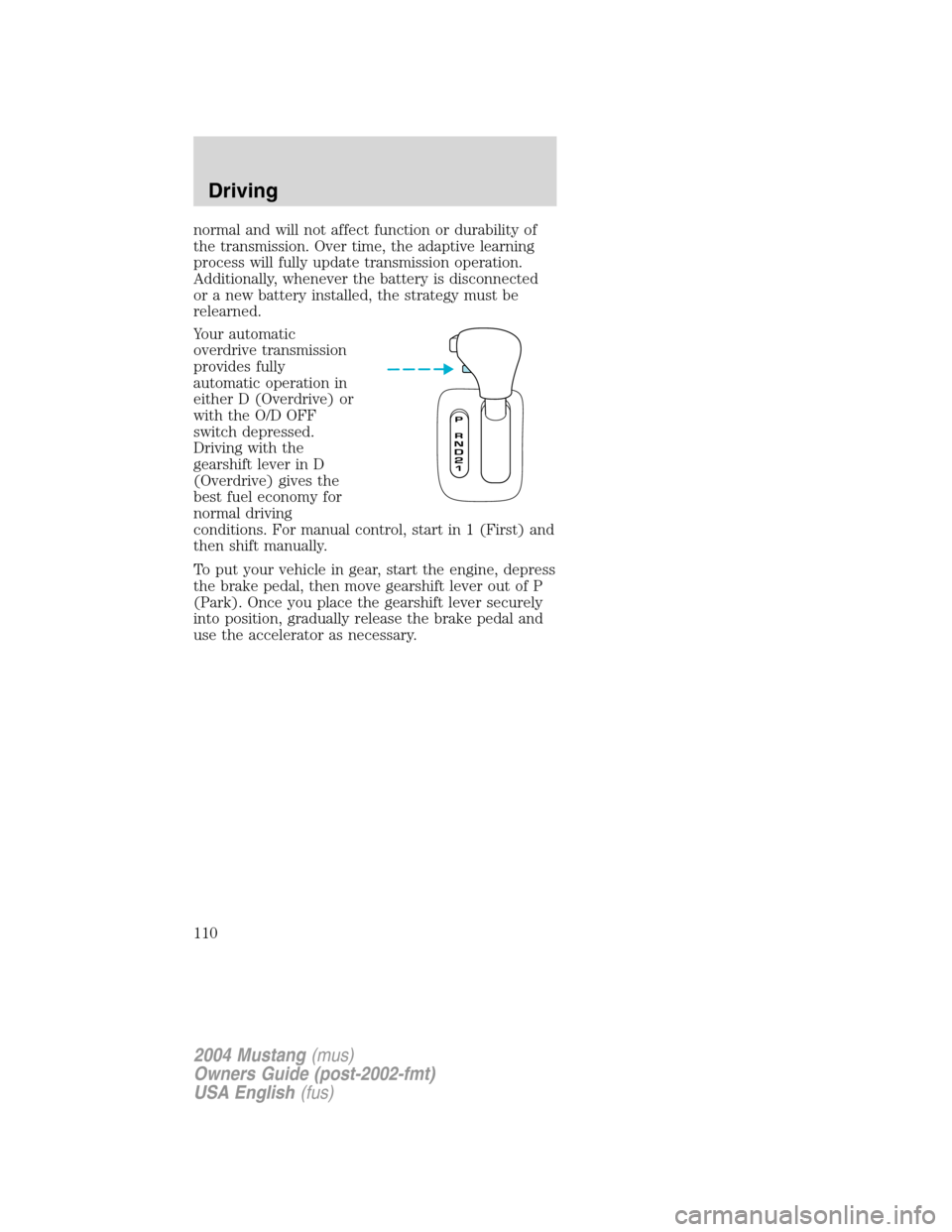
Your automatic
overdrive transmission
provides fully
automatic operation in
either D (Overdrive) or
with the O/D OFF
switch depressed.
Driving with the
gearshift lever in D
(Overdrive) gives the
best fuel economy for
normal driving
conditions. For manual control, start in 1 (First) and
then shift manually.
To put your vehicle in gear, start the engine, depress
the brake pedal, then move gearshift lever out of P
(Park). Once you place the gearshift lever securely
into position, gradually release the brake pedal and
use the accelerator as necessary.
2004 Mustang(mus)
Owners Guide (post-2002-fmt)
USA English(fus)
Driving
110
Page 111 of 240
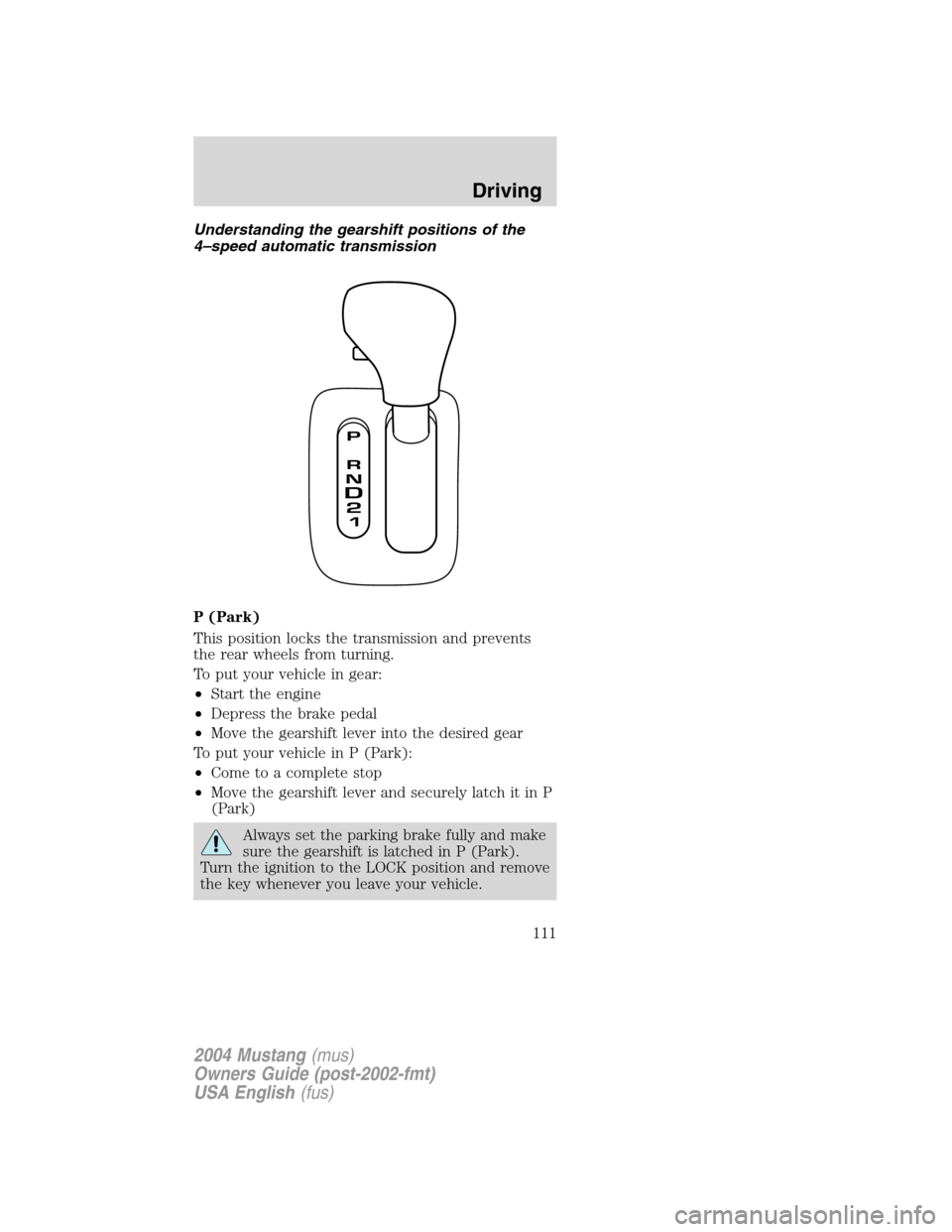
Understanding the gearshift positions of the
4–speed automatic transmission
P (Park)
This position locks the transmission and prevents
the rear wheels from turning.
To put your vehicle in gear:
•Start the engine
•Depress the brake pedal
•Move the gearshift lever into the desired gear
To put your vehicle in P (Park):
•Come to a complete stop
•Move the gearshift lever and securely latch it in P
(Park)
Always set the parking brake fully and make
sure the gearshift is latched in P (Park).
Turn the ignition to the LOCK position and remove
the key whenever you leave your vehicle.
2004 Mustang(mus)
Owners Guide (post-2002-fmt)
USA English(fus)
Driving
111
Page 112 of 240
R (Reverse)
With the gearshift lever in R (Reverse), the vehicle
will move backward. Always come to a complete
stop before shifting into and out of R (Reverse).
N (Neutral)
With the gearshift lever in N (Neutral), the vehicle
can be started and is free to roll. Hold the brake
pedal down while in this position.
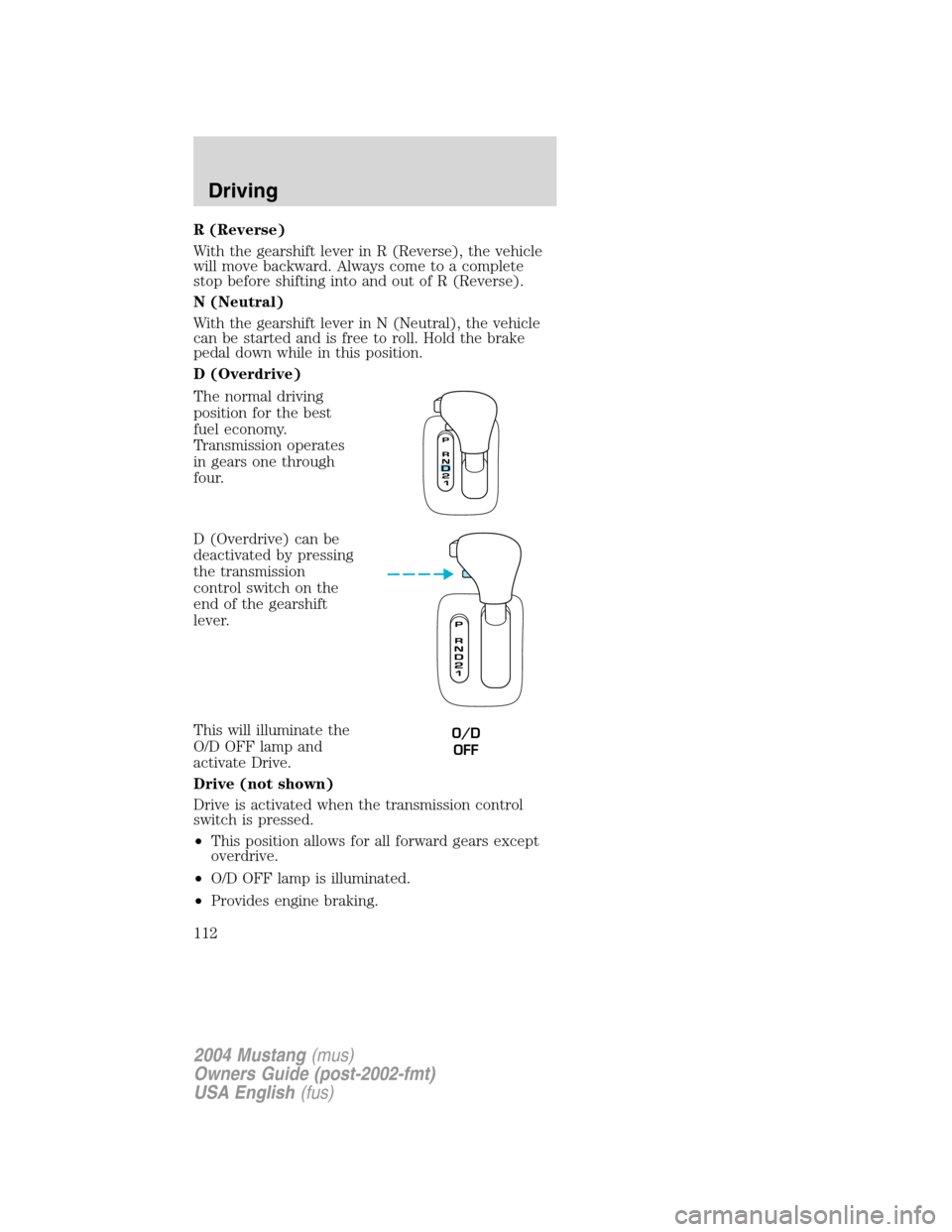
D (Overdrive)
The normal driving
position for the best
fuel economy.
Transmission operates
in gears one through
four.
D (Overdrive) can be
deactivated by pressing
the transmission
control switch on the
end of the gearshift
lever.
This will illuminate the
O/D OFF lamp and
activate Drive.
Drive (not shown)
Drive is activated when the transmission control
switch is pressed.
•This position allows for all forward gears except
overdrive.
•O/D OFF lamp is illuminated.
•Provides engine braking.
O/D
OFF
2004 Mustang(mus)
Owners Guide (post-2002-fmt)
USA English(fus)
Driving
112
Page 114 of 240
Do not rock the vehicle for more than a minute
or damage to the transmission and tires may
occur, or the engine may overheat.
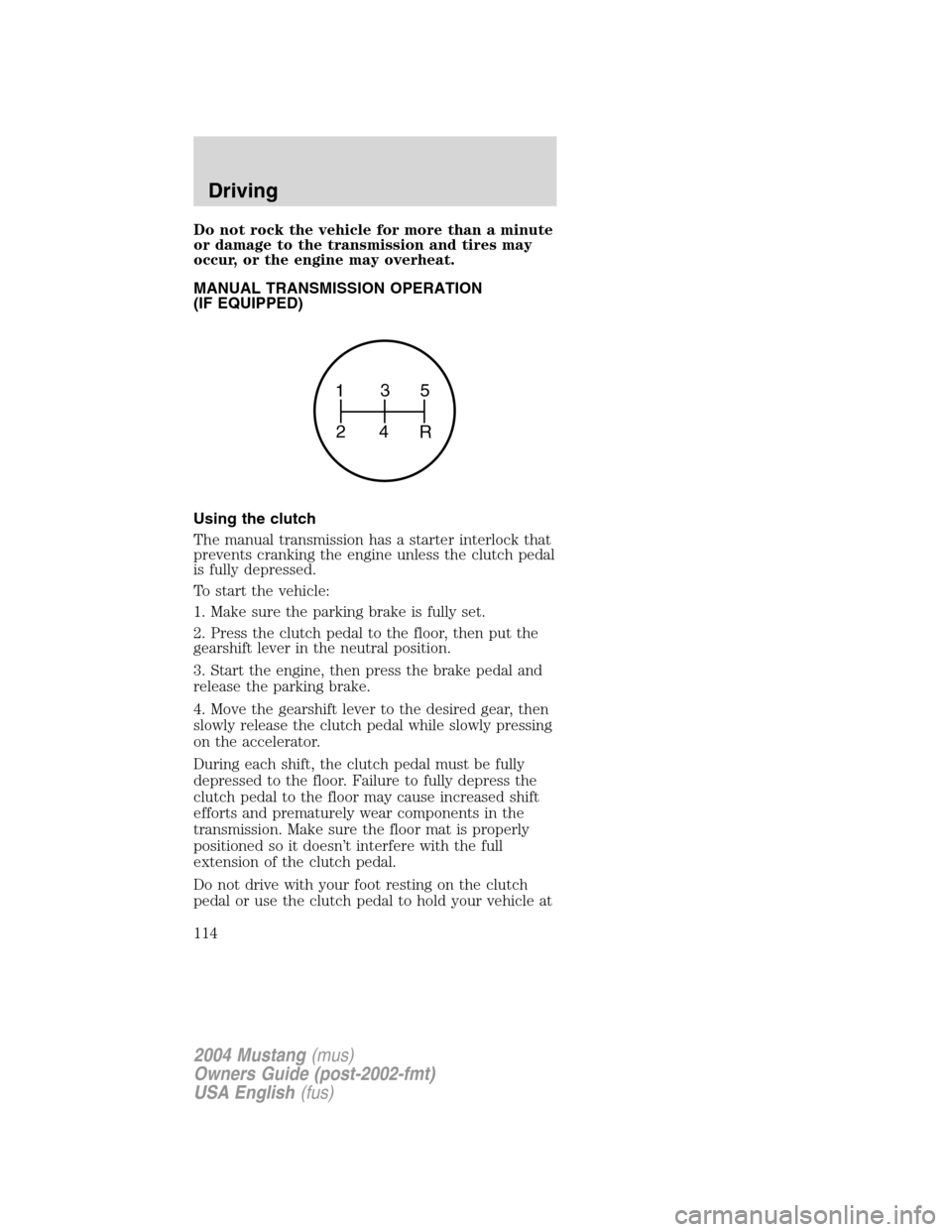
MANUAL TRANSMISSION OPERATION
(IF EQUIPPED)
Using the clutch
The manual transmission has a starter interlock that
prevents cranking the engine unless the clutch pedal
is fully depressed.
To start the vehicle:
1. Make sure the parking brake is fully set.
2. Press the clutch pedal to the floor, then put the
gearshift lever in the neutral position.
3. Start the engine, then press the brake pedal and
release the parking brake.
4. Move the gearshift lever to the desired gear, then
slowly release the clutch pedal while slowly pressing
on the accelerator.
During each shift, the clutch pedal must be fully
depressed to the floor. Failure to fully depress the
clutch pedal to the floor may cause increased shift
efforts and prematurely wear components in the
transmission. Make sure the floor mat is properly
positioned so it doesn’t interfere with the full
extension of the clutch pedal.
Do not drive with your foot resting on the clutch
pedal or use the clutch pedal to hold your vehicle at
135
24
R
2004 Mustang(mus)
Owners Guide (post-2002-fmt)
USA English(fus)
Driving
114