2004 FORD MUSTANG brake
[x] Cancel search: brakePage 167 of 240
WINDSHIELD WASHER FLUID
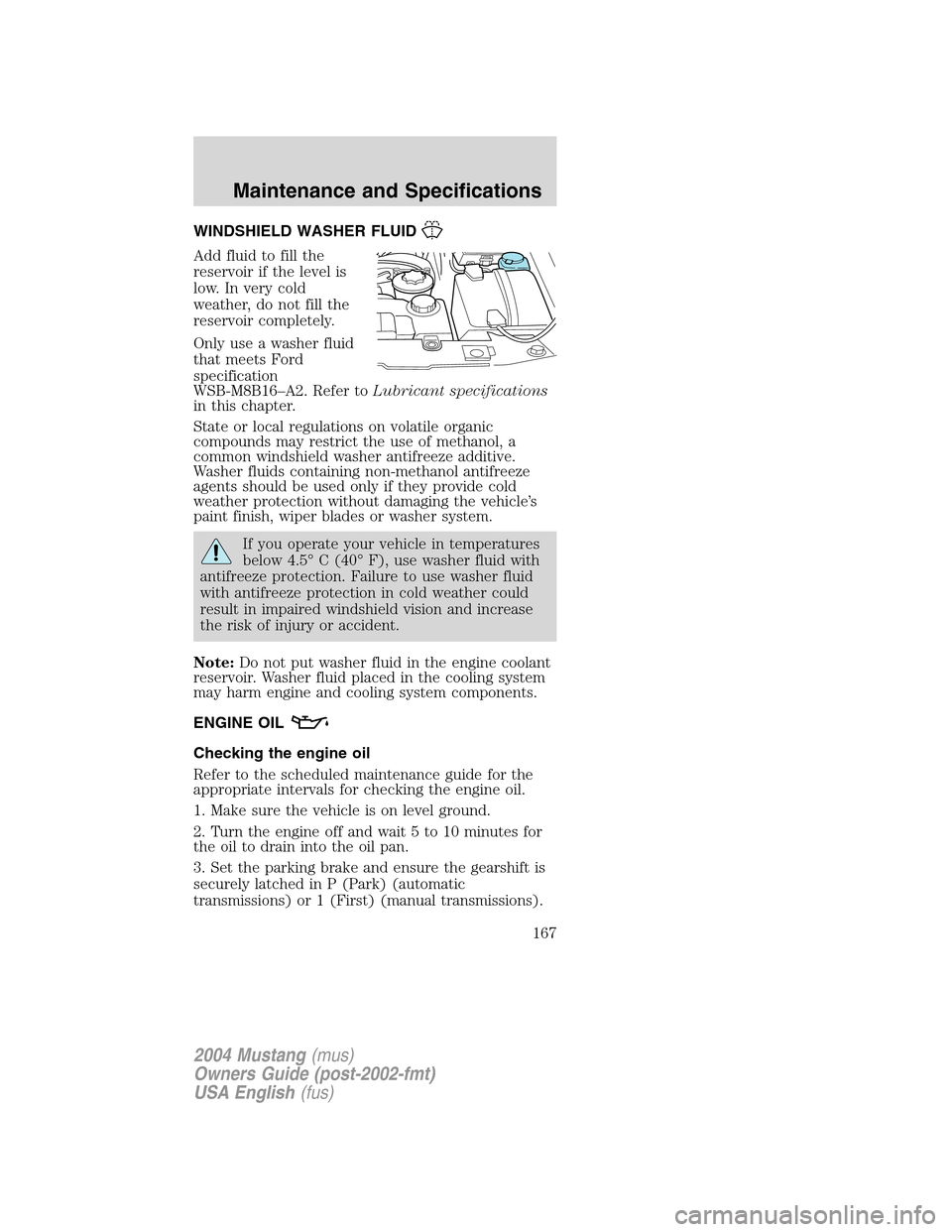
Add fluid to fill the
reservoir if the level is
low. In very cold
weather, do not fill the
reservoir completely.
Only use a washer fluid
that meets Ford
specification
WSB-M8B16–A2. Refer toLubricant specifications
in this chapter.
State or local regulations on volatile organic
compounds may restrict the use of methanol, a
common windshield washer antifreeze additive.
Washer fluids containing non-methanol antifreeze
agents should be used only if they provide cold
weather protection without damaging the vehicle’s
paint finish, wiper blades or washer system.
If you operate your vehicle in temperatures
below 4.5°C (40°F), use washer fluid with
antifreeze protection. Failure to use washer fluid
with antifreeze protection in cold weather could
result in impaired windshield vision and increase
the risk of injury or accident.
Note:Do not put washer fluid in the engine coolant
reservoir. Washer fluid placed in the cooling system
may harm engine and cooling system components.
ENGINE OIL
Checking the engine oil
Refer to the scheduled maintenance guide for the
appropriate intervals for checking the engine oil.
1. Make sure the vehicle is on level ground.
2. Turn the engine off and wait 5 to 10 minutes for
the oil to drain into the oil pan.
3. Set the parking brake and ensure the gearshift is
securely latched in P (Park) (automatic
transmissions) or 1 (First) (manual transmissions).
2004 Mustang(mus)
Owners Guide (post-2002-fmt)
USA English(fus)
Maintenance and Specifications
167
Page 173 of 240
battery is disconnected or a new battery is installed,
the engine must relearn its idle and fuel trim
strategy for optimum driveability and performance.
To begin this process:
1. With the vehicle at a complete stop, set the
parking brake.
2. Put the gearshift in P (Park) (automatic
transmission) or the neutral position (manual
transmission), turn off all accessories and start the
engine.
3. Run the engine until it reaches normal operating
temperature.
4. Allow the engine to idle for at least one minute.
5. Turn the A/C on and allow the engine to idle for
at least one minute.
6. Drive the vehicle to complete the relearning
process.
•The vehicle may need to be driven 16 km
(10 miles) or more to relearn the idle and fuel
trim strategy.
•If you do not allow the engine to relearn its
idle trim, the idle quality of your vehicle may
be adversely affected until the idle trim is
eventually relearned.
When the battery is disconnected or a new battery
installed, the transmission must relearn its adaptive
strategy. As a result of this, the transmission may
shift firmly. This operation is considered normal and
will not affect function or durability of the
transmission. Over time the adaptive learning
process will fully update transmission operation to
its optimum shift feel.
If the battery has been disconnected or a new
battery has been installed, the clock and the preset
radio stations must be reset once the battery is
reconnected.
2004 Mustang(mus)
Owners Guide (post-2002-fmt)
USA English(fus)
Maintenance and Specifications
173
Page 190 of 240
![FORD MUSTANG 2004 4.G Owners Manual •Sudden or hard accelerations may reduce fuel
economy.
•Slow down gradually.
•Driving at reasonable speeds (traveling at 88 km/h
[55 mph] uses 15% less fuel than traveling at
105 km/h [65 mph]).](/manual-img/11/5213/w960_5213-189.png "FORD MUSTANG 2004 4.G Owners Manual •Sudden or hard accelerations may reduce fuel
economy.
•Slow down gradually.
•Driving at reasonable speeds (traveling at 88 km/h
[55 mph] uses 15% less fuel than traveling at
105 km/h [65 mph]).")
•Sudden or hard accelerations may reduce fuel
economy.
•Slow down gradually.
•Driving at reasonable speeds (traveling at 88 km/h
[55 mph] uses 15% less fuel than traveling at
105 km/h [65 mph]).
•Revving the engine before turning it off may
reduce fuel economy.
•Using the air conditioner or defroster may reduce
fuel economy.
•You may want to turn off the speed control in
hilly terrain if unnecessary shifting between third
and fourth gear occurs. Unnecessary shifting of
this type could result in reduced fuel economy.
•Warming up a vehicle on cold mornings is not
required and may reduce fuel economy.
•Resting your foot on the brake pedal while driving
may reduce fuel economy.
•Combine errands and minimize stop-and-go
driving.
Maintenance
•Keep tires properly inflated and use only
recommended size.
•Operating a vehicle with the wheels out of
alignment will reduce fuel economy.
•Use recommended engine oil. Refer toLubricant
specificationsin this chapter.
•Perform all regularly scheduled maintenance
items. Follow the recommended maintenance
schedule and owner maintenance checks found in
your vehicle scheduled maintenance guide.
Conditions
•Heavily loading a vehicle or towing a trailer may
reduce fuel economy at any speed.
•Carrying unnecessary weight may reduce fuel
economy (approximately 0.4 km/L [1 mpg] is lost
for every 180 kg [400 lb] of weight carried).
2004 Mustang(mus)
Owners Guide (post-2002-fmt)
USA English(fus)
Maintenance and Specifications
190
Page 196 of 240
BRAKE FLUID RESERVOIR
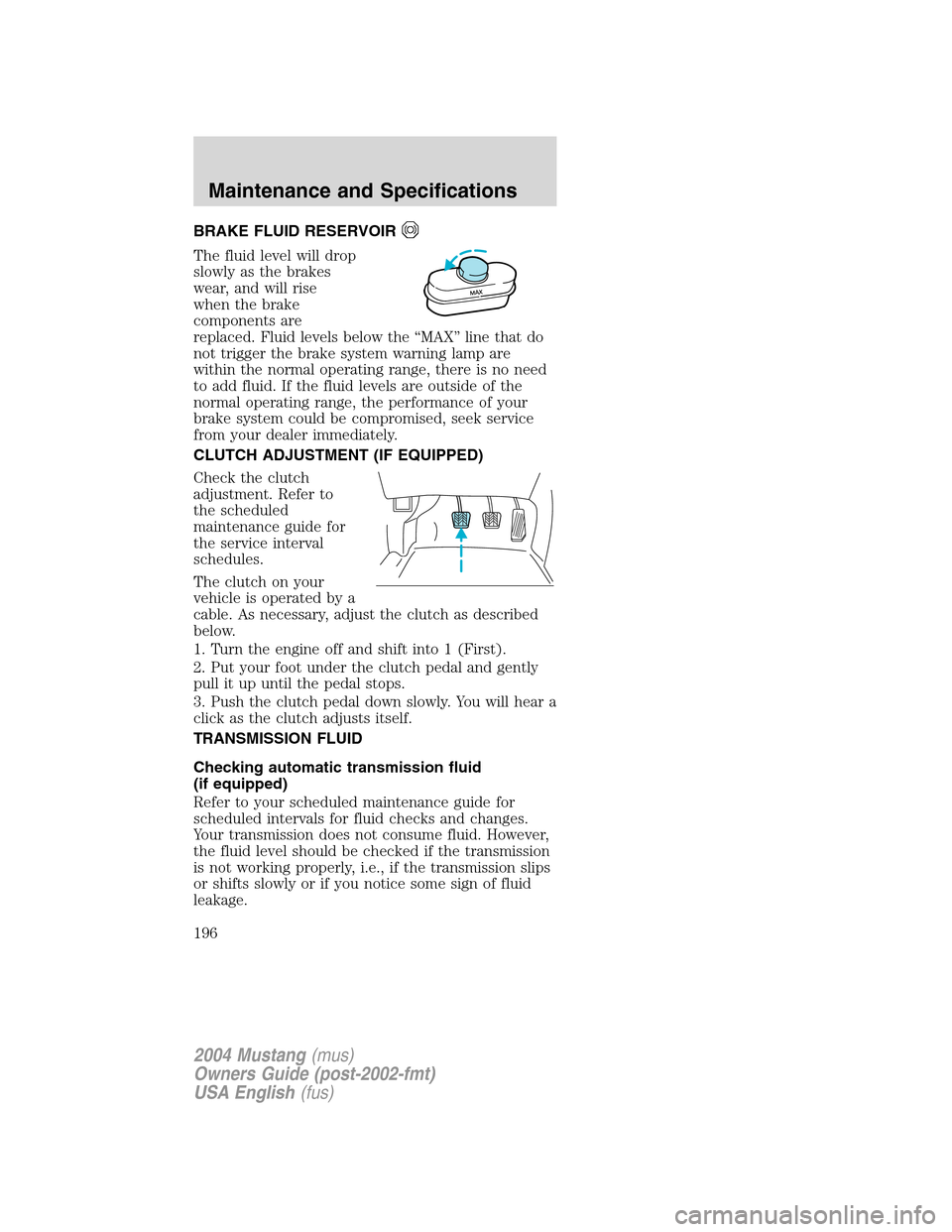
The fluid level will drop
slowly as the brakes
wear, and will rise
when the brake
components are
replaced. Fluid levels below the“MAX”line that do
not trigger the brake system warning lamp are
within the normal operating range, there is no need
to add fluid. If the fluid levels are outside of the
normal operating range, the performance of your
brake system could be compromised, seek service
from your dealer immediately.
CLUTCH ADJUSTMENT (IF EQUIPPED)
Check the clutch
adjustment. Refer to
the scheduled
maintenance guide for
the service interval
schedules.
The clutch on your
vehicle is operated by a
cable. As necessary, adjust the clutch as described
below.
1. Turn the engine off and shift into 1 (First).
2. Put your foot under the clutch pedal and gently
pull it up until the pedal stops.
3. Push the clutch pedal down slowly. You will hear a
click as the clutch adjusts itself.
TRANSMISSION FLUID
Checking automatic transmission fluid
(if equipped)
Refer to your scheduled maintenance guide for
scheduled intervals for fluid checks and changes.
Your transmission does not consume fluid. However,
the fluid level should be checked if the transmission
is not working properly, i.e., if the transmission slips
or shifts slowly or if you notice some sign of fluid
leakage.
M
A
X
2004 Mustang(mus)
Owners Guide (post-2002-fmt)
USA English(fus)
Maintenance and Specifications
196
Page 197 of 240
![FORD MUSTANG 2004 4.G Owners Manual Automatic transmission fluid expands when warmed.
To obtain an accurate fluid check, drive the vehicle
until it is at normal operating temperature
(approximately 30 km [20 miles]). If your vehicle has](/manual-img/11/5213/w960_5213-196.png "FORD MUSTANG 2004 4.G Owners Manual Automatic transmission fluid expands when warmed.
To obtain an accurate fluid check, drive the vehicle
until it is at normal operating temperature
(approximately 30 km [20 miles]). If your vehicle has")
Automatic transmission fluid expands when warmed.
To obtain an accurate fluid check, drive the vehicle
until it is at normal operating temperature
(approximately 30 km [20 miles]). If your vehicle has
been operated for an extended period at high
speeds, in city traffic during hot weather or pulling a
trailer, the vehicle should be turned off for about 30
minutes to allow fluid to cool before checking.
1. Drive the vehicle 30 km (20 miles) or until it
reaches normal operating temperature.
2. Park the vehicle on a level surface and engage the
parking brake.
3. With the parking brake engaged and your foot on
the brake pedal, start the engine and move the
gearshift lever through all of the gear ranges. Allow
sufficient time for each gear to engage.
4. Latch the gearshift lever in P (Park) and leave the
engine running.
5. Remove the dipstick, wiping it clean with a clean,
dry lint free rag. If necessary, refer toIdentifying
components in the engine compartmentin this
chapter for the location of the dipstick.
6. Install the dipstick making sure it is fully seated in
the filler tube.
7. Remove the dipstick and inspect the fluid level.
The fluid should be in the designated area for
normal operating temperature or ambient
temperature.
Low fluid level
Do not drive the
vehicle if the fluid level
is at the bottom of the
dipstick and the ambient temperature is above 10°C
(50°F).
Correct fluid level
The transmission fluid should be checked at normal
operating temperature 66°C-77°C (150°F-170°F) on
a level surface. The normal operating temperature
can be reached after approximately 30 km (20 miles)
of
driving.
2004 Mustang(mus)
Owners Guide (post-2002-fmt)
USA English(fus)
Maintenance and Specifications
197
Page 214 of 240
SNOW TIRES AND CHAINS
Driving too fast for conditions creates the
possibility of loss of vehicle control. Driving
at very high speeds for extended periods of time
may result in damage to vehicle components.
Snow tires must be the same size and grade
as the tires you currently have on your
vehicle.
The tires on your vehicle have all weather treads to
provide traction in rain and snow. However, in some
climates, you may need to use snow tires and
chains. Use chains on the tires only in an emergency
or if the law requires them.
Follow these guidelines when using snow tires and
chains:
•Chains may damage aluminum wheels.
•Use only Cable Type chains with size P225/55R16
or 245/45ZR17 tires. Use of SAE Class S chains
may damage your vehicle.
•Install chains securely, verifying that the chains do
not touch any wiring, brake lines or fuel lines.
•Drive cautiously. If you hear the chains rub or
bang against your vehicle, stop and re-tighten the
chains. If this does not work, remove the chains
to prevent damage to your vehicle.
•If possible, avoid fully loading your vehicle.
•Remove the tire chains when they are no longer
needed. Do not use tire chains on dry roads.
•The suspension insulation and bumpers will help
prevent vehicle damage. Do not remove these
components from your vehicle when using snow
tires and chains.
2004 Mustang(mus)
Owners Guide (post-2002-fmt)
USA English(fus)
Maintenance and Specifications
214
Page 215 of 240
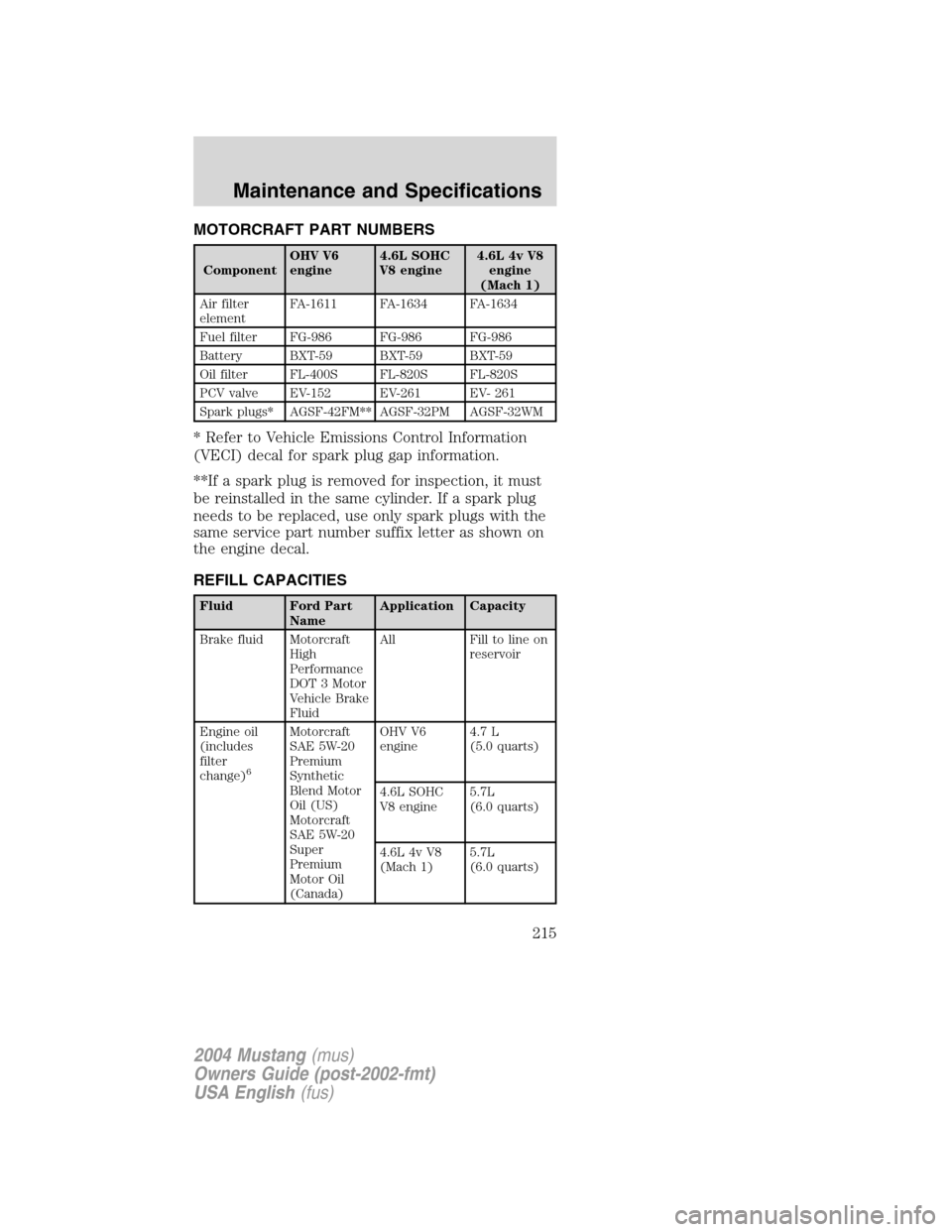
MOTORCRAFT PART NUMBERS
ComponentOHV V6
engine4.6L SOHC
V8 engine4.6L 4v V8
engine
(Mach 1)
Air filter
elementFA-1611 FA-1634 FA-1634
Fuel filter FG-986 FG-986 FG-986
Battery BXT-59 BXT-59 BXT-59
Oil filter FL-400S FL-820S FL-820S
PCV valve EV-152 EV-261 EV- 261
Spark plugs* AGSF-42FM** AGSF-32PM AGSF-32WM
* Refer to Vehicle Emissions Control Information
(VECI) decal for spark plug gap information.
**If a spark plug is removed for inspection, it must
be reinstalled in the same cylinder. If a spark plug
needs to be replaced, use only spark plugs with the
same service part number suffix letter as shown on
the engine decal.
REFILL CAPACITIES
Fluid Ford Part
NameApplication Capacity
Brake fluid Motorcraft
High
Performance
DOT 3 Motor
Vehicle Brake
FluidAll Fill to line on
reservoir
Engine oil
(includes
filter
change)
6
Motorcraft
SAE 5W-20
Premium
Synthetic
Blend Motor
Oil (US)
Motorcraft
SAE 5W-20
Super
Premium
Motor Oil
(Canada)OHV V6
engine4.7 L
(5.0 quarts)
4.6L SOHC
V8 engine5.7L
(6.0 quarts)
4.6L 4v V8
(Mach 1)5.7L
(6.0 quarts)
2004 Mustang(mus)
Owners Guide (post-2002-fmt)
USA English(fus)
Maintenance and Specifications
215
Page 218 of 240
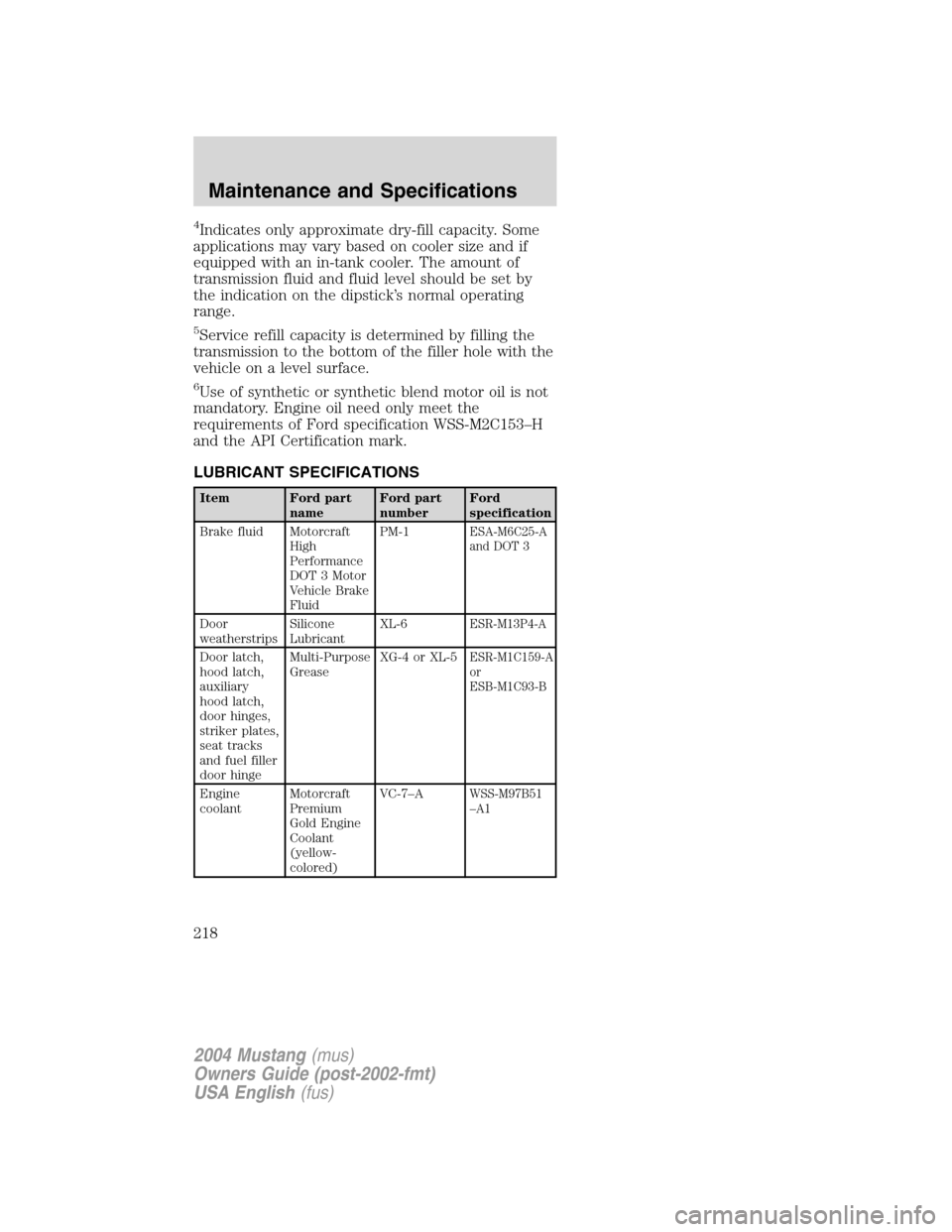
4Indicates only approximate dry-fill capacity. Some
applications may vary based on cooler size and if
equipped with an in-tank cooler. The amount of
transmission fluid and fluid level should be set by
the indication on the dipstick’s normal operating
range.
5Service refill capacity is determined by filling the
transmission to the bottom of the filler hole with the
vehicle on a level surface.
6Use of synthetic or synthetic blend motor oil is not
mandatory. Engine oil need only meet the
requirements of Ford specification WSS-M2C153–H
and the API Certification mark.
LUBRICANT SPECIFICATIONS
Item Ford part
nameFord part
numberFord
specification
Brake fluid Motorcraft
High
Performance
DOT 3 Motor
Vehicle Brake
FluidPM-1
ESA-M6C25-A
and DOT 3
Door
weatherstripsSilicone
LubricantXL-6ESR-M13P4-A
Door latch,
hood latch,
auxiliary
hood latch,
door hinges,
striker plates,
seat tracks
and fuel filler
door hingeMulti-Purpose
GreaseXG-4 or XL-5ESR-M1C159-A
or
ESB-M1C93-B
Engine
coolantMotorcraft
Premium
Gold Engine
Coolant
(yellow-
colored)VC-7–AWSS-M97B51
–A1
2004 Mustang(mus)
Owners Guide (post-2002-fmt)
USA English(fus)
Maintenance and Specifications
218