Page 163 of 240
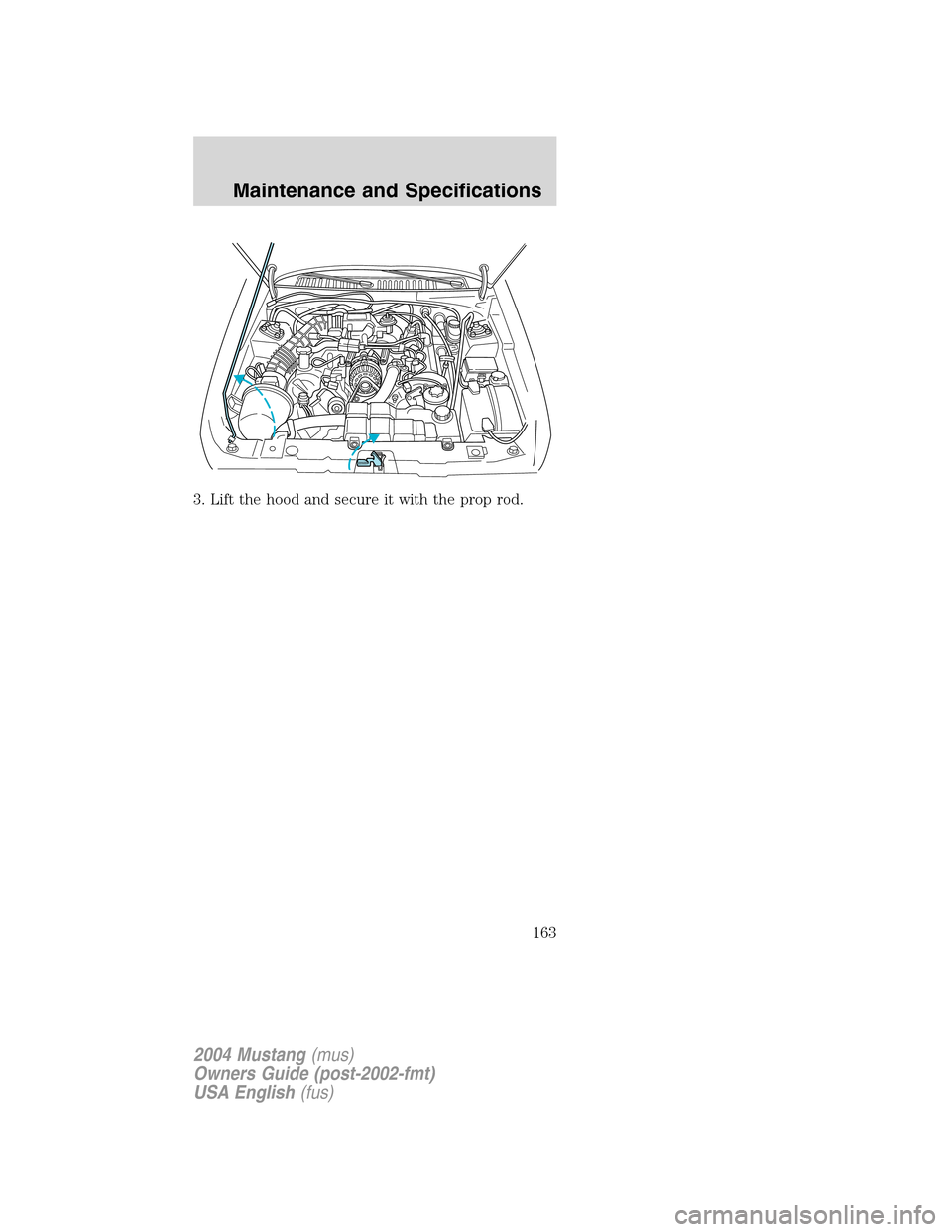
3. Lift the hood and secure it with the prop rod.
2004 Mustang(mus)
Owners Guide (post-2002-fmt)
USA English(fus)
Maintenance and Specifications
163
Page 167 of 240
WINDSHIELD WASHER FLUID
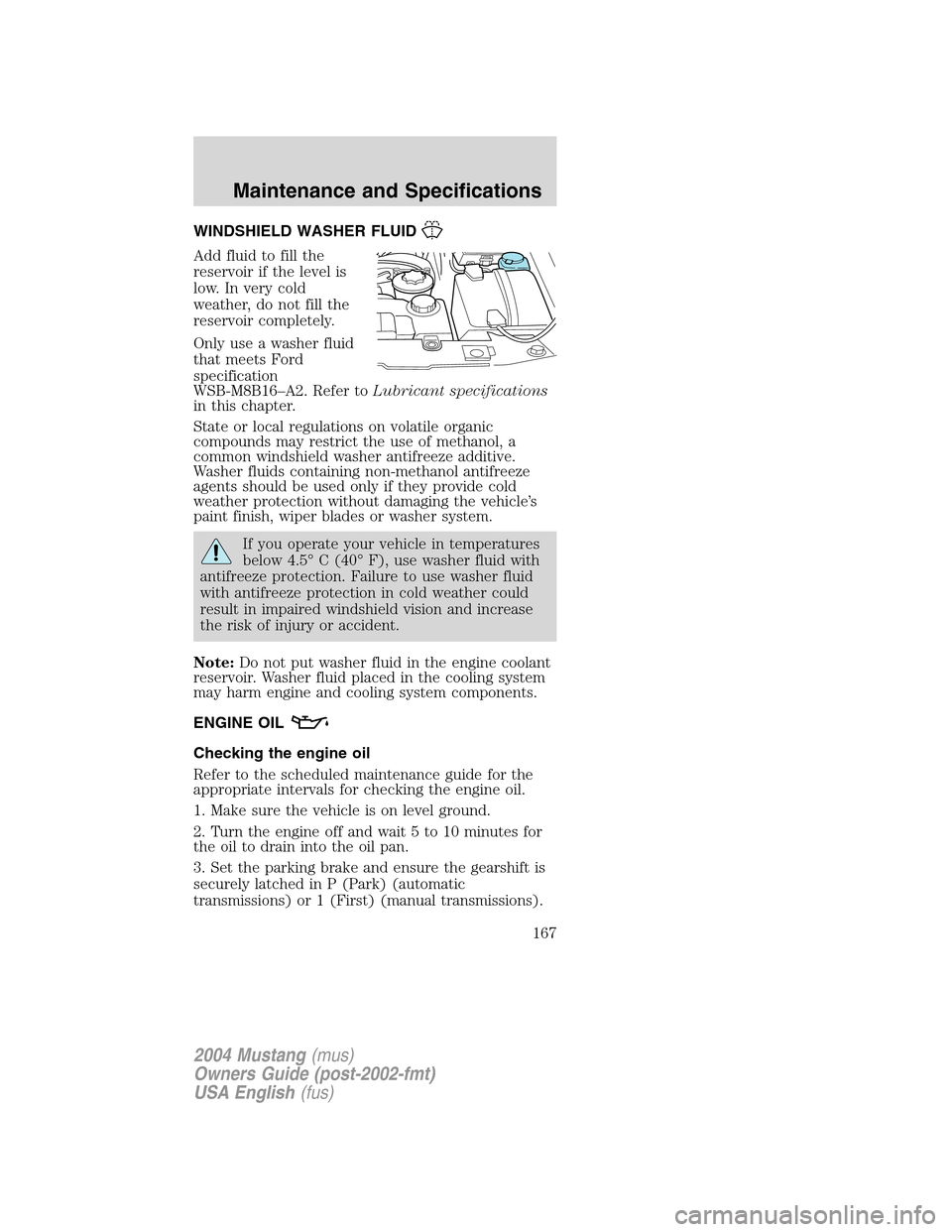
Add fluid to fill the
reservoir if the level is
low. In very cold
weather, do not fill the
reservoir completely.
Only use a washer fluid
that meets Ford
specification
WSB-M8B16–A2. Refer toLubricant specifications
in this chapter.
State or local regulations on volatile organic
compounds may restrict the use of methanol, a
common windshield washer antifreeze additive.
Washer fluids containing non-methanol antifreeze
agents should be used only if they provide cold
weather protection without damaging the vehicle’s
paint finish, wiper blades or washer system.
If you operate your vehicle in temperatures
below 4.5°C (40°F), use washer fluid with
antifreeze protection. Failure to use washer fluid
with antifreeze protection in cold weather could
result in impaired windshield vision and increase
the risk of injury or accident.
Note:Do not put washer fluid in the engine coolant
reservoir. Washer fluid placed in the cooling system
may harm engine and cooling system components.
ENGINE OIL
Checking the engine oil
Refer to the scheduled maintenance guide for the
appropriate intervals for checking the engine oil.
1. Make sure the vehicle is on level ground.
2. Turn the engine off and wait 5 to 10 minutes for
the oil to drain into the oil pan.
3. Set the parking brake and ensure the gearshift is
securely latched in P (Park) (automatic
transmissions) or 1 (First) (manual transmissions).
2004 Mustang(mus)
Owners Guide (post-2002-fmt)
USA English(fus)
Maintenance and Specifications
167
Page 193 of 240
On board diagnostics (OBD-II)
Your vehicle is equipped with a computer that
monitors the engine’s emission control system. This
system is commonly known as the On Board
Diagnostics System (OBD-II). This OBD-II system
protects the environment by ensuring that your
vehicle continues to meet government emission
standards. The OBD-II system also assists the
service technician in properly servicing your vehicle.
When theCheck Engine/Service Engine Soonlight
illuminates, the OBD-II system has detected a
malfunction. Temporary malfunctions may cause
yourCheck Engine/Service Engine Soonlight to
illuminate. Examples are:
1. The vehicle has run out of fuel. (The engine may
misfire or run poorly.)
2. Poor fuel quality or water in the fuel.
3. The fuel cap may not have been securely
tightened.
These temporary malfunctions can be corrected by
filling the fuel tank with good quality fuel and/or
properly tightening the fuel cap. After three driving
cycles without these or any other temporary
malfunctions present, theCheck Engine/Service
Engine Soonlight should turn off. (A driving cycle
consists of a cold engine startup followed by mixed
city/highway driving.) No additional vehicle service is
required.
If theCheck Engine/Service Engine Soonlight
remains on, have your vehicle serviced at the first
available opportunity.
Readiness for Inspection/Maintenance (I/M)
testing
In some localities, it may be a legal requirement to
pass an I/M test of the on-board diagnostics system.
If your“Check Engine/Service Engine Soon”light is
on, refer to the description in theWarning lights
and chimessection of theInstrument cluster
chapter. Your vehicle may not pass the I/M test with
the“Check Engine/Service Engine Soon”light on.
2004 Mustang(mus)
Owners Guide (post-2002-fmt)
USA English(fus)
Maintenance and Specifications
193
Page 200 of 240
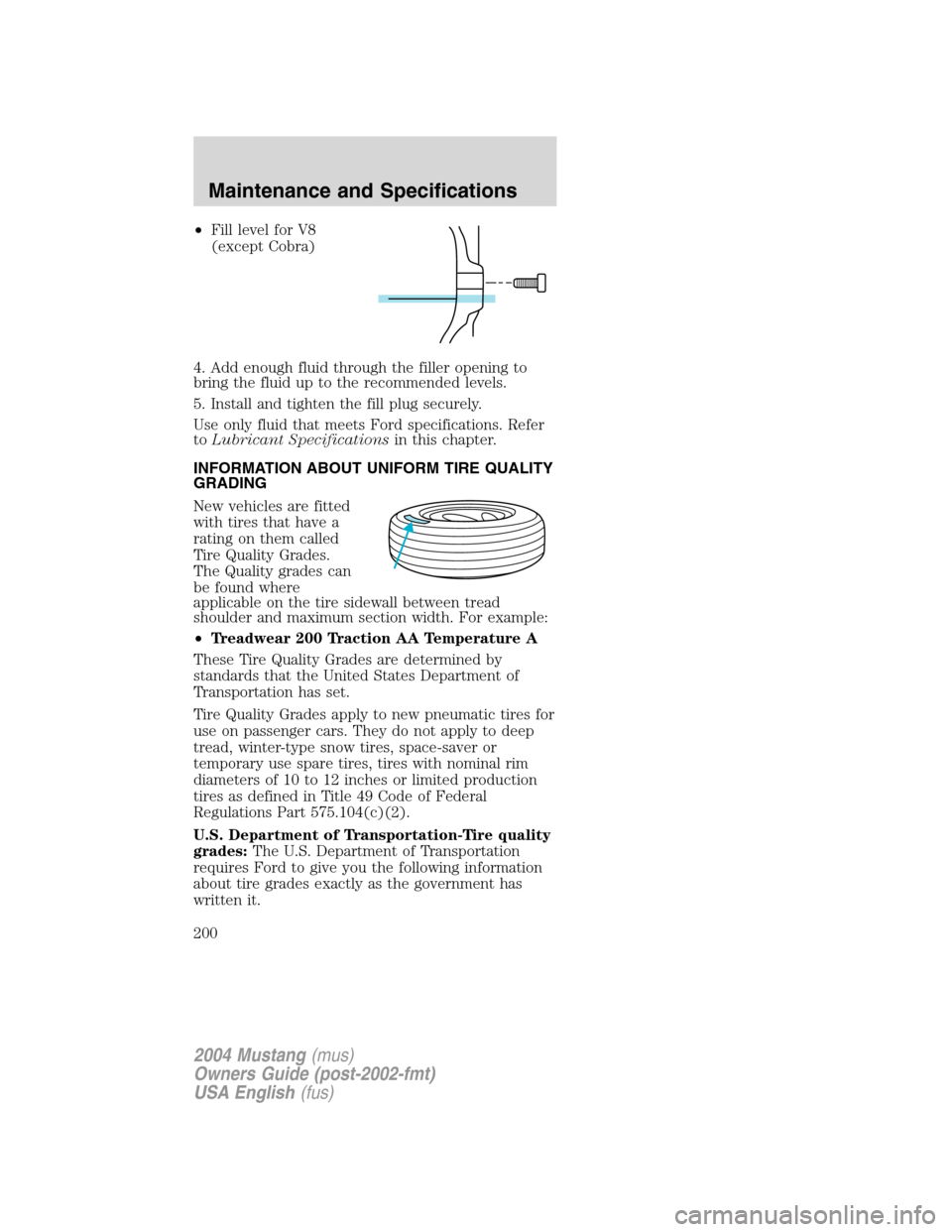
•Fill level for V8
(except Cobra)
4. Add enough fluid through the filler opening to
bring the fluid up to the recommended levels.
5. Install and tighten the fill plug securely.
Use only fluid that meets Ford specifications. Refer
toLubricant Specificationsin this chapter.
INFORMATION ABOUT UNIFORM TIRE QUALITY
GRADING
New vehicles are fitted
with tires that have a
rating on them called
Tire Quality Grades.
The Quality grades can
be found where
applicable on the tire sidewall between tread
shoulder and maximum section width. For example:
•Treadwear 200 Traction AA Temperature A
These Tire Quality Grades are determined by
standards that the United States Department of
Transportation has set.
Tire Quality Grades apply to new pneumatic tires for
use on passenger cars. They do not apply to deep
tread, winter-type snow tires, space-saver or
temporary use spare tires, tires with nominal rim
diameters of 10 to 12 inches or limited production
tires as defined in Title 49 Code of Federal
Regulations Part 575.104(c)(2).
U.S. Department of Transportation-Tire quality
grades:The U.S. Department of Transportation
requires Ford to give you the following information
about tire grades exactly as the government has
written it.
2004 Mustang(mus)
Owners Guide (post-2002-fmt)
USA English(fus)
Maintenance and Specifications
200
Page 214 of 240
SNOW TIRES AND CHAINS
Driving too fast for conditions creates the
possibility of loss of vehicle control. Driving
at very high speeds for extended periods of time
may result in damage to vehicle components.
Snow tires must be the same size and grade
as the tires you currently have on your
vehicle.
The tires on your vehicle have all weather treads to
provide traction in rain and snow. However, in some
climates, you may need to use snow tires and
chains. Use chains on the tires only in an emergency
or if the law requires them.
Follow these guidelines when using snow tires and
chains:
•Chains may damage aluminum wheels.
•Use only Cable Type chains with size P225/55R16
or 245/45ZR17 tires. Use of SAE Class S chains
may damage your vehicle.
•Install chains securely, verifying that the chains do
not touch any wiring, brake lines or fuel lines.
•Drive cautiously. If you hear the chains rub or
bang against your vehicle, stop and re-tighten the
chains. If this does not work, remove the chains
to prevent damage to your vehicle.
•If possible, avoid fully loading your vehicle.
•Remove the tire chains when they are no longer
needed. Do not use tire chains on dry roads.
•The suspension insulation and bumpers will help
prevent vehicle damage. Do not remove these
components from your vehicle when using snow
tires and chains.
2004 Mustang(mus)
Owners Guide (post-2002-fmt)
USA English(fus)
Maintenance and Specifications
214
Page 226 of 240
Grille inserts
Headlamps, fog lights and Daytime Running Lamps
(DRLS)
Splash guards
Wheels
Interior style
Cell phone holders
Electrochromatic compass/temperature interior
mirrors
Floor mats
Interior trim kits
Leather wrapped steering wheels
Scuff plates
Speed control
Lifestyle
Bike racks
Cargo organization and management
Engine block heaters and blankets
Peace of mind
Airbag anti-theft locks
First aid and safety kits
Full vehicle covers
Locking gas cap
Navigation systems
Remote start
Vehicle security systems
For maximum vehicle performance, keep the
following information in mind when adding
accessories or equipment to your vehicle:
•When adding accessories, equipment, passengers
and luggage to your vehicle, do not exceed the
total weight capacity of the vehicle or of the front
2004 Mustang(mus)
Owners Guide (post-2002-fmt)
USA English(fus)
Accessories
226