Page 180 of 296
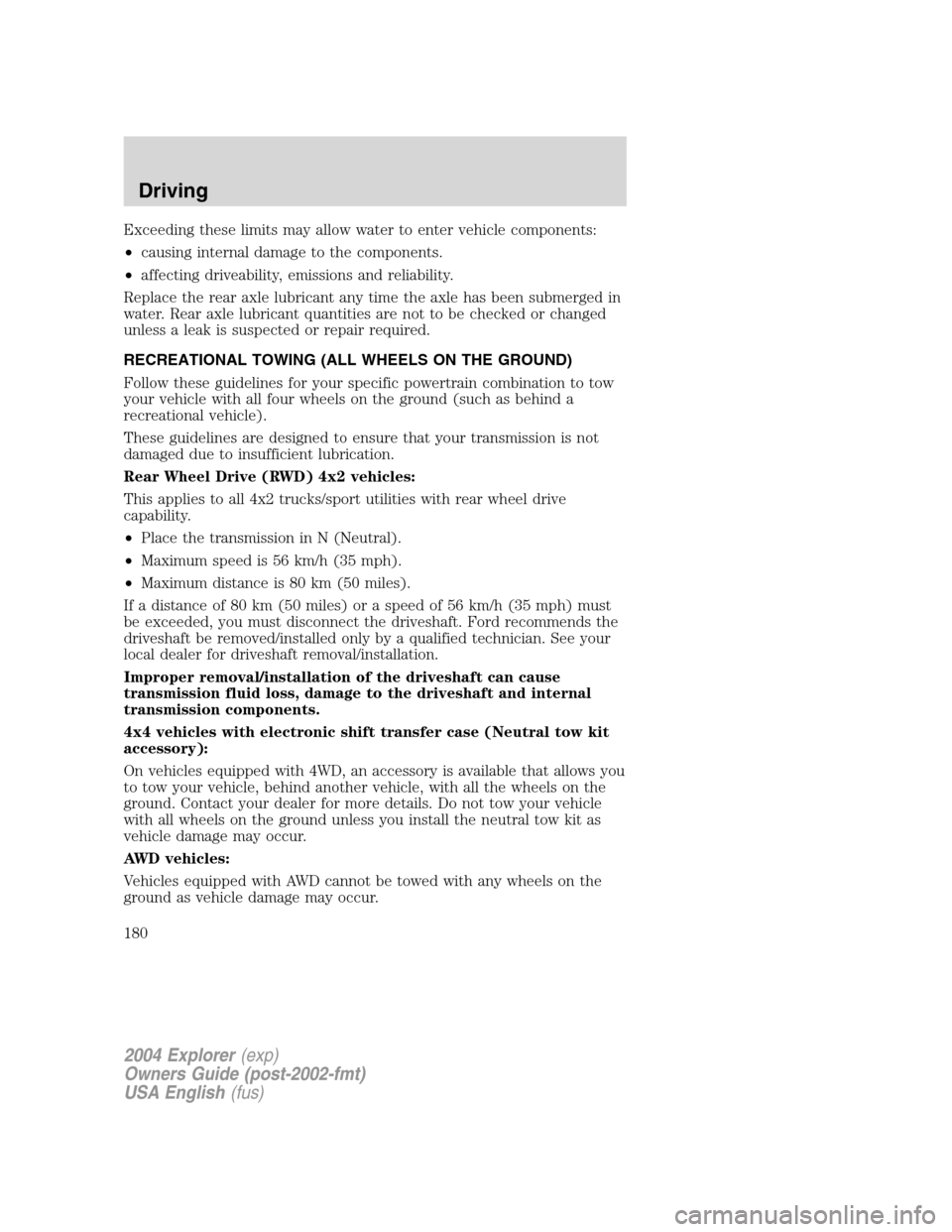
Exceeding these limits may allow water to enter vehicle components:
•causing internal damage to the components.
•affecting driveability, emissions and reliability.
Replace the rear axle lubricant any time the axle has been submerged in
water. Rear axle lubricant quantities are not to be checked or changed
unless a leak is suspected or repair required.
RECREATIONAL TOWING (ALL WHEELS ON THE GROUND)
Follow these guidelines for your specific powertrain combination to tow
your vehicle with all four wheels on the ground (such as behind a
recreational vehicle).
These guidelines are designed to ensure that your transmission is not
damaged due to insufficient lubrication.
Rear Wheel Drive (RWD) 4x2 vehicles:
This applies to all 4x2 trucks/sport utilities with rear wheel drive
capability.
•Place the transmission in N (Neutral).
•Maximum speed is 56 km/h (35 mph).
•Maximum distance is 80 km (50 miles).
If a distance of 80 km (50 miles) or a speed of 56 km/h (35 mph) must
be exceeded, you must disconnect the driveshaft. Ford recommends the
driveshaft be removed/installed only by a qualified technician. See your
local dealer for driveshaft removal/installation.
Improper removal/installation of the driveshaft can cause
transmission fluid loss, damage to the driveshaft and internal
transmission components.
4x4 vehicles with electronic shift transfer case (Neutral tow kit
accessory):
On vehicles equipped with 4WD, an accessory is available that allows you
to tow your vehicle, behind another vehicle, with all the wheels on the
ground. Contact your dealer for more details. Do not tow your vehicle
with all wheels on the ground unless you install the neutral tow kit as
vehicle damage may occur.
AWD vehicles:
Vehicles equipped with AWD cannot be towed with any wheels on the
ground as vehicle damage may occur.
2004 Explorer(exp)
Owners Guide (post-2002-fmt)
USA English(fus)
Driving
180
Page 181 of 296
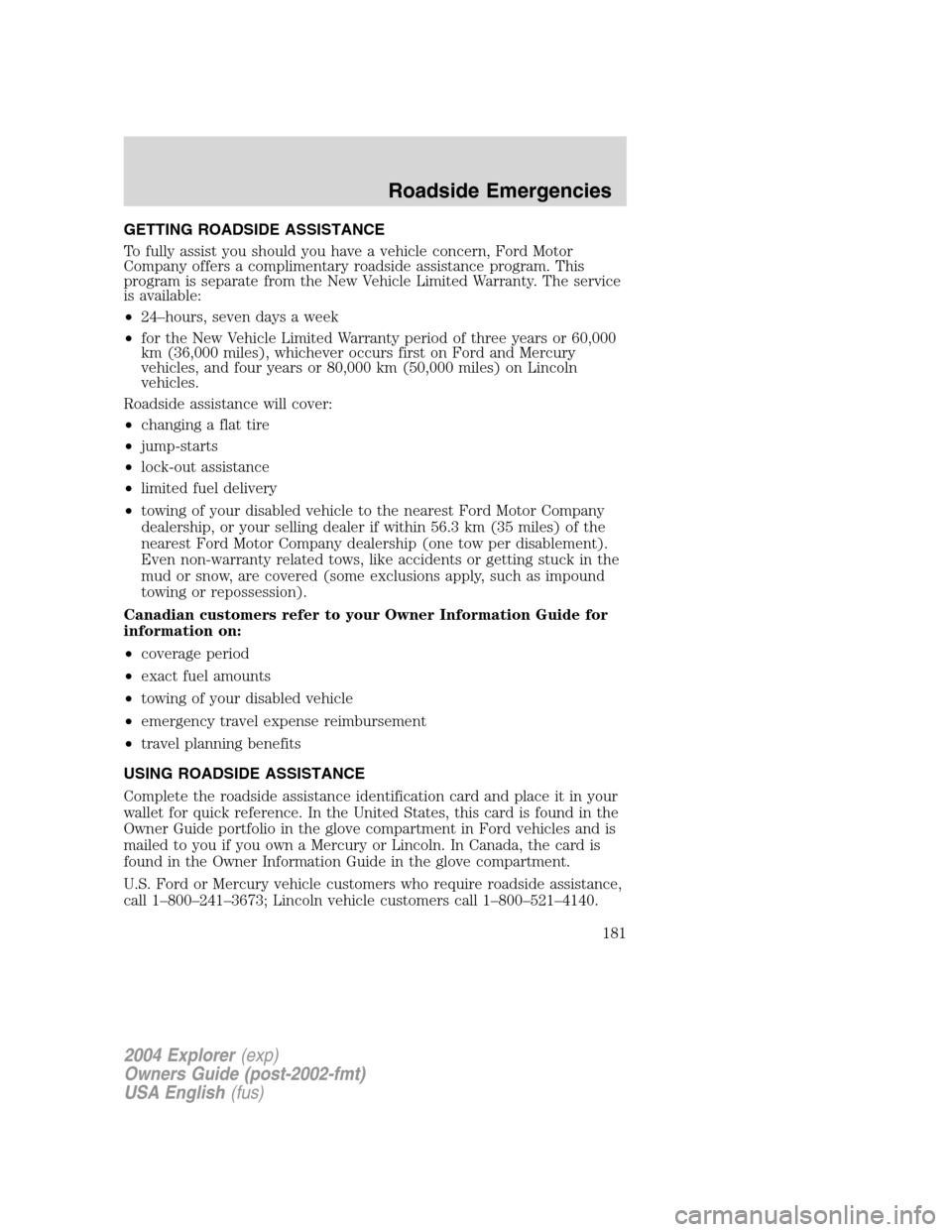
GETTING ROADSIDE ASSISTANCE
To fully assist you should you have a vehicle concern, Ford Motor
Company offers a complimentary roadside assistance program. This
program is separate from the New Vehicle Limited Warranty. The service
is available:
•24–hours, seven days a week
•for the New Vehicle Limited Warranty period of three years or 60,000
km (36,000 miles), whichever occurs first on Ford and Mercury
vehicles, and four years or 80,000 km (50,000 miles) on Lincoln
vehicles.
Roadside assistance will cover:
•changing a flat tire
•jump-starts
•lock-out assistance
•limited fuel delivery
•towing of your disabled vehicle to the nearest Ford Motor Company
dealership, or your selling dealer if within 56.3 km (35 miles) of the
nearest Ford Motor Company dealership (one tow per disablement).
Even non-warranty related tows, like accidents or getting stuck in the
mud or snow, are covered (some exclusions apply, such as impound
towing or repossession).
Canadian customers refer to your Owner Information Guide for
information on:
•coverage period
•exact fuel amounts
•towing of your disabled vehicle
•emergency travel expense reimbursement
•travel planning benefits
USING ROADSIDE ASSISTANCE
Complete the roadside assistance identification card and place it in your
wallet for quick reference. In the United States, this card is found in the
Owner Guide portfolio in the glove compartment in Ford vehicles and is
mailed to you if you own a Mercury or Lincoln. In Canada, the card is
found in the Owner Information Guide in the glove compartment.
U.S. Ford or Mercury vehicle customers who require roadside assistance,
call 1–800–241–3673; Lincoln vehicle customers call 1–800–521–4140.
2004 Explorer(exp)
Owners Guide (post-2002-fmt)
USA English(fus)
Roadside Emergencies
Roadside Emergencies
181
Page 187 of 296
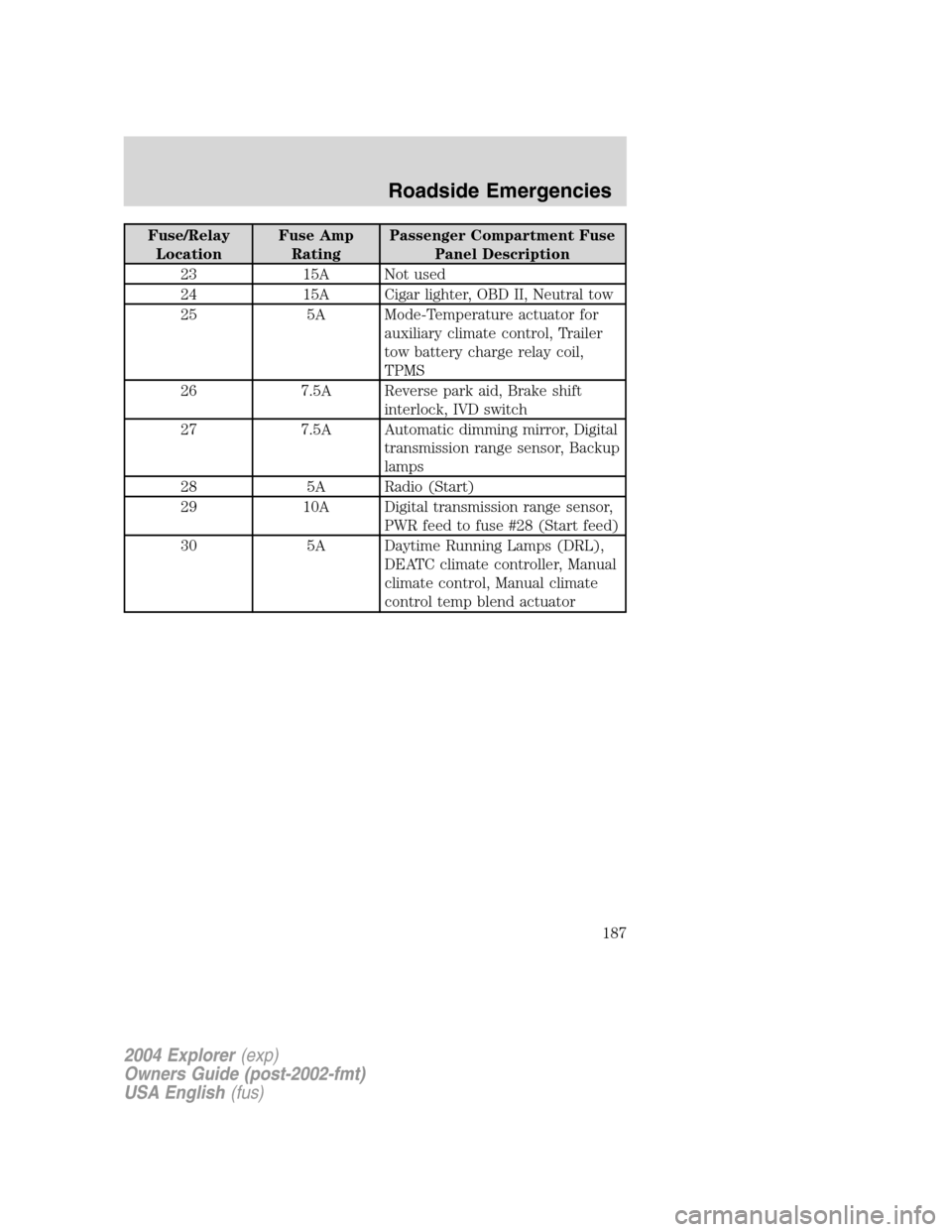
Fuse/Relay
LocationFuse Amp
RatingPassenger Compartment Fuse
Panel Description
23 15A Not used
24 15A Cigar lighter, OBD II, Neutral tow
25 5A Mode-Temperature actuator for
auxiliary climate control, Trailer
tow battery charge relay coil,
TPMS
26 7.5A Reverse park aid, Brake shift
interlock, IVD switch
27 7.5A Automatic dimming mirror, Digital
transmission range sensor, Backup
lamps
28 5A Radio (Start)
29 10A Digital transmission range sensor,
PWR feed to fuse #28 (Start feed)
30 5A Daytime Running Lamps (DRL),
DEATC climate controller, Manual
climate control, Manual climate
control temp blend actuator
2004 Explorer(exp)
Owners Guide (post-2002-fmt)
USA English(fus)
Roadside Emergencies
187
Page 190 of 296
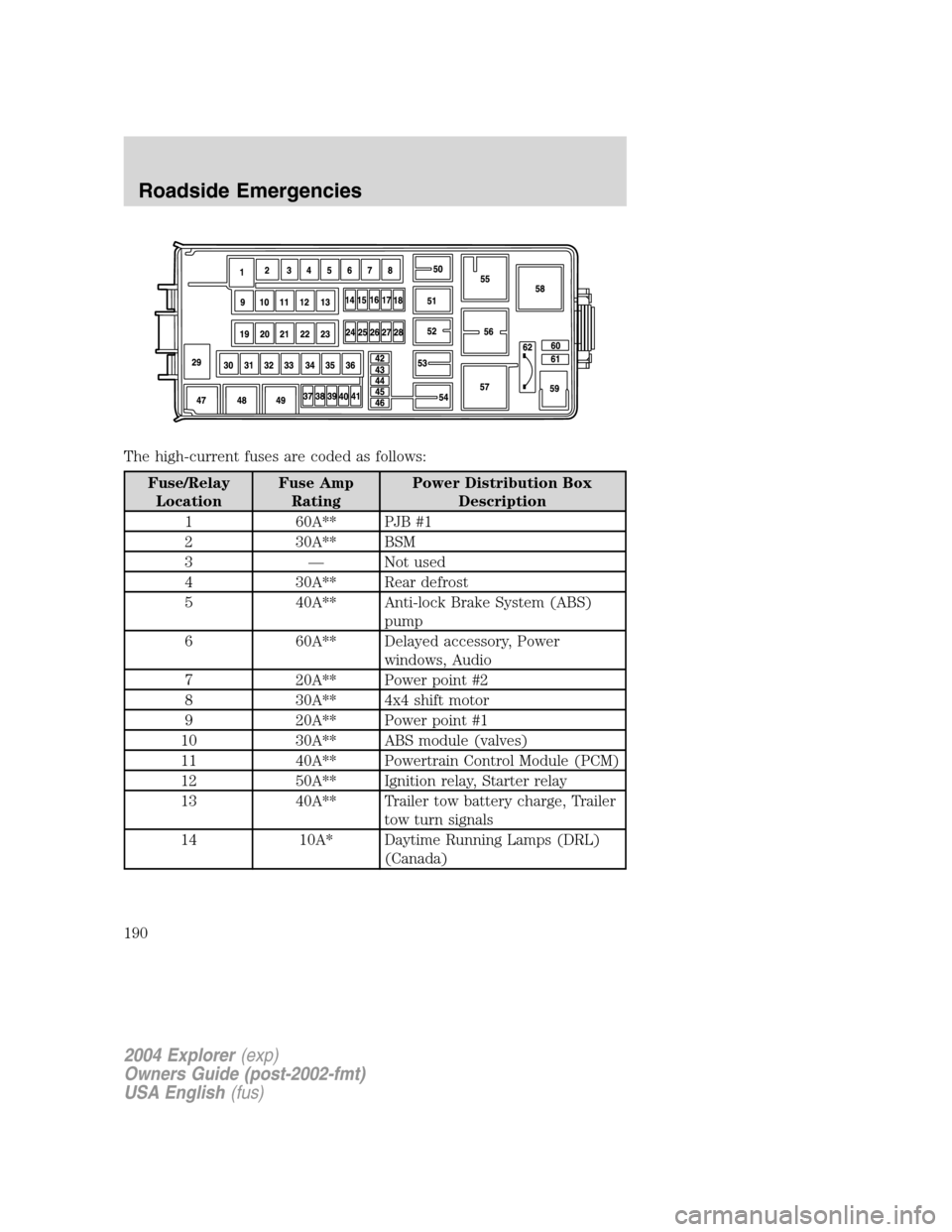
The high-current fuses are coded as follows:
Fuse/Relay
LocationFuse Amp
RatingPower Distribution Box
Description
1 60A** PJB #1
2 30A** BSM
3 — Not used
4 30A** Rear defrost
5 40A** Anti-lock Brake System (ABS)
pump
6 60A** Delayed accessory, Power
windows, Audio
7 20A** Power point #2
8 30A** 4x4 shift motor
9 20A** Power point #1
10 30A** ABS module (valves)
11 40A** Powertrain Control Module (PCM)
12 50A** Ignition relay, Starter relay
13 40A** Trailer tow battery charge, Trailer
tow turn signals
14 10A* Daytime Running Lamps (DRL)
(Canada)
2004 Explorer(exp)
Owners Guide (post-2002-fmt)
USA English(fus)
Roadside Emergencies
190
Page 191 of 296
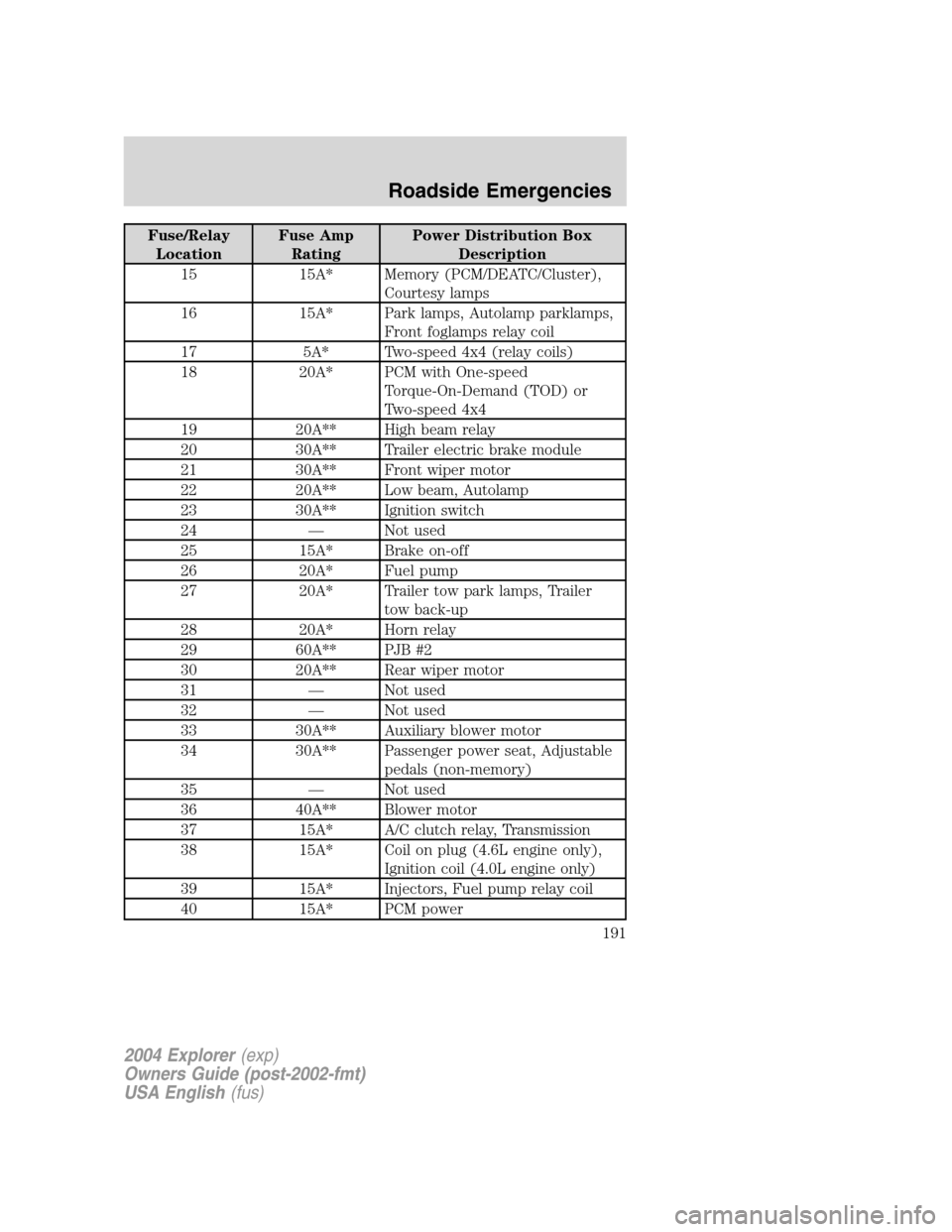
Fuse/Relay
LocationFuse Amp
RatingPower Distribution Box
Description
15 15A* Memory (PCM/DEATC/Cluster),
Courtesy lamps
16 15A* Park lamps, Autolamp parklamps,
Front foglamps relay coil
17 5A* Two-speed 4x4 (relay coils)
18 20A* PCM with One-speed
Torque-On-Demand (TOD) or
Two-speed 4x4
19 20A** High beam relay
20 30A** Trailer electric brake module
21 30A** Front wiper motor
22 20A** Low beam, Autolamp
23 30A** Ignition switch
24 — Not used
25 15A* Brake on-off
26 20A* Fuel pump
27 20A* Trailer tow park lamps, Trailer
tow back-up
28 20A* Horn relay
29 60A** PJB #2
30 20A** Rear wiper motor
31 — Not used
32 — Not used
33 30A** Auxiliary blower motor
34 30A** Passenger power seat, Adjustable
pedals (non-memory)
35 — Not used
36 40A** Blower motor
37 15A* A/C clutch relay, Transmission
38 15A* Coil on plug (4.6L engine only),
Ignition coil (4.0L engine only)
39 15A* Injectors, Fuel pump relay coil
40 15A* PCM power
2004 Explorer(exp)
Owners Guide (post-2002-fmt)
USA English(fus)
Roadside Emergencies
191
Page 192 of 296
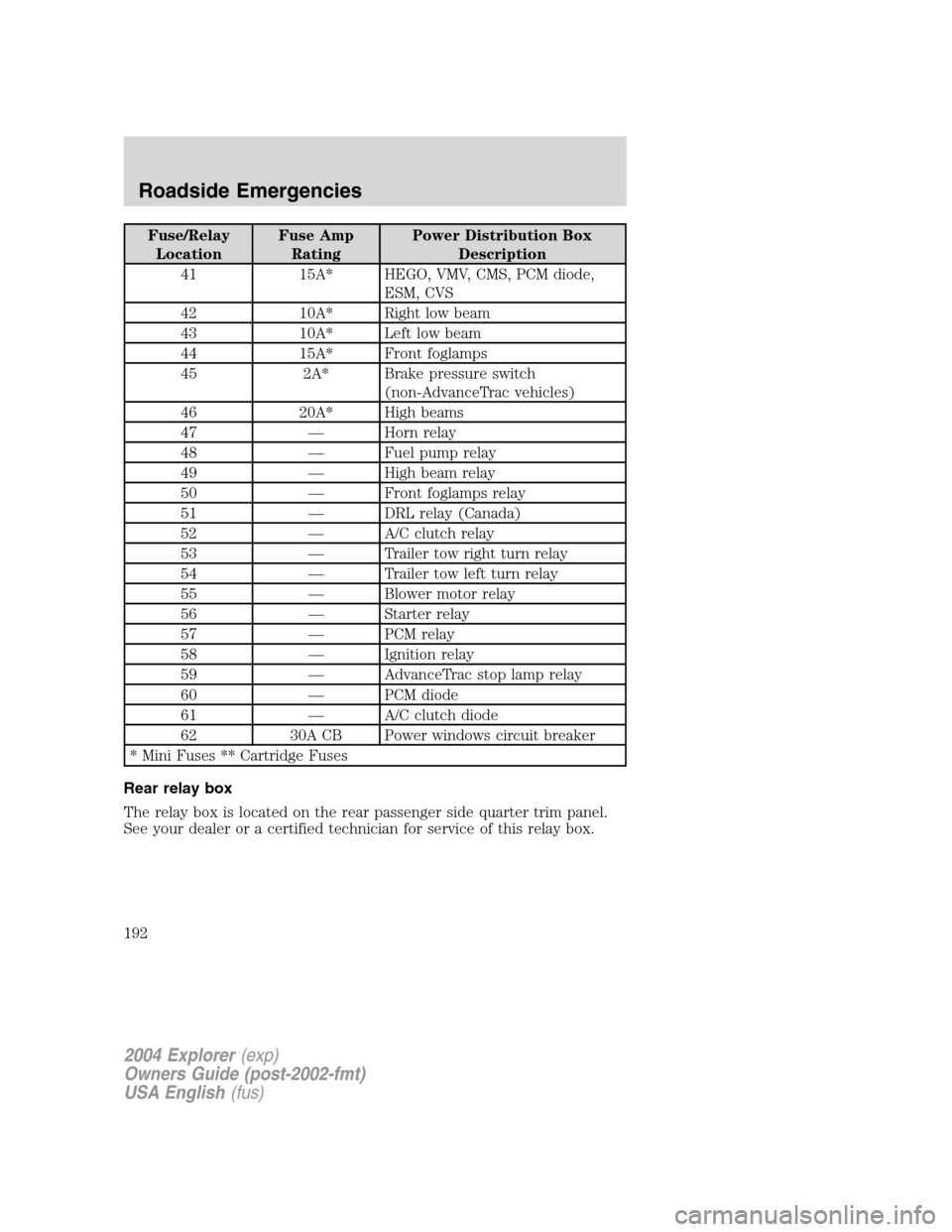
Fuse/Relay
LocationFuse Amp
RatingPower Distribution Box
Description
41 15A* HEGO, VMV, CMS, PCM diode,
ESM, CVS
42 10A* Right low beam
43 10A* Left low beam
44 15A* Front foglamps
45 2A* Brake pressure switch
(non-AdvanceTrac vehicles)
46 20A* High beams
47 — Horn relay
48 — Fuel pump relay
49 — High beam relay
50 — Front foglamps relay
51 — DRL relay (Canada)
52 — A/C clutch relay
53 — Trailer tow right turn relay
54 — Trailer tow left turn relay
55 — Blower motor relay
56 — Starter relay
57 — PCM relay
58 — Ignition relay
59 — AdvanceTrac stop lamp relay
60 — PCM diode
61 — A/C clutch diode
62 30A CB Power windows circuit breaker
* Mini Fuses ** Cartridge Fuses
Rear relay box
The relay box is located on the rear passenger side quarter trim panel.
See your dealer or a certified technician for service of this relay box.
2004 Explorer(exp)
Owners Guide (post-2002-fmt)
USA English(fus)
Roadside Emergencies
192
Page 193 of 296
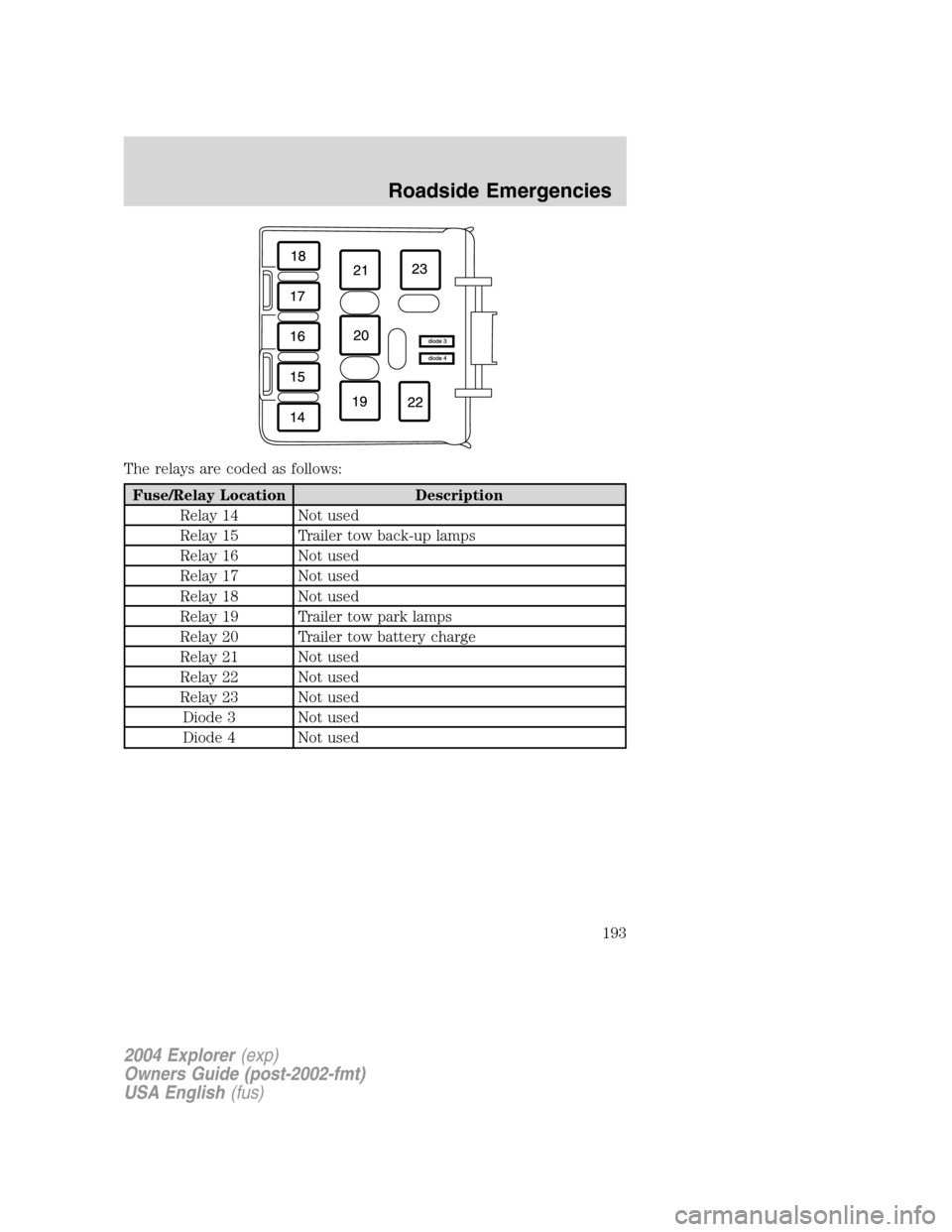
The relays are coded as follows:
Fuse/Relay Location Description
Relay 14 Not used
Relay 15 Trailer tow back-up lamps
Relay 16 Not used
Relay 17 Not used
Relay 18 Not used
Relay 19 Trailer tow park lamps
Relay 20 Trailer tow battery charge
Relay 21 Not used
Relay 22 Not used
Relay 23 Not used
Diode 3 Not used
Diode 4 Not used
2004 Explorer(exp)
Owners Guide (post-2002-fmt)
USA English(fus)
Roadside Emergencies
193
Page 195 of 296
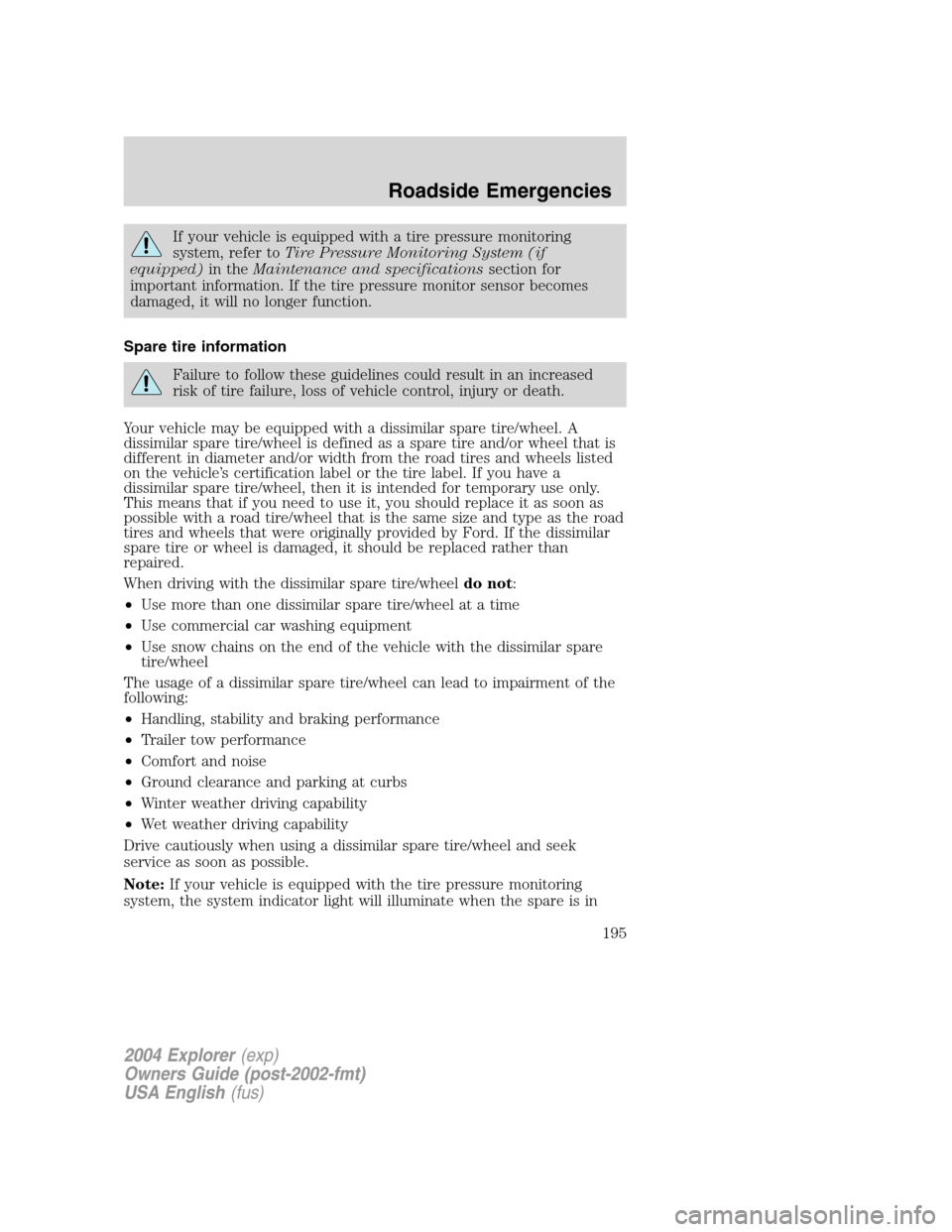
If your vehicle is equipped with a tire pressure monitoring
system, refer toTire Pressure Monitoring System (if
equipped)in theMaintenance and specificationssection for
important information. If the tire pressure monitor sensor becomes
damaged, it will no longer function.
Spare tire information
Failure to follow these guidelines could result in an increased
risk of tire failure, loss of vehicle control, injury or death.
Your vehicle may be equipped with a dissimilar spare tire/wheel. A
dissimilar spare tire/wheel is defined as a spare tire and/or wheel that is
different in diameter and/or width from the road tires and wheels listed
on the vehicle’s certification label or the tire label. If you have a
dissimilar spare tire/wheel, then it is intended for temporary use only.
This means that if you need to use it, you should replace it as soon as
possible with a road tire/wheel that is the same size and type as the road
tires and wheels that were originally provided by Ford. If the dissimilar
spare tire or wheel is damaged, it should be replaced rather than
repaired.
When driving with the dissimilar spare tire/wheeldo not:
•Use more than one dissimilar spare tire/wheel at a time
•Use commercial car washing equipment
•Use snow chains on the end of the vehicle with the dissimilar spare
tire/wheel
The usage of a dissimilar spare tire/wheel can lead to impairment of the
following:
•Handling, stability and braking performance
•Trailer tow performance
•Comfort and noise
•Ground clearance and parking at curbs
•Winter weather driving capability
•Wet weather driving capability
Drive cautiously when using a dissimilar spare tire/wheel and seek
service as soon as possible.
Note:If your vehicle is equipped with the tire pressure monitoring
system, the system indicator light will illuminate when the spare is in
2004 Explorer(exp)
Owners Guide (post-2002-fmt)
USA English(fus)
Roadside Emergencies
195