2004 DODGE DAKOTA child lock
[x] Cancel search: child lockPage 7 of 300

THINGS TO KNOW BEFORE STARTING YOUR VEHICLE
CONTENTS
mA Word About Your Keys................. 9
NKey-In-Ignition Reminder................ 9
NSentry Key Ð If Equipped................ 9
mIgnition And Steering Lock Ð If Equipped....11
NManual Transmissions...................11
NAutomatic Transmissions.................12
mIlluminated Entry.......................12
NVehicles Equipped With Power Door Locks....12
mDoor Locks...........................13
NManual Locks.........................13
NPower Door Locks Ð If Equipped..........14NChild Protection Door Lock...............16
mRemote Keyless Entry Ð If Equipped........17
NTo Unlock The Doors (Four Door Vehicles)....17
NTo Lock The Doors.....................18
NUsing The Panic Alarm..................19
NProgramming Additional Transmitters........19
NGeneral Information....................20
NTransmitter Battery Service...............21
mSecurity Alarm System Ð If Equipped.......21
NTo Set The Alarm......................21
NTo Disarm The System...................22
2
Page 13 of 300

There is also a battery saver feature that will turn the
interior lights off after 15 minutes if the ignition is OFF
and a door is left open or the dimmer control is in the
interior lights ON position or cargo light ON position.
DOOR LOCKS
Manual Locks
Front doors may be locked, sliding the lock knob rear-
ward. When the orange indicator is visible the lock knob
is in the unlocked position.
Both doors may be opened with the inside door handle
without sliding the lock knob forward. Doors locked
before closing will remain locked when closed.
The ignition key will unlock all the locks on your vehicle.
WARNING!
For personal security and safety in the event of an
accident, lock the vehicle doors when you drive as
well as when you park and leave the vehicle.
WARNING!
When leaving the vehicle always remove the key
from the ignition lock, and lock your vehicle. Do not
leave children unattended in the vehicle, or with
access to an unlocked vehicle. Unsupervised use of
vehicle equipment may cause severe personal inju-
ries and death.
THINGS TO KNOW BEFORE STARTING YOUR VEHICLE 13
2
Page 16 of 300
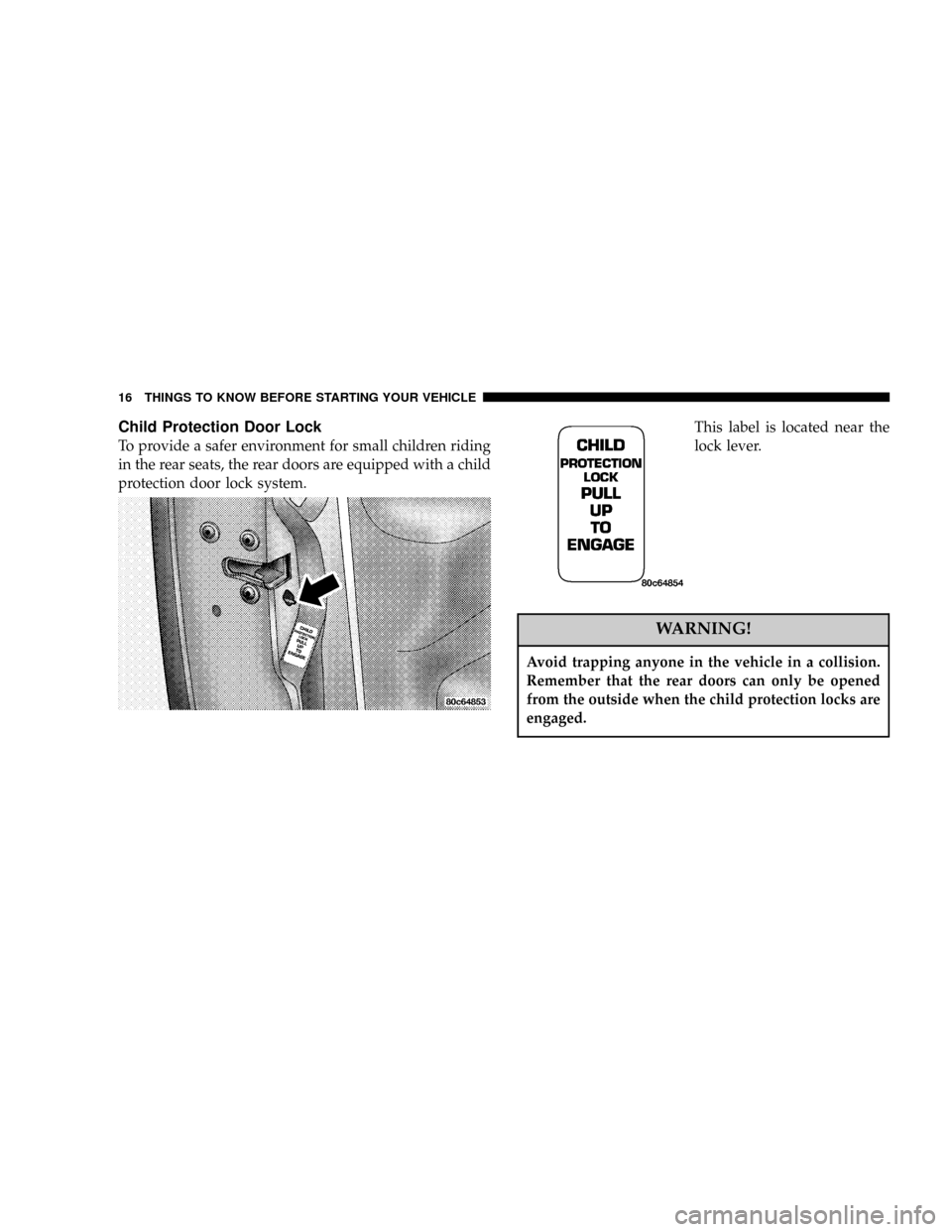
Child Protection Door Lock
To provide a safer environment for small children riding
in the rear seats, the rear doors are equipped with a child
protection door lock system.This label is located near the
lock lever.
WARNING!
Avoid trapping anyone in the vehicle in a collision.
Remember that the rear doors can only be opened
from the outside when the child protection locks are
engaged.
16 THINGS TO KNOW BEFORE STARTING YOUR VEHICLE
Page 24 of 300

Club Cab Vented Quarter Window
The Club Cab is equipped with rear quarter windows
that open out. Pull the window latch toward you to
unlock, and push out on the window. Press the latch
straight to secure the window in an open position.
WIND BUFFETING
Wind buffeting can be described as the perception of
pressure on the ears or a helicopter type sound in the
ears. Your vehicle may exhibit wind buffeting with the
windows down, or the sunroof (if so equipped) in certain
open or partially open positions. This is a normal occur-
rence and can be minimized. If the buffeting occurs with
the rear windows open, open the front and rear windows
together to minimize the buffeting. If the buffeting occurs
with the sunroof open, adjust the sunroof opening to
minimize the buffeting.
OCCUPANT RESTRAINTS
Some of the most important safety features in your
vehicle are the restraint systems. These include the front
and rear seat belts for the driver and all passengers, and
front airbags for both the driver and front passenger. If
you will be carrying children too small for adult-size
belts, your seat belts also can be used to hold infant and
child restraint systems.
Please pay close attention to the information in this
section. It tells you how to use your restraint system
properly to keep you and your passengers as safe as
possible.
WARNING!
In a collision, you and your passengers can suffer
much greater injuries if you are not properly buck-
led up. You can strike the interior of your vehicle or
other passengers, or you can be thrown out of the
vehicle. Always be sure you and others in your
vehicle are buckled up properly.
24 THINGS TO KNOW BEFORE STARTING YOUR VEHICLE
Page 35 of 300
seat is too small for a rear-facing infant restraint or
because the infant has a medical condition which
makes it necessary for the driver to be able to see the
infant,
²is a child, age 1 to 12 who must ride in the front seat
because there is no rear seat, because there is no rear
seat position available, or because the child has a
medical condition which makes it necessary for the
driver to be able to see the child,
²has a medical condition which makes passenger airbag
inflation (deployment) a greater risk for the passenger
than the risk of hitting the dashboard (instrument
panel) or windshield in a crash.
WARNING!
Whenever an airbag is turned off, even a lap/
shoulder belted passenger may hit their head, neck,
or chest on the dashboard (instrument panel) or
windshield in a crash. This may result in serious
injury or death.
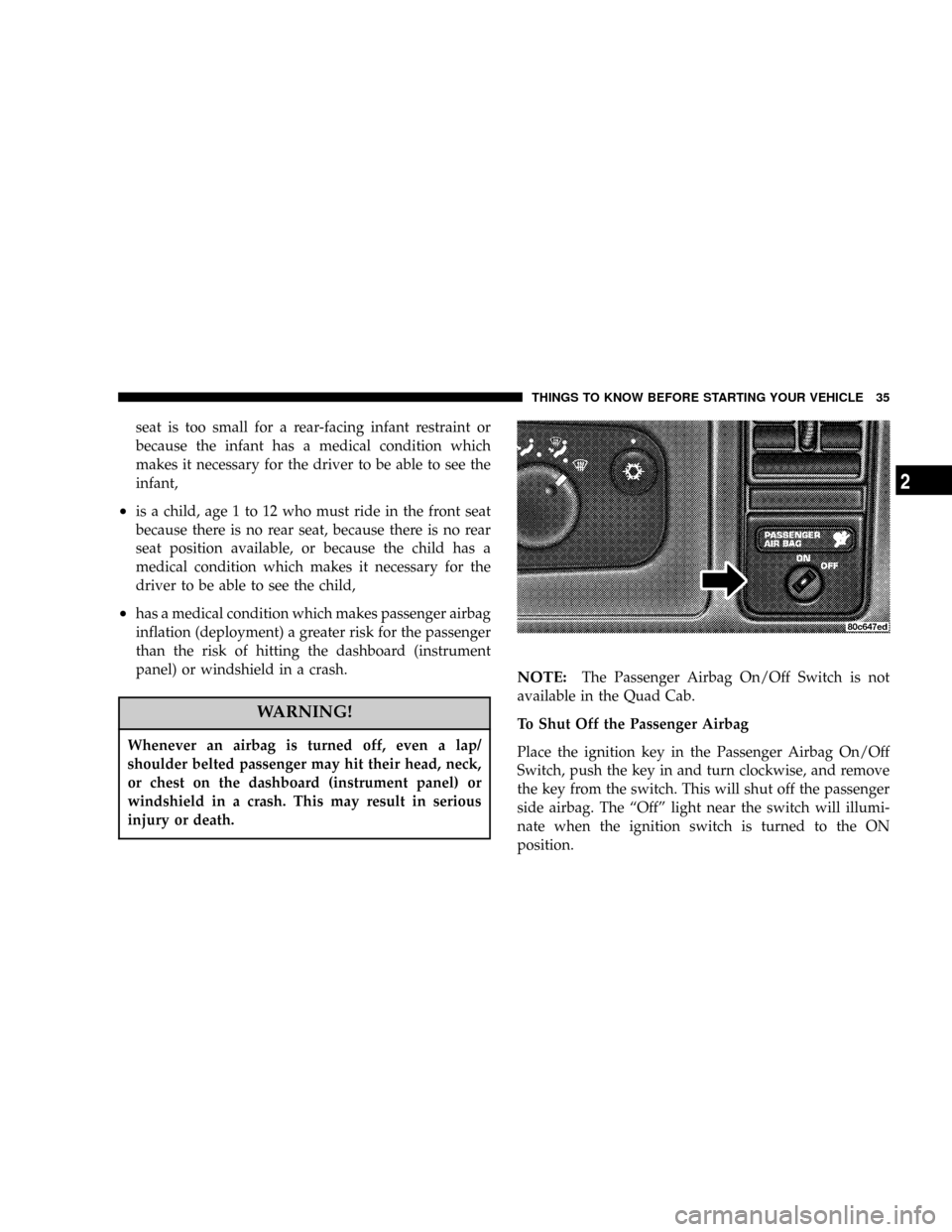
NOTE:The Passenger Airbag On/Off Switch is not
available in the Quad Cab.
To Shut Off the Passenger Airbag
Place the ignition key in the Passenger Airbag On/Off
Switch, push the key in and turn clockwise, and remove
the key from the switch. This will shut off the passenger
side airbag. The ªOffº light near the switch will illumi-
nate when the ignition switch is turned to the ON
position.
THINGS TO KNOW BEFORE STARTING YOUR VEHICLE 35
2
Page 38 of 300

Airbag Light
You will want to have the airbags ready to inflate for your
protection in an impact. While the airbag system is
designed to be maintenance free, if any of the following
occurs, have an authorized dealer service the system
promptly:
²The airbag light does not come on or flickers during
the 6 to 8 seconds when the ignition switch is first
turned on.
²The light remains on or flickers after the 6 to 8 second
interval.
²The light flickers or comes on and remains on while
driving.
NOTE:If the speedometer, tachometer or any engine
related gauges are not working, the airbag control mod-
ule may also be disabled. The airbags may not be ready
to inflate for your protection. Promptly check fuse num-
bers 18 and 19 in the fuse block. See your dealer if the
fuse is good.
Child Restraint
Everyone in your vehicle needs to be buckled up all the
time Ð babies and children, too. Every state in the United
States and all Canadian provinces require that small
children ride in proper restraint systems. This is the law,
and you can be prosecuted for ignoring it.
Children 12 years and under should ride properly buck-
led up in a rear seat, if available. According to crash
statistics, children are safer when properly restrained in
the rear seats rather than in the front.
WARNING!
In a collision, an unrestrained child, even a tiny
baby, can become a missile inside the vehicle. The
force required to hold even an infant on your lap can
become so great that you could not hold the child, no
matter how strong you are. The child and others
could be badly injured. Any child riding in your
vehicle should be in a proper restraint for the child's
size.
38 THINGS TO KNOW BEFORE STARTING YOUR VEHICLE
Page 40 of 300

with a front shield and are held in the vehicle by the
lap portion.) For further information refer to
www.seatcheck.org.
WARNING!
²Improper installation can lead to failure of an
infant or child restraint. It could come loose in a
collision. The child could be badly injured or
killed. Follow the manufacturers directions ex-
actly when installing an infant or child restraint.
²A rearward facing child restraint should only be
used in a rear seat, or in the front seat if the
passenger's front airbag is Off. If the airbag is left
On, a rearward facing child restraint in the front
seat may be struck by a deploying passenger
airbag which may cause severe or fatal injury to
the infant.
Here are some tips for getting the most out of your child
restraint:
²Before buying any restraint system, make sure that it
has a label certifying that it meets all applicable Safety
Standards. We also recommend that you make sure
that you can install the child restraint in the vehicle
where you will use it before you buy it.
²The restraint must be appropriate for your child's
weight and height. Check the label on the restraint for
weight and height limits.
²Carefully follow the instructions that come with the
restraint. If you install the restraint improperly, it may
not work when you need it.
²The passenger seat belts are equipped with cinching
latch plates, which are designed to keep the lap portion
tight around the child restraint so that it is not neces-
sary to use a locking clip. Pulling up on the shoulder
portion of the lap/shoulder belt will tighten the belt.
The cinching latch plate will keep the belt tight, how-
ever, any seat belt system will loosen with time, so
check the belt occasionally and pull it tight if necessary.
40 THINGS TO KNOW BEFORE STARTING YOUR VEHICLE
Page 146 of 300
CAUTION!
Long periods of engine idling can cause excessive
exhaust temperatures which can damage your ve-
hicle. Do not leave your vehicle unattended with the
engine running.
WARNING!
Do not leave children or animals inside parked
vehicles in hot weather. Interior heat build up may
cause serious injury or death.
Engine Block Heater Ð If Equipped
The engine block heater warms engine coolant and
permits quicker starts in cold weather. Connect the cord
to a standard 110-115 volt AC electrical outlet with a
grounded, three wire extension cord.
The engine block heater cord is located at the right front
of the engine compartment for all engine applications.
WARNING!
Remember to disconnect the cord before driving.
Damage to the 110-115 volt electrical cord could
cause electrocution.
SHIFTING
Automatic Transmission
The gear shift lever is mounted on the right side of the
steering column. To engage a gear for driving, move the
shift lever from P-Park or N-Neutral to the desired gear
range (R-Reverse, D-Drive, 2±Second, or 1±First). To
move the shift lever, pull it toward you, then release it
when the desired gear range is reached. The Transmis-
sion Range Indicator (labeled ªGear Selectorº) in the
instrument cluster shows the selected gear range. The
Indicator is illuminated for night driving.
Brake/Transmission Interlock System
This system prevents you from moving the gear shift out
of Park and into any gear unless the brake pedal is
pressed. This system is active only while the ignition
146 STARTING AND OPERATING