2004 DODGE DAKOTA engine
[x] Cancel search: enginePage 237 of 300
Whenever a change is noticed in the sound of the exhaust
system, when exhaust fumes can be detected inside the
vehicle, or when the underside or rear of the vehicle is
damaged, have a competent mechanic inspect the com-
plete exhaust system and adjacent body areas for broken,
damaged, deteriorated, or mispositioned parts. Open
seams or loose connections could permit exhaust fumes
to seep into the passenger compartment. In addition,
inspect the exhaust system each time the vehicle is raised
for lubrication or oil change. Replace as required.
WARNING!
Exhaust gases can injure or kill. They contain carbon
monoxide (CO) which is colorless and odorless.
Breathing it can make you unconscious and can
eventually poison you. To avoid breathing CO, fol-
low the preceding safety tips.
Cooling System
Inspection
Coolant protection checks should be made at every 12
months (before the onset of freezing weather, where
applicable). If coolant is dirty or rusty in appearance, the
system should be drained, flushed and refilled with fresh
coolant. Check face of radiator for any accumulation of
bugs, leaves, etc. If dirty, clean the radiator core by gently
spraying water from a garden hose at the back of the core.
Check the reserve tank tubing for condition and tightness
of connection at reserve tank and radiator. Inspect the
entire system for leaks.
With the engine at normal operating temperature (but
not running), check the coolant pressure cap for proper
vacuum sealing by draining a small amount of coolant
from the radiator drain cock. If the cap is sealing prop-
erly, the coolant will begin to drain from the reserve tank.
Do not remove the pressure cap when the cooling system
is hot.
MAINTAINING YOUR VEHICLE 237
7
Page 238 of 300
WARNING!
You or others can be badly burned by hot coolant or
steam from your radiator. If you see or hear steam
coming from under the hood don't open the hood
until the radiator has had time to cool. If you open
the hood and see steam or hot coolant escaping from
the radiator, don't touch anything. Get away quickly.
Never try to open a pressure cap when the radiator is
hot.
Cooling System Maintenance
At the intervals shown on the Maintenance Schedules,
the system should be drained, flushed and filled.
Cooling System Ð Drain, Flush And Refill
If the solution is dirty and contains a considerable
amount of sediment, clean and flush with a reliable
cooling system cleaner. Follow with a thorough rinsing to
remove all deposits and chemicals. Discard old antifreeze
solution according to recommended procedure.
Disposal of Used Engine Coolant
Used ethylene glycol-based engine coolant is a regulated
substance requiring proper disposal. Check with your
local authorities to determine the disposal rules for your
community. Do not store ethylene glycol-based engine
coolant in open containers or allow it to remain in
puddles on the ground. Prevent ingestion by animals and
children. If ingested by a child, contact a physician
immediately. Clean up any ground spills immediately.
Recommended Engine Coolant
Refer to Recommended Fluids, Lubricants and Genuine
Parts for correct fluid type.
238 MAINTAINING YOUR VEHICLE
Page 239 of 300
CAUTION!
Mixing of coolants other than specified (non-
HOAT), may result in engine damage that may not
be covered under the new vehicle warranty, and
decreased corrosion protection. If a non-HOAT cool-
ant is introduced into the cooling system in an
emergency, it should be replaced with the specified
coolant as soon as possible.
Do not use plain water alone or alcohol base anti-
freeze products. Do not use additional rust inhibi-
tors or antirust products, as they may not be compat-
ible with the radiator coolant and may plug the
radiator.
This vehicle has not been designed for use with
Propylene Glycol based coolants. Use of Propylene
Glycol based coolants is not recommended.
Adding Coolant
When adding coolant or refilling system, a 50% solution
of ethylene glycol antifreeze coolant in water should beused. Higher concentrations (not to exceed 65%) are
required if temperatures below ±37ÉF (± 38ÉC) are antici-
pated.
Use only high purity water such as distilled or deionized
water when mixing the water/antifreeze solution. The
use of lower quality water will reduce the amount of
corrosion protection in the engine cooling system.
Please note that it is the owner's responsibility to main-
tain the proper level of protection against freezing ac-
cording to the temperatures occurring in the area where
the vehicle is operated.
WARNING!
Never add coolant to the radiator when the engine is
overheated. Do not loosen or remove pressure cap to
cool overheated engine. The coolant is under pres-
sure and severe scalding could result.
MAINTAINING YOUR VEHICLE 239
7
Page 240 of 300
Coolant Pressure Cap
The coolant pressure cap must be fully tightened to
prevent loss of coolant, and to insure that coolant will
return to the radiator from the coolant reserve tank.
The pressure cap should be inspected and cleaned if there
is any accumulation of foreign material on the sealing
surfaces.
WARNING!
The warning words ªDO NOT OPEN HOTº on the
coolant pressure cap are a safety precaution. Heat
causes pressure to build up in the cooling system. To
prevent scalding or injury, do not remove the pres-
sure cap when the system is hot or under pressure.
Coolant Level
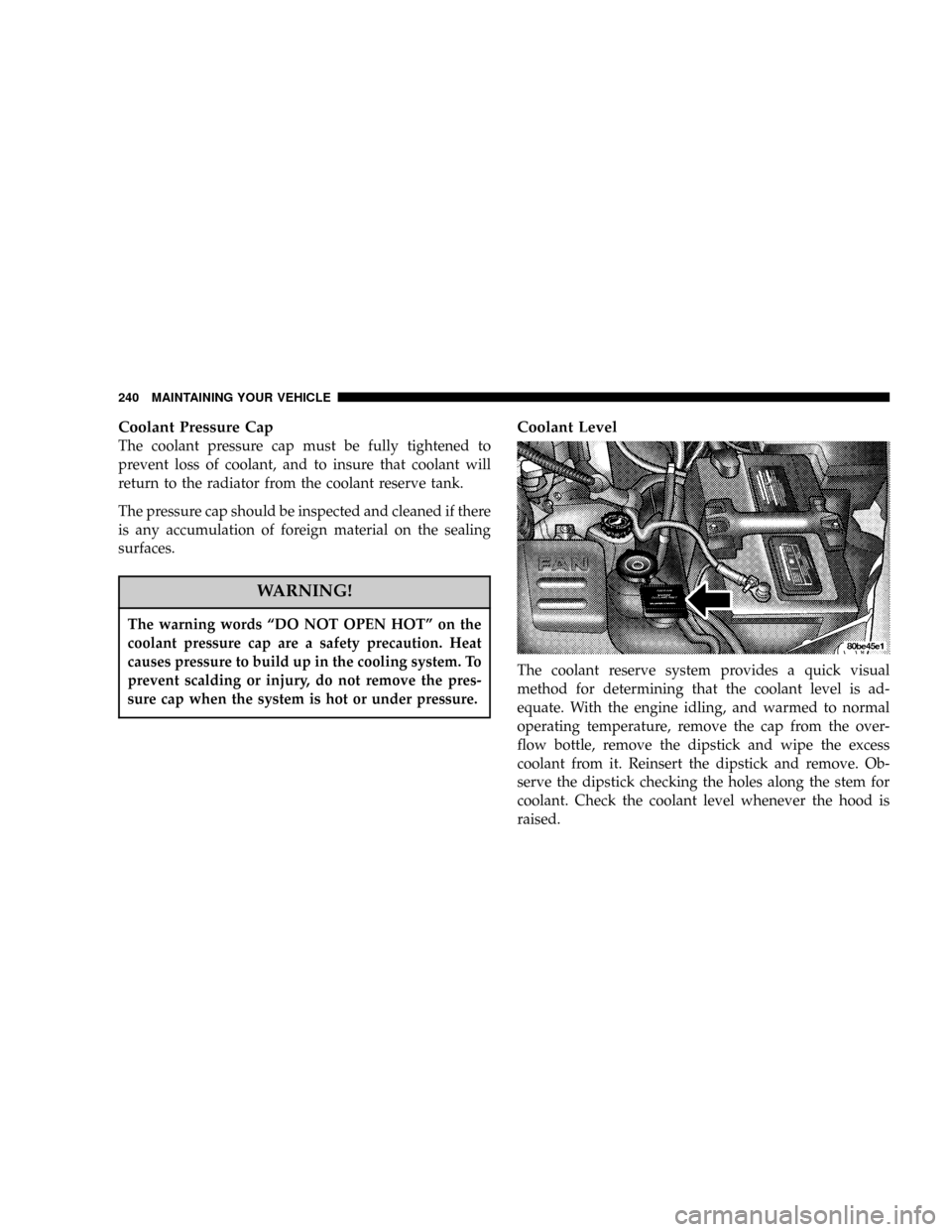
The coolant reserve system provides a quick visual
method for determining that the coolant level is ad-
equate. With the engine idling, and warmed to normal
operating temperature, remove the cap from the over-
flow bottle, remove the dipstick and wipe the excess
coolant from it. Reinsert the dipstick and remove. Ob-
serve the dipstick checking the holes along the stem for
coolant. Check the coolant level whenever the hood is
raised.
240 MAINTAINING YOUR VEHICLE
Page 241 of 300

The radiator normally remains completely full, so there is
no need to remove the pressure cap except when check-
ing coolant freeze point or when replacing coolant. Your
service attendant should be advised of this. When addi-
tional coolant is needed to maintain the proper level, it
should be added to the overflow bottle. Do not overfill.
Points To Remember
A. Do not overfill the reserve tank (overflow bottle).
B. Check coolant freeze point in the radiator and in the
reserve tank. If antifreeze needs to be added, contents of
reserve tank also must be protected against freezing.
C. If frequent coolant additions are required, or if the
level in the reserve tank does not drop when the engine
cools, the cooling system should be pressure tested for
leaks.D. Maintain a minimum coolant concentration of 50%
ethylene glycol.
E. Make sure that the radiator and reserve tank overflow
hoses are not kinked or obstructed.
F. Keep the front of the radiator clean. If your vehicle is
equipped with air conditioning, keep the front of the
condenser clean also.
G. The thermostat should not be changed for summer or
winter operation. If replacement is ever necessary, install
ONLY the correct type thermostat. Other designs may
result in unsatisfactory cooling performance.
Emission Related Components
Fuel System Hoses And Vapor/Vacuum Harnesses
When the vehicle is serviced for scheduled maintenance,
inspect surface of hoses and nylon tubing for evidence of
heat and mechanical damage. Hard and brittle rubber,
cracking, checking, tears, cuts, abrasions, and excessive
swelling suggest deterioration of the rubber. Particular
attention should be given to examining hose surfaces
nearest to high heat sources, such as the exhaust mani-
fold.
MAINTAINING YOUR VEHICLE 241
7
Page 244 of 300
WARNING!
Use of brake fluid that may have a lower initial
boiling point, or is unidentified as to specifications,
may result in sudden brake failure during hard
prolonged braking. You could have an accident.
WARNING!
Overfilling the brake fluid reservoir can result in
spilling brake fluid on hot engine parts and the
brake fluid catching fire.
Use only brake fluid that has been in a tightly closed
container to avoid contamination from foreign matter or
moisture.
CAUTION!
Do not allow a petroleum-base fluid to contaminate
the brake fluid. Seal damage may result.
Brake Linings
Your vehicle is equipped with self-adjusting brakes. A
few brake applications while moving in reverse will
maintain your brakes at the specified adjustment. Adjust-
ment will continue until the brake linings are worn. To
avoid brake failure, brake pull or damage to drums,
inspect the brake linings as specified. If excessively worn,
the brake linings must be replaced.
Brake Hoses
Inspection should be performed whenever the brake
system is serviced or at intervals specified. Inspect hy-
draulic brake hoses for surface cracking, scuffing or worn
spots. If there is any evidence of cracking, scuffing, or
worn spots, the hose should be replaced immediately!
Eventual deterioration of the hose can take place with
possible burst failure.
244 MAINTAINING YOUR VEHICLE
Page 245 of 300
WARNING!
Worn brake hoses can burst and cause brake failure.
You could have an accident. If you see any sign of
cracking, scuffing, or worn spots, have the brake
hoses replaced immediately.
Clutch Hydraulic System
The clutch hydraulic system is a sealed maintenance free
system. In the event of leakage or other malfunction, the
system must be replaced.
Manual Transmission
Fluid Level Check
This fluid should be checked whenever other underhood
services are performed. The fluid level is checked by
removing the fill plug. If the level of the lubricant is more
than 1/49(6.35 mm) below the bottom of the filler hole
while the vehicle is level, enough lubricant should be
added to bring the level to the bottom of the filler hole.
NV-3500 5-Speed Transmission Lubricant Selection
These transmissions are filled with manual transmission
fluid at the factory. This fluid does not require periodic
changing. If it becomes necessary to add or change the
fluid in these transmissions, Refer to Recommended
Fluids, Lubricants and Genuine Parts for correct fluid
type.
Automatic Transmission
Fluid Level Check ± 3.7/4.7L Engine
Check the fluid level while the transmission is at normal
operating temperature 180ÉF (82ÉC). This occurs after at
least 15 miles (25 km) of driving. At normal operating
temperature the fluid cannot be held comfortably be-
tween the fingertips.
To check the automatic transmission fluid level properly,
the following procedure must be used:
1. Operate the engine at idle speed and normal operating
temperature.
2. The vehicle must be on level ground.
MAINTAINING YOUR VEHICLE 245
7
Page 252 of 300

defrosters or windshields equipped with a windshield
wiper de-icer. Do not use scrapers or other sharp instru-
ments which may scratch the elements.
When cleaning the rear view mirror, spray cleaner on the
towel or rag that you are using. Do not spray cleaner
directly on the mirror.
Cleaning Plastic Instrument Cluster Lenses
The lenses in front of the instruments in this vehicle are
molded in clear plastic. When cleaning the lenses, care
must be taken to avoid scratching the plastic.
1. Clean with a wet soft rag. A mild soap solution may be
used, but do not use high alcohol content or abrasive
cleaners. If soap is used, wipe clean with a clean damp
rag.
2. Dry with a soft tissue.
Seat Belt Maintenance
Do not bleach, dye or clean the belts with chemical
solvents or abrasive cleaners. This will weaken the fabric.
Sun damage will also weaken the fabric.If the belts need cleaning, use a mild soap solution or
lukewarm water. Do not remove the belts from the car to
wash them.
Replace the belts if they appear frayed or worn or if the
buckles do not work properly.
POWER DISTRIBUTION CENTER
Your vehicle is equipped with an electrical Power Distri-
bution Center located in the engine compartment near
the battery.
252 MAINTAINING YOUR VEHICLE