Page 1032 of 2643
4A – 16IHYDRAULIC BRAKES
DAEWOO V–121 BL4
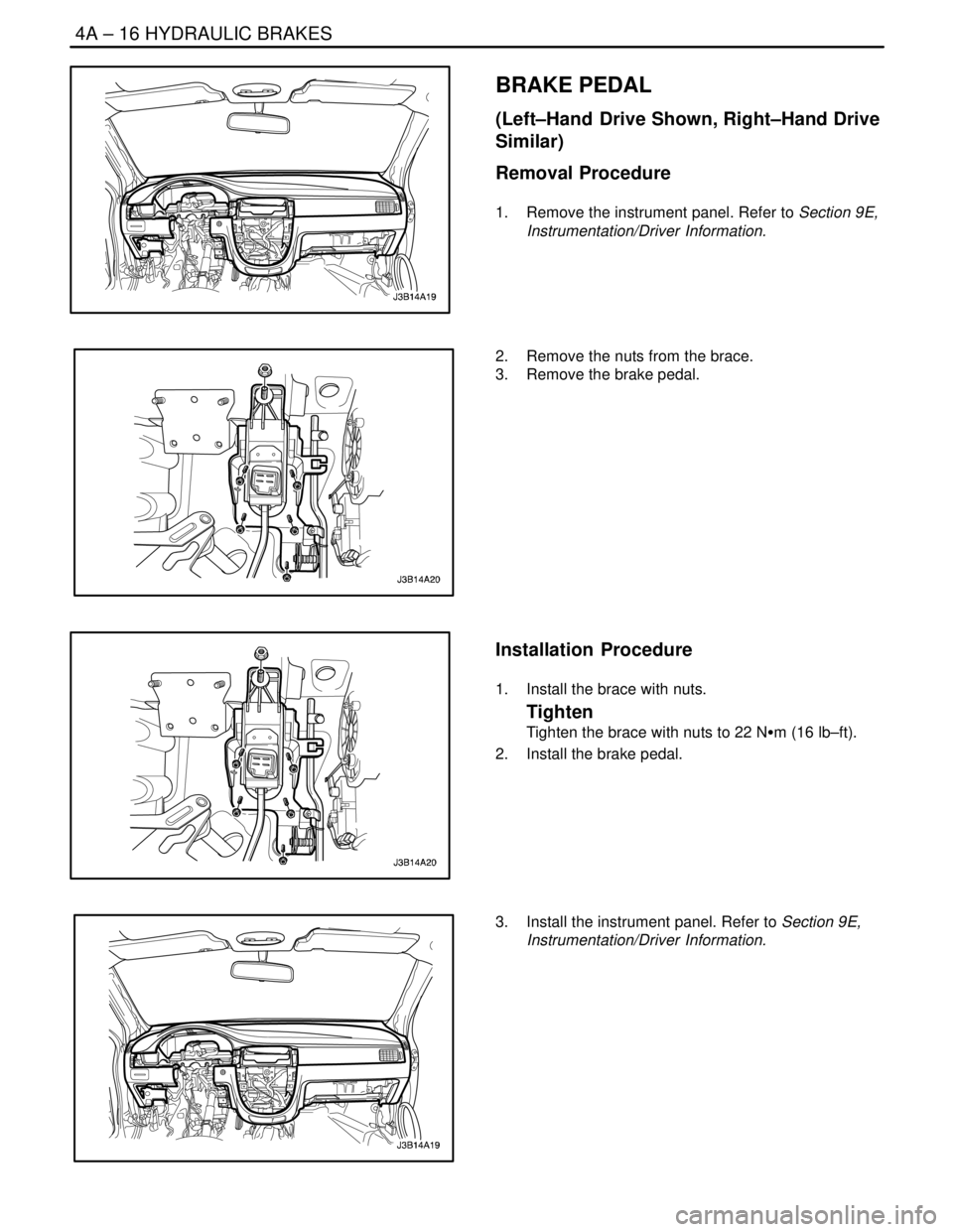
BRAKE PEDAL
(Left–Hand Drive Shown, Right–Hand Drive
Similar)
Removal Procedure
1. Remove the instrument panel. Refer to Section 9E,
Instrumentation/Driver Information.
2. Remove the nuts from the brace.
3. Remove the brake pedal.
Installation Procedure
1. Install the brace with nuts.
Tighten
Tighten the brace with nuts to 22 NSm (16 lb–ft).
2. Install the brake pedal.
3. Install the instrument panel. Refer to Section 9E,
Instrumentation/Driver Information.
Page 1033 of 2643
HYDRAULIC BRAKES 4A – 17
DAEWOO V–121 BL4
GENERAL DESCRIPTION
AND SYSTEM OPERATION
WARNING LAMP OPERATION
This brake system uses a BRAKE warning lamp located
in the instrument panel cluster. When the ignition switch
is in the START position, the BRAKE warning lamp should
illuminate. It should go off when the ignition switch returns
to the ON position.The following conditions will activate the BRAKE warning
lamp:
S The lamp should be on whenever the parking brake
is applied and the ignition switch is in the ON posi-
tion.
S A low fluid level in the master cylinder will turn the
BRAKE lamp on.
Page 1035 of 2643

4B – 2IMASTER CYLINDER
DAEWOO V–121 BL4
DIAGNOSIS
CHECKING BRAKE
PROPORTIONING VALVE
Use two brake pressure gauges to check the brake pro-
portioning valves that are attached to the master cylinder
on non–ABS braking systems. These valves limit the out-
let pressure to the rear brakes after a predetermined mas-
ter cylinder pressure has been reached. (On ABS braking
systems, the hydraulic modulator/motor pack assembly
controls the hydraulic pressure to both the rear wheel cyl-
inders or rear calipers, and the front calipers.)
When checking the brake proportioning valves, be sure
that the hydraulic line pressure is measured simulta-
neously and diagonally on the front and the rear axles.To measure the pressure, use the following steps.
1. Remove the bleeder valve and install a pressure
gauge to one of the rear brake cylinders.
2. Install another bleeder valve and install another
pressure gauge to the diagonally opposite front
brake.
3. Build pressure by pressing firmly on the brake ped-
al several times. (The pressure indicated on the
gauge is not regulated and represents the actual
brake system hydraulic pressure.)
4. Build pressure until the test values in the following
proportioning valve test chart are achieved.
Model
Reference Number for
Gradient and Switching
Pressure on the Valve
HousingInput Pressure Read on
the Manometer at the
Front Axle in kPa (psi)Output Pressure Read
on the Manometer at the
Front Axle in kPa (psi)
500 (73)500 (73)
N/B, H/B0.3/304 500 (653) 3 450 ± 200(500 ± 29)
10 000 (1,450)5 100 ± 300(740 ± 44)
500 (73)500 (73)
WAGON0.3/405 500 (798)4 450 ± 200(645 ± 29)
10 000 (1,450)5 800 ± 300(841 ± 44)
Important : If the pressure exceeds 10 000 kPa (1,450
psi), the pressure reading on the rear gauge will not be ac-
curate.5. Remove the gauges from the tested brake circuit
and repeat the test on the remaining circuit.
Page 1042 of 2643

MASTER CYLINDER 4B – 9
DAEWOO V–121 BL4
GENERAL DESCRIPTION
AND SYSTEM OPERATION
MASTER CYLINDER
The master cylinder is designed for use in a diagonal–split
system. One front and one diagonally opposite rear brake
are served by the primary piston. The opposite front and
rear brakes are served by the secondary piston. The mas-
ter cylinder incorporates the functions of the standard dual
master cylinder, plus a low fluid level indicator and the pro-
portioning valves in the non–antilock braking system. The
proportioning valves limit the outlet pressure to the rear
brakes after a predetermined master cylinder pressure
has been reached.
Important :
S Replace all the components included in the repair
kits used to service this master cylinder.S Lubricate rubber parts with clean brake fluid to ease
assembly.
S Do not use lubricated shop air on brake parts, as
this may damage rubber components.
S If any hydraulic component is removed or discon-
nected, it may be necessary to bleed all or part of
the brake system.
S The torque values specified are for dry, unlubri-
cated fasteners.
S Perform all service operations on a clean bench,
free from all traces of mineral oil.
FLUID LEVEL SENSOR
The master cylinder is equipped with a fluid level sensor.
This sensor will activate the BRAKE light if a low fluid level
condition is detected. Once the fluid level is corrected, the
BRAKE light will go out.
Page 1046 of 2643
4C – 4IPOWER BOOSTER
DAEWOO V–121 BL4
Installation Procedure
1. Check the pushrod and the pushrod clevis for dam-
age and proper fit.
2. Install the hex nut and the pushrod clevis on the
booster shaft.
Tighten
Tighten the booster hex nut and the pushrod clevis to
18 NSm (13 lb–ft).
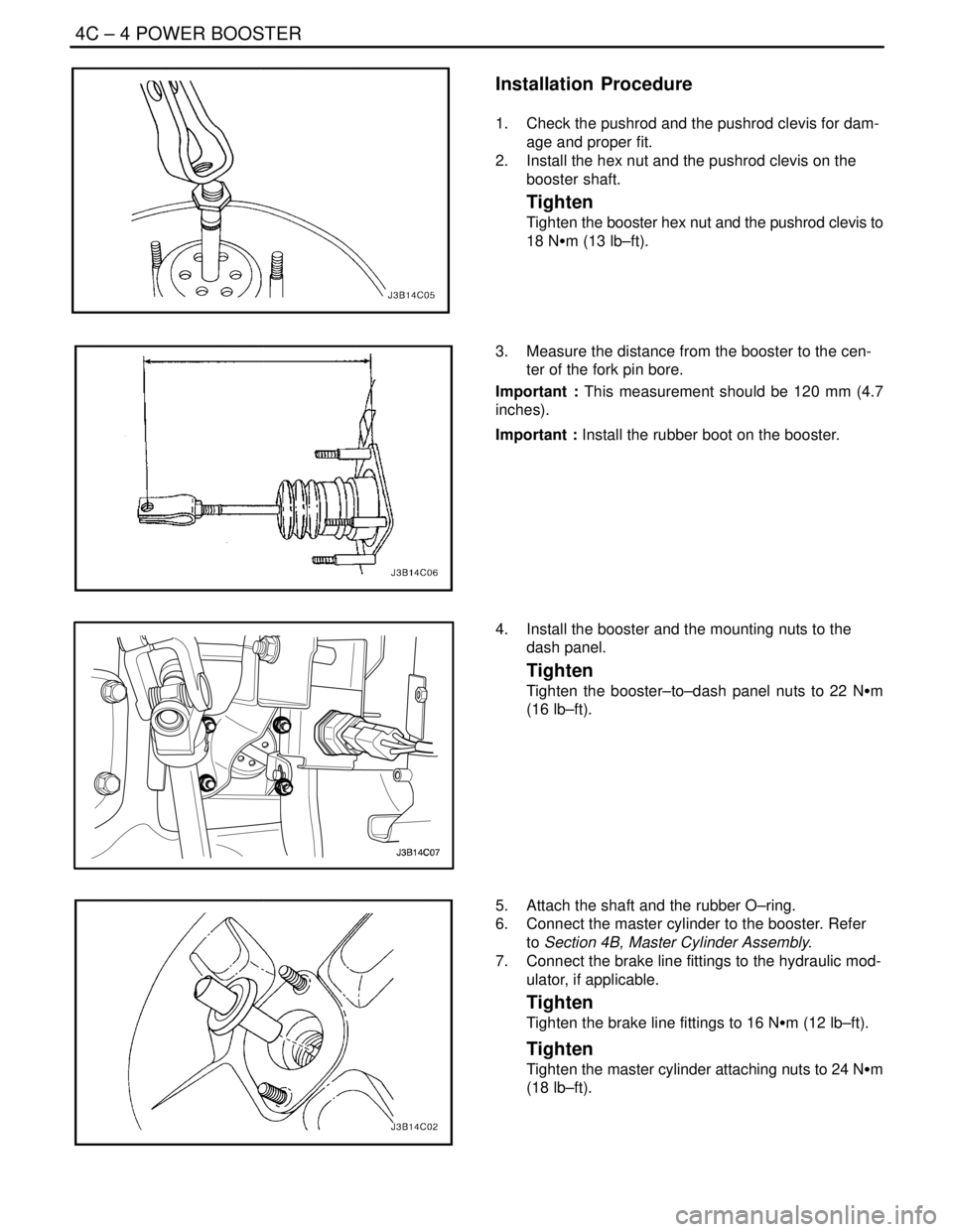
3. Measure the distance from the booster to the cen-
ter of the fork pin bore.
Important : This measurement should be 120 mm (4.7
inches).
Important : Install the rubber boot on the booster.
4. Install the booster and the mounting nuts to the
dash panel.
Tighten
Tighten the booster–to–dash panel nuts to 22 NSm
(16 lb–ft).
5. Attach the shaft and the rubber O–ring.
6. Connect the master cylinder to the booster. Refer
to Section 4B, Master Cylinder Assembly.
7. Connect the brake line fittings to the hydraulic mod-
ulator, if applicable.
Tighten
Tighten the brake line fittings to 16 NSm (12 lb–ft).
Tighten
Tighten the master cylinder attaching nuts to 24 NSm
(18 lb–ft).
Page 1047 of 2643
POWER BOOSTER 4C – 5
DAEWOO V–121 BL4
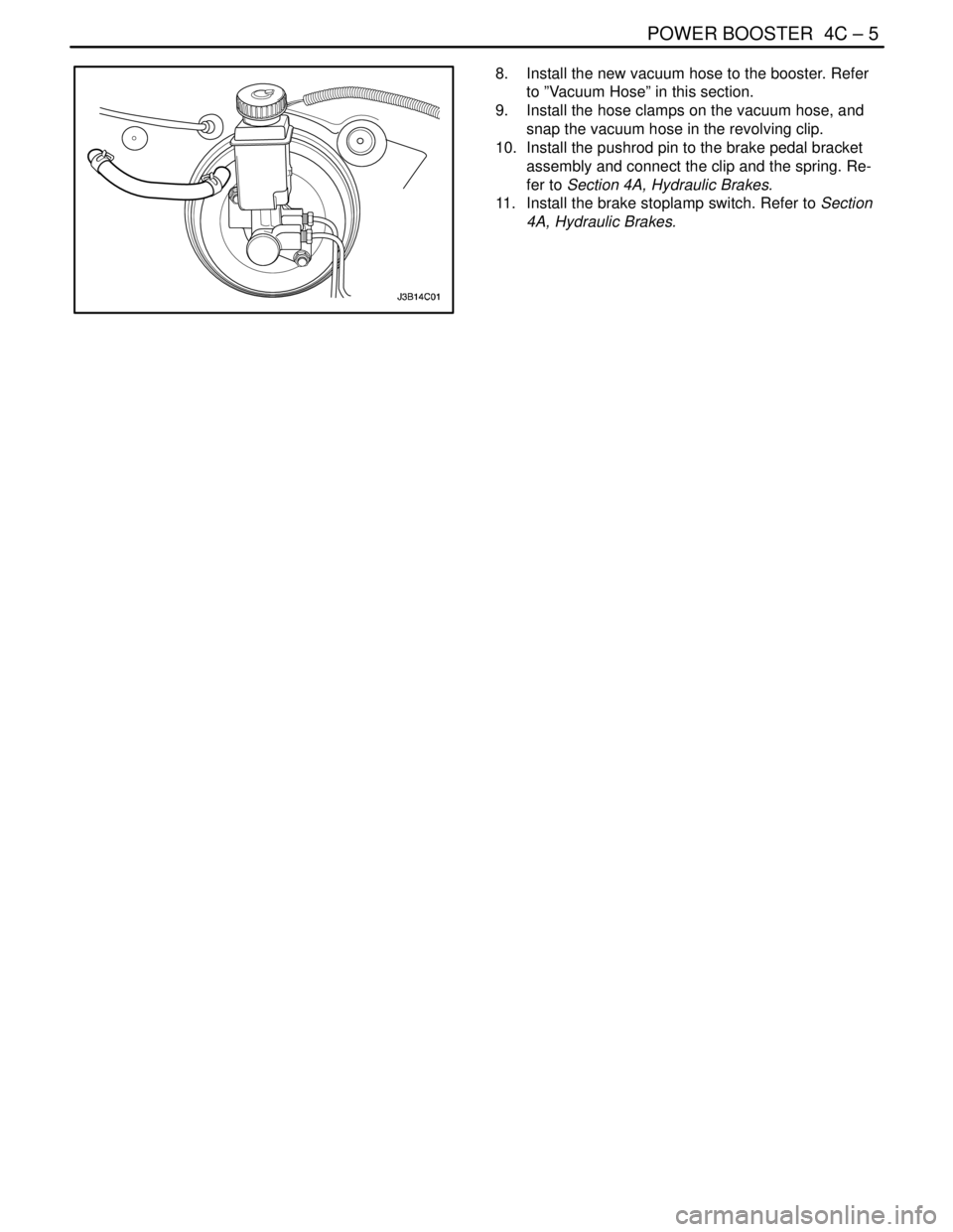
8. Install the new vacuum hose to the booster. Refer
to ”Vacuum Hose” in this section.
9. Install the hose clamps on the vacuum hose, and
snap the vacuum hose in the revolving clip.
10. Install the pushrod pin to the brake pedal bracket
assembly and connect the clip and the spring. Re-
fer to Section 4A, Hydraulic Brakes.
11. Install the brake stoplamp switch. Refer to Section
4A, Hydraulic Brakes.
Page 1048 of 2643
4C – 6IPOWER BOOSTER
DAEWOO V–121 BL4
GENERAL DESCRIPTION
AND SYSTEM OPERATION
POWER BOOSTER
This booster is a single or tandem diaphragm, vacuum–
suspended unit. In a normal operating mode, with the ser-
vice brakes in the release position, a vacuum–suspended
booster operates with a vacuum on both sides of its dia-phragm. When the brakes are applied, air at atmospheric
pressure is admitted to one side of the diaphragm to pro–
vide the power assist. When the brakes are released, at-
mospheric air is shut off from that side of the dia–phragm.
The air is then drawn from the booster through the vacuum
check valve by the vacuum source.
Important : If any hydraulic component is removed or dis-
connected, it may be necessary to bleed all or part of the
brake system.
Page 1052 of 2643
4D – 4IFRONT DISC BRAKES
DAEWOO V–121 BL4
Installation Procedure
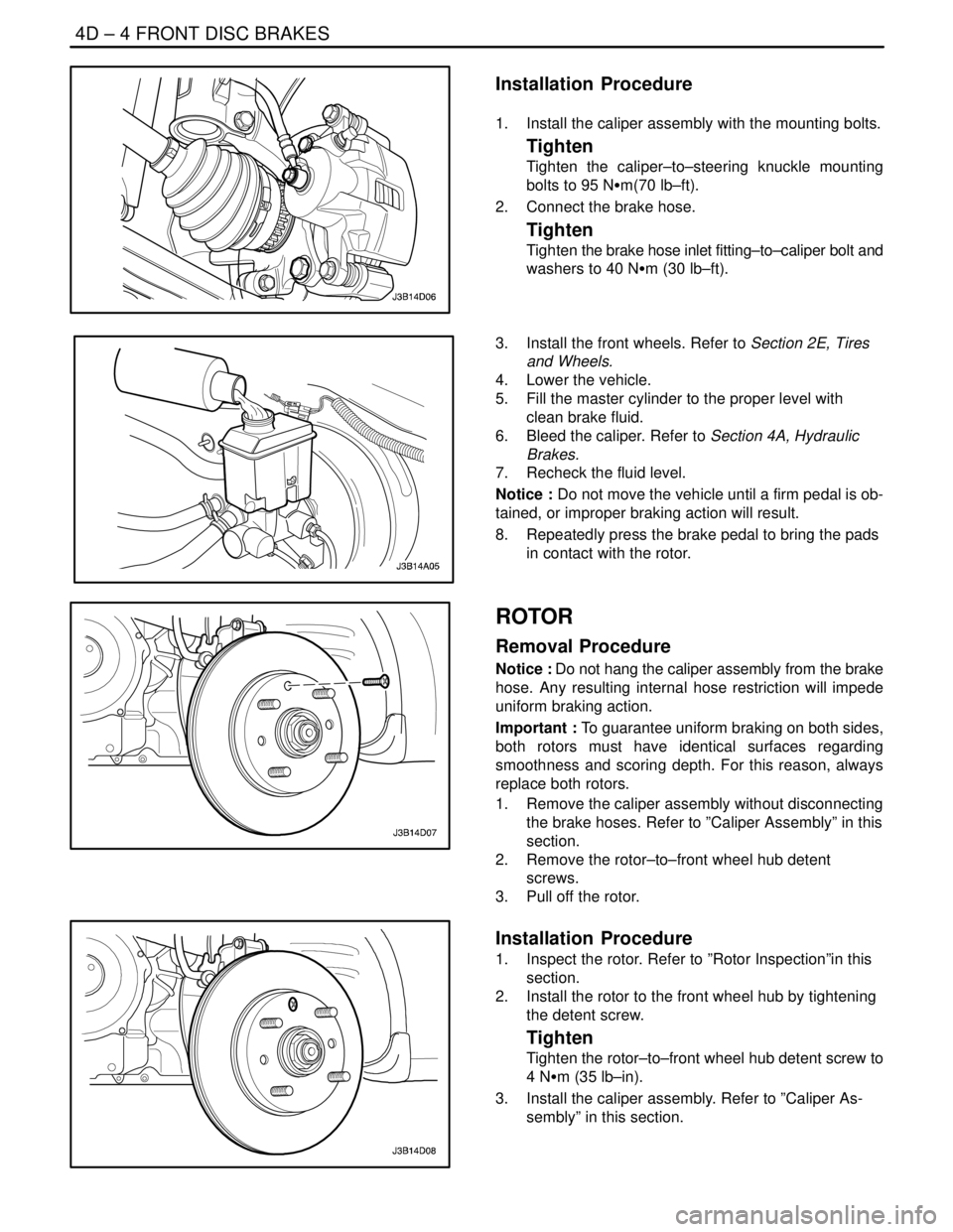
1. Install the caliper assembly with the mounting bolts.
Tighten
Tighten the caliper–to–steering knuckle mounting
bolts to 95 NSm(70 lb–ft).
2. Connect the brake hose.
Tighten
Tighten the brake hose inlet fitting–to–caliper bolt and
washers to 40 NSm (30 lb–ft).
3. Install the front wheels. Refer to Section 2E, Tires
and Wheels.
4. Lower the vehicle.
5. Fill the master cylinder to the proper level with
clean brake fluid.
6. Bleed the caliper. Refer to Section 4A, Hydraulic
Brakes.
7. Recheck the fluid level.
Notice : Do not move the vehicle until a firm pedal is ob-
tained, or improper braking action will result.
8. Repeatedly press the brake pedal to bring the pads
in contact with the rotor.
ROTOR
Removal Procedure
Notice : Do not hang the caliper assembly from the brake
hose. Any resulting internal hose restriction will impede
uniform braking action.
Important : To guarantee uniform braking on both sides,
both rotors must have identical surfaces regarding
smoothness and scoring depth. For this reason, always
replace both rotors.
1. Remove the caliper assembly without disconnecting
the brake hoses. Refer to ”Caliper Assembly” in this
section.
2. Remove the rotor–to–front wheel hub detent
screws.
3. Pull off the rotor.
Installation Procedure
1. Inspect the rotor. Refer to ”Rotor Inspection”in this
section.
2. Install the rotor to the front wheel hub by tightening
the detent screw.
Tighten
Tighten the rotor–to–front wheel hub detent screw to
4 NSm (35 lb–in).
3. Install the caliper assembly. Refer to ”Caliper As-
sembly” in this section.