2004 DAEWOO LACETTI fuse
[x] Cancel search: fusePage 1924 of 2643

POWER STEERING GEAR 6C – 7
DAEWOO V–121 BL4
SPEED SENSITIVE POWER STEERING SYSTEM
OPERATING WITH FULL ASSIST AT ALL TIMES
StepActionValue(s)YesNo
1Perform an initial inspection of the power steering
system.
Is the system operational?–Go to Step 2Go to
Section 6A,
Power Steering
System
2Check the speedometer.
Is the speedometer inoperative?–Go to
Section5,
TransaxleGo to Step 3
3Check the diagnostic trouble codes at the engine
control module (ECM).
Is the ECM code 24 set?–Go to
Section1F,
Engine
ControlsGo to Step 4
41. Turn the ignition ON.
2. Disconnect the electronic variable orifice (EVO)
solenoid actuator electrical connector at the
power steering pump.
3. Probe terminal 1 of the EVO actuator connec-
tor with a voltmeter.
Does the voltmeter display the specified value?–Go to Step 6Go to Step 5
5Repair the open or short in the circuit between termi-
nal 1 of the EVO solenoid actuator electrical connec-
tor and terminal 2 on the speed sensitive power
steering (SSPS) control module connector.
Is the repair complete?–System OK–
61. Remove the EVO solenoid actuator from the
power steering pump.
2. Turn the actuator upside down to position the
pintle.
3. Stimulate the actuator by connecting it to the
battery.
Does the actuator click?–Go to Step 8Go to Step 7
7Replace the EVO solenoid actuator.
Is the repair complete?–System OK–
81. Turn the ignition OFF.
2. Remove the SSPS control module from the
control module bracket.
3. Disconnect the SSPS control module connec-
tor.
4. Connect a test light from terminal 8 on the
SSPS control module connector to the ground.
5. Turn the ignition ON.
Is the test light on?–Go to Step 14Go to Step 9
9Check the ignition fuse.
Is the ignition fuse open?–Go to Step 10Go to Step 11
10Replace the ignition fuse.
Is the repair complete?–System OK–
11Check for an open or short in the circuit between ter-
minal 8 of the control module connector and the I/P
fuse block.
Is the connection faulty?–Go to Step 12Go to Step 13
Page 1925 of 2643

6C – 8IPOWER STEERING GEAR
DAEWOO V–121 BL4
StepNo Yes Value(s) Action
12Repair the open or short in the circuit between termi-
nal 8 of the SSPS control module connector and the
I/P fuse block.
Is the repair complete?–System OK–
13Repair the power feed to the ignition fuse F2.
Is the repair complete?–System OK–
141. Turn the ignition OFF.
2. Connect a test light from terminal 10 of the
SSPS control module connector to B+.
Is the test light on?–Go to Step 16Go to Step 15
15Repair the open in the ground circuit between termi-
nal 10 of the SSPS control module connector and
G203.
Is the repair complete?–System OK–
16Check for a short to B+ or an open in the circuit be-
tween terminal 1 of the SSPS control module con-
nector and terminal B of the EVO solenoid actuator
connector.
Is the connection faulty?–Go to Step 17Go to Step 18
17Repair the short to B+ or an open in the circuit be-
tween terminal 1 of the SSPS control module con-
nector and terminal 2 of the EVO solenoid actuator
connector.
Is the repair complete?–System OK–
181. Disconnect the steering wheel rotation sensor.
2. Turn the ignition ON.
3. Check for an open, short to ground, short to
B+, or poor terminal contact between terminal
5 of the SSPS control module connector and
terminal 1 of the steering wheel rotation sensor
connector.
Is the connection faulty?–Go to Step 19Go to Step 20
19Repair the open, short to ground, short to B+, or poor
terminal contact between terminal 5 of the SSPS
control module connector and terminal 1 of the
steering wheel rotation sensor connector.
Is the repair complete?–System OK–
20Check for an open between terminal 3 of the SSPS
control module connector and terminal 3 of the
steering wheel rotation sensor connector.
Is the connection faulty?–Go to Step 21Go to Step 22
21Repair the open between terminal 3 of the SSPS
control module connector and terminal 3 of the
steering wheel rotation sensor connector.
Is the repair complete?–System OK–
22Check for an open, short to ground, short to B+, or
poor terminal contact between terminal 14 of the
SSPS control module connector and terminal 2 of
the steering wheel rotation sensor connector.
Is the connection faulty?–Go to Step 23Go to Step 24
Page 1957 of 2643

STEERING WHEEL AND COLUMN 6E – 3
DAEWOO V–121 BL4
High Lock Effort
ChecksAction
Check the lock cylinder for damage.Replace the lock cylinder.
Check the ignition switch for lack of free movement.Lubricate the ignition switch.
Check for extreme misalignment of the housing to the cov-
er.Realign the cover on the housing. Replace the cover as
needed.
Check for a bent ignition switch mounting bracket.Replace the ignition switch mounting bracket.
Key Cannot Be Removed in the LOCK Position
ChecksAction
Check to see that the ignition switch is set correctly.Reset the ignition switch.
Check the lock cylinder for damage.Replace the lock cylinder.
Check the fuse F17 from the I/P fuse block.Replace the fuse F17
Check for an open or short in the circuit between terminal
2 of key interlock solenoid and the I/P fuse block.Replace the fuse F17
Select the gear shift lever to ”P” position.
Check the resistance between the terminal 2 and 1 of the
”P” position switch.Replace the ”P” position switch.
Check for an open or short in the circuit between the
ground G202 and terminal 1 of the key interlock unit.Replace the open or short from the circuit.
Turn the ignition ON.
Select the gear shift lever to ”P” position.
Check the resistance between the terminal 1 and 2 of the
key interlock solenoid.Replace the key interlock solenoid.
Page 1983 of 2643

HEATING AND VENTILATION SYSTEM 7A – 9
DAEWOO V–121 BL4
StepNo Yes Value(s) Action
341. Set the blower on maximum speed.
2. Rotate the temperature control from full hot to
full cold.
3. Listen for an airflow change.
Does the airflow change?–Go to Step 35Go to Step 36
351. Check the following aspects of the temperature
door:
S Travel.
S Cables.
S Linkage.
S Control.
2. Verify the accuracy of the temperature control
at full hot.
Is the repair complete?–Go to Step 1–
361. Check the system for any obstruction between
the blower and the system outlets.
2. Remove any obstruction.
Is the repair complete?–Go to Step 1–
BLOWER ELECTRICAL
StepActionValue(s)YesNo
1Verify the customer’s complaint.
Are the customer’s concerns verified?–Go to Step 2System OK
2Turn the blower ON.
Does the blower run at any speed?–Go to Step 14Go to Step 3
31. Disconnect the power connector from the blow-
er motor under the dashboard on the passen-
ger side of the vehicle.
2. Turn the ignition ON.
3. Turn the blower ON.
4. Test for voltage on the connector. The terminal
connected to the violet wire is positive and the
terminal connected to the black wire is nega-
tive.
Is this voltage present?11–14vGo to Step 4Go to Step 5
4Replace the blower motor.
Is the repair complete?–System OK–
5Check fuse F7 in the I/P fuse block in the engine fuse
block.
Is the fuse blown?–Go to Step 6Go to Step 7
61. Turn the ignition ON.
2. Use a short detector to locate a possible short
in the following locations:
S Fuse panel–to–blower speed switch.
S Blower speed switch–to–heater resistor
block.
S Heater resistor block–to–blower motor.
S Blower speed switch–to–blower HI relay.
3. Repair any short.
4. Replace any blown fuse.
Is the repair complete?–System OK–
Page 1984 of 2643

7A – 10IHEATING AND VENTILATION SYSTEM
DAEWOO V–121 BL4
StepNo Yes Value(s) Action
71. Turn the ignition ON.
2. Set the blower switch on 4.
3. Check the blower motor ground.
Is ground OK?–Go to Step 9Go to Step 8
8Repair the blower motor ground.
Is the repair complete?–System OK–
9Check the motor connector with a 12–volt test light.
Does the test light come on?–Go to Step 10Go to Step 11
10Repair the open in the feed wire from the resistor
block to the blower motor.
Is the repair complete?–System OK–
11Use the 12–volt test light to check the power feed
terminal on the blower speed switch.
Does the light come on?–Go to Step 12Go to Step 13
12Replace the blower speed switch.
Is the repair complete?–System OK–
13Repair the open in the power wire from the blower
speed switch to the fuse panel.
Is the repair complete?–System OK–
14Turn the blower on speed 4.
Does the blower fail to operate at speed 4?–Go to Step 15Go to Step 21
15Check fuse EF3 in the engine fuse block.
Is the fuse blown?–Go to Step 16Go to Step 17
161. Turn the ignition ON.
2. Turn the blower motor switch to 4.
3. Use a short detector to locate a possible short
in the following locations:
S Engine fuse panel–to–blower HI relay.
S Blower HI relay–to–blower motor.
4. Repair any short.
5. Replace the EF3 fuse.
Is the repair complete?–System OK–
171. Turn the ignition switch ON.
2. Set the blower switch to 4.
3. Check for 12 volts on the blower HI relay coil
terminal from the blower speed switch terminal
A7.
Is this voltage present?–Go to Step 18Go to Step 19
18Replace the blower speed switch.
Is the repair complete?–System OK–
191. Turn the ignition OFF.
2. Check for opens in the following locations:
S EF3 fuse–to–blower HI relay.
S Blower speed switch–to–blower– HI relay.
S Blower HI relay–to–ground.
S Blower HI relay–to–blower motor.
3. Repair any opens.
Is the repair complete?–System OKGo to Step 20
20Replace the blower HI relay.
Is the repair complete?–System OK–
Page 2014 of 2643

7B – 12IMANUAL CONTROL HEATING, VENTILATION AND AIR CONDITIONING SYSTEM
DAEWOO V–121 BL4
V5 SYSTEM AIR CONDITIONING DIAGNOSIS
INSUFFICIENT COOLING DIAGNOSIS
Test Description
The numbers below refer to steps on the diagnostic table.
13. See the Important below.
32. See the Important below.Important : Perform this test under garage conditions with
the air temperature at 21–32°C (70–90°F), and no sun
load. Follow this test carefully for accurate results.
Important : Perform this test exactly as described to ob-
tain accurate results.
Step
ActionValue(s)YesNo
1Record the customer’s complaint.
Can you verify the customer’s complaint?–Go to Step 2System OK
21. Check the A/C fuse.
2. Check the blower fan operation.
3. Check the engine cooling fan operation.
4. Check the A/C compressor belt.
5. Check the A/C condenser for restricted airflow.
6. Check the clutch coil connection.
7. Repair or replace any components as needed.
8. Check the discharge air temperature with the
A/C turned ON.
Is the discharge air temperature normal?At least 7°C
(12°F) below
ambient air
temperatureSystem OKGo to Step 3
31. Turn the ignition switch to LOCK.
2. Connect the high– and the low–pressure
gauges.
Are both pressures within the value specified?69–345 kPa
(10–50 psi)Go to Step 4Go to Step 5
41. Check the A/C system for leaks.
2. Repair any refrigerant leaks as needed.
3. Recover, evacuate, and recharge the A/C sys-
tem.
4. Observe the two pressure gauges.
Are both pressures above the value specified?345 kPa
(50 psi)Go to Step 7–
5Observe the two pressure gauges.
Are both pressures below the value specified?69 kPa
(10 psi)Go to Step 6Go to Step 7
61. Add 0.45 kg (1 pound) of refrigerant R–134a.
2. Check the A/C system for leaks.
3. Repair any refrigerant leaks, as needed.
4. Recover, evacuate, and recharge the A/C sys-
tem.
5. Observe the two pressure gauges.
Are both pressures above the value specified?345 kPa
(50 psi)Go to Step 7–
71. Start the engine and allow it to run at idle.
2. Set the A/C controls to the following positions:
S The A/C switch to the ON.
S The fresh air control switch to fresh air (in-
dicator lamp OFF).
S The blower motor to 4.
S The temperature to full cold.
Does the A/C compressor clutch engage?–Go to Step 8Go to Step 10
Page 2015 of 2643

MANUAL CONTROL HEATING, VENTILATION AND AIR CONDITIONING SYSTEM 7B – 13
DAEWOO V–121 BL4
StepNo Yes Value(s) Action
81. Check for a knocking noise from the A/C com-
pressor.
2. Cycle the A/C compressor ON and OFF in or-
der to verify the source of the noise.
Do you hear a loud knocking noise?–Go to Step 9Go to Step 13
91. Recover the A/C system refrigerant.
2. Replace the A/C compressor.
3. Evacuate and recharge the A/C system.
4. Check the A/C system for leaks.
Is the compressor running normally?–Go to Step 13–
101. Turn the ignition switch to LOCK.
2. Disconnect the A/C compressor clutch coil con-
nector.
3. Connect a jumper wire from ground to one A/C
compressor clutch coil terminal.
4. Connect a fused jumper wire from the positive
battery terminal to the other A/C compressor
clutch coil terminal.
Does the A/C clutch engage?–Go to Step 11Go to Step 12
11Repair the electrical circuit to the A/C compressor
clutch coil.
Does the A/C clutch engage?–Go to Step 8–
12Replace the A/C compressor clutch coil.
Does the A/C clutch engage?–Go to Step 8–
131. Close all of the vehicle’s windows and doors.
2. Set the A/C controls to the following positions:
S The A/C switch to the ON position.
S The fresh air control switch to fresh air.
S The blower motor to 4.
S The temperature to full cold.
3. Start the engine and allow it to run at idle for 5
minutes.
4. Feel the evaporator inlet and outlet pipes.
Is there a noticeable difference in the temperature of
the evaporator inlet and outlet pipes?–Go to Step 15Go to Step 14
141. Turn the ignition switch to LOCK.
2. Recover the A/C system refrigerant.
3. Examine the high–pressure pipe for an ob-
struction.
4. Examine the expansion valve for an obstruction
or a malfunction.
5. Repair the obstruction or replace the expansion
valve as needed.
6. Evacuate and recharge the A/C system.
7. Check the A/C system for leaks.
8. Note the discharge air temperature with the
A/C ON.
Is the discharge temperature normal?At least 7°C
(12°F) below
ambient air
temperatureGo to Step 15Go to Step 13
Page 2026 of 2643
7B – 24IMANUAL CONTROL HEATING, VENTILATION AND AIR CONDITIONING SYSTEM
DAEWOO V–121 BL4
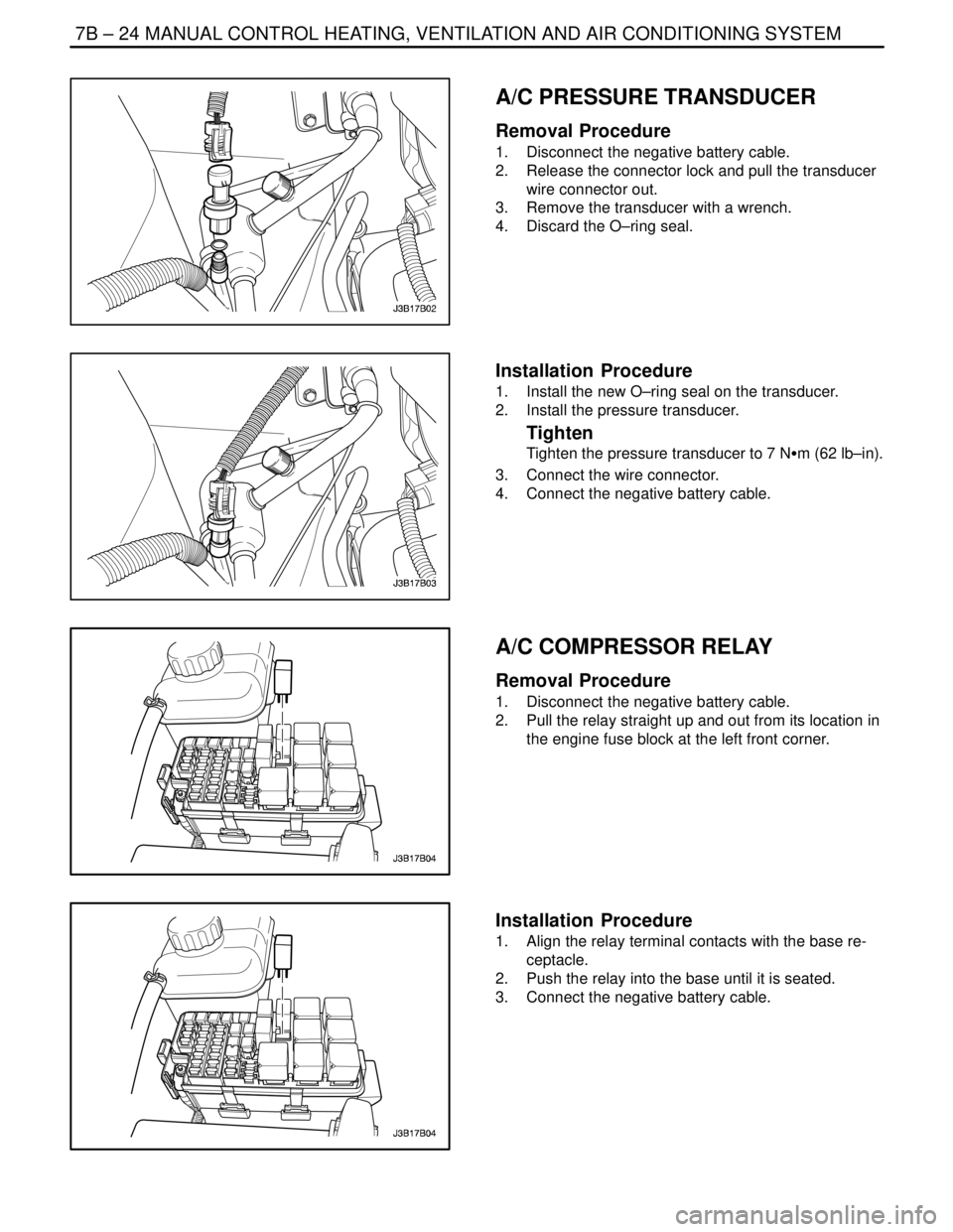
A/C PRESSURE TRANSDUCER
Removal Procedure
1. Disconnect the negative battery cable.
2. Release the connector lock and pull the transducer
wire connector out.
3. Remove the transducer with a wrench.
4. Discard the O–ring seal.
Installation Procedure
1. Install the new O–ring seal on the transducer.
2. Install the pressure transducer.
Tighten
Tighten the pressure transducer to 7 NSm (62 lb–in).
3. Connect the wire connector.
4. Connect the negative battery cable.
A/C COMPRESSOR RELAY
Removal Procedure
1. Disconnect the negative battery cable.
2. Pull the relay straight up and out from its location in
the engine fuse block at the left front corner.
Installation Procedure
1. Align the relay terminal contacts with the base re-
ceptacle.
2. Push the relay into the base until it is seated.
3. Connect the negative battery cable.