Page 162 of 277

WARNING!
•Leaving children in a vehicle unattended is dan-
gerous for several reasons. A child or others could
be injured. Children should be warned not to
touch the parking brake or the gear selector. Don’t
leave the keys in the ignition. A child could
operate power windows, other controls, or move
the vehicle.
•Be sure the parking brake is fully disengaged
before driving; failure to do so can lead to brake
failure and an accident.
BRAKE SYSTEM
Your vehicle is equipped with power brakes as standard
equipment. In the event you lose power assist for any
reason (for example, repeated brake applications with the
engine off), the brakes will still function. The effort
required to brake the vehicle will be substantially in-
creased over that required with the power system oper-
ating.
If either of the two hydraulic systems lose normal capa-
bility, the remaining system will still function with some
loss of overall braking effectiveness. This will be evident
by increased pedal travel during application, greater
pedal force required to slow or stop, and activation of the
Brake Warning Lamp during brake use.
162 STARTING AND OPERATING
Page 175 of 277

FUEL REQUIREMENTS
300M
Your engine is designed to meet all emissions regulations
and provide satisfactory fuel economy and performance
when using high quality unleaded gasoline having an
octane range of 87 to 89 or higher. The manufacturer
recommends the use of 89 octane for optimum perfor-
mance.
300M Special Only
Your engine is designed to meet all emissions regulations
and provide satisfactory fuel economy and performance
when using high quality unleaded gasoline having an
octane range of 87 to 91. The manufacturer recommends
the use of 91 octane premium gasoline for optimum
performance.
Light spark knock at low engine speeds is not harmful to
your engine. However, continued heavy spark knock at
high speeds can cause damage and should be reported to
your dealer immediately. Engine damage resulting from
operating with a heavy spark knock may not be covered
by the new vehicle warranty.Poor quality gasoline can cause problems such as hard
starting, stalling and stumble. If you experience these
problems, try another brand of gasoline before consider-
ing service for the vehicle.
Over 40 automobile manufacturers around the world
have issued and endorsed consistent gasoline specifica-
tions (the World Wide Fuel Charter, WWFC) to define
fuel properties necessary to deliver enhanced emissions,
engine performance, and durability for your vehicle. The
manufacturer recommends the use of gasolines that meet
the WWFC specifications if they are available.
Reformulated Gasoline
Many areas of the country require the use of cleaner
burning fuel referred to as “Reformulated Gasoline”.
Reformulated gasolines contain oxygenates, and are spe-
cially blended to reduce vehicle emissions and improve
air quality.
The manufacturer supports the use of reformulated gaso-
lines. Properly blended reformulated gasolines will pro-
vide excellent performance and durability of engine and
fuel system components.
STARTING AND OPERATING 175
5
Page 178 of 277
CAUTION!
Damage to the fuel system or emission control
system could result from using an improper fuel
tank filler tube cap (gas cap). A poorly fitting cap
could let impurities into the fuel system. The Mal-
function Indicator light will come on if the gas cap is
not properly secured.
NOTE:The fuel tank filler tube has a restricting door
about 2 inches (50 mm) down from the opening. If fuel is
poured from a portable container, the container should
have a flexible nozzle long enough to force open the
restricting door.
CAUTION!
To avoid fuel spillage and overfilling, do not “top
off” the fuel tank after filling.
NOTE:
•
When the fuel nozzle “clicks” or shuts off, the fuel
tank is full.
•Tighten the gas cap until you hear a “clicking” sound.
This is an indication that the gas cap is properly
tightened.
The Malfunction Indicator light will come on if the gas
cap is not properly secured. Make sure that the gas cap
is tightened each time the vehicle is refueled.
WARNING!
•Never have any smoking materials lit in or near
the vehicle when the gas cap is removed or the
tank filled.
•Never add fuel to the vehicle when the engine is
running.
•A fire may result if gasoline is pumped into a
portable container that is inside of a vehicle. You
could be burned. Always place gas containers on
the ground while filling.
178 STARTING AND OPERATING
Page 180 of 277
adequate performance. For Example, choose “4” if the
desired speed can be maintained. Choose “3” or “2” if
needed to maintain the desired speed.
Extended driving at high RPM’s should be avoided to
prevent excess heat generation. A reduction in vehicle
speed may be necessary to avoid extended driving at
high RPMs. Return to a higher gear range or vehicle
speed when road conditions and RPM level allow.
•
The trailer tongue load must be considered as part of
the tow vehicle load capacity when loading the ve-
hicle.
•If the trailer weighs more than 1,000 lbs. (450 kg), it
should have its own brakes.
WARNING!
Connecting trailer brakes to your vehicle’s hydraulic
brake lines can overload your brake system and
cause it to fail. You might not have brakes when you
need them and could have an accident.
•Whenever you pull a trailer, regardless of the trailer
size, stop lights and turn signals on the trailer are
recommended for motoring safety.
•The automatic transmission fluid, filter, and hypoid
differential fluid should be changed per Maintenance
Schedule “B” if you tow a trailer.
•If your Engine Coolant Light comes on, see the para-
graph on Overheating in Section 6 of this manual.
NOTE:Check the automatic transmission fluid level
before all towing. Fluid discoloration, or a burnt odor,
shows the need for a transmission fluid and filter change.
180 STARTING AND OPERATING
Page 181 of 277
WHAT TO DO IN EMERGENCIES
CONTENTS
�Hazard Warning Flasher.................182
�If Your Engine Overheats................182
�Jacking And Tire Changing...............183
▫Preparations For Jacking................184
▫Jacking And Changing a Tire.............184
▫Compact Spare Tire-For Temporary Emergency
Use Only...........................188
▫Wheel Cover Installation (If Required)......188
�Jump-Starting The Battery...............189
�Driving On Slippery Surfaces.............191
▫Acceleration.........................191
▫Traction............................192
�Freeing A Stuck Vehicle.................192
�Towing A Disabled Vehicle...............193
6
Page 182 of 277
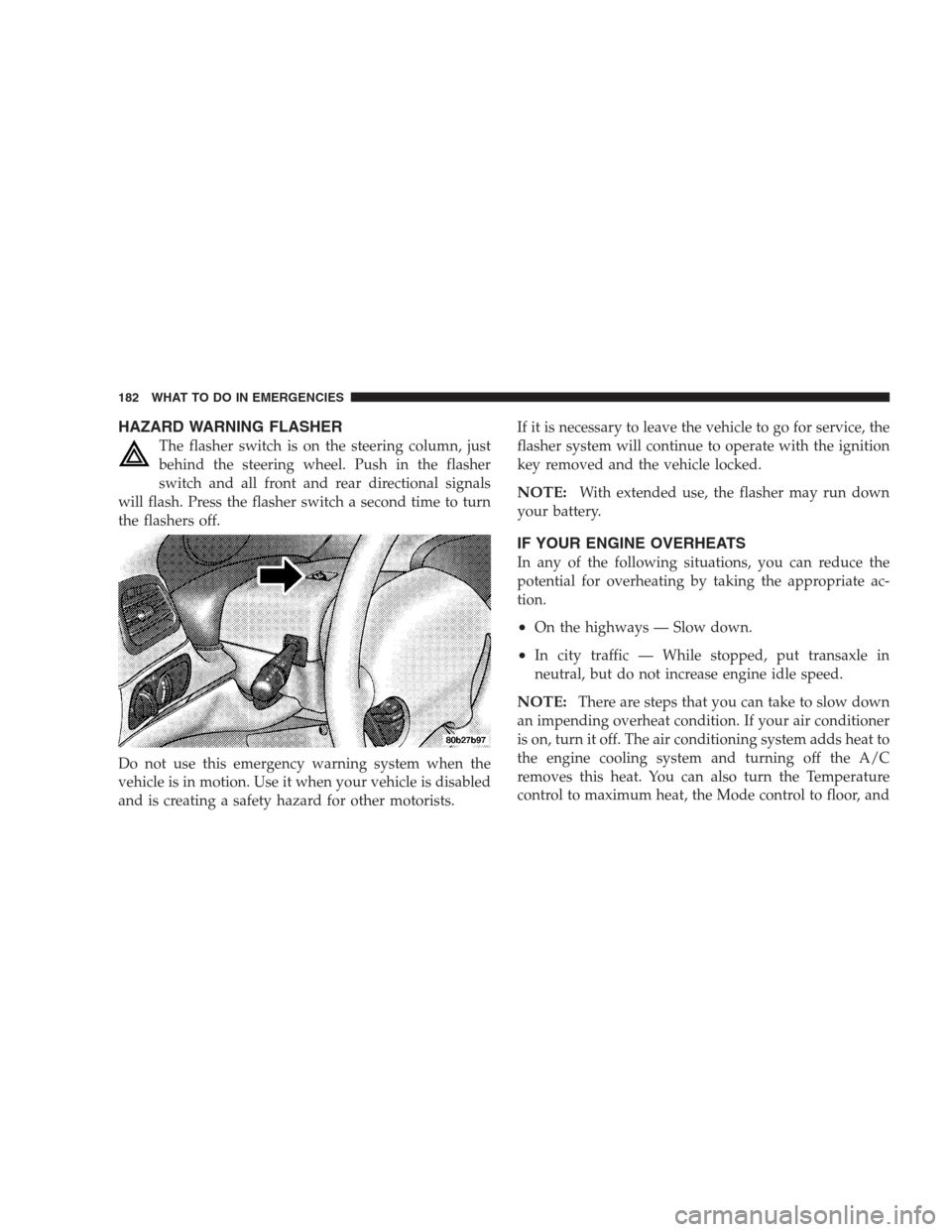
HAZARD WARNING FLASHER
The flasher switch is on the steering column, just
behind the steering wheel. Push in the flasher
switch and all front and rear directional signals
will flash. Press the flasher switch a second time to turn
the flashers off.
Do not use this emergency warning system when the
vehicle is in motion. Use it when your vehicle is disabled
and is creating a safety hazard for other motorists.If it is necessary to leave the vehicle to go for service, the
flasher system will continue to operate with the ignition
key removed and the vehicle locked.
NOTE:With extended use, the flasher may run down
your battery.
IF YOUR ENGINE OVERHEATS
In any of the following situations, you can reduce the
potential for overheating by taking the appropriate ac-
tion.
•On the highways — Slow down.
•In city traffic — While stopped, put transaxle in
neutral, but do not increase engine idle speed.
NOTE:There are steps that you can take to slow down
an impending overheat condition. If your air conditioner
is on, turn it off. The air conditioning system adds heat to
the engine cooling system and turning off the A/C
removes this heat. You can also turn the Temperature
control to maximum heat, the Mode control to floor, and
182 WHAT TO DO IN EMERGENCIES
Page 183 of 277
the fan control to High. This allows the heater core to act
as a supplement to the radiator and aids in removing heat
from the engine cooling system.
CAUTION!
Driving with a hot cooling system could damage
your vehicle. If temperature gauge reads “H”, pull
over and stop the vehicle. Idle the vehicle with the
air conditioner turned off until the pointer drops
back into the normal range. If the pointer remains on
the “H”, turn the engine off immediately, and call for
service.
WARNING!
A hot engine cooling system is dangerous. You or
others could be badly burned by steam or boiling
coolant. You may want to call a service center if your
vehicle overheats. If you decide to look under the
hood yourself, see Section 7, Maintenance, of this
manual. Follow the warnings under the Cooling
System Pressure Cap paragraph.
JACKING AND TIRE CHANGING
WARNING!
Getting under a jacked-up vehicle is dangerous. The
vehicle could slip off the jack and fall on you. You
could be crushed. Never get any part of your body
under a vehicle that is on a jack. Never start or run
the engine while the vehicle is on a jack. If you need
to get under a raised vehicle, take it to a service
center where it can be raised on a lift.
WHAT TO DO IN EMERGENCIES 183
6
Page 184 of 277
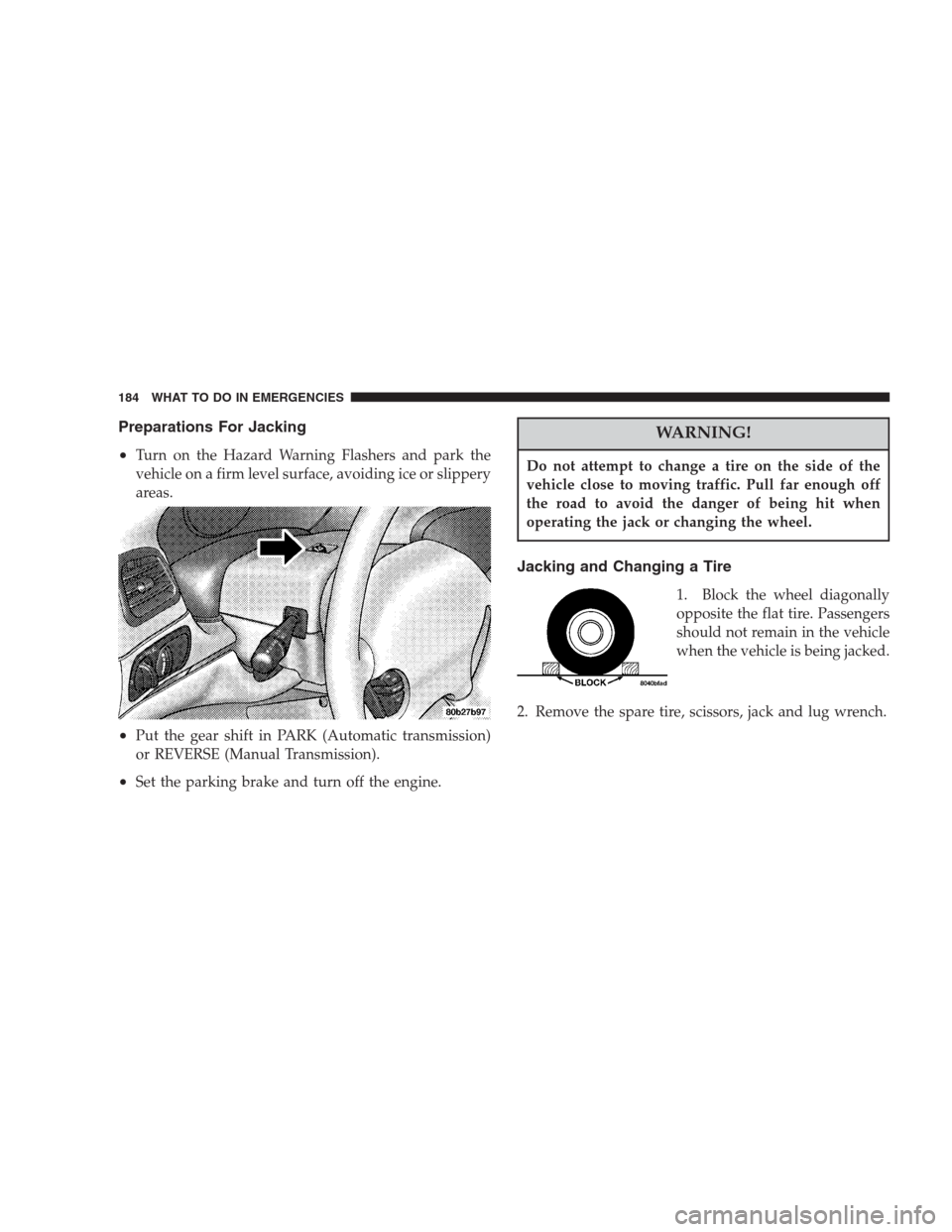
Preparations For Jacking
•
Turn on the Hazard Warning Flashers and park the
vehicle on a firm level surface, avoiding ice or slippery
areas.
•Put the gear shift in PARK (Automatic transmission)
or REVERSE (Manual Transmission).
•Set the parking brake and turn off the engine.
WARNING!
Do not attempt to change a tire on the side of the
vehicle close to moving traffic. Pull far enough off
the road to avoid the danger of being hit when
operating the jack or changing the wheel.
Jacking and Changing a Tire
1. Block the wheel diagonally
opposite the flat tire. Passengers
should not remain in the vehicle
when the vehicle is being jacked.
2. Remove the spare tire, scissors, jack and lug wrench.
184 WHAT TO DO IN EMERGENCIES