Page 113 of 277

INSTRUMENT CLUSTER DESCRIPTION
1. Fuel Gauge
When the ignition is in the ON position, the
pointer will show the level of fuel remaining in
the tank.
2. Low Fuel Warning Light
When the fuel level drops to about 2 gallons (8
liters), the Low Fuel symbol will light and re-
main lit until fuel is added. A warning chime will
sound when the light comes on.
3. Low Oil Pressure Light
This light indicates low engine oil pressure. The
light should come on briefly as a bulb check
when the engine is first started. If the light stays on or
comes on while driving, stop the vehicle and shut off
the engine. DO NOT operate the vehicle until the
cause is corrected.This light does not show how
much oil is in the engine.The engine oil level must be
checked under the hood.4. TRAC ON/OFF Lights
The Traction Control On light (TRAC ON) will come on
momentarily as a bulb check when the ignition switch is
first turned ON. If the light does not come on, have the
bulb replaced.
The TRAC ON light will also come on when the system
is controlling traction.
The Traction Control Off light (TRAC OFF) will come on
momentarily as a bulb check when the ignition switch is
first turned ON. If the light does not come on, have the
bulb checked.
The TRAC OFF light will come on when the Traction
Control switch has been used to turn the system off.
5. Trunk Ajar Light
This light indicates that the trunk is not latched
6. Tachometer
Measures engine revolutions-per-minute (R.P.M.). The
red numbers at the end on the scale show the maximum
permissible R.P.M. Ease off on the accelerator before
reaching the red area.
UNDERSTANDING YOUR INSTRUMENT PANEL 113
4
Page 201 of 277
WARNING!
You can be badly injured working on or around a
motor vehicle. Do only that service work for which
you have the knowledge and the proper equipment.
If you have any doubt about your ability to perform
a service job, take your vehicle to a competent
mechanic.
MAINTENANCE PROCEDURES
The pages that follow contain the maintenance service
recommended by the engineers who designed your ve-
hicle.
Besides the maintenance items for which there are fixed
maintenance intervals, there are other items that should
operate satisfactorily without periodic maintenance.
However, if a malfunction of these items does occur, it
could adversely affect the engine or vehicle performance.
These items should be inspected if a malfunction is
observed or suspected.
Engine Oil
Checking Oil Level
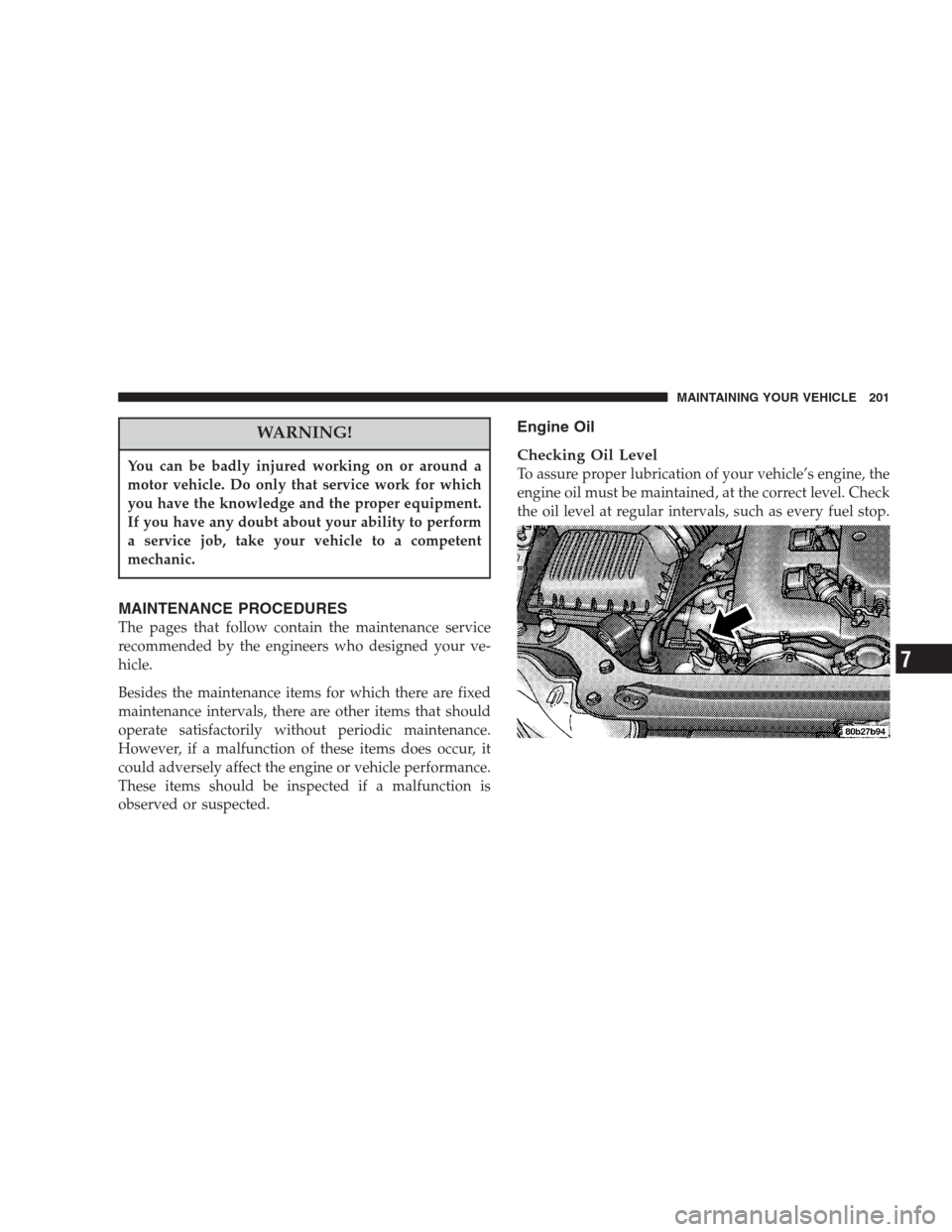
To assure proper lubrication of your vehicle’s engine, the
engine oil must be maintained, at the correct level. Check
the oil level at regular intervals, such as every fuel stop.
MAINTAINING YOUR VEHICLE 201
7
Page 202 of 277
The best time to check the oil level is about 5 minutes
after a fully warmed up engine is shut off or before
starting the engine after it has sat overnight.
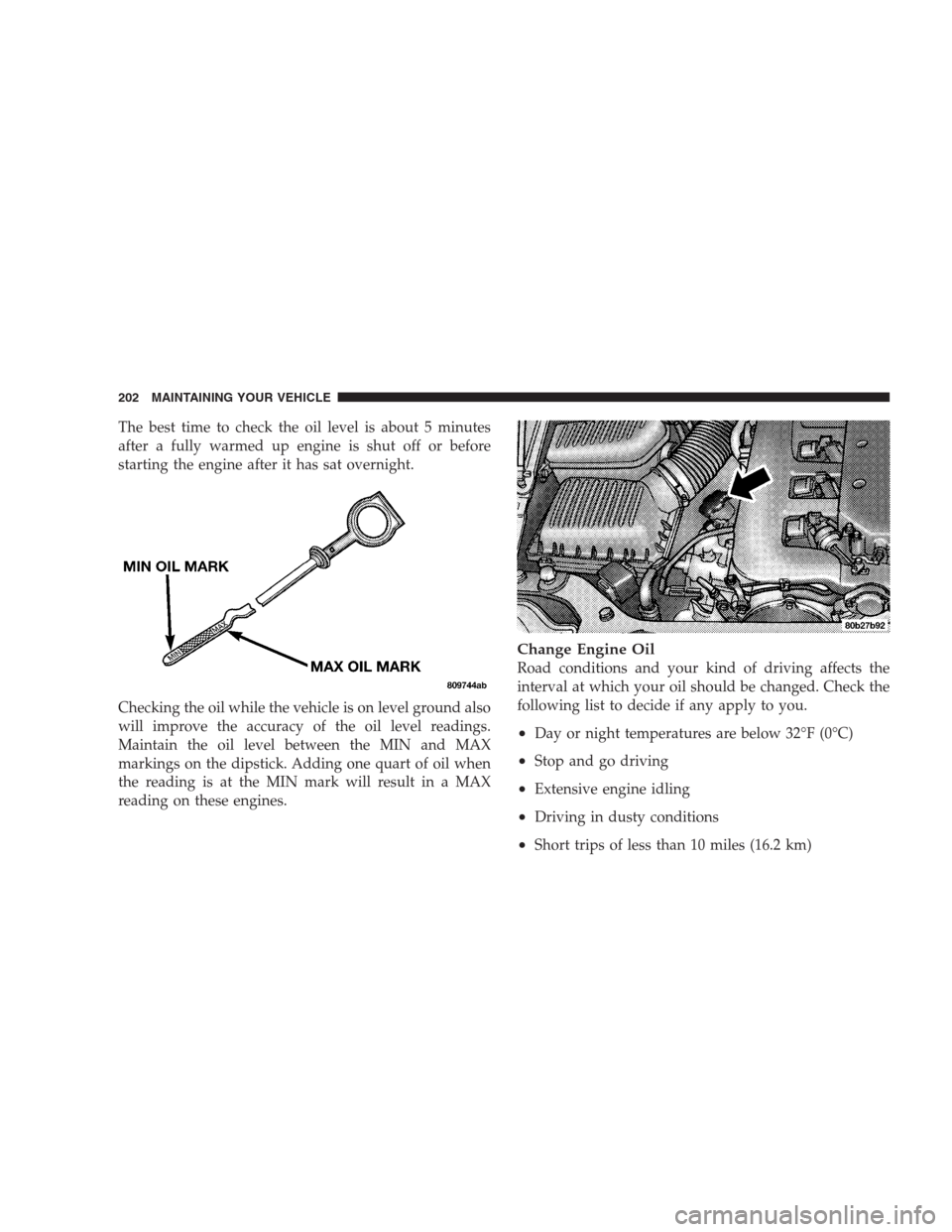
Checking the oil while the vehicle is on level ground also
will improve the accuracy of the oil level readings.
Maintain the oil level between the MIN and MAX
markings on the dipstick. Adding one quart of oil when
the reading is at the MIN mark will result in a MAX
reading on these engines.
Change Engine Oil
Road conditions and your kind of driving affects the
interval at which your oil should be changed. Check the
following list to decide if any apply to you.
•Day or night temperatures are below 32°F (0°C)
•Stop and go driving
•Extensive engine idling
•Driving in dusty conditions
•Short trips of less than 10 miles (16.2 km)
202 MAINTAINING YOUR VEHICLE
Page 213 of 277
Windshield Washers
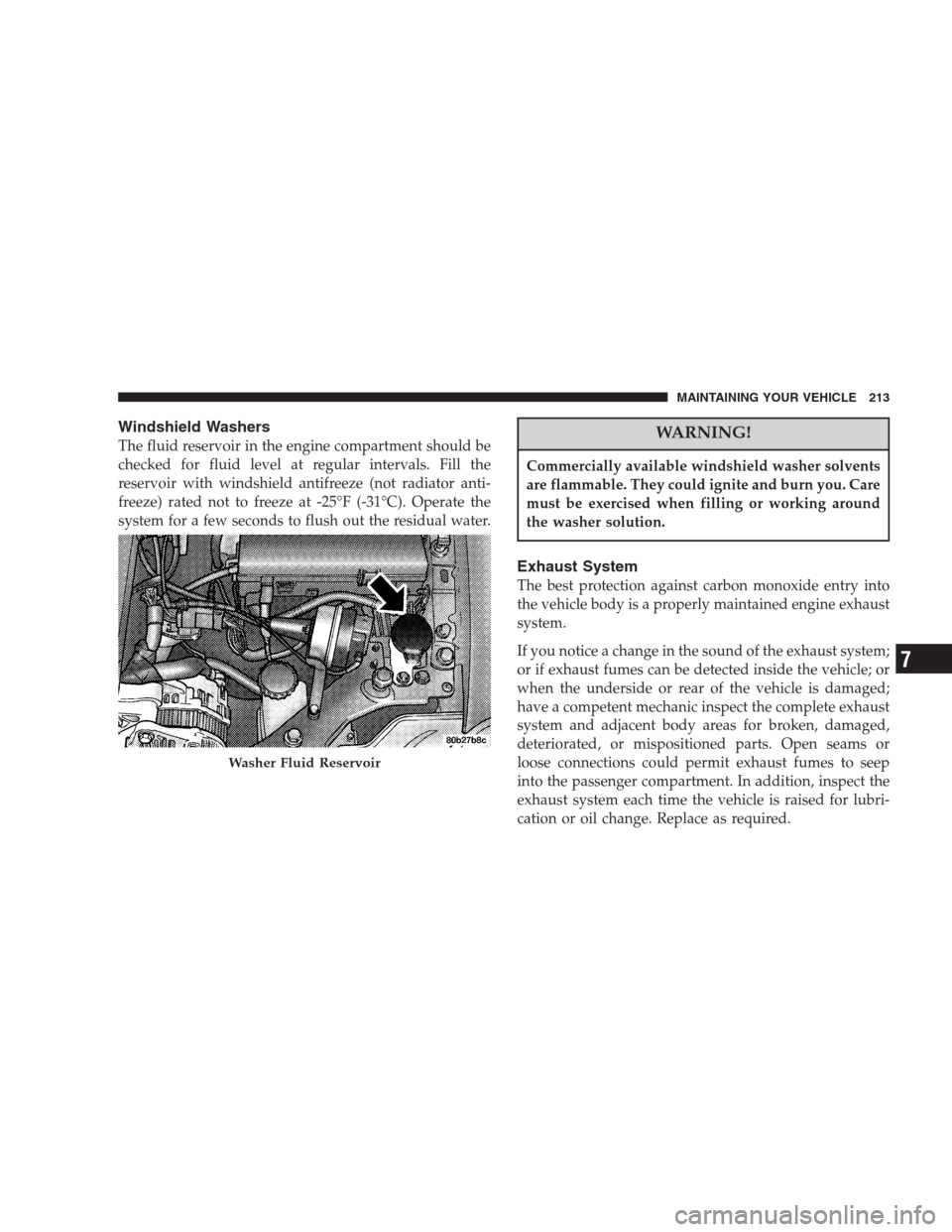
The fluid reservoir in the engine compartment should be
checked for fluid level at regular intervals. Fill the
reservoir with windshield antifreeze (not radiator anti-
freeze) rated not to freeze at -25°F (-31°C). Operate the
system for a few seconds to flush out the residual water.WARNING!
Commercially available windshield washer solvents
are flammable. They could ignite and burn you. Care
must be exercised when filling or working around
the washer solution.
Exhaust System
The best protection against carbon monoxide entry into
the vehicle body is a properly maintained engine exhaust
system.
If you notice a change in the sound of the exhaust system;
or if exhaust fumes can be detected inside the vehicle; or
when the underside or rear of the vehicle is damaged;
have a competent mechanic inspect the complete exhaust
system and adjacent body areas for broken, damaged,
deteriorated, or mispositioned parts. Open seams or
loose connections could permit exhaust fumes to seep
into the passenger compartment. In addition, inspect the
exhaust system each time the vehicle is raised for lubri-
cation or oil change. Replace as required.
Washer Fluid Reservoir
MAINTAINING YOUR VEHICLE 213
7
Page 219 of 277
WARNING!
Riding the brakes can lead to brake failure and
possibly an accident. Driving with your foot resting
or riding on the brake pedal can result in abnormally
high brake temperatures, excessive lining wear, and
possible brake damage. You wouldn’t have your full
braking capacity in an emergency.
Brake and Power Steering System Hoses
When servicing the vehicle for scheduled maintenance,
inspect surface of hoses for evidence of heat and me-
chanical damage. Hard and brittle rubber, cracking,
checking, tears, cuts, abrasion, and excessive swelling
suggest deterioration of the rubber. Particular attention
should be made to examining those hose surfaces nearest
to high heat sources, such as the exhaust manifold.
Inspect all hose clamps and couplings to make sure they
are secure and no leaks are present.
NOTE:Often, fluids such as oil, power steering fluid,
and brake fluid are used during assembly plant opera-
tions to ease the assembly of hoses to couplings. There-
fore, oil wetness at the hose-coupling area is not neces-
sarily an indication of leakage. Actual dripping of hot
fluid when systems are under pressure (during vehicle
operation) should be noted before hose is replaced based
on leakage.
NOTE:Inspection of brake hoses should be done
whenever the brake system is serviced and every engine
oil change.
WARNING!
Worn brake hoses can burst and cause brake failure.
You could have an accident. If you see any signs of
cracking, scuffing, or worn spots, have the brake
hoses replaced immediately.
Brake Master CylinderThe fluid level in the master cylinder should be checked
when performing under hood services, or immediately if
the brake system warning lamp shows system failure.
MAINTAINING YOUR VEHICLE 219
7
Page 220 of 277
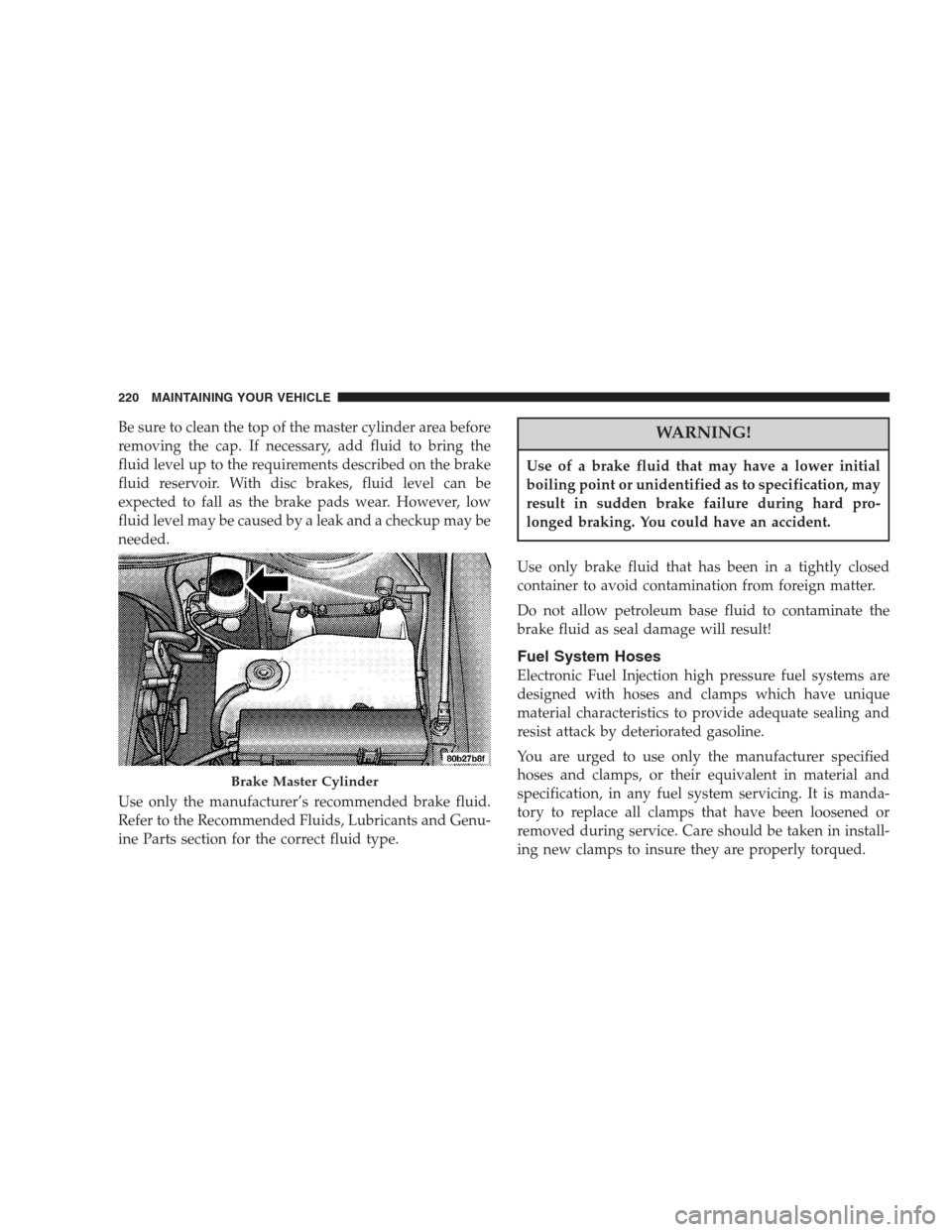
Be sure to clean the top of the master cylinder area before
removing the cap. If necessary, add fluid to bring the
fluid level up to the requirements described on the brake
fluid reservoir. With disc brakes, fluid level can be
expected to fall as the brake pads wear. However, low
fluid level may be caused by a leak and a checkup may be
needed.
Use only the manufacturer’s recommended brake fluid.
Refer to the Recommended Fluids, Lubricants and Genu-
ine Parts section for the correct fluid type.WARNING!
Use of a brake fluid that may have a lower initial
boiling point or unidentified as to specification, may
result in sudden brake failure during hard pro-
longed braking. You could have an accident.
Use only brake fluid that has been in a tightly closed
container to avoid contamination from foreign matter.
Do not allow petroleum base fluid to contaminate the
brake fluid as seal damage will result!
Fuel System Hoses
Electronic Fuel Injection high pressure fuel systems are
designed with hoses and clamps which have unique
material characteristics to provide adequate sealing and
resist attack by deteriorated gasoline.
You are urged to use only the manufacturer specified
hoses and clamps, or their equivalent in material and
specification, in any fuel system servicing. It is manda-
tory to replace all clamps that have been loosened or
removed during service. Care should be taken in install-
ing new clamps to insure they are properly torqued.
Brake Master Cylinder
220 MAINTAINING YOUR VEHICLE
Page 236 of 277
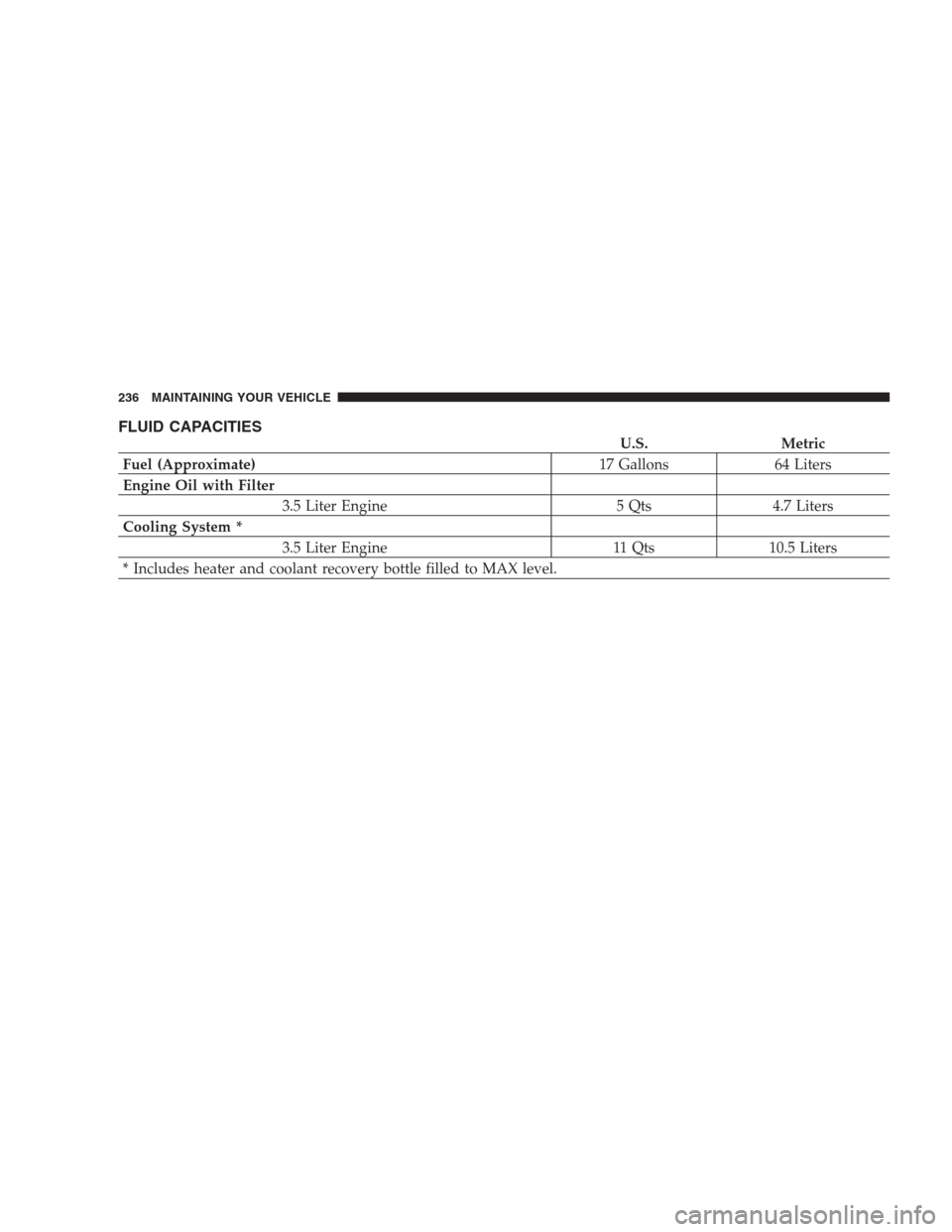
FLUID CAPACITIES
U.S. Metric
Fuel (Approximate)17 Gallons 64 Liters
Engine Oil with Filter
3.5 Liter Engine 5 Qts 4.7 Liters
Cooling System *
3.5 Liter Engine 11 Qts 10.5 Liters
* Includes heater and coolant recovery bottle filled to MAX level.
236 MAINTAINING YOUR VEHICLE
Page 241 of 277

NOTE:IfANYof these apply to you then change your
engine oil every 3,000 miles (5 000 km) or 3 months,
whichever comes first and follow schedule “B” of the
�Maintenance Schedules�section of this manual.
NOTE:Most vehicles are operated under the conditions
listed for Schedule�B�.
Second is Schedule“A”. It is for vehicles that are not
operated under any of the conditions listed under Sched-
ule�B�.
Use the schedule that best describes your driving condi-
tions. Where time and mileage are listed, follow the
interval that occurs first.
NOTE:Under no circumstances should oil change
intervals exceed 6000 miles (10 000 km) or 6 months
whichever comes first.
CAUTION!
Failure to perform the required maintenance items
may result in damage to the vehicle.
At Each Stop for Fuel
•
Check the engine oil level about 5 minutes after a fully
warmed engine is shut off. Checking the oil level while
the vehicle is on level ground will improve the accu-
racy of the oil level reading. Add oil only when the
level is at or below the ADD or MIN mark.
•Check the windshield washer solvent and add if
required.
MAINTENANCE SCHEDULES 241
8
M
A
I
N
T
E
N
A
N
C
E
S
C
H
E
D
U
L
E
S