Page 189 of 277
JUMP-STARTING THE BATTERY
WARNING!
Take care to avoid the radiator cooling fan whenever
the hood is raised. It can start anytime the ignition
switch is on. You can be hurt by the fan.
CAUTION!
Do not try to push or tow your vehicle to get it
started. Your vehicle cannot be started this way.
Pushing with another vehicle may damage the trans-
axle or the rear of your vehicle. If your vehicle has a
discharged (dead) battery, booster cables may be
used to obtain a start from another vehicle. This type
of start can be dangerous if done improperly, so
follow the procedure carefully.
WARNING!
Battery fluid is a corrosive acid solution; do not
allow battery fluid to contact eyes, skin or clothing.
Don’t lean over battery when attaching clamps or
allow the clamps to touch each other. If acid splashes
in eyes or on skin, flush the contaminated area
immediately with large quantities of water.
A battery generates hydrogen gas which is flam-
mable and explosive. Keep flame or spark away
from the vent holes. Do not use a booster battery or
any other booster source with an output that exceeds
12 volts.
NOTE:The battery is stored in a compartment in front
of the tire in the right front fender and is accessible
through the engine compartment. The tire and wheel
need not be removed to gain access to the battery.
WHAT TO DO IN EMERGENCIES 189
6
Page 190 of 277
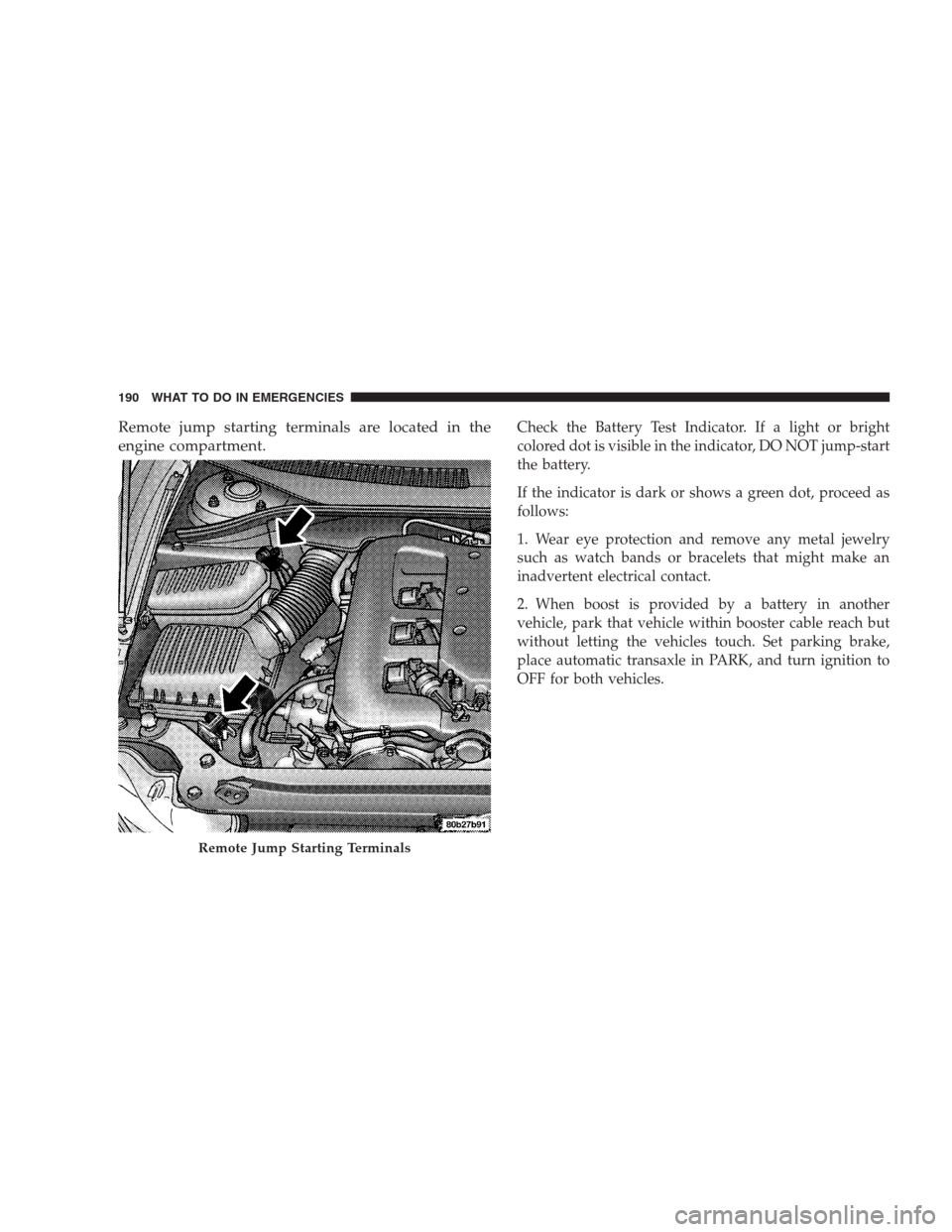
Remote jump starting terminals are located in the
engine compartment.Check the Battery Test Indicator. If a light or bright
colored dot is visible in the indicator, DO NOT jump-start
the battery.
If the indicator is dark or shows a green dot, proceed as
follows:
1. Wear eye protection and remove any metal jewelry
such as watch bands or bracelets that might make an
inadvertent electrical contact.
2. When boost is provided by a battery in another
vehicle, park that vehicle within booster cable reach but
without letting the vehicles touch. Set parking brake,
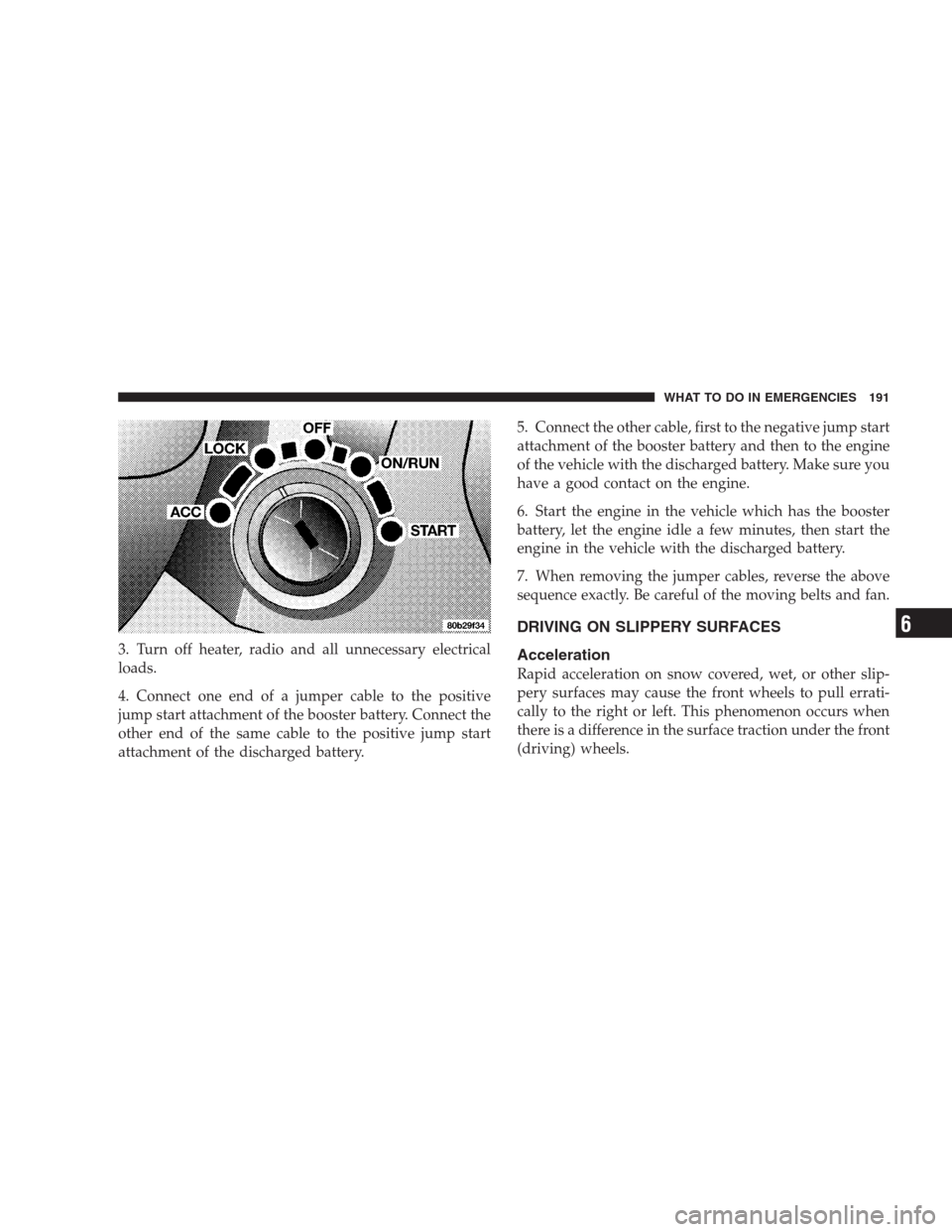
place automatic transaxle in PARK, and turn ignition to
OFF for both vehicles.
Remote Jump Starting Terminals
190 WHAT TO DO IN EMERGENCIES
Page 191 of 277
3. Turn off heater, radio and all unnecessary electrical
loads.
4. Connect one end of a jumper cable to the positive
jump start attachment of the booster battery. Connect the
other end of the same cable to the positive jump start
attachment of the discharged battery.5. Connect the other cable, first to the negative jump start
attachment of the booster battery and then to the engine
of the vehicle with the discharged battery. Make sure you
have a good contact on the engine.
6. Start the engine in the vehicle which has the booster
battery, let the engine idle a few minutes, then start the
engine in the vehicle with the discharged battery.
7. When removing the jumper cables, reverse the above
sequence exactly. Be careful of the moving belts and fan.
DRIVING ON SLIPPERY SURFACES
Acceleration
Rapid acceleration on snow covered, wet, or other slip-
pery surfaces may cause the front wheels to pull errati-
cally to the right or left. This phenomenon occurs when
there is a difference in the surface traction under the front
(driving) wheels.
WHAT TO DO IN EMERGENCIES 191
6
Page 193 of 277
CAUTION!
Racing the engine or spinning the wheels too fast
may lead to transmission overheating and failure. It
can also damage the tires. Do not spin the wheels
above 30 mph (48 km/h).
TOWING A DISABLED VEHICLE
Only two ways of towing are approved; front towing and
flat bed towing.
CAUTION!
•Do not attempt to tow this vehicle from the front
with sling type towing equipment. Damage to the
front fascia will result.
•Always use wheel lift equipment when towing
from the front. The only other approved method
of towing is with a flat bed truck.
•Do not tow the vehicle from the rear. Damage to
the rear sheet metal and fascia will occur.
•Do not push or tow this vehicle with another
vehicle as damage to the bumper fascia and trans-
axle may result.
If damage to the vehicle prevents towing from the front,
move the vehicle onto a flat bed tow truck.
WHAT TO DO IN EMERGENCIES 193
6
Page 195 of 277
MAINTAINING YOUR VEHICLE
CONTENTS
�3.5L Engine..........................197
�Onboard Diagnostic System (OBD II).......198
�Emissions Inspection And Maintenance
Programs
............................199
�Replacement Parts.....................200
�Dealer Service........................200
�Maintenance Procedures.................201
▫Engine Oil..........................201
▫Chassis Lubrication....................210
▫Drive Shaft Universal Joints..............211
▫Body Lubrication.....................211
▫Windshield Wiper Blades................212▫Windshield Washers...................213
▫Exhaust System......................213
▫Cooling System.......................214
▫Hoses And Vacuum/Vapor Harnesses.......218
▫Brakes.............................218
▫Fuel System Hoses....................220
▫Automatic Transaxle...................221
▫Appearance Care And Protection From
Corrosion...........................223
�Fuses...............................227
▫Fuse Block Relays.....................227
▫Underhood Fuses.....................228
7
Page 196 of 277
�Replacement Light Bulbs................230
�Bulb Replacement......................230
▫Headlight And Parking Light Removal......230
▫Front Park, Turn Signal And Front Sidemarker
Light..............................233
▫Fog Light...........................233
▫Center Stop Light.....................234
▫Tail, Stop, Back Up, And Turn Signal Lights . . 234▫License Plate Light....................235�Specifications.........................235
�Fluid Capacities.......................236
�Recommended Fluids, Lubricants And Genuine
Parts
...............................237
▫Engine.............................237
▫Chassis............................237
▫Body..............................238
196 MAINTAINING YOUR VEHICLE
Page 197 of 277
3.5L ENGINE
MAINTAINING YOUR VEHICLE 197
7
Page 198 of 277
ONBOARD DIAGNOSTIC SYSTEM (OBD II)
To meet new government regulations and promote
cleaner air, your vehicle is equipped with a sophisticated
onboard diagnostic system called OBD II. This system
monitors the performance of the emissions, engine, and
automatic transaxle control systems. When these systems
are operating properly, your vehicle will provide excel-
lent performance and fuel economy, as well as engine
emissions well within current government regulations.
If any of these systems require service, the OBD II system
will turn on the Malfunction Indicator or Service Engine
Soon Light. It will also store diagnostic codes and other
information to assist your service technician in making
repairs. Although your vehicle will usually be driveable
and not need towing, see your dealer for service as soon
as possible.CAUTION!
Prolonged driving with the light on could cause
further damage to the emission control system. It
could also affect fuel economy and driveability. The
vehicle must be serviced before any state emissions
tests can be performed.
If the light is flashing, severe catalytic converter damage
and power loss will soon occur. Immediate service is
required.
If the gas cap is not tightened properly, the light may
come on. Be sure the gas cap is tightened every time you
add fuel. Tighten the cap until you hear it “click.”
198 MAINTAINING YOUR VEHICLE