Page 199 of 277
EMISSIONS INSPECTION AND MAINTENANCE
PROGRAMS
In some localities, it may be a legal requirement to pass
an inspection of your vehicle’s emissions control system.
Failure to pass could prevent vehicle registration.
For states which have an I/M (Inspection and
Maintenance) requirement, this check verifies the
following: the MIL (Malfunction Indicator Lamp)
is functioning and is not on when the engine is running,
and that the OBD (On Board Diagnostic) system is ready
for testing.
Normally, the OBD system will be ready. The OBD
system maynotbe ready if your vehicle was recently
serviced, if you recently had a dead battery, or a battery
replacement. If the OBD system should be determined
not ready for the I/M test, your vehicle may fail the test.
Your vehicle has a simple ignition key actuated test
which you can use prior to going to the test station. To
check if your vehicle’s OBD system is ready, you must do
the following:
1. Insert your ignition key into the ignition switch.2. Turn the ignition to the ON position, but do not crank
or start the engine.
3. If you crank or start the engine, you will have to start
this test over.
4. As soon as you turn your key to the ON position, you
will see your MIL symbol come on as part of a normal
bulb check.
5. Approximately 15 seconds later, one of two things will
happen:
a. The MIL will flash for about 10 seconds and then
return to being fully illuminated until you turn off
the ignition key or start the engine. This means that
your vehicle’s OBD system isnot readyand you
shouldnotproceed to the I/M station.
b. The MIL will not flash at all and will remain fully
illuminated until you turn off the ignition key or
start the engine. This means that your vehicle’s OBD
system isreadyand you can proceed to the I/M
station.
MAINTAINING YOUR VEHICLE 199
7
Page 200 of 277
If your OBD system isnot ready,you should see your
authorized dealer or repair facility. If your vehicle was
recently serviced or had a battery failure or replacement,
you may need to do nothing more than drive your
vehicle as you normally would in order for your OBD
system to update. A recheck with the above test routine
may then indicate that the system is now ready.
Regardless of whether your vehicle’s OBD system is
ready or not ready, if the MIL symbol is illuminated
during normal vehicle operation, you should have your
vehicle serviced before going to the I/M station. The I/M
station can fail your vehicle because the MIL symbol is on
with the engine running.REPLACEMENT PARTS
Use of genuine Mopar�parts for normal/scheduled
maintenance and repairs is highly recommended to in-
sure the designed performance. Damage or failures
caused by the use of non-Mopar�parts for maintenance
and repairs will not be covered by the manufacturer’s
warranty.
DEALER SERVICE
Your dealer has the qualified service personnel, special
tools and equipment to perform all service operations in
an expert manner. Service Manuals are available which
include detailed service information for your vehicle.
Refer to these manuals before attempting any procedure
yourself.
NOTE:Intentional tampering with emissions control
systems can result in civil penalties being assessed
against you.
200 MAINTAINING YOUR VEHICLE
Page 201 of 277
WARNING!
You can be badly injured working on or around a
motor vehicle. Do only that service work for which
you have the knowledge and the proper equipment.
If you have any doubt about your ability to perform
a service job, take your vehicle to a competent
mechanic.
MAINTENANCE PROCEDURES
The pages that follow contain the maintenance service
recommended by the engineers who designed your ve-
hicle.
Besides the maintenance items for which there are fixed
maintenance intervals, there are other items that should
operate satisfactorily without periodic maintenance.
However, if a malfunction of these items does occur, it
could adversely affect the engine or vehicle performance.
These items should be inspected if a malfunction is
observed or suspected.
Engine Oil
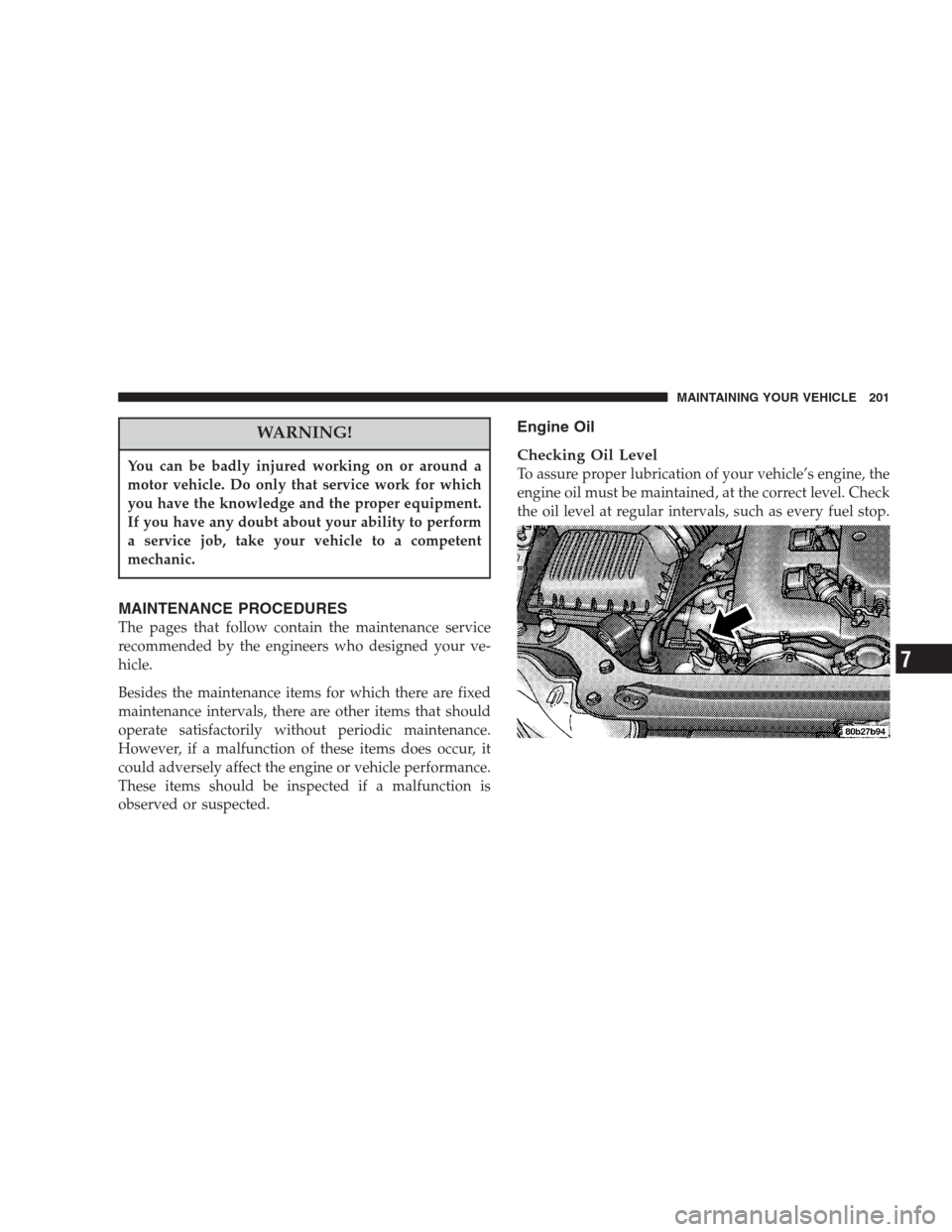
Checking Oil Level
To assure proper lubrication of your vehicle’s engine, the
engine oil must be maintained, at the correct level. Check
the oil level at regular intervals, such as every fuel stop.
MAINTAINING YOUR VEHICLE 201
7
Page 202 of 277
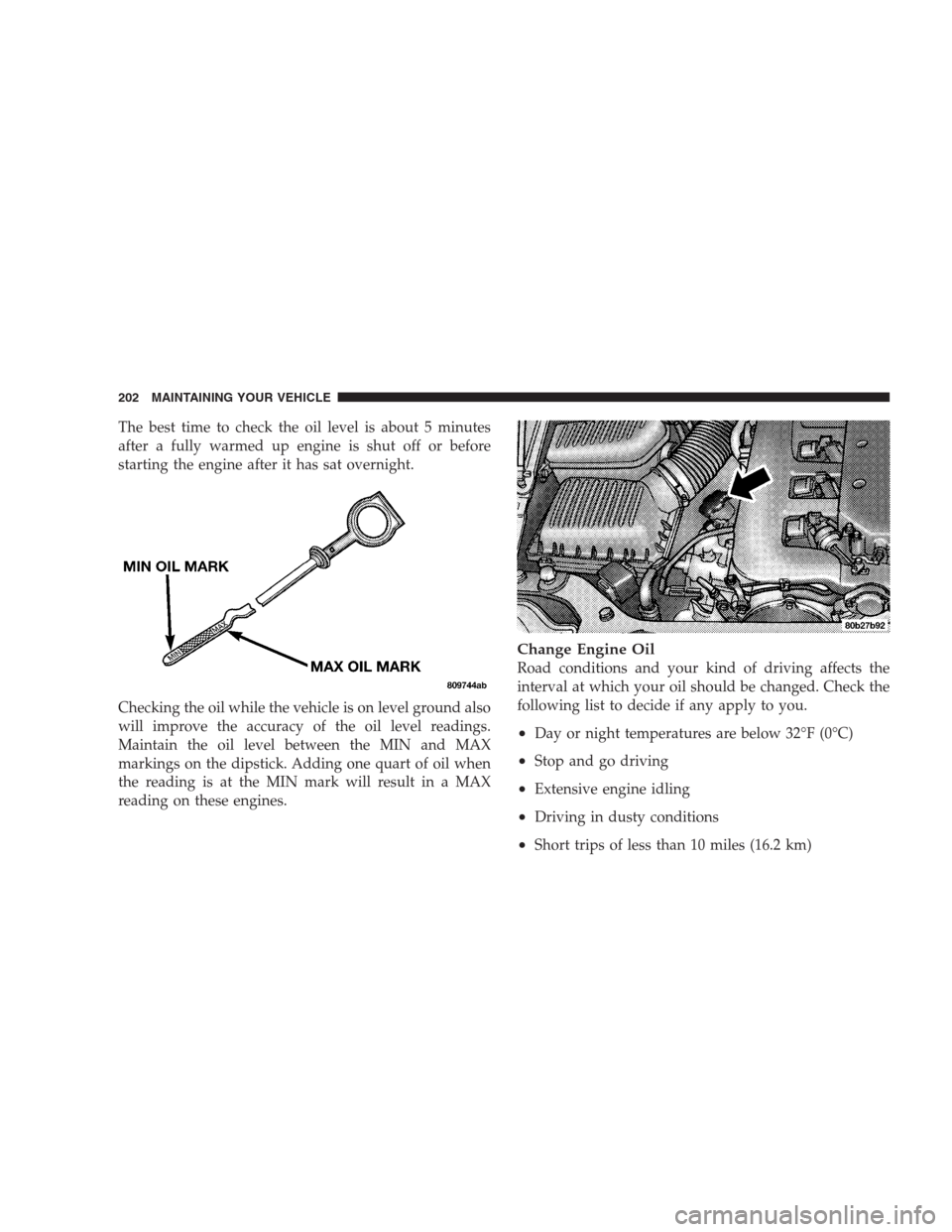
The best time to check the oil level is about 5 minutes
after a fully warmed up engine is shut off or before
starting the engine after it has sat overnight.
Checking the oil while the vehicle is on level ground also
will improve the accuracy of the oil level readings.
Maintain the oil level between the MIN and MAX
markings on the dipstick. Adding one quart of oil when
the reading is at the MIN mark will result in a MAX
reading on these engines.
Change Engine Oil
Road conditions and your kind of driving affects the
interval at which your oil should be changed. Check the
following list to decide if any apply to you.
•Day or night temperatures are below 32°F (0°C)
•Stop and go driving
•Extensive engine idling
•Driving in dusty conditions
•Short trips of less than 10 miles (16.2 km)
202 MAINTAINING YOUR VEHICLE
Page 203 of 277
•More than 50% of your driving is at sustained high
speeds during hot weather above 90°F (32°C)
•Trailer towing
•Taxi, police or delivery service (commercial service)
•Off road or desert operation
•If equipped for and operating with E —85 (ethanol)
fuel
NOTE:IfANYof these apply to you then change your
engine oil every 3,000 miles (5 000 km) or 3 months,
whichever comes first and follow schedule “B” of the
�Maintenance Schedules�section of this manual.
If none of these apply to you, then change your engine oil
at every interval shown on schedule�A�of the�Mainte-
nance Schedules�section of this manual.
NOTE:Under no circumstances should oil change
intervals exceed 6000 miles (10 000 km) or 6 months
whichever comes first.
CAUTION!
Overfilling or underfilling the crankcase will cause
oil aeration or loss of oil pressure. This could dam-
age your engine.
Engine Oil Selection
For best performance and maximum protection under all
types of operating conditions, we only recommend en-
gine oils that are API Certified and meet the requirements
of DaimlerChrysler Material Standard MS-6395. Use Mo-
par or an equipvalent oil meeting the specification MS-
6395.
MAINTAINING YOUR VEHICLE 203
7
Page 204 of 277
American Petroleum Institute (API) Engine Oil
Identification Symbol
This symbol means that the oil has
been certified by the American
Petroleum Institute (API). We
only recommend API Certified en-
gine oils that meet the require-
ments of DaimlerChrysler’s Mate-
rial Standard MS-6395. Use Mopar
or an equivalent oil meeting the
specification MS-6395.
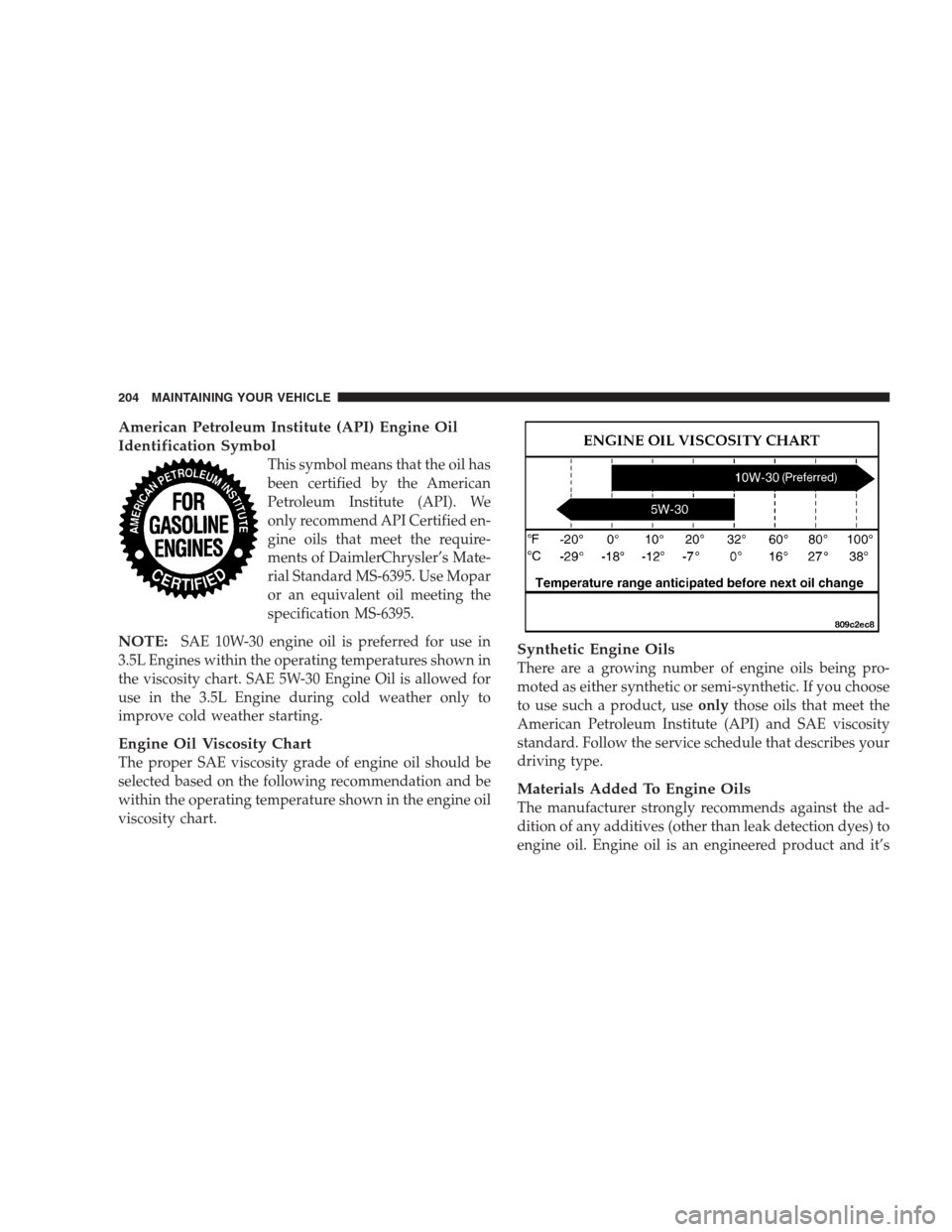
NOTE:SAE 10W-30 engine oil is preferred for use in
3.5L Engines within the operating temperatures shown in
the viscosity chart. SAE 5W-30 Engine Oil is allowed for
use in the 3.5L Engine during cold weather only to
improve cold weather starting.
Engine Oil Viscosity Chart
The proper SAE viscosity grade of engine oil should be
selected based on the following recommendation and be
within the operating temperature shown in the engine oil
viscosity chart.
Synthetic Engine Oils
There are a growing number of engine oils being pro-
moted as either synthetic or semi-synthetic. If you choose
to use such a product, useonlythose oils that meet the
American Petroleum Institute (API) and SAE viscosity
standard. Follow the service schedule that describes your
driving type.
Materials Added To Engine Oils
The manufacturer strongly recommends against the ad-
dition of any additives (other than leak detection dyes) to
engine oil. Engine oil is an engineered product and it’s
204 MAINTAINING YOUR VEHICLE
Page 205 of 277
performance may be impaired by supplemental addi-
tives.
Disposing of Used Engine Oil
Care should be taken in disposing of used engine oil from
your vehicle. Used oil, indiscriminately discarded, can
present a problem to the environment. Contact your
dealer, service station, or governmental agency for advice
on how and where used oil can be safely discarded in
your area.
Engine Oil Filter
The engine oil filter should be replaced at every engine
oil change.
Engine Oil Filter Selection
All of the manufacturer’s engines have a full-flow type
disposable oil filter. Use a filter of this type for replace-
ment. The quality of replacement filters varies consider-
ably. Only high quality filters should be used to assure
most efficient service. Mopar Engine Oil Filters are high
quality oil filters and are recommended.
Drive Belts — Check Condition and Tension
At the mileage shown in the maintenance schedules,
check all drive belts for condition and proper tension.
Improper belt tension can cause belt slippage and failure.
Inspect the drive belts for evidence of cuts, cracks, or
glazing and replace them if there is any sign of damage
which could result in belt failure. If adjustment is re-
quired, adjust the belts according to the specifications
and procedures shown in the Service Manual.
Special tools are required to properly measure tension
and to restore belt tension to factory specifications. Also,
check belt routing to make sure there is no interference
between the belts and other engine components.
Spark Plugs
Spark plugs must fire properly to assure engine perfor-
mance and emission control. New plugs should be in-
stalled at the mileage specified in the appropriate main-
tenance chart. The entire set should be replaced if there is
any malfunction due to a faulty spark plug. Check the
specifications section for the proper type of spark plug
for use in your vehicle.
MAINTAINING YOUR VEHICLE 205
7
Page 206 of 277
Engine Air Cleaner Filter
Under normal driving conditions, replace the air filter at
the intervals shown on Schedule “A”. If, however, you
drive the vehicle frequently under dusty or severe con-
ditions, the filter element should be inspected periodi-
cally and replaced if necessary at the intervals shown on
Schedule “B”.
WARNING!
The air cleaner can provide a measure of protection
in the case of engine backfire. Do not remove the air
cleaner unless such removal is necessary for repair or
maintenance. Make sure that no one is near the
engine compartment before starting the vehicle with
the air cleaner removed. Failure to do so can result in
serious personal injury.
Engine Fuel Filter
A plugged fuel filter can cause hard starting or limit the
speed at which a vehicle can be driven. Should an
excessive amount of dirt accumulate in the fuel tank,
frequent replacement of the fuel filter which is mounted
in the fuel tank may be necessary. See your dealer for
service.
Catalytic Converter
The catalytic converter requires the use of unleaded fuel
only. Leaded gasoline will destroy the effectiveness of the
catalyst as an emission control device.
Under normal operating conditions, the catalytic con-
verter will not require maintenance. However, it is im-
portant to keep the engine properly serviced to assure
proper catalyst operation and prevent possible catalyst
damage. If the Malfunction Indicator light is flashing,
immediate service is required.
206 MAINTAINING YOUR VEHICLE