Page 241 of 366

Adding Coolant
If you need more coolant, add the proper DEX-COOL®
coolant mixtureat the surge tank, but only when the
engine is cool.
{CAUTION:
You can be burned if you spill coolant on hot
engine parts. Coolant contains ethylene glycol,
and it will burn if the engine parts are hot
enough. Do not spill coolant on a hot engine.
When replacing the pressure cap, make sure it is
hand-tight.
Engine Coolant (Caterpillar®Diesel
Engines)
If your vehicle has a Caterpillar®diesel engine, see the
Caterpillar®Diesel Engine Operation & Maintenance
Manual provided with your vehicle to find out what
to add, also when and how to service your cooling
system.
Coolant Surge Tank Pressure Cap
The surge tank pressure
cap is located in the
engine compartment, on
the driver’s side of the
vehicle.
Notice:Your vehicle’s surge tank pressure cap is
designed for use with medium-duty cooling systems
only. If the surge tank pressure cap is not tightly
installed, coolant loss and possible engine damage
may occur. Be sure the cap is properly and tightly
secured.
5-35
Page 244 of 366
Cooling System
When you decide it’s safe to lift the hood, here’s what
you’ll see:
A. Engine Fan
B. Coolant Surge Tank
If your vehicle has a Caterpillar
®diesel engine, see the
Caterpillar®Diesel Engine Operation and Maintenance
Manual provided with your vehicle.
If the coolant inside the coolant surge tank is boiling,
don’t do anything else until it cools down. The vehicle
should be parked on a level surface.The coolant level should
be at COLD FILL or
higher. If it isn’t, you may
have a leak at the
pressure cap or in the
radiator hoses, heater
hoses, radiator, water
pump or somewhere else
in the cooling system.
{CAUTION:
Heater and radiator hoses, and other engine
parts, can be very hot. Do not touch them. If
you do, you can be burned.
Do not run the engine if there is a leak. If you
run the engine, it could lose all coolant. That
could cause an engine re, and you could be
burned. Get any leak xed before you drive the
vehicle.
5-38
Page 249 of 366
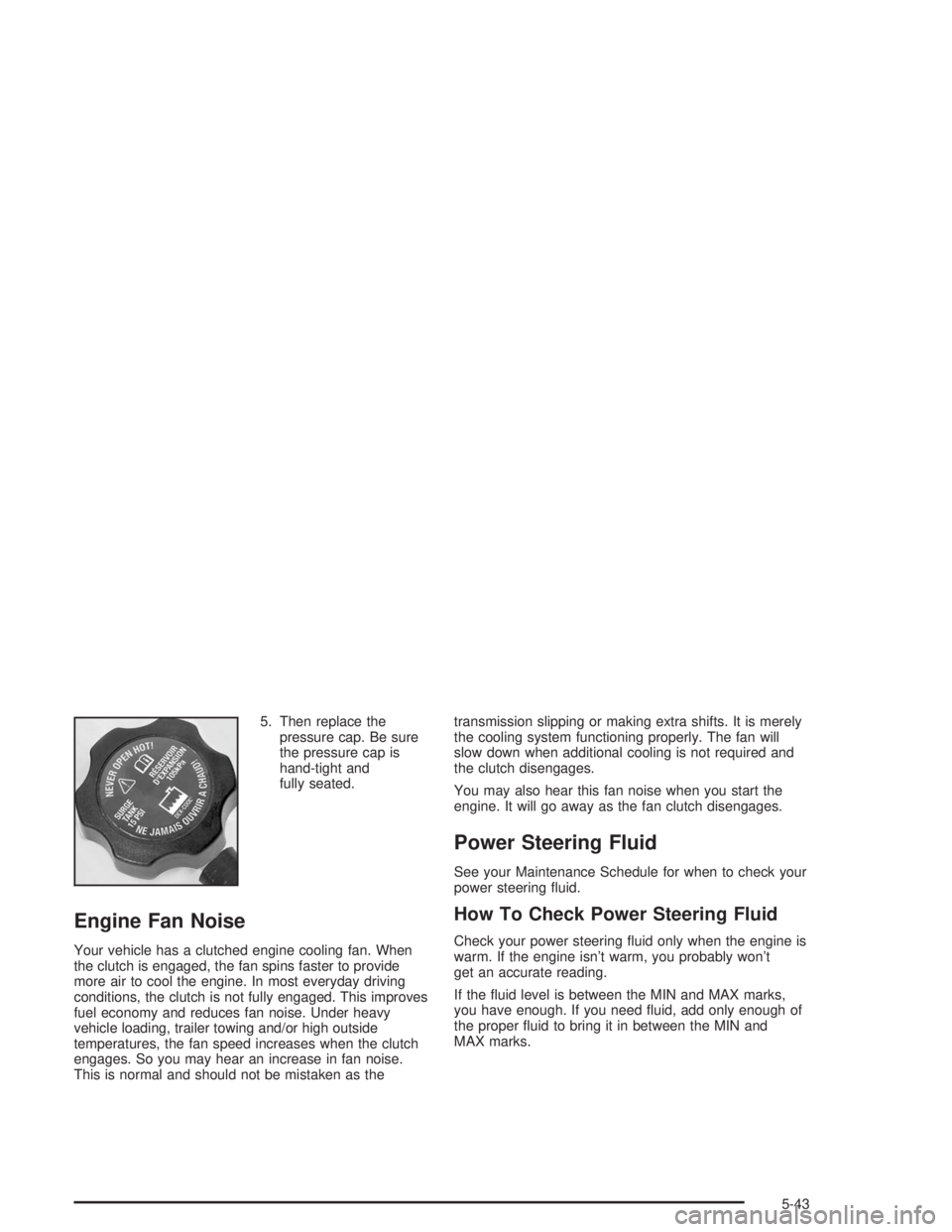
5. Then replace the
pressure cap. Be sure
the pressure cap is
hand-tight and
fully seated.
Engine Fan Noise
Your vehicle has a clutched engine cooling fan. When
the clutch is engaged, the fan spins faster to provide
more air to cool the engine. In most everyday driving
conditions, the clutch is not fully engaged. This improves
fuel economy and reduces fan noise. Under heavy
vehicle loading, trailer towing and/or high outside
temperatures, the fan speed increases when the clutch
engages. So you may hear an increase in fan noise.
This is normal and should not be mistaken as thetransmission slipping or making extra shifts. It is merely
the cooling system functioning properly. The fan will
slow down when additional cooling is not required and
the clutch disengages.
You may also hear this fan noise when you start the
engine. It will go away as the fan clutch disengages.
Power Steering Fluid
See your Maintenance Schedule for when to check your
power steering fluid.
How To Check Power Steering Fluid
Check your power steering fluid only when the engine is
warm. If the engine isn’t warm, you probably won’t
get an accurate reading.
If the fluid level is between the MIN and MAX marks,
you have enough. If you need fluid, add only enough of
the proper fluid to bring it in between the MIN and
MAX marks.
5-43
Page 252 of 366
Brakes
Brake Fluid
If your vehicle has hydraulic brakes, there is a brake
master cylinder. Refer to the Maintenance Schedule to
determine when to check your brake fluid.
{CAUTION:
Do not add brake uid before you check the
level. If you do, you could get too much brake
uid. Brake uid could spill on the hot engine
and it can catch re. You could be burned and
your vehicle could be damaged. See “Checking
Brake Fluid” in this section.
5-46
Page 254 of 366

What to Add
Use the proper fluid listed in your Maintenance
Schedule. Use new brake fluid from a sealed
container only.
Always clean the brake fluid reservoir cap/cover and the
area around the cap/cover before removing it. This
will help keep dirt from entering the reservoir.
{CAUTION:
With the wrong kind of uid in your brake
system, your brakes may not work well, or
they may not even work at all. This could
cause a crash. Always use the proper brake
uid.Notice:
Using the wrong uid can badly damage brake
system parts. For example, just a few drops of
mineral-based oil, such as engine oil, in your
brake system can damage brake system
parts so badly that they will have to be replaced.
Do not let someone put in the wrong kind of
uid, and do not use DOT-5 silicone brake uid.
If you spill brake uid on your vehicle’s painted
surfaces, the paint nish can be damaged. Be
careful not to spill brake uid on your vehicle. If
you do, wash it off immediately. SeeAppearance
Care on page 5-76.
5-48
Page 256 of 366
Air Brake Systems
If your vehicle has air brakes, it is important to get rid of
moisture in your system. Moisture will damage your
system if it is not removed daily.
There are two ways to do this. One is automatic if your
air-brake vehicle has the optional moisture ejector. If
your vehicle does not have that option, you must drain
the air reservoirs occasionally to be sure the air
dryer is working properly.
Drain the air brakes at full system pressure. To be sure
you are at full pressure, check your air pressure
gage. It should read at least 100 psi (692 kPa).
Moisture Ejector
If you have air brakes with a moisture ejector, the valve
automatically ejects moisture from the reserve tank
when the air compressor cycles.
Air Dryer
If your vehicle has air brakes, it may have an air dryer.
This collects and removes dirt, moisture or other
foreign matter from the air prior to entering the brake
system. It is mounted on the passenger’s side frame rail.
If your dryer is a Bendix-Westinghouse, it has a filter
that you need to change at intervals. SeeScheduled
Maintenance on page 6-5for more about servicing this
filter.
5-50
Page 257 of 366
Electric Air Compressor
Your vehicle may have an electric air compressor. This
compressor is used to run options that require
pressurized air, such as air horn, air seat, exhaust
restrictor or an exhaust brake.
The air compressor is used when vehicles are not
equipped with an air brake system.
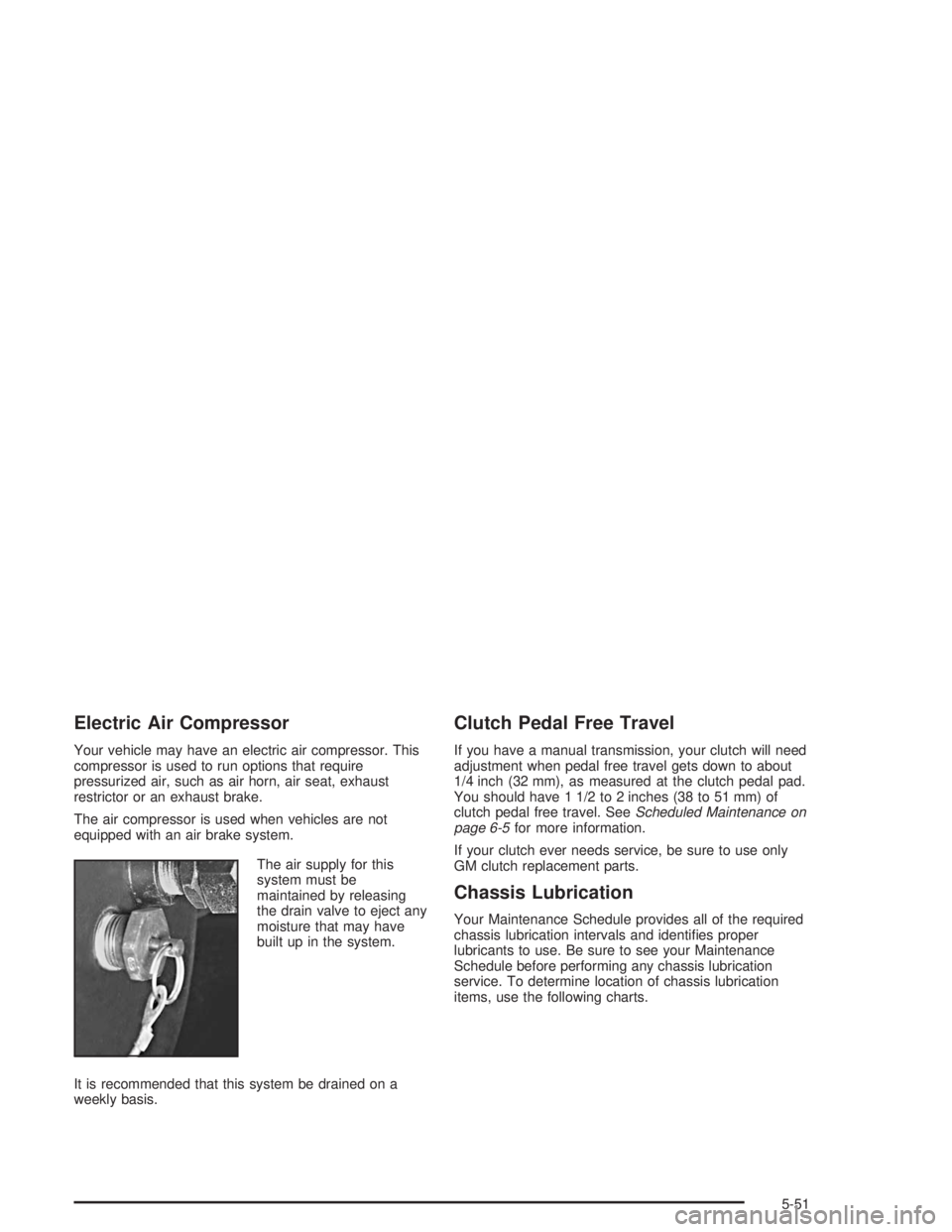
The air supply for this
system must be
maintained by releasing
the drain valve to eject any
moisture that may have
built up in the system.
It is recommended that this system be drained on a
weekly basis.
Clutch Pedal Free Travel
If you have a manual transmission, your clutch will need
adjustment when pedal free travel gets down to about
1/4 inch (32 mm), as measured at the clutch pedal pad.
You should have 1 1/2 to 2 inches (38 to 51 mm) of
clutch pedal free travel. SeeScheduled Maintenance on
page 6-5for more information.
If your clutch ever needs service, be sure to use only
GM clutch replacement parts.
Chassis Lubrication
Your Maintenance Schedule provides all of the required
chassis lubrication intervals and identifies proper
lubricants to use. Be sure to see your Maintenance
Schedule before performing any chassis lubrication
service. To determine location of chassis lubrication
items, use the following charts.
5-51
Page 261 of 366
Battery
Your new vehicle comes with one or more maintenance
free ACDelco®batteries. When it is time for a new
battery, be sure it has the replacement number shown
on the original battery’s label. We recommend an
ACDelco
®battery.
Warning:Battery posts, terminals and related
accessories contain lead and lead compounds,
chemicals known to the State of California to cause
cancer and reproductive harm. Wash hands after
handling.
Vehicle Storage
If you are not going to drive your vehicle for 25 days or
more, remove the black, negative (−) cable from the
battery. This will help keep your battery from running
down. (If your vehicle has more than one battery,
be sure to remove the negative (−) battery cable from
each battery.)
{CAUTION:
Batteries have acid that can burn you and gas
that can explode. You can be badly hurt if you
are not careful. SeeJump Starting on
page 5-56for tips on working around a battery
without getting hurt.
When you are ready to use the vehicle again, refer to
the engine starting procedure in the Index.
Contact your dealer to learn how to prepare your
vehicle for longer storage periods.
5-55

