2004 CHEVROLET KODIAK maintenance
[x] Cancel search: maintenancePage 306 of 366
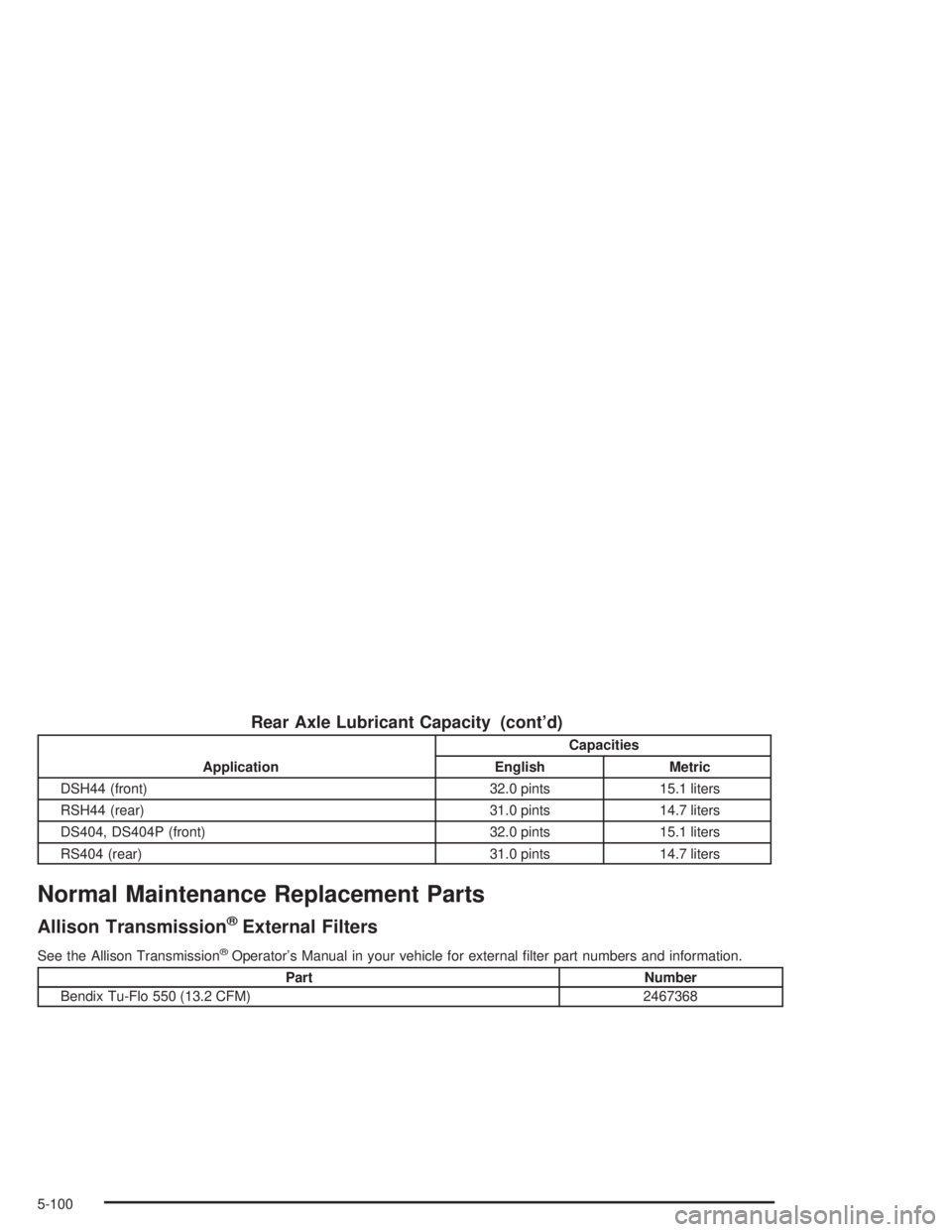
Rear Axle Lubricant Capacity (cont’d)
ApplicationCapacities
English Metric
DSH44 (front) 32.0 pints 15.1 liters
RSH44 (rear) 31.0 pints 14.7 liters
DS404, DS404P (front) 32.0 pints 15.1 liters
RS404 (rear) 31.0 pints 14.7 liters
Normal Maintenance Replacement Parts
Allison Transmission®External Filters
See the Allison Transmission®Operator’s Manual in your vehicle for external filter part numbers and information.
Part Number
Bendix Tu-Flo 550 (13.2 CFM) 2467368
5-100
Page 311 of 366
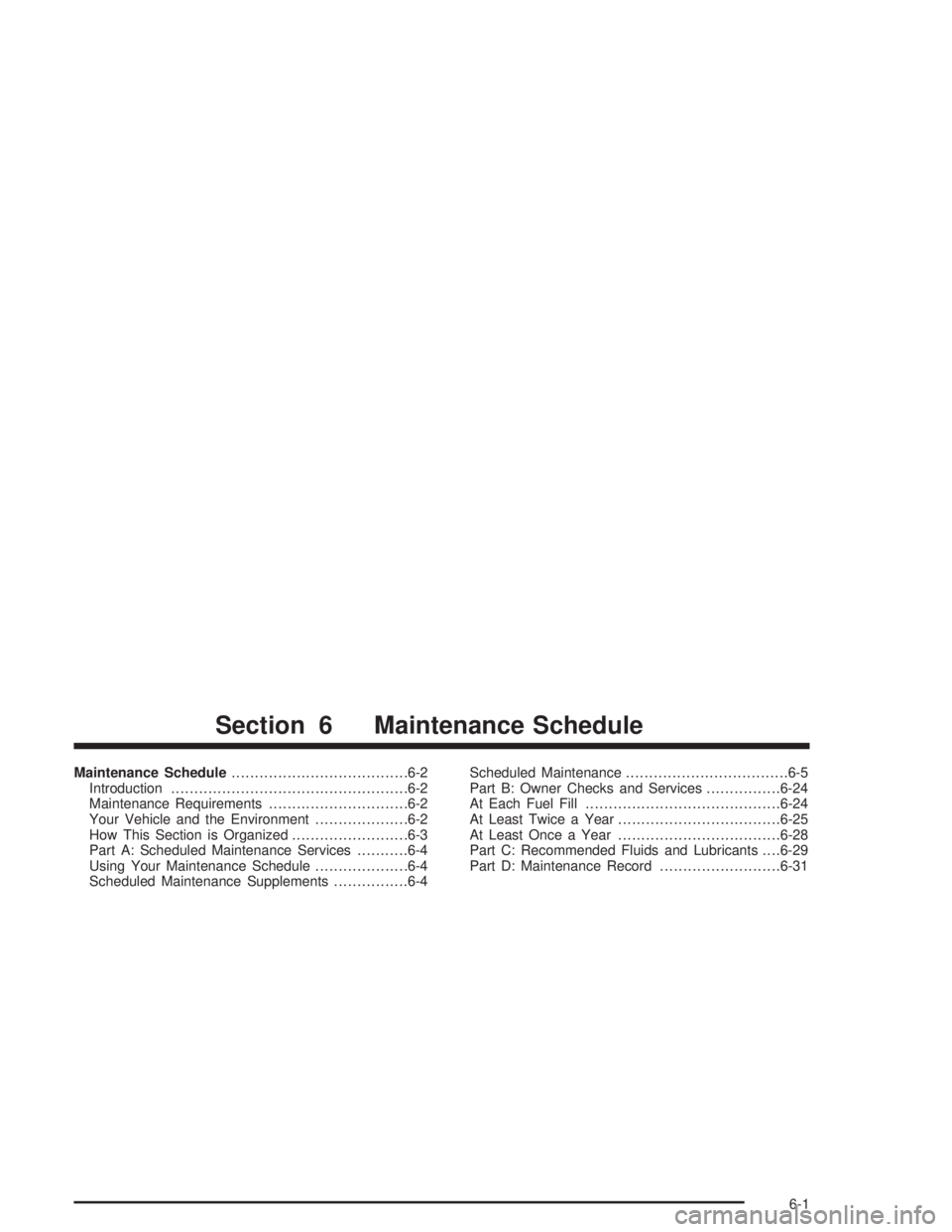
Maintenance Schedule......................................6-2
Introduction...................................................6-2
Maintenance Requirements..............................6-2
Your Vehicle and the Environment....................6-2
How This Section is Organized.........................6-3
Part A: Scheduled Maintenance Services...........6-4
Using Your Maintenance Schedule....................6-4
Scheduled Maintenance Supplements................6-4Scheduled Maintenance...................................6-5
Part B: Owner Checks and Services................6-24
At Each Fuel Fill..........................................6-24
At Least Twice a Year...................................6-25
At Least Once a Year...................................6-28
Part C: Recommended Fluids and Lubricants. . . .6-29
Part D: Maintenance Record..........................6-31
Section 6 Maintenance Schedule
6-1
Page 312 of 366

Maintenance Schedule
Introduction
Important: Keep engine oil at the proper level and
change as recommended.
Have you purchased the GM Protection Plan? The Plan
supplements your new vehicle warranties. See your
Warranty and Owner Assistance booklet or your dealer
for details.
Maintenance Requirements
Maintenance intervals, checks, inspections and
recommended fluids and lubricants as prescribed in this
manual are necessary to keep your vehicle in good
working condition. Any damage caused by failure
to follow scheduled maintenance may not be covered by
warranty.
Your Vehicle and the Environment
Proper vehicle maintenance not only helps to keep your
vehicle in good working condition, but also helps the
environment. Improper vehicle maintenance can
even affect the quality of the air we breathe. Improper
fluid levels or the wrong tire inflation can increase
the level of emissions from your vehicle. To help protect
our environment, and to keep your vehicle in good
condition, be sure to maintain your vehicle properly.
6-2
Page 313 of 366
How This Section is Organized
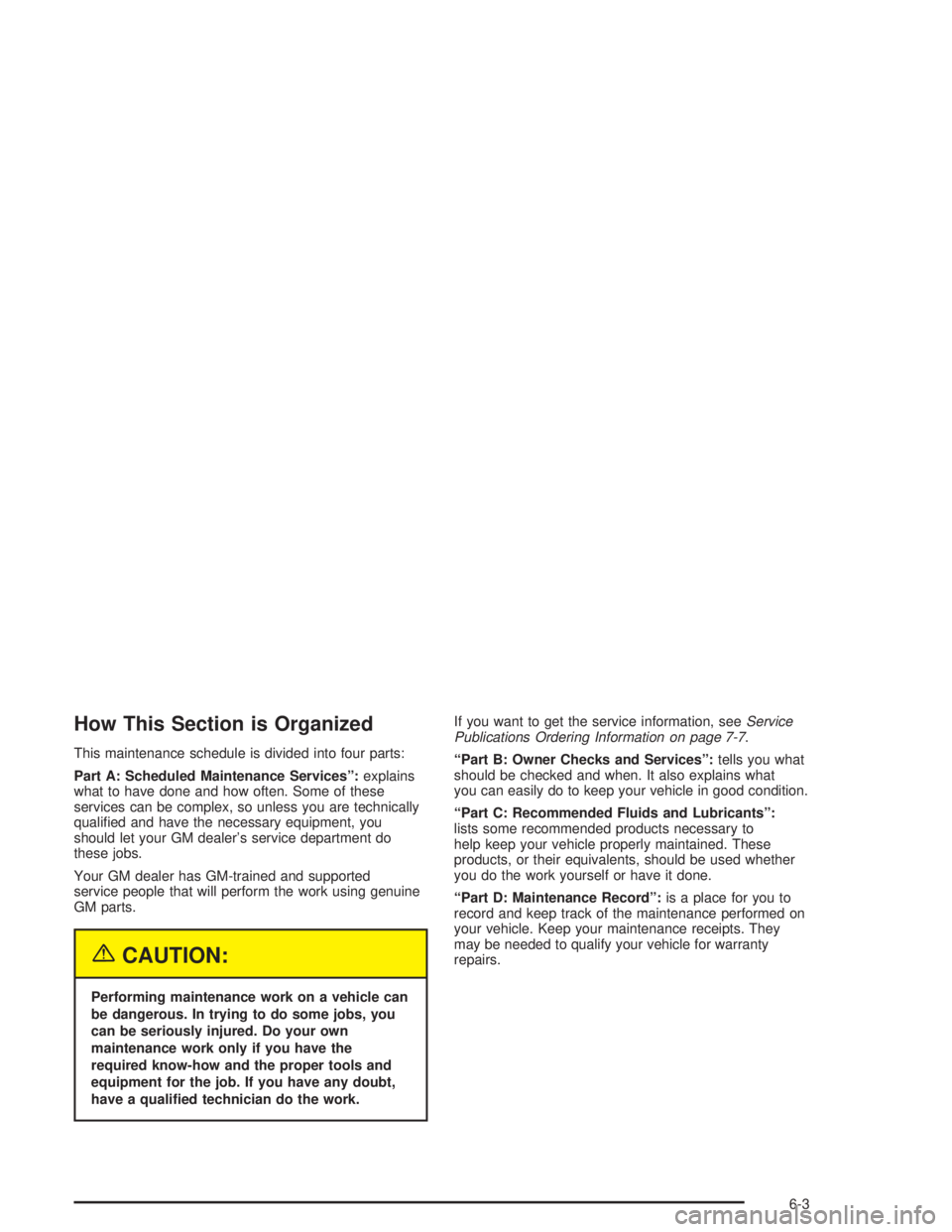
This maintenance schedule is divided into four parts:
Part A: Scheduled Maintenance Services”:explains
what to have done and how often. Some of these
services can be complex, so unless you are technically
qualified and have the necessary equipment, you
should let your GM dealer’s service department do
these jobs.
Your GM dealer has GM-trained and supported
service people that will perform the work using genuine
GM parts.
{CAUTION:
Performing maintenance work on a vehicle can
be dangerous. In trying to do some jobs, you
can be seriously injured. Do your own
maintenance work only if you have the
required know-how and the proper tools and
equipment for the job. If you have any doubt,
have a qualied technician do the work.If you want to get the service information, seeService
Publications Ordering Information on page 7-7.
“Part B: Owner Checks and Services”:tells you what
should be checked and when. It also explains what
you can easily do to keep your vehicle in good condition.
“Part C: Recommended Fluids and Lubricants”:
lists some recommended products necessary to
help keep your vehicle properly maintained. These
products, or their equivalents, should be used whether
you do the work yourself or have it done.
“Part D: Maintenance Record”:is a place for you to
record and keep track of the maintenance performed on
your vehicle. Keep your maintenance receipts. They
may be needed to qualify your vehicle for warranty
repairs.
6-3
Page 314 of 366

Part A: Scheduled Maintenance
Services
In this part are scheduled maintenance services which
are to be performed at the mileage intervals specified.
Using Your Maintenance Schedule
We at General Motors want to help keep your vehicle in
good working condition. But we do not know exactly
how you will drive it. You may drive very short distances
only a few times a week. Or you may drive long
distances all the time in very hot, dusty weather. You
may use your vehicle in making deliveries or in
many other ways.
Because of all the different ways people use their
vehicles, maintenance needs vary. You may need more
frequent checks and replacements. So please read
the following and note how you drive. If you have any
questions on how to keep your vehicle in good condition,
see your dealer.
This part tells you the maintenance services you should
have done and when to schedule them.
When you go to your dealer for your service needs, you
will know that GM-trained and supported service
people will perform the work using genuine GM parts.The proper fluids and lubricants to use are listed in
Part C. Make sure whoever services your vehicle uses
these. All parts should be replaced and all necessary
repairs done before you or anyone else drives the
vehicle.
This schedule is for vehicles that:
•carry passengers and cargo within recommended
limits. You will find limits on your vehicle’s GVW
Rating label. SeeLoading Your Vehicle on
page 4-33.
•are driven on reasonable road surfaces within legal
driving limits.
•use the recommended fuel. SeeWhat Fuel to Use
on page 5-8.
Scheduled Maintenance
Supplements
If your vehicle has a Caterpillar®diesel engine, your
owner’s manual is supplemented by the Caterpillar®
Diesel Engine Operation & Maintenance Manual. If your
vehicle has an Allison transmission, your owner’s
manual is supplemented by an Allison
Transmission
®Operator’s Manual. Always refer to these
manuals for related maintenance services.
6-4
Page 315 of 366

Scheduled Maintenance
The services shown in this schedule up to 100,000 miles
(166 000 km) should be repeated after 100,000 miles
(166 000 km) at the same intervals for the life of
this vehicle. The services shown after 100,000 miles
(166 000 km) should be repeated at the same miles (km)
after those intervals for the life of this vehicle.
Gasoline engine vehicles have a computer that lets you
know when to change your engine oil. This is not
based on mileage, but on engine revolutions and engine
operating temperature. When the computer has
calculated that the oil needs changing, the GM Oil Life
System will indicate that a change is necessary.
The “Footnotes” at the end of this Maintenance
Schedule further explain maintenance services.
SeeService Publications Ordering Information on
page 7-7.
100 Miles (160 km)
❑Wheel stud nut service.(46)
1,000 Miles (1 600 km)
❑Wheel stud nut service.(46)
❑Rear axle air shift motor service.(11)
7,500 Miles (12 000 km)
❑Gasoline Engine Only: Check Oil Life System. If
engine oil and filter are changed, reset system. See
“Engine Oil (Gasoline Engine)” in the Index.(3) (9)
❑Check fluid levels (or every 3 months, whichever
occurs first).(1) (6)
❑Chassis lubrication service (or every 6 months,
whichever occurs first).(12)
❑Wheels and tires service.(15)
❑Hydraulic brake service (or every 6 months, whichever
occurs first).(7) (46)
❑Parking brake service (or every 6 months, whichever
occurs first).(8)
❑Air brake service (or every 6 months, whichever
occurs first).(39)
❑Air brake automatic slack adjuster service (or every
500 hours, whichever occurs first).(40)
❑Check air brake relay valve operation and check for
leaks (or every month, or every 300 hours, whichever
occurs first).
❑Clean air brake application valve (or every 3 months,
or every 300 hours, whichever occurs first). Lubricate
linkage.
❑Air brake chamber service (or every 2 months,
whichever occurs first).(41)
❑Trailer brake hand control valve service (or every
3 months, or every 900 hours, whichever occurs
first).(42)
6-5
Page 329 of 366

300,000 Miles (480 000 km)
❑Remove, disassemble, clean and inspect the air
brake air dryer (or every 3 years, or 10,800 hours,
whichever occurs first). Replace desiccant on
Bendix-Westinghouse units.
Footnotes
† = The U.S. Environmental Protection Agency or the
California Air Resources Board has determined that the
failure to perform this maintenance item will not nullify
the emission warranty or limit recall liability prior to
the completion of the vehicle’s useful life. We, however,
urge that all recommended maintenance services be
performed at the indicated intervals and the
maintenance be recorded.
(1)= If your vehicle has an Allison automatic
transmission, your GM owner’s manual is supplemented
by an Allison Transmission
®Operator’s Manual.
Always refer to these manuals for related maintenance
services.
(2)= Refer to the Caterpillar
®Diesel Engine Operation
and Maintenance Manual for oil recommendations
and change intervals.
(3)= An Emission Control Service.
(4)= A Noise Emission Control Device.
(5)= Applies only to vehicles sold in the United States.(6)= Check fluid level in brake master cylinder, power
steering pump, axle, transmission and hydraulic
spring parking brake pump (if equipped). A low fluid
level in the brake master cylinder can indicate
worn brake linings and should be checked accordingly.
(7)= Inspect brake lines and hoses for proper
hook-up, binding, leaks, cracks, chafing, etc. Inspect
disc brake pads for wear and rotors for surface
condition. Inspect caliper assemblies. Check brake
pedal for excessive free play or travel (or every
6 months, whichever occurs first) and have serviced if
needed. Check brakes more often if driving habits
and conditions result in frequent braking.
(8)= Inspect parking brake drum and linings for wear or
cracks and check linkage and adjustment.
(9)= This vehicle has the GM Oil Life System. This
system will show you when to change the engine oil and
filter – usually between 3,000 miles (5 000 km) and
7,500 miles (12 000 km) since your last oil change.
Under severe conditions, the indicator may come on
before 3,000 miles (5 000 km). Never drive your vehicle
more than 7,500 miles (12 000 km) or 12 months
without an oil and filter change.
Remember to reset the Oil Life System whenever the oil
is changed. For more information, seeChange Engine
Oil Light on page 3-39.
6-19
Page 332 of 366

(24)= Check the air intake system installation to see
that gaskets are seated properly and all hose
connections, fasteners and other components are tight.
Tighten connections and fasteners or replace parts
as required.
(26)= Evaporative Control System Service (if equipped):
Check all fuel and vapor lines and hoses for proper
connections and correct routing (or every 24 months,
whichever occurs first). Replace parts as needed.
(28)= Replace spark plugs. Inspect wires for damage.
Check the wire boot and boot heat shield fit at spark
plugs and coil. Replace parts as needed.
(30)= Check the fuel tank, fuel cap and fuel lines for
damage which could cause leakage. Inspect fuel cap for
correct sealing ability and any indications of damage.
Check fuel cap gasket for even filler neck imprint.
Replace parts as needed.
(31)= Check EGR system as described in the service
manual. SeeService Publications Ordering Information
on page 7-7.(32)= Inspect Electronic Vacuum Regulator Valve
(EVRV) filter for excessive contamination or plugging. If
needed, clean filter with solution of soap and water,
let dry and install.
(35)= Drain, flush and refill cooling system. SeePart C:
Recommended Fluids and Lubricants on page 6-29
for what to use. Inspect hoses. Clean radiator,
condenser, pressure cap and neck. Pressure test
cooling system and pressure cap. For Caterpillar
®diesel
engines, always refer to the Caterpillar®Diesel Engine
Operation & Maintenance Manual for coolant
recommendations and change intervals.
(37)= Rear axle service: Change the lubricant. See
Part C: Recommended Fluids and Lubricants on
page 6-29.
(38)= Front axle service: Re-pack upper kingpin roller
bearing.
6-22