2004 CHEVROLET CORVETTE radio
[x] Cancel search: radioPage 284 of 384
1. Check the other vehicle. It must have a 12-volt
battery with a negative ground system.
Notice:If the other vehicle’s system is not a 12-volt
system with a negative ground, both vehicles can
be damaged. Only use vehicles with 12-volt systems
with negative grounds to jump start your vehicle.
2. Get the vehicles close enough so the jumper cables
can reach, but be sure the vehicles are not touching
each other. If they are, it could cause a ground
connection you do not want. You would not be able
to start your vehicle, and the bad grounding
could damage the electrical systems.
To avoid the possibility of the vehicles rolling, set
the parking brake firmly on both vehicles involved in
the jump start procedure. Put an automatic
transmission in PARK (P) or a manual transmission
in NEUTRAL before setting the parking brakes.Notice:If you leave your radio or other accessories
on during the jump starting procedure, they could
be damaged. The repairs would not be covered
by your warranty. Always turn off your radio and
other accessories when jump starting your vehicle.
3. Turn off the ignition on both vehicles. Unplug
unnecessary accessories plugged into the cigarette
lighter or in the accessory power outlet. Turn off
the radio and all lamps that are not needed. This will
avoid sparks and help save both batteries. And it
could save your radio!
4. Open the hoods and locate the batteries. Find the
positive (+) and negative (−) terminal locations on
each vehicle. SeeEngine Compartment Overview
on page 5-12for more information on location.
{CAUTION:
An electric fan can start up even when the
engine is not running and can injure you. Keep
hands, clothing and tools away from any
underhood electric fan.
5-42
Page 306 of 384
Tire Pressure Monitor Operation
(Except Z06)
The Tire Pressure Monitor (TPM) has a sensor on each
road wheel that transmits to a receiver on the
instrument panel.
The system operates on a radio frequency subject to
Federal Communications Commission (FCC) Rules and
with Industry and Science Canada.
This device complies with Part 15 of the FCC Rules.
Operation is subject to the following two conditions:
(1) this device may not cause harmful interference, and
(2) this device must accept any interference received,
including interference that may cause undesired
operation.
This device complies with RSS–210 of Industry and
Science Canada. Operation is subject to the following
two conditions: (1) this device may not cause
interference, and (2) this device must accept any
interference received, including interference that may
cause undesired operation of the device.Changes or modifications to this system by other than
an authorized service facility could void authorization to
use this equipment.
If a tire’s inflation pressure is between 5 psi (35 kPa)
and 25 psi (170 kPa), you will see a message on
the Driver Information Center. This message will show
which tire is underinflated and two chimes will sound. An
example would be LOW TIRE PRESSURE-LR. This
would mean that the inflation pressure in your left rear
tire is between 5 psi (35 kPa) and 25 psi (170 kPa).
If the inflation pressure in the tire drops below
5 psi (35 kPa), the message would read FLAT TIRE-LR
and four chimes will sound. SeeDriver Information
Center (DIC) on page 3-48.
The TPM will also alert you if a tire’s pressure is higher
than 42 psi (290 kPa). The message will show which
tire is overinflated and two chimes will sound. An
example would be HIGH PRESSURE-LR. This would
mean that the inflation pressure in your left rear tire
is higher than 42 psi (290 kPa). SeeDriver Information
Center (DIC) on page 3-48.
5-64
Page 322 of 384
Notice:If the air compressor runs for more than
six minutes, at a time, it may overheat. The
excessive heat could damage the compressor.
Always operate the compressor for six minutes or
less when inating a tire.
Notice:If 26 psi (179 kPa) tire pressure cannot be
reached after six minutes the vehicle should not
be driven further. Damage to the tire is severe and
the sealant will not be effective. Remove the air
compressor plug from the accessory power outlet
and unscrew the inating hose from the tire
valve. See “Roadside Assistance” in the Index.
If 26 psi (179 kPa) tire pressure is reached in six
minutes or less, disconnect the air compressor and
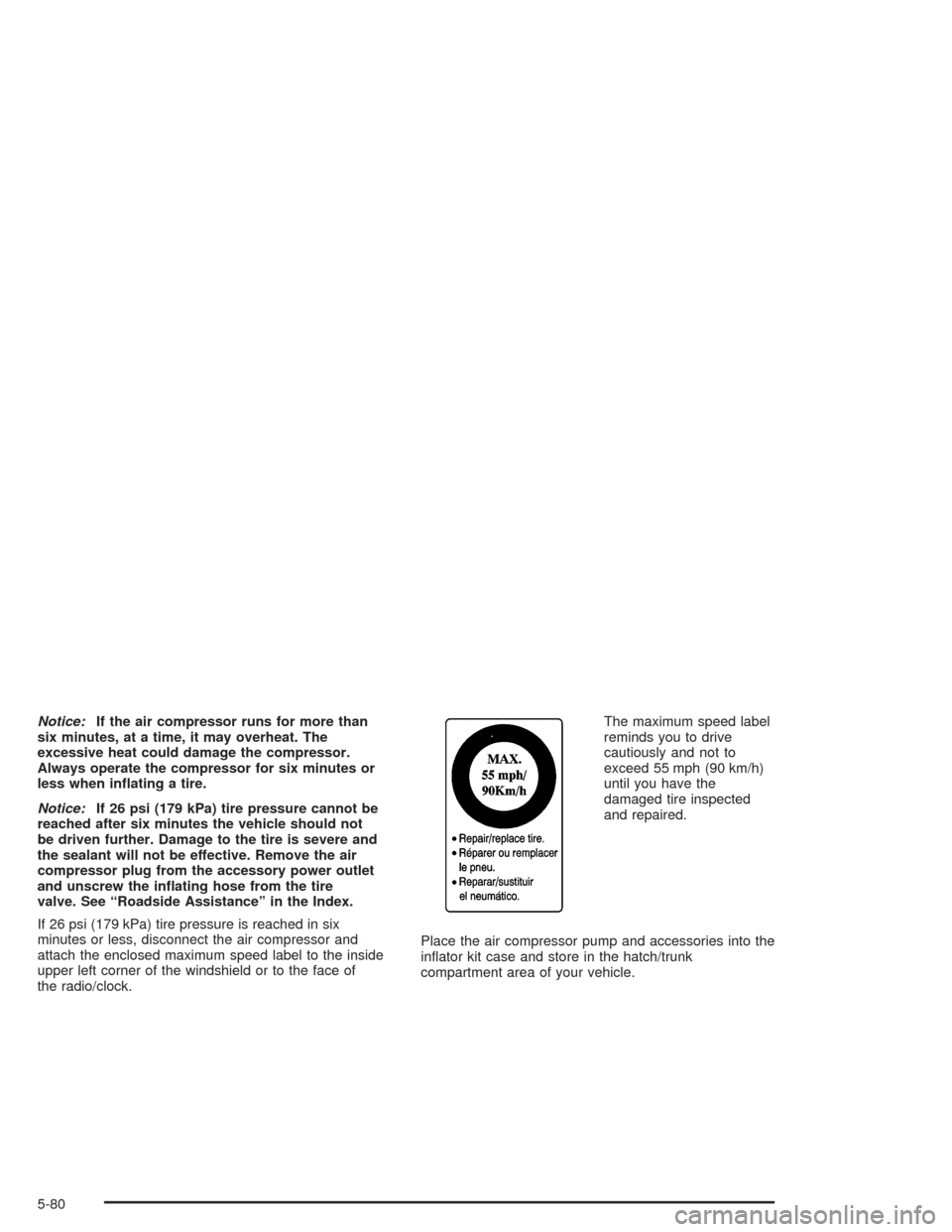
attach the enclosed maximum speed label to the inside
upper left corner of the windshield or to the face of
the radio/clock.The maximum speed label
reminds you to drive
cautiously and not to
exceed 55 mph (90 km/h)
until you have the
damaged tire inspected
and repaired.
Place the air compressor pump and accessories into the
inflator kit case and store in the hatch/trunk
compartment area of your vehicle.
5-80
Page 326 of 384
Cleaning Leather
Use a soft cloth with lukewarm water and a mild soap or
saddle soap and wipe dry with a soft cloth. Then, let
the leather dry naturally. Do not use heat to dry.
•For stubborn stains, use a leather cleaner.
•Never use oils, varnishes, solvent-based or abrasive
cleaners, furniture polish or shoe polish on leather.
•Soiled or stained leather should be cleaned
immediately. If dirt is allowed to work into the finish,
it can harm the leather.
Cleaning the Top of the
Instrument Panel
Use only mild soap and water to clean the top surfaces
of the instrument panel. Sprays containing silicones
or waxes may cause annoying reflections in the
windshield and even make it difficult to see through the
windshield under certain conditions.
Cleaning Interior Plastic Components
Use only a mild soap and water solution on a soft cloth
or sponge. Commercial cleaners may affect the
surface finish.
Cleaning the Security Shade and
Convenience Net
Wash with warm water and mild detergent, rinse with
cold water and tumble dry on low. Do not use chlorine
bleach.
Cleaning Glass Surfaces
Glass should be cleaned often. GM Glass Cleaner or a
liquid household glass cleaner will remove normal
tobacco smoke and dust films on interior glass. See
Vehicle Care/Appearance Materials on page 5-90.
Notice:If you use abrasive cleaners when cleaning
glass surfaces on your vehicle, you could scratch
the glass and/or cause damage to the rear window
defogger and the integrated radio antenna. When
cleaning the glass on your vehicle, use only a soft
cloth and glass cleaner.
5-84
Page 335 of 384
Fuses and Circuit Breakers
The wiring circuits in your vehicle are protected from
short circuits by a combination of maxi-fuses, mini-fuses
and circuit breakers. This greatly reduces the chance
of fires caused by electrical problems.
Look at the silver-colored band inside the fuse. If the
band is broken or melted, replace the fuse. Be sure you
replace a bad fuse with a new one of the identical
size and rating.
If you ever have a problem on the road and do not have
a spare fuse, you can borrow one that has the same
amperage. Just pick some feature of your vehicle
that you can get along without – like the radio or
cigarette lighter – and use its fuse, if it is the correct
amperage. Replace it as soon as you can.
Instrument Panel Fuse Block
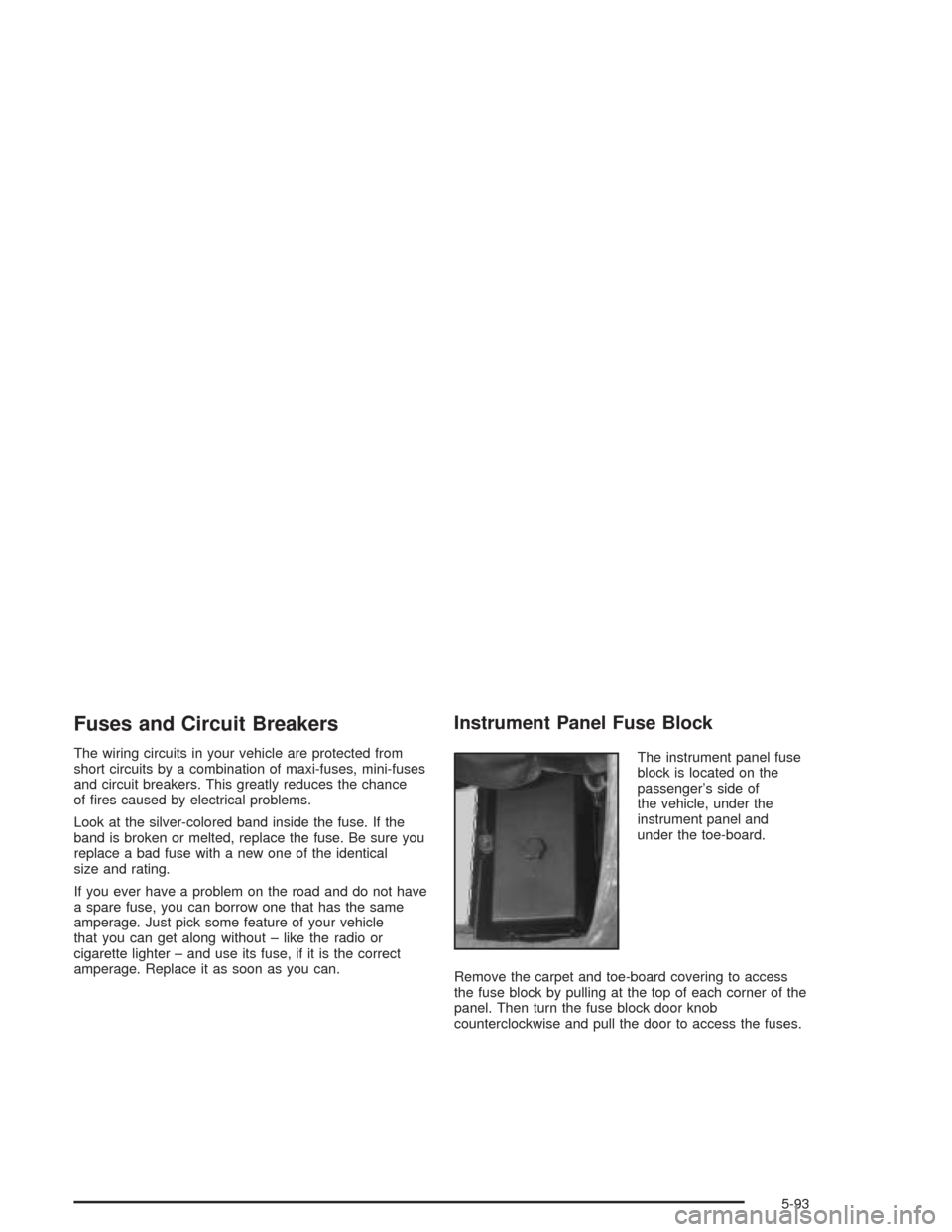
The instrument panel fuse
block is located on the
passenger’s side of
the vehicle, under the
instrument panel and
under the toe-board.
Remove the carpet and toe-board covering to access
the fuse block by pulling at the top of each corner of the
panel. Then turn the fuse block door knob
counterclockwise and pull the door to access the fuses.
5-93
Page 336 of 384
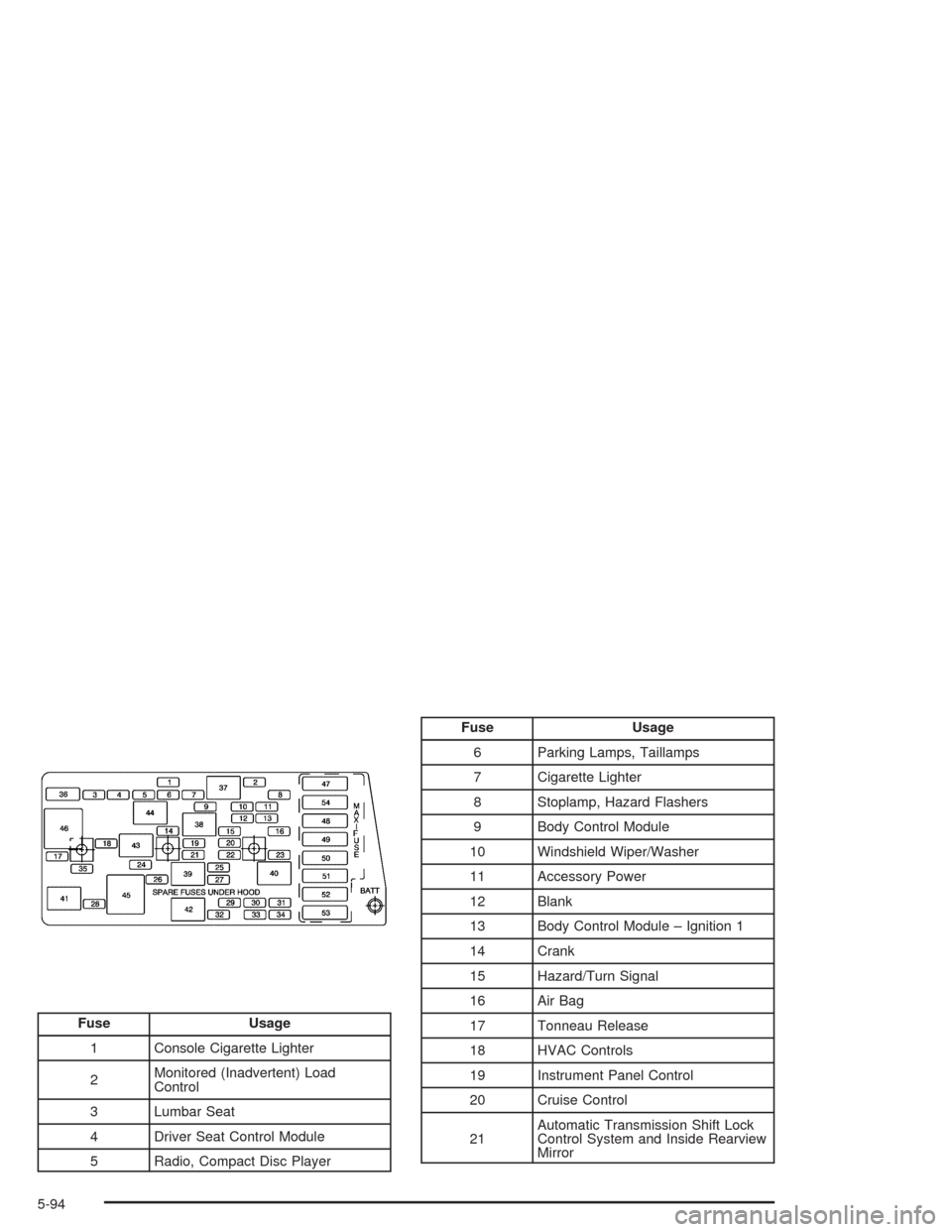
Fuse Usage
1 Console Cigarette Lighter
2Monitored (Inadvertent) Load
Control
3 Lumbar Seat
4 Driver Seat Control Module
5 Radio, Compact Disc Player
Fuse Usage
6 Parking Lamps, Taillamps
7 Cigarette Lighter
8 Stoplamp, Hazard Flashers
9 Body Control Module
10 Windshield Wiper/Washer
11 Accessory Power
12 Blank
13 Body Control Module – Ignition 1
14 Crank
15 Hazard/Turn Signal
16 Air Bag
17 Tonneau Release
18 HVAC Controls
19 Instrument Panel Control
20 Cruise Control
21Automatic Transmission Shift Lock
Control System and Inside Rearview
Mirror
5-94
Page 337 of 384
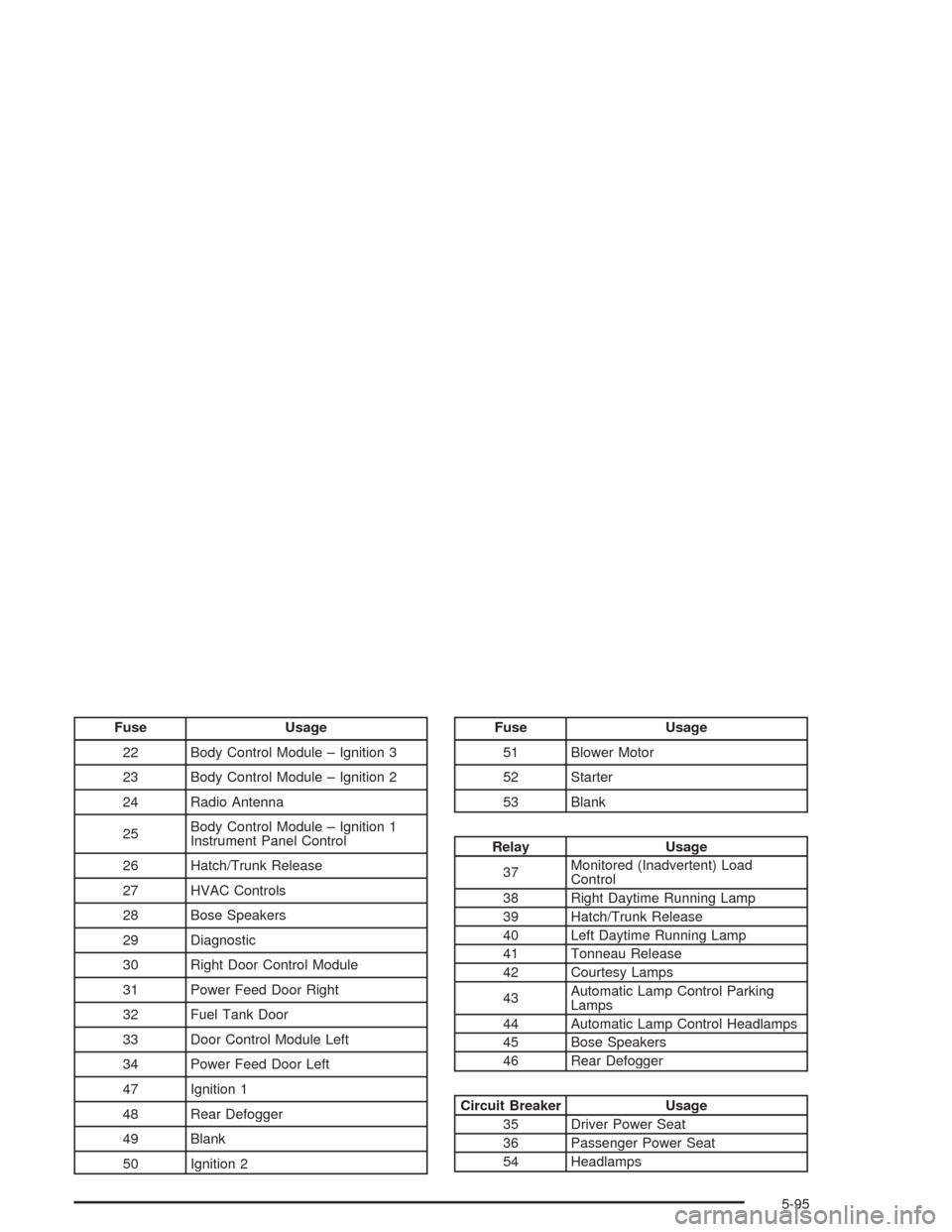
Fuse Usage
22 Body Control Module – Ignition 3
23 Body Control Module – Ignition 2
24 Radio Antenna
25Body Control Module – Ignition 1
Instrument Panel Control
26 Hatch/Trunk Release
27 HVAC Controls
28 Bose Speakers
29 Diagnostic
30 Right Door Control Module
31 Power Feed Door Right
32 Fuel Tank Door
33 Door Control Module Left
34 Power Feed Door Left
47 Ignition 1
48 Rear Defogger
49 Blank
50 Ignition 2Fuse Usage
51 Blower Motor
52 Starter
53 Blank
Relay Usage
37Monitored (Inadvertent) Load
Control
38 Right Daytime Running Lamp
39 Hatch/Trunk Release
40 Left Daytime Running Lamp
41 Tonneau Release
42 Courtesy Lamps
43Automatic Lamp Control Parking
Lamps
44 Automatic Lamp Control Headlamps
45 Bose Speakers
46 Rear Defogger
Circuit Breaker Usage
35 Driver Power Seat
36 Passenger Power Seat
54 Headlamps
5-95
Page 371 of 384
A
Accessory Power Outlets.................................3-22
Activating the Theft-Deterrent Feature................3-86
Active Handling System...................................4-10
Active Handling System Light...........................3-40
Adding Washer Fluid.......................................5-36
Additional Program Information........................... 7-9
Additives, Fuel................................................. 5-6
Add-On Electrical Equipment............................5-92
Adjusting the Speakers (Balance/Fade)......3-72, 3-78
Air Bag
Off Light.....................................................3-36
Readiness Light..........................................3-35
Air Bag System..............................................1-40
Air Bag Off Switch.......................................1-46
How Does an Air Bag Restrain?....................1-44
Servicing Your Air Bag-Equipped Vehicle.........1-49
What Makes an Air Bag Inflate?....................1-43
What Will You See After an
Air Bag Inflates?......................................1-44
When Should an Air Bag Inflate?...................1-43
Where Are the Air Bags?..............................1-42
Air Cleaner/Filter, Engine.................................5-18
Air Compressor..............................................5-78
Air Dam, Front...............................................2-19
Airbag Sensing and Diagnostic Module (SDM)...... 7-9
AM ...............................................................3-88
Antenna, Fixed Mast.......................................3-89
Antenna, Power Antenna Mast Care..................3-90Antennas, Integrated Windshield and Rear
Window......................................................3-90
Anti-lock Brake System (ABS)............................ 4-7
Anti-Lock Brake, System Warning Light..............3-39
Appearance Care............................................5-82
Care of Safety Belts....................................5-85
Chemical Paint Spotting...............................5-90
Cleaning the Inside of Your Vehicle................5-83
Cleaning the Outside of Your Vehicle..............5-85
Fiberglass Springs.......................................5-90
Finish Damage............................................5-89
Titanium Exhaust System..............................5-89
Underbody Maintenance...............................5-89
Vehicle Care/Appearance Materials................5-90
Weatherstrips..............................................5-85
Arming the System.........................................2-16
Ashtrays........................................................3-23
Audio System(s).............................................3-69
Care of Your Cassette Tape Player................3-88
Care of Your CD Player...............................3-89
Care of Your CDs........................................3-89
Fixed Mast Antenna.....................................3-89
Integrated Windshield and Rear Window
Antennas................................................3-90
Power Antenna Mast Care............................3-90
Radio with Cassette.....................................3-70
Radio with CD............................................3-76
Setting the Time..........................................3-69
Theft-Deterrent Feature................................3-86
Trunk-Mounted CD Changer..........................3-81
1