2004 CHEVROLET CORVETTE check engine light
[x] Cancel search: check engine lightPage 235 of 384
{CAUTION:
Snow can trap exhaust gases under your
vehicle. This can cause deadly CO (carbon
monoxide) gas to get inside. CO could
overcome you and kill you. You can not see it
or smell it, so you might not know it is in your
vehicle. Clear away snow from around the
base of your vehicle, especially any that is
blocking your exhaust pipe. And check around
again from time to time to be sure snow does
not collect there.
Open a window just a little on the side of the
vehicle that is away from the wind. This will
help keep CO out.Run your engine only as long as you must. This saves
fuel. When you run the engine, make it go a little
faster than just idle. That is, push the accelerator
slightly. This uses less fuel for the heat that you get and
it keeps the battery charged. You will need a
well-charged battery to restart the vehicle, and possibly
for signaling later on with your headlamps. Let the
heater run for a while.
Then, shut the engine off and close the window almost
all the way to preserve the heat. Start the engine
again and repeat this only when you feel really
uncomfortable from the cold. But do it as little as
possible. Preserve the fuel as long as you can. To help
keep warm, you can get out of the vehicle and do
some fairly vigorous exercises every half hour or so until
help comes.
4-31
Page 247 of 384
Gasoline Octane
Use premium unleaded gasoline with a posted octane of
91 or higher for best performance. You may also use
middle grade or regular unleaded gasoline rated at
87 octane or higher, but your vehicle’s acceleration may
be slightly reduced. If the octane is less than 87, you
may get a heavy knocking noise when you drive. If this
occurs, use a gasoline rated at 87 octane or higher
as soon as possible. Otherwise, you might damage
your engine.
Gasoline Specications
It is recommended that gasoline meet specifications
which were developed by automobile manufacturers
around the world and contained in the World-Wide Fuel
Charter which is available from the Alliance of
Automobile Manufacturers at
www.autoalliance.org/fuel_charter.htm. Gasoline
meeting these specifications could provide improved
driveability and emission control system performance
compared to other gasoline.In Canada, look for the
“Auto Makers’ Choice”
label on the pump.California Fuel
If your vehicle is certified to meet California Emission
Standards (see the underhood emission control label), it
is designed to operate on fuels that meet California
specifications. If this fuel is not available in states
adopting California emissions standards, your vehicle will
operate satisfactorily on fuels meeting federal
specifications, but emission control system performance
may be affected. The malfunction indicator lamp may turn
on (seeMalfunction Indicator Lamp on page 3-41) and
your vehicle may fail a smog-check test. If this occurs,
return to your authorized GM dealer for diagnosis. If it is
determined that the condition is caused by the type of fuel
used, repairs may not be covered by your warranty.Canada Only
5-5
Page 265 of 384
How to Check and Add Fluid
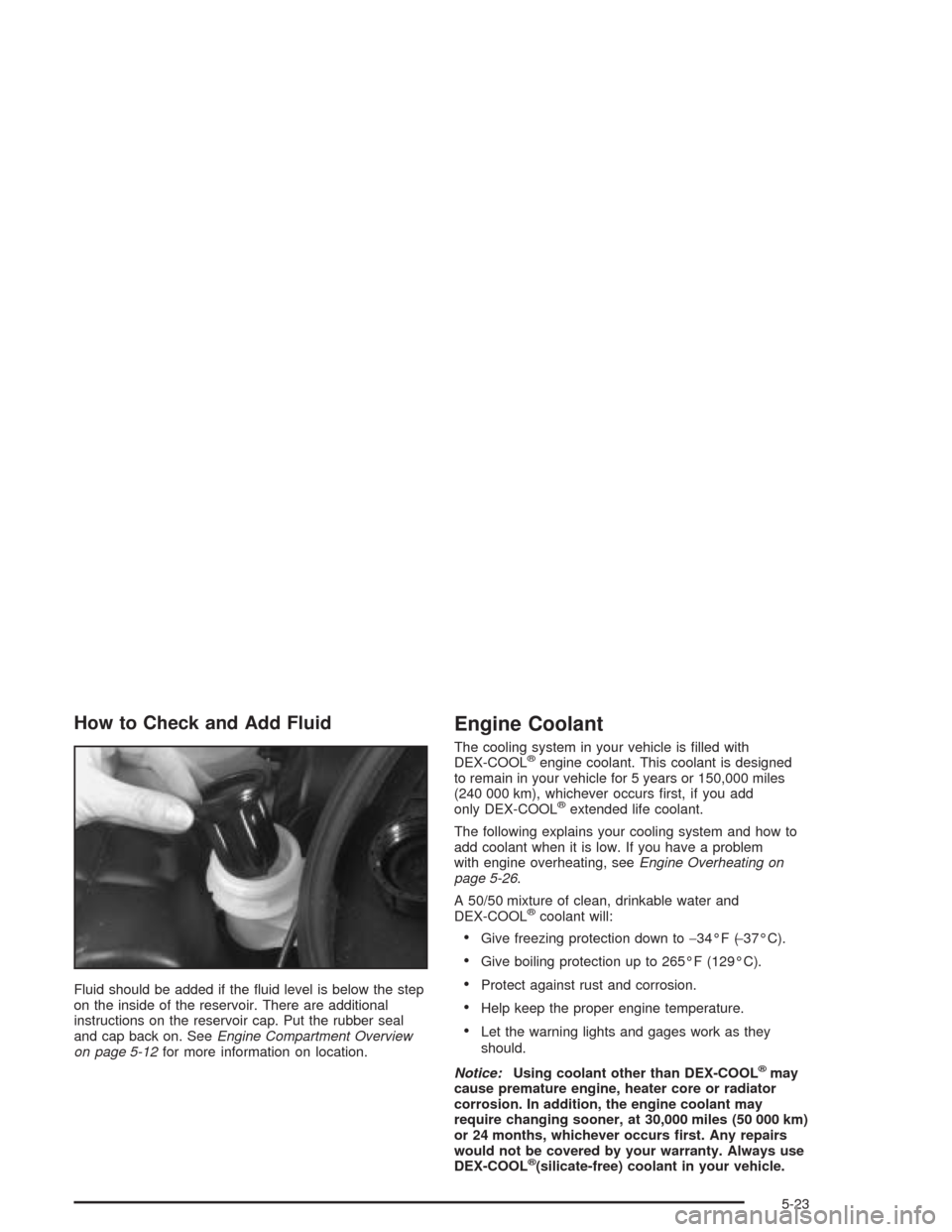
Fluid should be added if the fluid level is below the step
on the inside of the reservoir. There are additional
instructions on the reservoir cap. Put the rubber seal
and cap back on. SeeEngine Compartment Overview
on page 5-12for more information on location.
Engine Coolant
The cooling system in your vehicle is filled with
DEX-COOL®engine coolant. This coolant is designed
to remain in your vehicle for 5 years or 150,000 miles
(240 000 km), whichever occurs first, if you add
only DEX-COOL
®extended life coolant.
The following explains your cooling system and how to
add coolant when it is low. If you have a problem
with engine overheating, seeEngine Overheating on
page 5-26.
A 50/50 mixture of clean, drinkable water and
DEX-COOL
®coolant will:
•Give freezing protection down to−34°F (−37°C).
•Give boiling protection up to 265°F (129°C).
•Protect against rust and corrosion.
•Help keep the proper engine temperature.
•Let the warning lights and gages work as they
should.
Notice:Using coolant other than DEX-COOL
®may
cause premature engine, heater core or radiator
corrosion. In addition, the engine coolant may
require changing sooner, at 30,000 miles (50 000 km)
or 24 months, whichever occurs rst. Any repairs
would not be covered by your warranty. Always use
DEX-COOL
®(silicate-free) coolant in your vehicle.
5-23
Page 268 of 384
Coolant Surge Tank Pressure Cap
Notice:If the pressure cap is not tightly installed,
coolant loss and possible engine damage may
occur. Be sure the cap is properly and tightly
secured.
SeeEngine Compartment Overview on page 5-12for
information on location.
Engine Overheating
You will find an engine coolant temperature gage on the
instrument panel cluster and a COOLANT OVER
TEMP message on the Driver Information Center (DIC).
SeeEngine Coolant Temperature Gage on page 3-41
andDIC Warnings and Messages on page 3-58.
Overheated Engine Protection
Operating Mode
If an overheated engine condition exists and the
messages COOLANT OVER TEMP and REDUCED
ENGINE POWER are displayed, along with the Check
Engine light, an overheat protection mode which
alternates firing groups of cylinders helps prevent engine
damage. In this mode, you will notice a loss in power
and engine performance. This operating mode
allows your vehicle to be driven to a safe place in an
emergency; you may drive up to 50 miles (80 km).
Notice:After driving in the overheated engine
protection operating mode, to avoid engine damage,
allow the engine to cool before attempting any
repair. The engine oil will be severely degraded.
Repair the cause of coolant loss, change the oil and
reset the oil life system. SeeEngine Oil on
page 5-13.
5-26
Page 284 of 384
1. Check the other vehicle. It must have a 12-volt
battery with a negative ground system.
Notice:If the other vehicle’s system is not a 12-volt
system with a negative ground, both vehicles can
be damaged. Only use vehicles with 12-volt systems
with negative grounds to jump start your vehicle.
2. Get the vehicles close enough so the jumper cables
can reach, but be sure the vehicles are not touching
each other. If they are, it could cause a ground
connection you do not want. You would not be able
to start your vehicle, and the bad grounding
could damage the electrical systems.
To avoid the possibility of the vehicles rolling, set
the parking brake firmly on both vehicles involved in
the jump start procedure. Put an automatic
transmission in PARK (P) or a manual transmission
in NEUTRAL before setting the parking brakes.Notice:If you leave your radio or other accessories
on during the jump starting procedure, they could
be damaged. The repairs would not be covered
by your warranty. Always turn off your radio and
other accessories when jump starting your vehicle.
3. Turn off the ignition on both vehicles. Unplug
unnecessary accessories plugged into the cigarette
lighter or in the accessory power outlet. Turn off
the radio and all lamps that are not needed. This will
avoid sparks and help save both batteries. And it
could save your radio!
4. Open the hoods and locate the batteries. Find the
positive (+) and negative (−) terminal locations on
each vehicle. SeeEngine Compartment Overview
on page 5-12for more information on location.
{CAUTION:
An electric fan can start up even when the
engine is not running and can injure you. Keep
hands, clothing and tools away from any
underhood electric fan.
5-42
Page 285 of 384
{CAUTION:
Using a match near a battery can cause battery
gas to explode. People have been hurt doing
this, and some have been blinded. Use a
ashlight if you need more light.
Be sure the battery has enough water. You do
not need to add water to the ACDelco
®battery
installed in your new vehicle. But if a battery
has ller caps, be sure the right amount of
uid is there. If it is low, add water to take care
of that rst. If you do not, explosive gas could
be present.
Battery uid contains acid that can burn you.
Do not get it on you. If you accidentally get it
in your eyes or on your skin, ush the place
with water and get medical help immediately.
{CAUTION:
Fans or other moving engine parts can injure
you badly. Keep your hands away from moving
parts once the engine is running.
5. Check that the jumper cables do not have loose or
missing insulation. If they do, you could get a
shock. The vehicles could be damaged, too.
Before you connect the cables, here are some
basic things you should know. Positive (+) will go to
positive (+) or to a remote positive (+) terminal if
the vehicle has one. Negative (−) will go to a heavy,
unpainted metal engine part or to a remote
negative (−) terminal if the vehicle has one.
Do not connect positive (+) to negative (−)oryou
will get a short that would damage the battery
and maybe other parts, too. And do not connect the
negative (−) cable to the negative (−) terminal on
the dead battery because this can cause sparks.
5-43
Page 372 of 384
Audio System(s) (cont.)
Understanding Radio Reception.....................3-88
Automatic Transmission...................................2-21
Fluid..........................................................5-20
Operation...................................................2-25
B
Battery..........................................................5-40
Battery Replacement......................................... 2-8
Battery Run-Down Protection............................3-18
Before Leaving on a Long Trip.........................4-25
Brake
Parking......................................................2-31
System Warning Light..................................3-38
Brake Fluid....................................................5-37
Brake Wear...................................................5-39
Brakes..........................................................5-37
Braking........................................................... 4-6
Braking in Emergencies..................................... 4-9
Break-In, New Vehicle.....................................2-19
Bulb Replacement...........................................5-48
Back-Up Lamps...........................................5-52
Halogen Bulbs............................................5-48
Headlamps.................................................5-48
Replacement Bulbs......................................5-52
Taillamps and Turn Signal Lamps..................5-50
Buying New Tires...........................................5-66
C
California Fuel.................................................. 5-5
Canada – Customer Assistance.......................... 7-4
Canadian Owners................................................ ii
Canadian Roadside Assistance........................... 7-7
Capacities and Specifications............................5-99
Carbon Fiber Hood.........................................5-89
Carbon Monoxide...................4-28, 4-38, 2-11, 2-36
Care of
Safety Belts................................................5-85
Your Cassette Tape Player............................3-88
Your CD Player...........................................3-89
Your CDs ...................................................3-89
Cargo Cover..................................................2-43
Cassette Tape Messages.................................3-75
Cassette Tape Player Service............................. 6-9
CD Adapter Kits.............................................3-75
CD Changer, Trunk-Mounted............................3-81
CD Messages........................................3-80, 3-85
Center Console Storage Area...........................2-40
Chains, Tires..................................................5-71
Check
Engine Light...............................................3-41
Gages Warning Light...................................3-46
Check Engine Light.........................................3-41
Checking Coolant............................................5-24
Checking Engine Oil........................................5-13
2
Page 373 of 384
Checking Things Under the Hood......................5-10
Chemical Paint Spotting...................................5-90
Child Restraints
Child Restraint Systems...............................1-25
Infants and Young Children...........................1-22
Lower Anchorages and Top Tethers for
Children (LATCH System)..........................1-30
Older Children.............................................1-19
Securing a Child Restraint Designed for
the LATCH System...................................1-33
Securing a Child Restraint in the
Passenger Seat Position...........................1-36
Top Strap...................................................1-28
Top Strap Anchor Location............................1-30
Cigarette Lighter.............................................3-23
Cleaning
Fiberglass Springs.......................................5-90
Inside of Your Vehicle..................................5-83
Outside of Your Vehicle................................5-85
Titanium Exhaust System..............................5-89
Underbody Maintenance...............................5-89
Weatherstrips..............................................5-85
Cleaning Aluminum Wheels..............................5-88
Cleaning Coated Moldings................................5-83
Cleaning Exterior Lamps/Lenses.......................5-86
Cleaning Fabric/Carpet....................................5-83
Cleaning Glass Surfaces..................................5-84
Cleaning Interior Plastic Components.................5-84Cleaning Leather............................................5-84
Cleaning Removable Roof Panel.......................5-87
Cleaning the Convertible Top............................5-88
Cleaning the Security Shade and
Convenience Net.........................................5-84
Cleaning the Top of the Instrument Panel...........5-84
Cleaning Tires................................................5-88
Cleaning Windshield and Wiper Blades..............5-87
Climate Control System
Dual Automatic............................................3-23
Outlet Adjustment........................................3-31
Clutch, Hydraulic.............................................5-22
Competitive Driving Mode................................4-12
Control of a Vehicle.......................................... 4-6
Convenience Net............................................2-43
Convertible Top..............................................2-50
Lowering the Convertible Top........................2-51
Raising the Convertible Top..........................2-55
Coolant
Engine Temperature Gage............................3-41
Heater, Engine............................................2-23
Surge Tank Pressure Cap.............................5-26
Cooling System..............................................5-29
Courtesy Lamps.............................................3-17
Cruise Control................................................3-10
Cupholder(s)..................................................2-40
Current and Past Model Order Forms................7-12
Customer Assistance Information
Courtesy Transportation.................................. 7-7
3