2004 CADILLAC SEVILLE ignition
[x] Cancel search: ignitionPage 298 of 410
Brakes
Brake Fluid
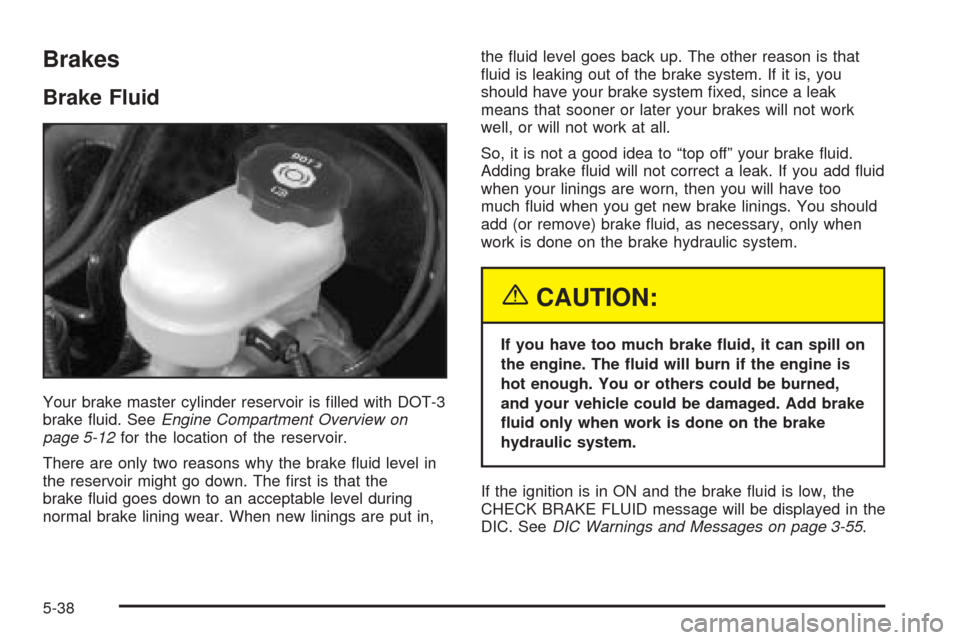
Your brake master cylinder reservoir is filled with DOT-3
brake fluid. SeeEngine Compartment Overview on
page 5-12for the location of the reservoir.
There are only two reasons why the brake fluid level in
the reservoir might go down. The first is that the
brake fluid goes down to an acceptable level during
normal brake lining wear. When new linings are put in,the fluid level goes back up. The other reason is that
fluid is leaking out of the brake system. If it is, you
should have your brake system fixed, since a leak
means that sooner or later your brakes will not work
well, or will not work at all.
So, it is not a good idea to “top off” your brake fluid.
Adding brake fluid will not correct a leak. If you add fluid
when your linings are worn, then you will have too
much fluid when you get new brake linings. You should
add (or remove) brake fluid, as necessary, only when
work is done on the brake hydraulic system.
{CAUTION:
If you have too much brake fluid, it can spill on
the engine. The fluid will burn if the engine is
hot enough. You or others could be burned,
and your vehicle could be damaged. Add brake
fluid only when work is done on the brake
hydraulic system.
If the ignition is in ON and the brake fluid is low, the
CHECK BRAKE FLUID message will be displayed in the
DIC. SeeDIC Warnings and Messages on page 3-55.
5-38
Page 303 of 410
Jump Starting
If your battery has run down, you may want to use
another vehicle and some jumper cables to start your
vehicle. Be sure to follow the steps below to do it safely.
{CAUTION:
Batteries can hurt you. They can be dangerous
because:
•They contain acid that can burn you.
•They contain gas that can explode or
ignite.
•They contain enough electricity to
burn you.
If you do not follow these steps exactly, some
or all of these things can hurt you.
Notice:Ignoring these steps could result in costly
damage to your vehicle that would not be covered
by your warranty.
Trying to start your vehicle by pushing or pulling it
will not work, and it could damage your vehicle.1. Check the other vehicle. It must have a 12-volt
battery with a negative ground system.
Notice:If the other vehicle’s system is not a 12-volt
system with a negative ground, both vehicles can
be damaged. Only use vehicles with 12-volt systems
with negative grounds to jump start your vehicle.
2. Get the vehicles close enough so the jumper cables
can reach, but be sure the vehicles are not touching
each other. If they are, it could cause a ground
connection you do not want. You would not be able
to start your vehicle and the bad grounding could
damage the electrical systems.
To avoid the possibility of the vehicles rolling, set
the parking brake firmly on both vehicles involved in
the jump start procedure. Put an automatic
transaxle in PARK (P) or a manual transaxle in
NEUTRAL before setting the parking brake.
Notice:If you leave your radio or other accessories
on during the jump starting procedure, they could
be damaged. The repairs would not be covered
by your warranty. Always turn off your radio and
other accessories when jump starting your vehicle.
3. Turn off the ignition on both vehicles. Unplug
unnecessary accessories plugged into the cigarette
lighter or in the accessory power outlets. Turn off
the radio and all lamps that are not needed. This will
avoid sparks and help save both batteries. And it
could save your radio!
5-43
Page 358 of 410
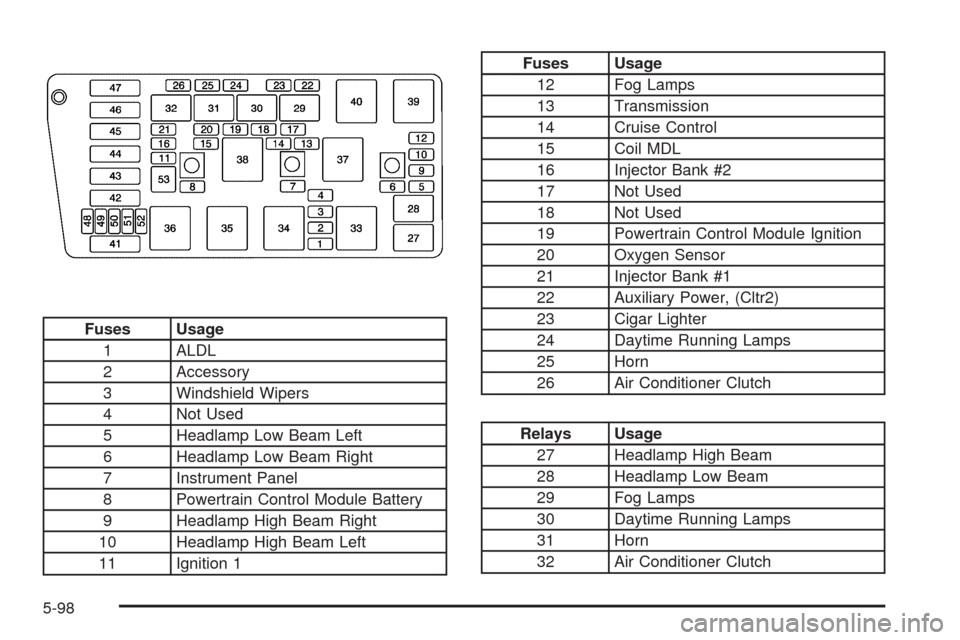
Fuses Usage
1 ALDL
2 Accessory
3 Windshield Wipers
4 Not Used
5 Headlamp Low Beam Left
6 Headlamp Low Beam Right
7 Instrument Panel
8 Powertrain Control Module Battery
9 Headlamp High Beam Right
10 Headlamp High Beam Left
11 Ignition 1
Fuses Usage
12 Fog Lamps
13 Transmission
14 Cruise Control
15 Coil MDL
16 Injector Bank #2
17 Not Used
18 Not Used
19 Powertrain Control Module Ignition
20 Oxygen Sensor
21 Injector Bank #1
22 Auxiliary Power, (Cltr2)
23 Cigar Lighter
24 Daytime Running Lamps
25 Horn
26 Air Conditioner Clutch
Relays Usage
27 Headlamp High Beam
28 Headlamp Low Beam
29 Fog Lamps
30 Daytime Running Lamps
31 Horn
32 Air Conditioner Clutch
5-98
Page 359 of 410
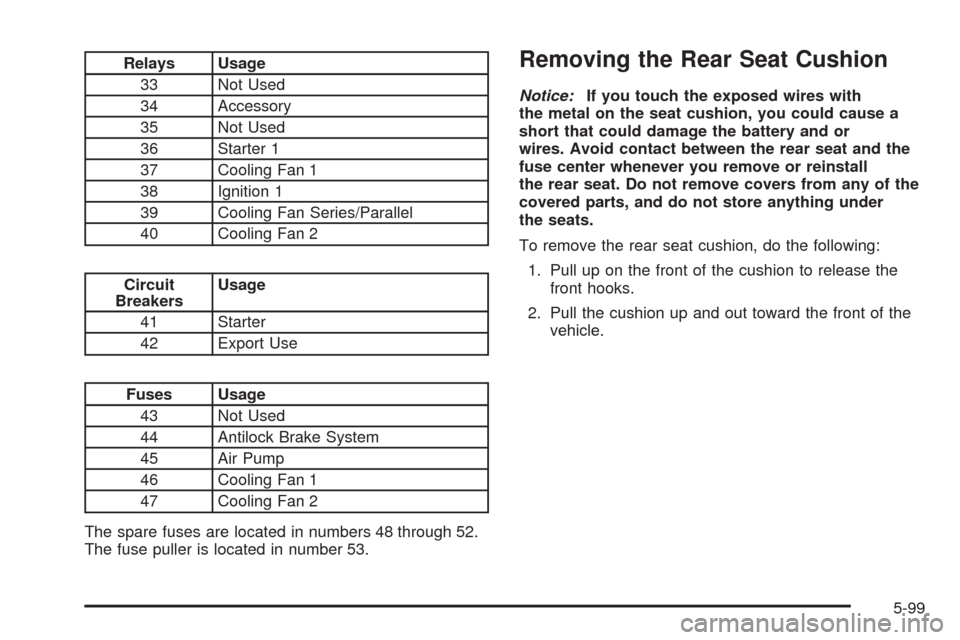
Relays Usage
33 Not Used
34 Accessory
35 Not Used
36 Starter 1
37 Cooling Fan 1
38 Ignition 1
39 Cooling Fan Series/Parallel
40 Cooling Fan 2
Circuit
BreakersUsage
41 Starter
42 Export Use
Fuses Usage
43 Not Used
44 Antilock Brake System
45 Air Pump
46 Cooling Fan 1
47 Cooling Fan 2
The spare fuses are located in numbers 48 through 52.
The fuse puller is located in number 53.
Removing the Rear Seat Cushion
Notice:If you touch the exposed wires with
the metal on the seat cushion, you could cause a
short that could damage the battery and or
wires. Avoid contact between the rear seat and the
fuse center whenever you remove or reinstall
the rear seat. Do not remove covers from any of the
covered parts, and do not store anything under
the seats.
To remove the rear seat cushion, do the following:
1. Pull up on the front of the cushion to release the
front hooks.
2. Pull the cushion up and out toward the front of the
vehicle.
5-99
Page 362 of 410
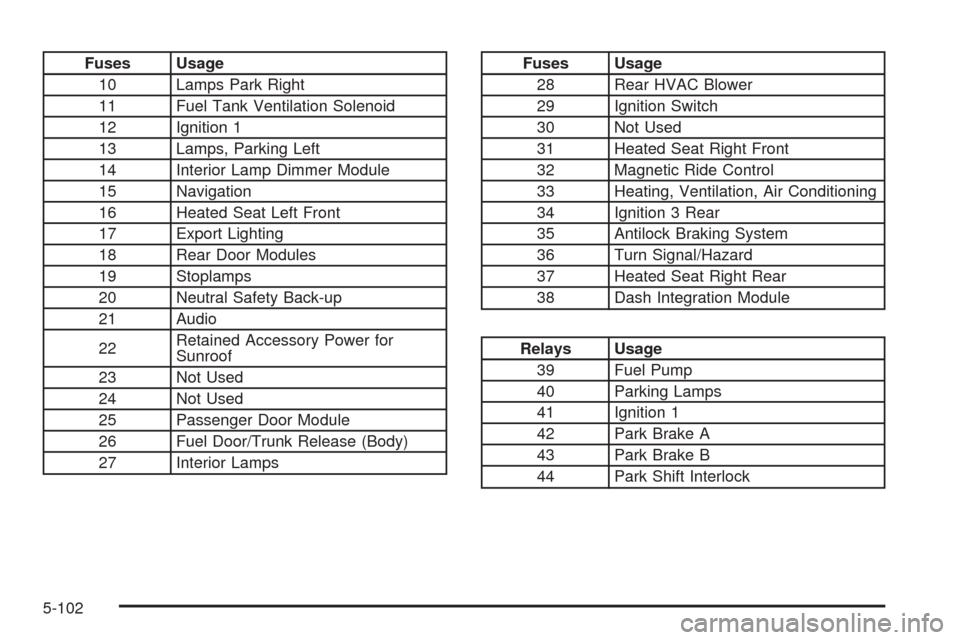
Fuses Usage
10 Lamps Park Right
11 Fuel Tank Ventilation Solenoid
12 Ignition 1
13 Lamps, Parking Left
14 Interior Lamp Dimmer Module
15 Navigation
16 Heated Seat Left Front
17 Export Lighting
18 Rear Door Modules
19 Stoplamps
20 Neutral Safety Back-up
21 Audio
22Retained Accessory Power for
Sunroof
23 Not Used
24 Not Used
25 Passenger Door Module
26 Fuel Door/Trunk Release (Body)
27 Interior LampsFuses Usage
28 Rear HVAC Blower
29 Ignition Switch
30 Not Used
31 Heated Seat Right Front
32 Magnetic Ride Control
33 Heating, Ventilation, Air Conditioning
34 Ignition 3 Rear
35 Antilock Braking System
36 Turn Signal/Hazard
37 Heated Seat Right Rear
38 Dash Integration Module
Relays Usage
39 Fuel Pump
40 Parking Lamps
41 Ignition 1
42 Park Brake A
43 Park Brake B
44 Park Shift Interlock
5-102
Page 363 of 410
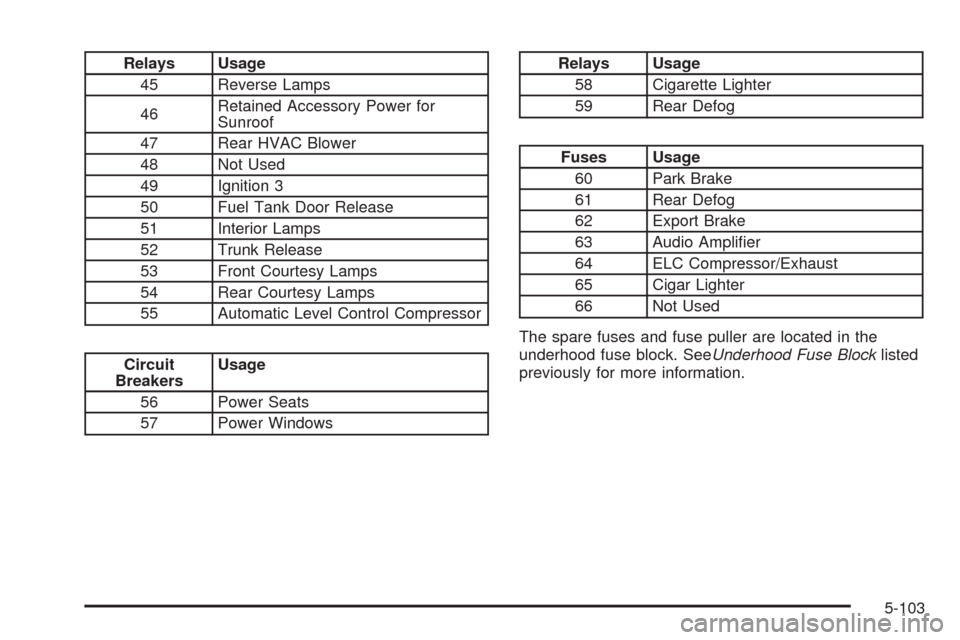
Relays Usage
45 Reverse Lamps
46Retained Accessory Power for
Sunroof
47 Rear HVAC Blower
48 Not Used
49 Ignition 3
50 Fuel Tank Door Release
51 Interior Lamps
52 Trunk Release
53 Front Courtesy Lamps
54 Rear Courtesy Lamps
55 Automatic Level Control Compressor
Circuit
BreakersUsage
56 Power Seats
57 Power Windows
Relays Usage
58 Cigarette Lighter
59 Rear Defog
Fuses Usage
60 Park Brake
61 Rear Defog
62 Export Brake
63 Audio Amplifier
64 ELC Compressor/Exhaust
65 Cigar Lighter
66 Not Used
The spare fuses and fuse puller are located in the
underhood fuse block. SeeUnderhood Fuse Blocklisted
previously for more information.
5-103
Page 374 of 410
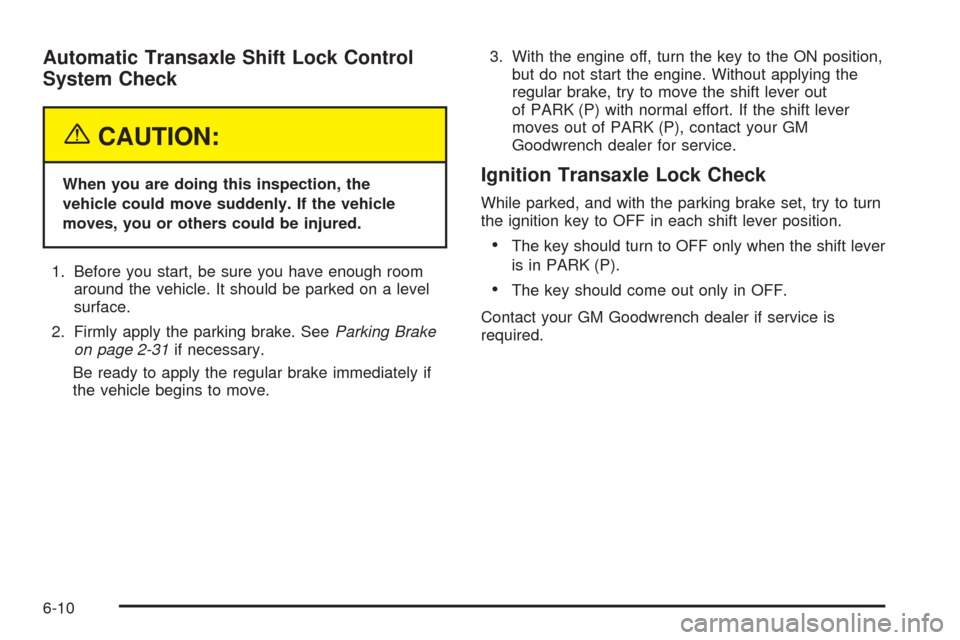
Automatic Transaxle Shift Lock Control
System Check
{CAUTION:
When you are doing this inspection, the
vehicle could move suddenly. If the vehicle
moves, you or others could be injured.
1. Before you start, be sure you have enough room
around the vehicle. It should be parked on a level
surface.
2. Firmly apply the parking brake. SeeParking Brake
on page 2-31if necessary.
Be ready to apply the regular brake immediately if
the vehicle begins to move.3. With the engine off, turn the key to the ON position,
but do not start the engine. Without applying the
regular brake, try to move the shift lever out
of PARK (P) with normal effort. If the shift lever
moves out of PARK (P), contact your GM
Goodwrench dealer for service.Ignition Transaxle Lock Check
While parked, and with the parking brake set, try to turn
the ignition key to OFF in each shift lever position.
•The key should turn to OFF only when the shift lever
is in PARK (P).
•The key should come out only in OFF.
Contact your GM Goodwrench dealer if service is
required.
6-10
Page 401 of 410
H
Hazard Warning Flashers................................... 3-6
Headlamp
Aiming.......................................................5-49
Horizontal Aiming.........................................5-51
Vertical Aiming............................................5-51
Headlamp High/Low-Beam Changer...................3-10
Headlamp Wiring............................................5-96
Headlamps....................................................5-54
Bulb Replacement.......................................5-53
Front Turn Signal Lamps..............................5-57
Halogen Bulbs............................................5-54
High Intensity Discharge (HID) Lighting...........5-53
Heated Seats................................................... 1-3
Highway Hypnosis...........................................4-22
Hill and Mountain Roads..................................4-22
Hitches..........................................................4-40
HomeLink
®Transmitter....................................2-44
HomeLink®Transmitter, Programming................2-45
Hood
Checking Things Under................................5-10
Release.....................................................5-11
Horn............................................................... 3-7
Horn Sounds at Lock......................................3-68
How the System Works...................................3-25
How to Add Coolant to the Coolant
Surge Tank.................................................5-31
How to Add Fluid............................................5-23How to Check........................................5-21, 5-69
How to Check Power Steering Fluid..................5-36
How to Reset the Transaxle Fluid Change
Indicator.....................................................5-23
How to Use This Manual...................................... ii
How to Wear Safety Belts Properly...................1-11
Hydroplaning..................................................4-18
I
If No Steam Is Coming From Your Engine..........5-28
If Steam Is Coming From Your Engine...............5-27
If the Light Is Flashing.....................................3-47
If the Light Is On Steady.................................3-47
If You Are Caught in a Blizzard.........................4-26
If You Are Stuck in Sand, Mud, Ice
or Snow.....................................................4-28
If You Do Decide To Pull A Trailer.....................4-38
Ignition Positions.............................................2-25
Inadvertent Power Battery Saver.......................3-24
Infants and Young Children, Restraints...............1-25
Inflation - Tire Pressure...................................5-68
Instrument Panel
Cluster.......................................................3-38
Overview..................................................... 3-4
Instrument Panel Brightness.............................3-22
Interior Lamps................................................3-22
Interior Lamps Control.....................................3-22
7