Page 179 of 283
Youshoulddothefollowingchecks
and adjustments every day bef ore
you drive your vehicle.Make sure all windows, mirrors,
and outside lights are clean and
unobstructed. Remove f rost, snow,
or ice.
Check that the hood and trunk are
f ully closed.
Visually check the tires. If a tire
looks low, use a gauge to check its
pressure.
Check that any items you may be
carrying with you inside are stored
properly or f astened down
securely. Check the seat adjustment (see
page ).
Check the adjustment of the
inside and outside mirrors (see
page ).
Check the steering wheel
adjustment (see page ).
Make sure the doors are securely
closed and locked.
When you start the engine, check
the gauges and indicator lights in the
instrument panel (see page ).
Fasten your seat belt. Check that
your passengers have f astened
their seat belts (see page ).
3. 2.
1.
4. 5.
6.
7.
8.
9. 88
91 78
14 51
Preparing to Drive
Driving176
Page 181 of 283

When slowing down, you can get
extra braking from the engine by
shifting to a lower gear. This extra
braking can help you maintain a safe
speed and prevent your brakes f rom
overheating while going down a
steep hill. Bef ore downshif ting,
make sure engine speed will not go
into the tachometer’s red zone in the
lower gear.
The manual transmission is
synchronized in all f orward gears f or
smooth operation. It has a lockout so
you cannot accidentally shif t f rom
f if th to Reverse instead of sixth (see
page ) while the vehicle is
moving. When shif ting up or down,
make sure you push the clutch pedal
down all the way, shift to the next
gear, and let the pedal up gradually.
When you are not shif ting, do not
rest your f oot on the clutch pedal.
This can cause your clutch to wear
out f aster. Come to a full stop before you shift
into Reverse. You can damage the
transmission by trying to shif t into
Reverse with the vehicle moving.
Push down the clutch pedal, and
pause f or a f ew seconds bef ore
shif ting into Reverse, or shif t into
one of the f orward gears f or a
moment. This stops the gears so
they won’t ‘‘grind.’’
180The engine can be damaged if
you inadvertently downshif t into the wrong gear (f or example, going f romthird gear at high rpms to second gearinstead of upshif ting to f ourth gear; therev limiter will not work in this situation).
6-speed Manual T ransmission
Driving178
Note:
Rapid slowing or speeding-up
can cause loss of control on
slippery surfaces. If you crash,
you can be injured.
Use extra care when driving on
slippery surfaces.
Page 183 of 283
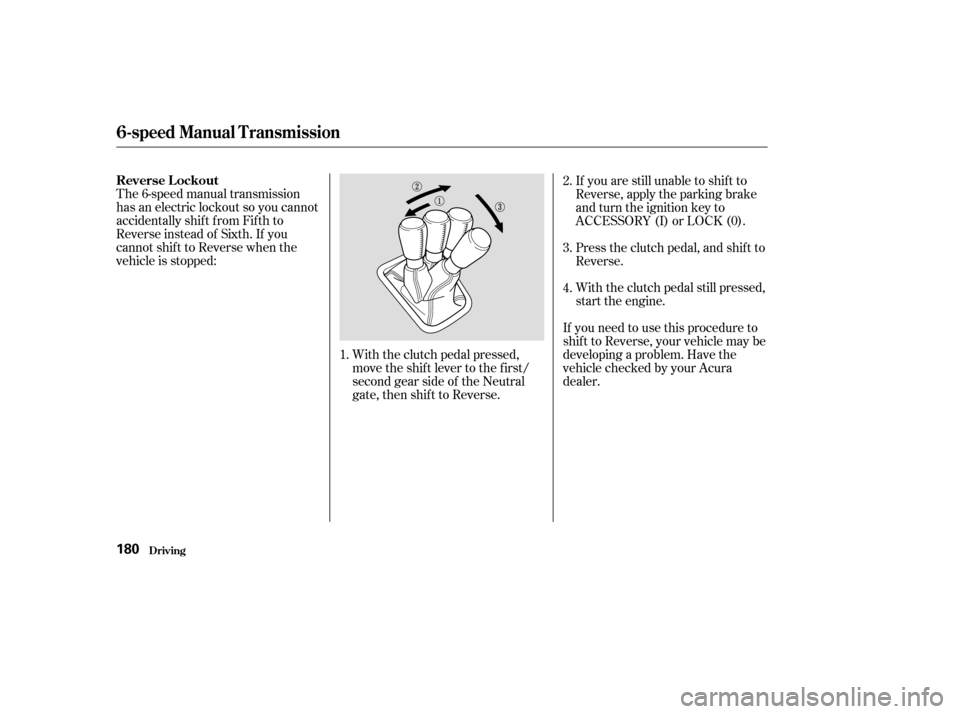
The 6-speed manual transmission
has an electric lockout so you cannot
accidentally shif t f rom Fif th to
Reverse instead of Sixth. If you
cannot shif t to Reverse when the
vehicle is stopped:With the clutch pedal pressed,
move the shift lever to the first/
second gear side of the Neutral
gate, then shif t to Reverse.If you are still unable to shif t to
Reverse, apply the parking brake
and turn the ignition key to
ACCESSORY (I) or LOCK (0).
Press the clutch pedal, and shif t to
Reverse.
With the clutch pedal still pressed,
start the engine.
If you need to use this procedure to
shif t to Reverse, your vehicle may be
developing a problem. Have the
vehicle checked by your Acura
dealer.
1. 2.
3.
4.
Driving
6-speed Manual T ransmission
Reverse Lockout
180
Page 184 of 283
These indicators on the instrument
panel show which position the shif t
lever is in. The illuminated number
next to the ‘‘L’’ indicator shows you
the gear you have selected in the
Sequential SportShif t mode.The ‘‘D’’ indicator comes on f or a
f ew seconds when you turn the
ignition switch to ON (II). If it
f lashes while driving (in any shif t
position), it indicates a possible
problem in the transmission. Avoid
rapid acceleration and have the
transmission checked by an Acura
dealer as soon as possible.
To shif t f rom any position, press
f irmly on the brake pedal. You
cannot shif t out of Park when the
ignition switch is in the LOCK (0) or
ACCESSORY (I) position.
CONT INUED
Shif t L ever Position Indicators Shif ting
Automatic Transmission
Driving181
Page 185 of 283

�µ�µ�µ
�µ
�µ �µ
To avoid transmission damage, come
to a complete stop bef ore shif ting
into Park. The shif t lever must be in
Park bef ore you can remove the key
from the ignition switch.
Your vehicle has a reverse lockout so
you cannot accidentally shif t to
Reverse from Neutral or any other
driving position when the vehicle
speed exceeds 5 6 mph (8 10
km/h).
If you cannot shif t to Reverse when
the vehicle is stopped, press the
brake pedal and slowly shift to
Neutral, and then to Reverse.
If there is a problem in the reverse
lockout system, or your vehicle’s battery is disconnected or goes dead,
you cannot shif t to Reverse. (Ref er
to Shif t Lock Release on page ).
Use Neutral if you
need to restart a stalled engine, or if
it is necessary to stop brief ly with
the engine idling. Shif t to the Park
position if you need to leave your
vehicle for any reason. Press on the
brake pedal when you are moving
the shift lever from Neutral to
another gear.
Use this position f or
your normal driving. The transmis-
sion automatically selects a suitable
gear f or your speed and acceleration.
ForfasteraccelerationwheninD,
you can get the transmission to
automatically downshif t by pushing
the accelerator pedal to the floor.
The transmission will shif t down one,
two or three gears, depending on
your speed.
This position mechani-
cally locks the transmission. Use
Park whenever you are turning of f or
starting the engine. To shif t out of
Park, you must press on the brake
pedal and have your f oot of f the
accelerator pedal.
If you have done all of the above and
still cannot move the lever out of
Park, see on
page . Press the brake
pedal to shift from Park to Reverse.
To shift from Neutral to Reverse,
come to a complete stop and then
shif t.
185 185
To shift from:
PtoR
RtoN
NtoD DtoL
LtoD
DtoN NtoR RtoP Do this:
Press the brake pedal, then
move the shift lever.
Move the lever.
Neutral (N)
Drive (D)
Park (P)
Shif t L ock Release Reverse (R)
Automatic Transmission
Driving182
Page 188 of 283

�à
�à
�à
To shift from
32
43
54 When you are in Sequential
Sportshif t mode, and the vehicle is
stopped, push f orward on the shif t
lever to shif t to second gear. You will
see ‘‘2’’ in the display. Starting out in
second gear will help to reduce
wheelspin in deep snow or on a
slippery surf ace.
If you exceed the maximum speed
f or the gear you are in, the engine
speed will enter into the tachometer’s
red zone. If this occurs, you may f eel
the engine cut in and out. This is
caused by a limiter in the engine’s
computer controls. The engine will
run normally when you reduce the
RPM below the red zone. This allows you to move the shif t
lever out of Park if the normal
method of pushing on the brake
pedal does not work. This procedure
is also used to release the Reverse
Lockout.
Set the Parking brake.
Make sure the ignition switch is in
the LOCK (0) position.
To release the Reverse Lockout,
make sure the ignition switch is in
the ACCESSORY (I) position.
Speed range
under 63 mph
(102 km/h)
under 97 mph
(156 km/h)
under 149 mph
(240 km/h) 1.
2.
CONT INUED
Starting in Second Gear
Engine Speed L imiterShif t L ock Release
Driving
Automatic Transmission
185
Page 189 of 283
Put a cloth on the edge of the Shif t
Lock Release slot cover next to
theshiftlever.Useasmallflat-
tipped screwdriver or a metal
f ingernail f ile to remove the cover.
Caref ully pry on the edge of the
cover.Push down on the key and move
the shift lever out of Park to
Neutral.
To release the Reverse Lockout,
move the shift lever from Neutral
to Reverse, then to Park.Remove the key from the Shift
Lock Release slot, then reinstall
thecover.Makesurethenotchon
the cover is on the right side.
Press the brake pedal, and restart
the engine.
If you need to use the Shif t Lock
Release, it means your vehicle is
developing a problem. Have the
vehicle checked by an Acura dealer.
Insert a key into the Shift Lock
Release slot.
3. 6.
5. 4.
Automatic Transmission
Driving186
SHIFT LOCK RELEASE SLOT
COVER
Page 190 of 283

Always use the parking brake when
you park your vehicle. Make sure
the parking brake is set f irmly or
your vehicle may roll if it is parked
on an incline.
If your vehicle has an automatic
transmission, set the parking brake
bef ore you put the transmission in
Park. This keeps the vehicle f rom
moving and putting pressure on the
parking mechanism in the
transmission.Make sure the moonroof and the
windows are closed.
Turn of f the lights.
Place any packages, valuables, etc.,
in the trunk or take them with you. Never park over dry leaves, tall
grass, or other f lammable
materials. The hot three way
catalytic converter could cause
these materials to catch on fire.
If the vehicle is f acing uphill, turn
the f ront wheels away f rom the
curb. If you have a manual
transmission, put it in f irst gear.
If the vehicle is f acing downhill,
turn the front wheels toward the
curb. If you have a manual
transmission, put it in reverse gear.
Make sure the parking brake is
f ully released bef ore driving away.
Driving with the parking brake
partially set can overheat or
damage the rear brakes.
Lock the doors.
Parking T ips
Parking
Driving187