The tire has a bump, bulge or split.
The tire has a puncture, cut or other damage that
can’t be repaired well because of the size or
location of the damage.
Buying New Tires
To find out what kind and size of tires you need, look at
the Tire-Loading Information label.
The tires installed on your vehicle when it was new had
a Tire Performance Criteria Specification (TPC Spec)
number on each tire’s sidewall. When you get new tires,
get ones with that same TPC Spec number. That way
your vehicle will continue to have tires that are designed
to give proper endurance, handling, speed rating,
traction, ride and other things during normal service
on
your vehicle. If your tires have an all-season tread
design, the TPC number will be followed by an
“MS”
(for mud and snow).
If you ever replace your tires with those not having
a
TPC Spec number, make sure they are the same
size, load range, speed rating and construction type
(bias, bias-belted or radial) as your original tires.
MiXing tires COUld C8USt2 YOU aQ COnarO!
while driving. If you mix tires of different sizes
or types (radial and bias-belted tires), the
vehicle may not handle properly, and you could have a crash. Using tires of different
sizes may
also cause damage to your vehicle.
Be sure to use the same size and type tires on
all wheels.
It’s all right to drive with your
compact spare temporarily,
it was developed
for use on your vehicle. See “Compact Spare
Tire”
in the index.
.. ~OL ,se bias-ply tires on your vehicle, ..le
wheel rim flanges could develop cracks after many miles of driving.
A tire and/or wheel
could fail suddenly, causing a crash. Use only radial-ply tires with the wheels on your vehicle.
I
5-71
Removing the Flat Tire and Installing
the Spare Tire
1.
2.
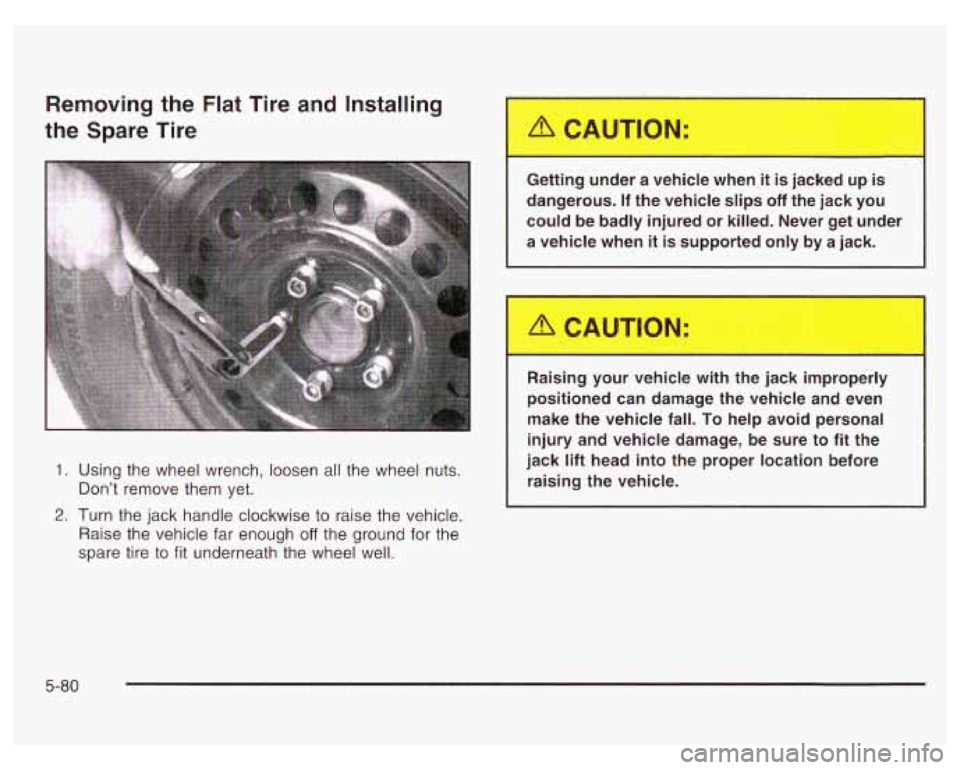
Using the wheel wrench, loosen all the wheel nuts.
Don’t remove them yet.
Turn the jack handle clockwise to raise the vehicle.
Raise the vehicle far enough
off the ground for the
spare tire to fit underneath the wheel well. Getting under a vehicle when
it is jacked up is
dangerous. If the vehicle
slips off the jack you
could be badly injured or killed. Never get under
a vehicle when
it is supported only by a jack.
Raising your
v icle with th _ack imp1 -1erly
positioned can damage the vehicle and even
make the vehicle fall.
To help avoid personal
injury and vehicle damage, be sure to
fit the
jack
lift head into the proper location before
raising the vehicle.
5-80
B
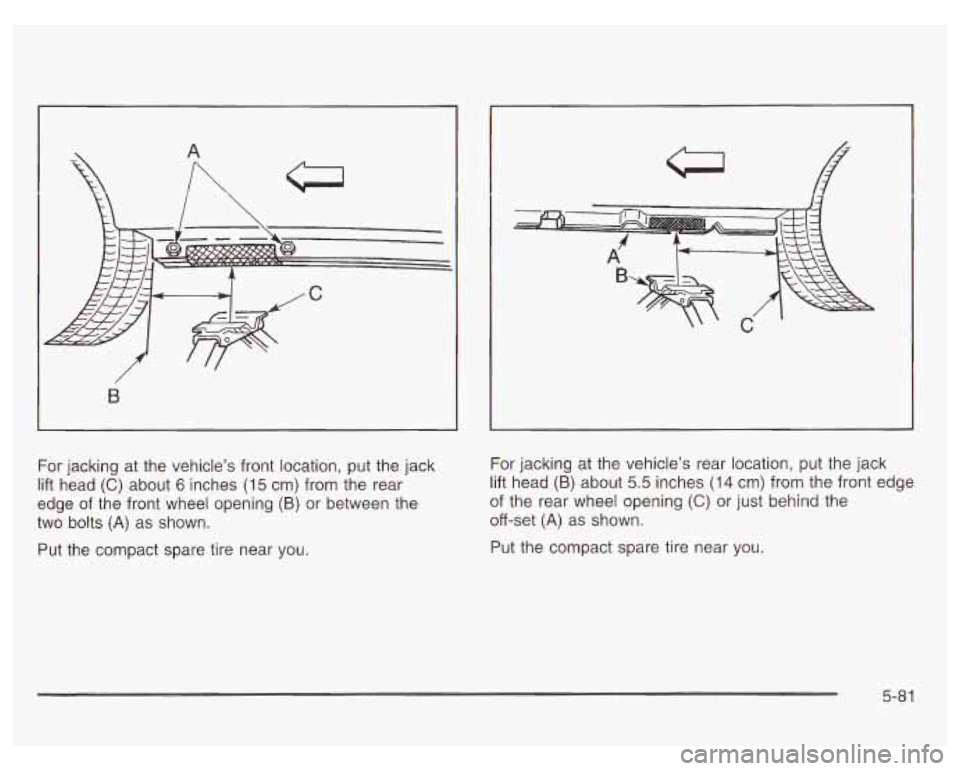
For jacking at the vehicle’s front location, put the jack
lift head
(C) about 6 inches (15 cm) from the rear
edge of the front wheel opening
(B) or between the
two bolts
(A) as shown.
Put the compact spare tire near
you.
a- $.>: .............. .... <,..:.:.:.:+:.:.:.’ -7==.== ..............
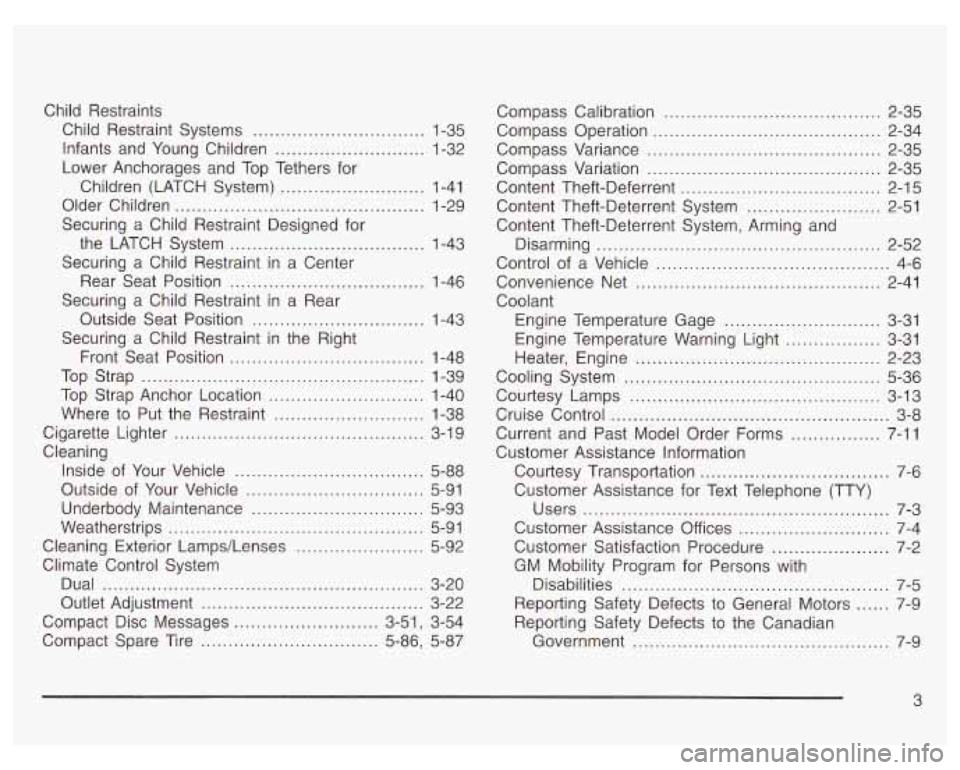
For jacking at the vehicle’s rear location, put the jack
lift head
(B) about 5.5 inches (14 cm) from the front edge
of the rear wheel opening
(C) or just behind the
off-set
(A) as shown.
Put the compact spare tire near
you.
5-8 1
Child Restraints Child Restraint Systems
............................... 1-35
Infants and Young Children
........................... 1-32
Lower Anchorages and Top Tethers for
Children (LATCH System)
.......................... 1-41
Older Children
............................................. 1-29
Securing a Child Restraint Designed for
the LATCH System
................................... 1-43
Securing a Child Restraint in a Center
Rear Seat Position
................................... 1-46
Securing a Child Restraint in a Rear
Outside Seat Position
............................... 1-43
Securing a Child Restraint in the Right
Front Seat Position
................................... 1-48
Top Strap
................................................... 1-39
Top Strap Anchor Location
.......... ........... 1-40
Where
to Put the Restraint ..... ............... 1-38
Cigarette Lighter
............................................. 3-1 9
Cleaning Inside of Your Vehicle
.................................. 5-88
Outside of Your Vehicle
................................ 5-91
Underbody Maintenance
............................... 5-93
Weatherstrips
.............................................. 5-91
Cleaning Exterior Lamps/Lenses
....................... 5-92
Climate Control System
Dual
.......................................................... 3-20
Outlet Adjustment
........................................ 3-22
Compact Disc Messages
.......................... 3-51, 3-54
Compact Spare Tire
.............. ... 5-86, 5-87 Compass
Calibration
.... ............................ 2-35
Compass Operation
......................................... 2-34
Compass Variance
.......................................... 2-35
Compass Variation
.......................................... 2-35
Content Theft-Deferrent
.................................... 2-15
Content Theft-Deterrent System
........................ 2-51
Content Theft-Deterrent System, Arming and
Disarming
................................................... 2-52
Control of a Vehicle
......................... .......... 4-6
Convenience Net
................................ ..... 2-41
Coolant Engine Temperature Gage
............................ 3-31
Engine Temperature Warning Light
................. 3-31
Heater, Engine
............................................ 2-23
Cooling System
.............................................. 5-36
Courtesy Lamps
............................................. 3-13
Cruise Control
.................................................. 3-8
Current and Past Model Order Forms
................ 7-11
Customer Assistance Information
Courtesy Transportation
.................................. 7-6
Customer Assistance for Text Telephone (TTY)
Users
....................................................... 7-3
Customer Assistance
Off ices ........................... 7-4
Customer Satisfaction Procedure
..................... 7-2
GM Mobility Program for Persons with
Disabilities
................................................ 7-5
Reporting Safety Defects
to General Motors ...... 7-9
Reporting Safety Defects
to the Canadian
Government
.............................................. 7-9
3