Page 91 of 131

30-06-2003
YOUR 206 CC IN DETAIL
90
Operating programmes
You have a choice of three operating programmes:
- Autoadaptive (normal).
- Sport.
- Snow.One press on button
Aor Bwill
select Sport or Snow respectively. The selection is displayed on theinstrument panel. Pressing the but-ton a second time will return to theautoadaptive (normal) programme. Autoadaptive programme (normal) Gear changes are carried out on the basis of various parameters, suchas:
- driving style,
- road characteristics,
- vehicle load.The gearbox selects the most suit- able programme from those in thememory for the current driving con-ditions. Sport programme The Sport programme automatically favours more dynamic driving. Snow Programme In position
D, the Snow programme
provides smooth driving suited to slippery roads in order to improve
traction and stability. Starting is in2nd gear and changing down is at
low engine speeds. Special operating features
- During prolonged braking, the gearbox changes down automati-
cally, so as to provide efficientengine braking.
- If you take your foot off the accel- erator suddenly (when you aretaken by surprise, for example),the gearbox will not change up,
so as to improve safety.
- When the engine is cold, the gearbox automatically selects aspecial programme that enablesthe engine to reach its ideal tem-perature more quickly in order todecrease pollution.
Kickdown For immediate maximum accelera-
tion without touching the gear lever,press the accelerator pedal down as
far as it will go. The gearbox willchange down automatically or stayin the gear selected, up to maximumengine speed.Any disruption of the system is signalled by the simultane-ous flashing of the Sport andSnow lights on the instrument
panel. In such a case, the gearbox
will operate in downgrade mode. Youmay feel a substantial knock whenreverse is selected from Pto R or N
to R(without any risk of damage to
the gearbox). Do not exceed 60 mph (100km/h).Contact a PEUGEOT dealer without
delay. When the engine is idling with the car
in gear, the car will move even with-out you accelerating. Do not accelerate while a gear is being selected, when the vehicle is
stationary.
When stationary, have your foot on the brake pedal when selecting a
gear. Do not accelerate in gear with the brakes on. If work needs to be done with the engine running, apply the handbrakeand select position P.
Do not change down to brake on slip-pery roads. Never select position Nwhen the
vehicle is moving.Never engage Por Runless the vehi-
cle is stationary.Do not leave children inside the vehi- cle unsupervised when the engine isrunning.
Page 93 of 131

30-06-2003
YOUR 206 CC IN DETAIL
92
TRACTION CONTROL (ASR)
AND DYNAMIC STABILITY
CONTROL (ESP) These systems are linked and com-
plement the ABS.
The ASR system optimises drive to prevent the wheels skidding, by act-ing on the brakes of the drive wheelsand on the engine. It also allows thedirectional stability of the vehicle tobe improved on acceleration. If there is a variation between the tra- jectory followed by the vehicle and
that required by the driver, the ESPsystem automatically acts on theengine and the brake of one or morewheels, in order to put the vehicleback on course. Disarming the ASR/
ESP systems In exceptional conditions (starting a vehicle which is bogged down, stuck
in snow, on soft ground), it may be
advisable to disarm the ASR and
ESP systems, so that the wheels canmove freely and regain grip. �
Press the "ESP OFF" switch,
located under the steering wheel to the left.
The switch lights up and thewarning light comes on: the
ASR and ESP systems aredisarmed.
These are triggered again: � automatically if the ignition is
switched off,
� manually by pressing the switchagain.
Operation of the ASR and ESPsystems
The warning light flashes if
the ASR or ESP is activated.Operating checkWhen a malfunction of the systems occurs, the switchlight flashes and the warninglight comes on.
Contact a PEUGEOT dealer to havethe system checked.
The ESP system offers exceptional safety in nor-mal driving, but thisshould not encourage thedriver to take extra risks or
drive at high speed. The correct functioning of this sys- tem depends on observation of themanufacturer's recommendationsregarding wheels (tyres and rims),the braking components and theelectronic components, as well asthe PEUGEOT assembly andoperation procedures. After an impact, have the system
checked by a PEUGEOT dealer.
Page 99 of 131
30-06-2003
PRACTICAL INFORMATION
96
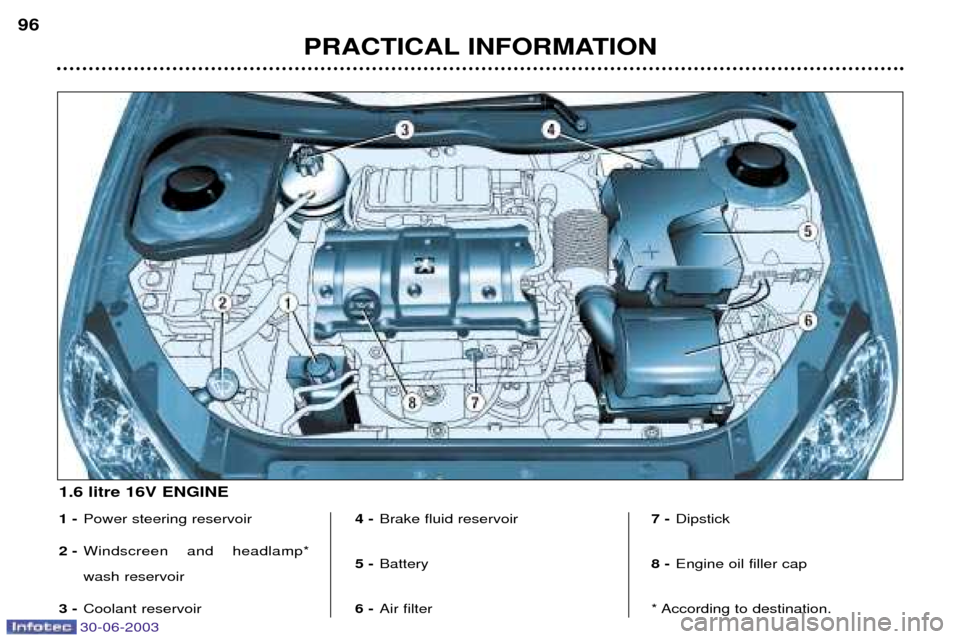
1 -
Power steering reservoir
2 - Windscreen and headlamp* wash reservoir
3 - Coolant reservoir 4 -
Brake fluid reservoir
5 - Battery
6 - Air filter 7 -
Dipstick
8 - Engine oil filler cap
* According to destination.
1.6 litre 16V ENGINE
Page 100 of 131
30-06-2003
PRACTICAL INFORMATION97
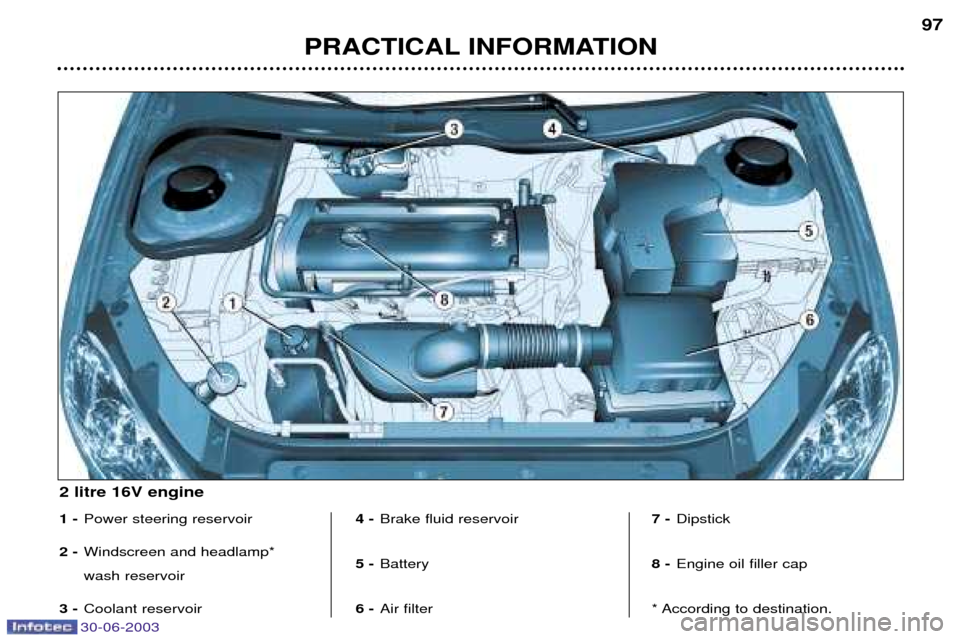
1 -
Power steering reservoir
2 - Windscreen and headlamp* wash reservoir
3 - Coolant reservoir 4 -
Brake fluid reservoir
5 - Battery
6 - Air filter 7 -
Dipstick
8 - Engine oil filler cap
* According to destination.
2 litre 16V engine
Page 101 of 131

30-06-2003
PRACTICAL INFORMATION
98
CHECKING THE LEVELS Oil level �
Check the level regularly and top
up between changes. The maxi-mum consumption is 0.5 l per 600miles (1000 km).
Check the level with the vehicle level,engine cold, using the oil level gaugeon the instrument panel or the dips-tick.
Dipstick There are two marks on the dipstick: A= maximum
Never fill past this mark. B = minimum
To maintain the reliabi- lity of engines andemission control sys-tems, the use of addi-tives in engine oil isprohibited.
Oil change According to the information given in
"PEUGEOT SERVICING" .
Note: avoid used oil coming into
prolonged contact with the skin. Viscosity selection In all cases, the oil selected must meet the manufacturer's require-ments. Brake fluid level:
- The level must always be bet-
ween the DANGER and MAXI-
MUM marks in the reservoir.
- If the level drops substantially, contact a PEUGEOT dealer
immediately.
Fluid change:
- must be carried out according to the manufacturer's servicing schedule.
- use fluids recommended by the manufacturer, which fulfil DOT4standards.
Note: brake fluid is harmful to heal-
th and very corrosive. Avoid allcontact with the skin. Cooling systemUse the fluid recommended by the
manufacturer. When the engine is warm, the temperature of the coolant is
controlled by the engine fan. As thisfan can operate with the ignition keyremoved and because the coolingsystem is pressurised, wait for atleast one hour after the engine hasstopped before carrying out anywork. Slacken the cap to the first notch torelease the pressure to prevent anyrisk of scalding. When the pressurehas dropped, remove the cap andtop up the level. Note:
the coolant does not need to
be changed. Used oil Do not dispose of used oil, brake fluid or coolant into drains or into theground. Power steering reservoir � Open the reservoir, with the engi-
ne at ambient temperature. Thelevel should always be above theMIN. mark and close to the MAX.mark.
Windscreen and headlamp* washlevel For best quality cleaning and for
your safety, we would advise thatyou use products recommended by
PEUGEOT.
* According to destination.
Page 111 of 131
30-06-2003
PRACTICAL INFORMATION
108
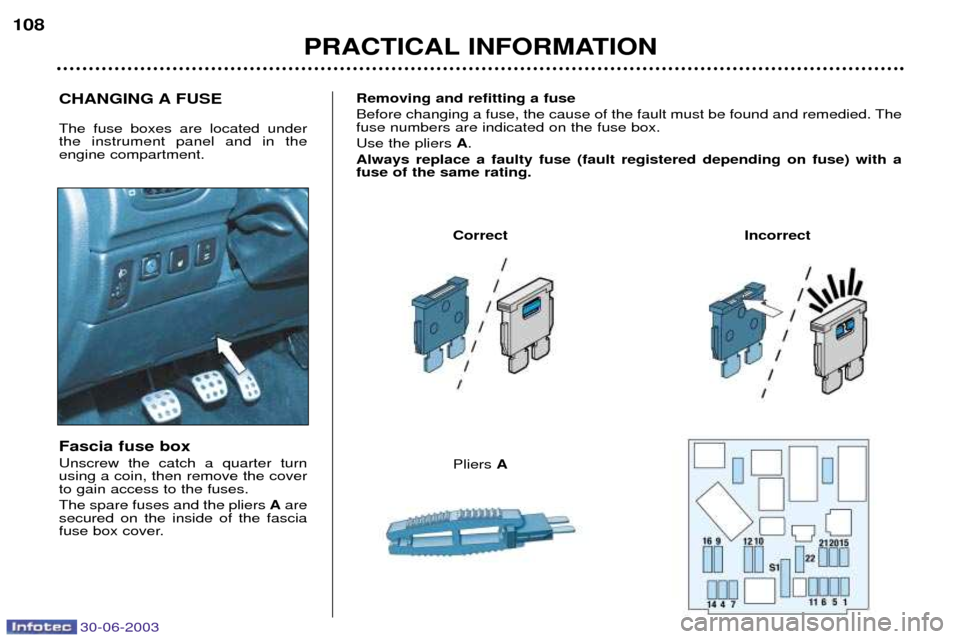
Fascia fuse box Unscrew the catch a quarter turn using a coin, then remove the coverto gain access to the fuses. The spare fuses and the pliers
Aare
secured on the inside of the fascia
fuse box cover. Removing and refitting a fuse
Before changing a fuse, the cause of the fault must be found and remedied. The fuse numbers are indicated on the fuse box. Use the pliers
A.
Always replace a faulty fuse (fault registered depending on fuse) with a fuse of the same rating.
Correct Incorrect
CHANGING A FUSE The fuse boxes are located under the instrument panel and in theengine compartment.
Pliers A
Page 112 of 131
30-06-2003
PRACTICAL INFORMATION
108
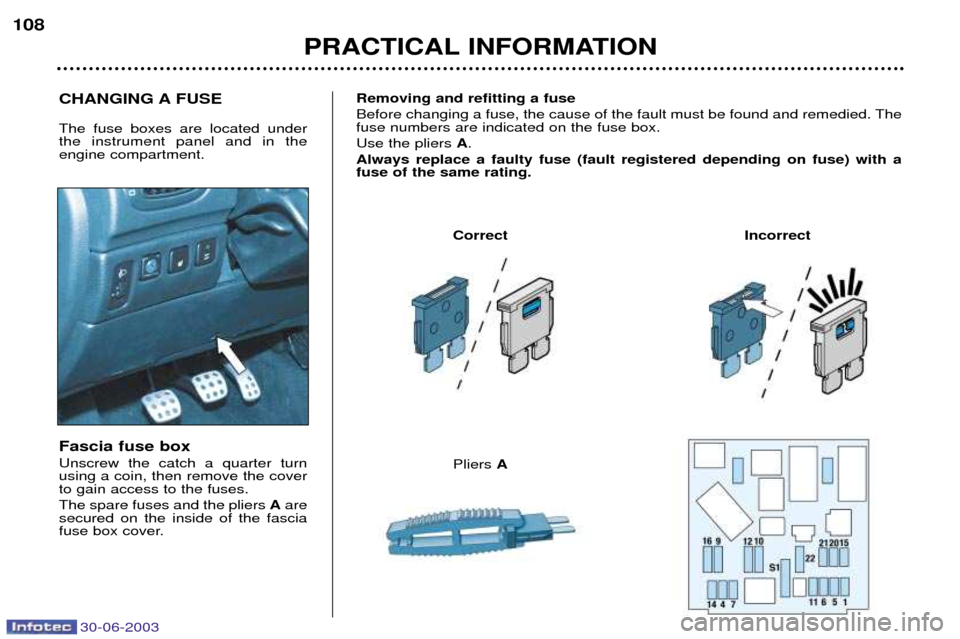
Fascia fuse box Unscrew the catch a quarter turn using a coin, then remove the coverto gain access to the fuses. The spare fuses and the pliers
Aare
secured on the inside of the fascia
fuse box cover. Removing and refitting a fuse
Before changing a fuse, the cause of the fault must be found and remedied. The fuse numbers are indicated on the fuse box. Use the pliers
A.
Always replace a faulty fuse (fault registered depending on fuse) with a fuse of the same rating.
Correct Incorrect
CHANGING A FUSE The fuse boxes are located under the instrument panel and in theengine compartment.
Pliers A
Page 113 of 131
30-06-2003
PRACTICAL INFORMATION109
Fuse Rating
Functions
1 15 A Heated seat - Alarm
4 20 A Mulltifunction screen - Navigation control unit - Boot lighting - Audio system - Retractable roof control unit
5 15 A Automatic gearbox diagnostics
6 10 A Coolant level - Automatic gearbox - Audio system - Steering wheel angle sensor (ESP)
7 15 A Driving school accessories - Alarm fitted as an accessory - Rain detector
9 30 A Hydraulic pump
10 40 A Driving mirror demisting 11 15 A Windscreen wiper
12 30 A Front windows
14 10 A Engine module - Air bags - Steering wheel stalk
15 15 A Instrument panel - Multifunction screen - Navigation control unit - Air conditioning - Audio system
16 30 A Locking/unlocking of doors
20 10 A Right-hand brake light
21 15 A Left-hand brake light - 3rd brake light
22 20 A Front courtesy light - Glove box lighting - Lighter
S1 Shunt PARC shunt