Page 114 of 131
30-06-2003
PRACTICAL INFORMATION
110
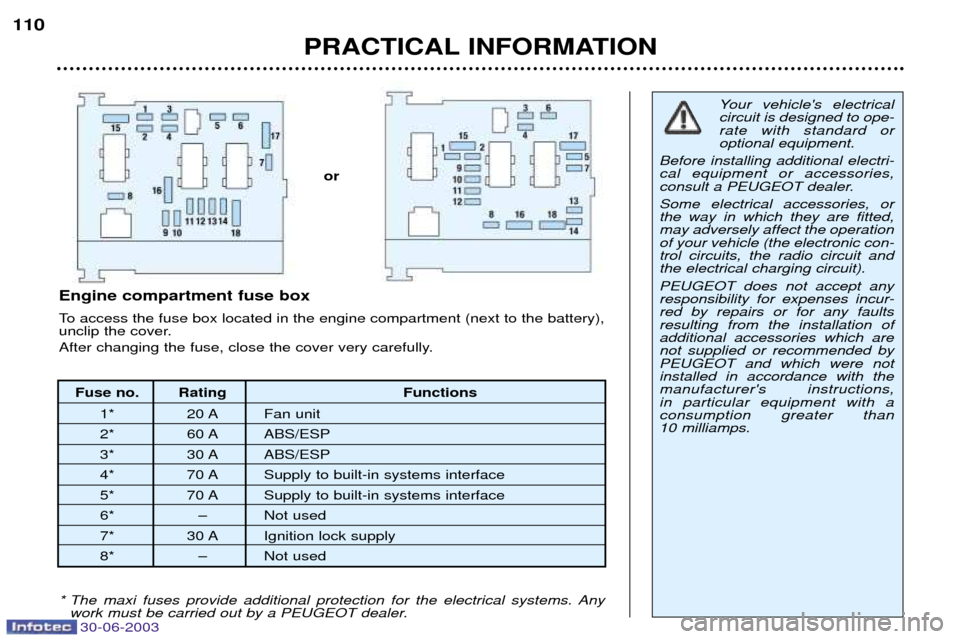
Fuse no. Rating Functions
1* 20 A Fan unit
2* 60 A ABS/ESP
3* 30 A ABS/ESP
4* 70 A Supply to built-in systems interface
5* 70 A Supply to built-in systems interface
6* Ð Not used
7* 30 A Ignition lock supply
8* Ð Not used
Engine compartment fuse box
To access the fuse box located in the engine compartment (next to the battery),
unclip the cover.
After changing the fuse, close the cover very carefully.
Your vehicle's electrical circuit is designed to ope-rate with standard oroptional equipment.
Before installing additional electri-cal equipment or accessories,
consult a PEUGEOT dealer. Some electrical accessories, or the way in which they are fitted,may adversely affect the operationof your vehicle (the electronic con-trol circuits, the radio circuit andthe electrical charging circuit). PEUGEOT does not accept any responsibility for expenses incur-red by repairs or for any faultsresulting from the installation ofadditional accessories which arenot supplied or recommended byPEUGEOT and which were notinstalled in accordance with themanufacturer's instructions, in particular equipment with aconsumption greater than 10 milliamps.
* The maxi fuses provide additional protection for the electrical systems. Any work must be carried out by a PEUGEOT dealer.
or
Page 115 of 131
30-06-2003
PRACTICAL INFORMATION111
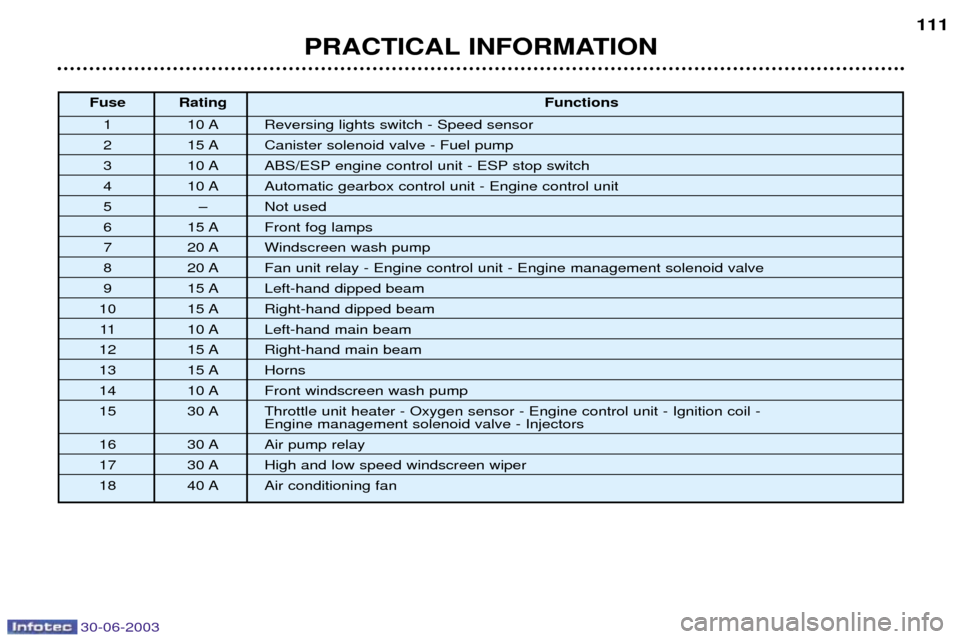
Fuse Rating
Functions
1 10 A Reversing lights switch - Speed sensor
2 15 A Canister solenoid valve - Fuel pump
3 10 A ABS/ESP engine control unit - ESP stop switch
4 10 A Automatic gearbox control unit - Engine control unit
5 Ð Not used
6 15 A Front fog lamps
7 20 A Windscreen wash pump
8 20 A Fan unit relay - Engine control unit - Engine management solenoid valve
9 15 A Left-hand dipped beam
10 15 A Right-hand dipped beam
11 10 A Left-hand main beam
12 15 A Right-hand main beam
13 15 A Horns
14 10 A Front windscreen wash pump
15 30 A Throttle unit heater - Oxygen sensor - Engine control unit - Ignition coil -
Engine management solenoid valve - Injectors
16 30 A Air pump relay
17 30 A High and low speed windscreen wiper
18 40 A Air conditioning fan
Page 116 of 131
30-06-2003
PRACTICAL INFORMATION
112
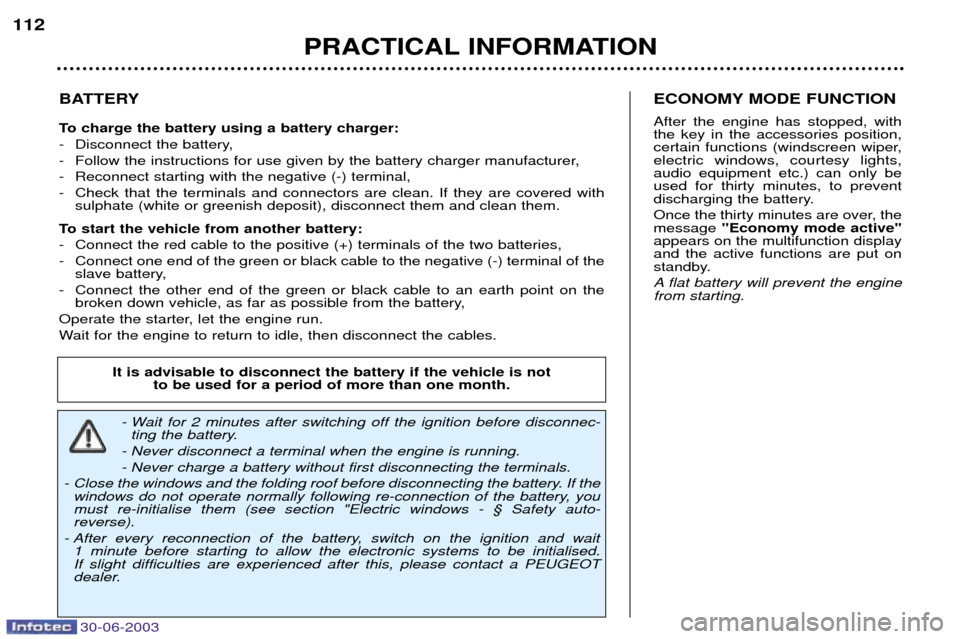
BATTERY
To charge the battery using a battery charger:
- Disconnect the battery,
- Follow the instructions for use given by the battery charger manufacturer,
- Reconnect starting with the negative (-) terminal,
- Check that the terminals and connectors are clean. If they are covered with
sulphate (white or greenish deposit), disconnect them and clean them.
To start the vehicle from another battery:
- Connect the red cable to the positive (+) terminals of the two batteries,
- Connect one end of the green or black cable to the negative (-) terminal of the slave battery,
- Connect the other end of the green or black cable to an earth point on the broken down vehicle, as far as possible from the battery,
Operate the starter, let the engine run.
Wait for the engine to return to idle, then disconnect the cables. ECONOMY MODE FUNCTION After the engine has stopped, with the key in the accessories position,
certain functions (windscreen wiper,electric windows, courtesy lights,audio equipment etc.) can only beused for thirty minutes, to prevent
discharging the battery.
Once the thirty minutes are over, the message
"Economy mode active"
appears on the multifunction displayand the active functions are put on
standby.
A flat battery will prevent the engine from starting.
- Wait for 2 minutes after switching off the ignition before disconnec- ting the battery.
- Never disconnect a terminal when the engine is running.
- Never charge a battery without first disconnecting the terminals.
- Close the windows and the folding roof before disconnecting the battery. If the windows do not operate normally following re-connection of the battery, you must re-initialise them (see section "Electric windows - ¤ Safety auto-reverse).
- After every reconnection of the battery, switch on the ignition and wait 1 minute before starting to allow the electronic systems to be initialised. If slight difficulties are experienced after this, please contact a PEUGEOT
dealer. It is advisable to disconnect the battery if the vehicle is not
to be used for a period of more than one month.
Page 119 of 131

30-06-2003
PRACTICAL INFORMATION115
TOWING A TRAILER,
CARAVAN, BOAT etc.
Only use original PEUGEOT tow bars that have been tested andapproved from the design stage of
your vehicle. The tow bar must be
fitted by a PEUGEOT dealer.
Your vehicle is primarily designed for transporting people and luggagebut it may also be used for towing a
trailer. Driving with a trailer subjects the towing vehicle to more significantstress and its driver must beparticularly careful. Air density decreases with altitude, thus reducing engine performance.Above 1000 metres, the maximumtowing load must be reduced by 10% and so on for every 1000 metres of altitude.Driving advice Distribution of loads :
Distribute
the load in the trailer so that the heaviest items are as close as pos-sible to the axle and the nose weightapproaches the maximum permittedwithout exceeding it. Cooling :
Towing a trailer on a slope increases the temperature of the coolant. As the fan is electrically controlled, its cooling capacity is not dependenton the engine speed.
On the contrary, use a high gear to lower the engine speed and reduceyour speed. The maximum towing load on a long slope depends on the gradient andthe outside temperature. In all cases, pay attention to the coolant temperature. If the warning light comes on, stop
the vehicle and switch off the engineas soon as possible. Tyres : Check the tyre pressures of the tow-
ing vehicle and of the trailer, observ-ing the recommended pressures. Braking :
Towing increases the braking distance. Lights : Check the electrical signalling on the
trailer. Side wind :
Take into acount the increased sensitivity to side wind.
Page 128 of 131
30-06-2003
TECHNICAL DATA
124
ENGINES AND GEARBOXES
MODELS Model codes 2DNFUF 2DNFUR 2DRFNF
ENGINES 1.6 litre 16V 2 litres 16V
Cubic capacity (cm 3
) 1 587 1 997
Bore x stroke (mm) 78.5 x 82 85 x 88
EU standard maximum power (kW) 80 100
Maximum power at engine speed (rpm) 5 800 6 000
EU standard maximum torque (Nm) 147 190
Maximum torque at engine speed (rpm) 4 000 4 100 Fuel Unleaded Unleaded
Catalytic converter Yes Yes
Gearbox Manual Automatic Manual
(5 speed) (4 speed) (5 speed)
Unit capacities (in litres)
Engine (with cartridge replacement) 3 3 4.25Gearbox-Final drive 2 Ð 1.9
Page 129 of 131
30-06-2003
TECHNICAL DATA125
CONSUMPTION
In accordance with directive 99/100 M.P.G. (litres/100 km)
Engine Gearbox Model Urban Inter-urban Mixed Emission codes driving of CO
2 by
weight g/Km
1.6 litre 16V manual 2DNFUF 9.5 5.7 7 166
1.6 litre 16V automatic 2DNFUR 10.6 6 7.7 183 2 litres 16V manual 2DRFNF 11.2 6.2 8 191
Fuel consumption values correct at time of printing.
Engine 1.6 litre 16V 1.6 litre 16V 2 litres 16V
Gearbox Manual Automatic Manual
Model codes: 2DNFUF 2DNFUR 2DRFNF
¥ Kerb weight
1 215 1 252 1 227
¥ Gross vehicle weight (GVW) 1 535 1 572 1 562
¥ Gross train weight (GTW)* 2 435 2 472 2 462
¥ Unbraked trailer
600 600 600
¥ Braked trailer (within GTW) 1 100 1 100 1 100
WEIGHTS AND TOWING LOADS (IN KG)
* In the case of a towing vehicle, the speed is limited to 60 mph (100 km/h).