2003 Oldsmobile Alero ECU
[x] Cancel search: ECUPage 59 of 354
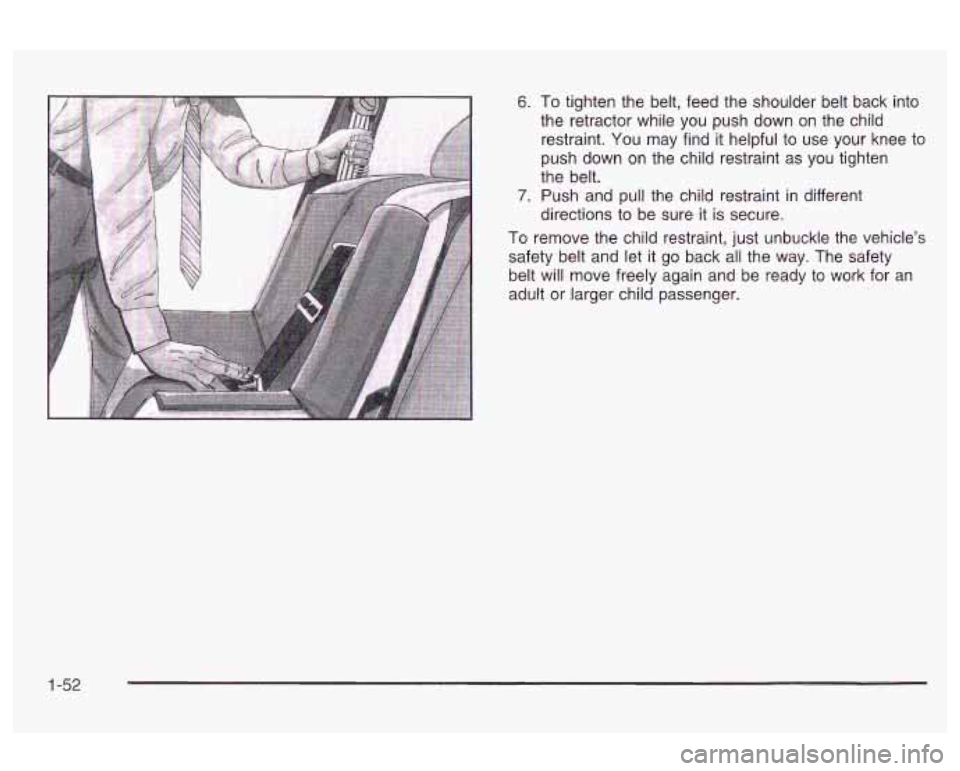
6. To tighten the belt, feed the shoulder belt back into
the retractor while you push down on the child
restraint. You may find it helpful to use your knee to
push down on the child restraint as you tighten
the belt.
directions to be sure it is secure.
7. Push and pull the child restraint in different
To remove the child restraint, just unbuckle the vehicle’s
safety belt and let
it go back all the way. The safety
belt
will move freely again and be ready to work for an
adult or larger child passenger.
1-52
Page 61 of 354
Air bags inflate with great force, faster than the blink of an eye. If you’re too close to an
inflating air bag, as you would be if you were
leaning forward,
it could seriously injure you.
Safety belts help keep you
in position before
and during a crash. Always wear your safety
belt, even with air bags. The driver should
sit
as far back as possible while still maintaining
control of the vehicle.
A CAU,TION:
Anyone who is up against, or very close to,
any air bag when
it inflates can be seriously
injured or killed. Air bags plus lap-shoulder
belts offer the best protection for adults, but
not for young children and infants.Neither the
vehicle’s safety belt system nor its air bag system is designed for them. Young children
and infants need the protection that a child restraint system can provide. Always secure
children properly in your vehicle. To read how,
see the parts of this manual called “Older
Children” and “Infants and Young Children”.
1-54
Page 70 of 354

Section 2 Features and Controls
Keys ............................................................... 2.2
Remote Keyless Entry System
......................... 2.3
Remote Keyless Entry System Operation
.......... -2-4
Doors and
Locks ............................................. 2-7
Door Locks
................................................... -2-7
Power Door Locks
.......................................... 2-8
Delayed Locking
............................................ -2-8
Programmable Automatic Door Locks
................................................ 2.8
Rear Door Security Locks
.............................. 2-10
Lockout Protection
........................................ 2.11
Leaving Your Vehicle
.................................... 2-1 1
Trunk .......................................................... 2-1 1
Windows .......................... ...................... -2-1 4
Manual Windows
...................................... -2-1 4
Power Windows
............................. ....... 2.15
Sun Visors
............................................... 2.15
Theft-Deterrent Systems
.................................. 2.16
Passlock@
@ ................................................. 2.16
Starting and Operating Your Vehicle
................ 2.17
New Vehicle Break-In
.................................... 2.17
Ignition Positions
.......................................... 2.17 Starting
Your Engine
................................. 2.18
Engine Coolant Heater
.................................. 2.20
Automatic Transaxle Operation
....................... 2.22
Manual Transaxle Operation
........................... 2.25
Parking Brake
.............................................. 2.26
Parking Your Vehicle/Key Removal
.................. 2-29
Engine Exhaust
............................................ 2-30
Running Your Engine While You Are Parked
.... 2-30
Mirrors
........................................................... 2-32
Manual Rearview Mirror
................................. 2-32
Outside Remote Control Mirror
....................... 2-32
Outside Power Mirrors
................................... 2-33
Outside Convex Mirror
................................... 2-33
Storage Areas
................................................ 2-34
Glove Box
................................................... 2.34
Cupnoiaerjsj
d-34
Center Console Storage Area ......................... 2-34
Sunroof
......................................................... 2.35
Shifting Into
Park
(P) ..................................... 2-27
Shifting Out
of Park (P) ................................. 2-28
Parking Over Things That Burn
....................... 2-29
n e’ ................................................
2- 1
Page 79 of 354
Rear Door Security Locks
If your vehicle is a four-door model, it has rear door
security locks that help prevent passengers from
opening the rear doors from the inside.
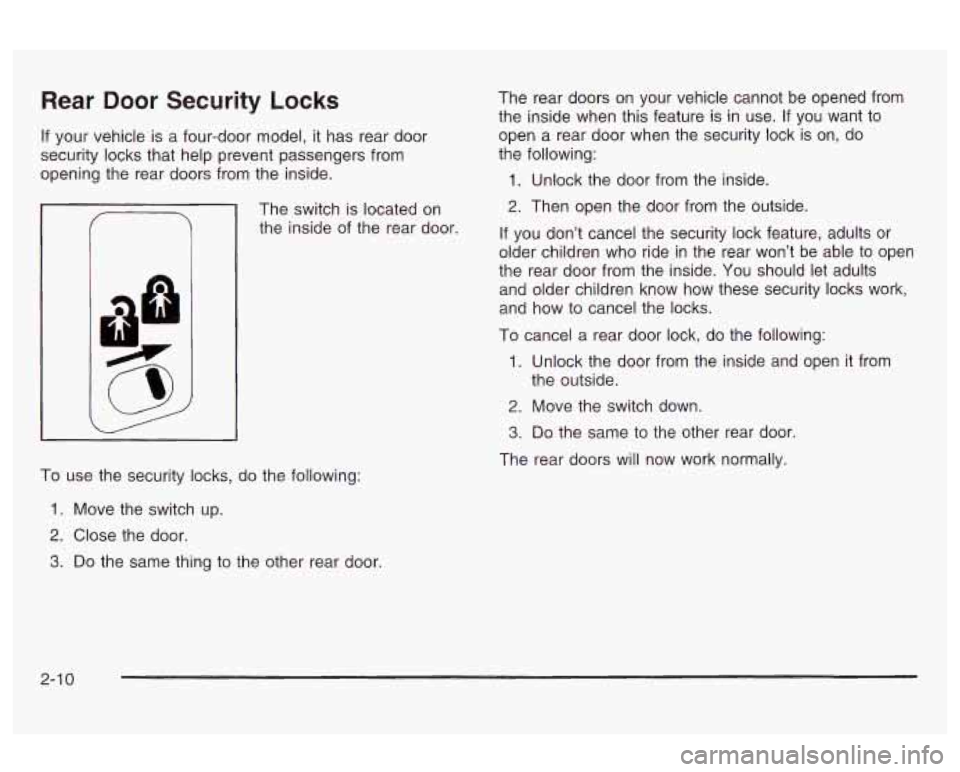
The switch is located on
the inside of the rear door. The
rear doors on your vehicle cannot be opened from
the inside when this feature
is in use. If you want to
open a rear door when the security lock is on, do
the following:
1. Unlock the door from the inside.
2. Then open the door from the outside.
If you don’t cancel the security lock feature, adults or
older children who ride in the rear won’t be able
to open
the rear door from the inside. You should let adults
and older children know how these security locks work,
and how to cancel the locks.
To cancel a rear door lock,
do the following:
1. Unlock the door from the inside and open it from
2. Move the switch down.
the
outside.
3. Do the same to the other rear door.
The rear doors will now work normally.
To use the security locks, do the following:
1. Move the switch up.
2. Close the door.
3. Do the same thing to the other rear door.
2-1 0
Page 80 of 354

Lockout Protection
Lockout protection is intended to provide enhanced
security and convenience. This feature prevents a driver
who has left the keys in the ignition from locking the
doors, using the power door locks while any door
is open.
To override this feature, when the key is in the ignition
and any door is open, press and hold down the
power door lock switch for three seconds.
This feature cannot guarantee that you will never be
locked out of your vehicle.
If you don’t leave the keys in
the ignition, or
if you use the manual door lock or the
remote keyless entry transmitter, you could still lock your
keys inside your vehicle. Always remember to take
your keys with you.
Leaving Your Vehicle
If you are leaving your vehicle, open your door and
set the locks from the inside, then get out and close
the door.
Trunk
When closing the trunk, close from the center to ensure
’+ ‘ully latches.
It can be d,,,gerous L drive wit.. Ihe trL ... c lid
open because carbon monoxide (CO) gas can
come into your vehicle. You can’t see or smell
CO.
It can cause unconsciousness and even
death. If you must drive with the trunk
lid open
or if electrical wiring or other cable
connections must pass through the seal
between the body and the trunk
lid:
Make sure all other windows are shut.
0 Turn the fan on your heating or cooling
system to
its highest speed and select the
control setting that will force outside air into your vehicle. See “Climate Controls”
in the Index.
instrument panel, open them all the way.
- !f ywu lIUYC UII “ULlrLV V., V. U..UY. L.. Y .-~~ma CImnerr mi~ AII+ICI+E A- AS. ~~nr(ar )ha
See “Engine Exhaust” in the Index.
To unlock the trunk from the outside, insert the key and
turn the trunk lock cylinder or use the remote keyless
entry transmitter,
if your vehicle has this feature.
2-1 1
Page 82 of 354
Emergency Trunk Release Handle
v‘
Notice: The emergency trunk release handle is not
designed to be used to tie down the trunk
lid or
as an anchor point when securing items in the trunk.
handle could damage it.
I-nwnm-w mmen -4 +ha nmnrnnnrur tr1Bnk rnlngcn nnntrr urws v-zb VI LIIW -m..v. 3-m m-1 =m -...I .-.-I--
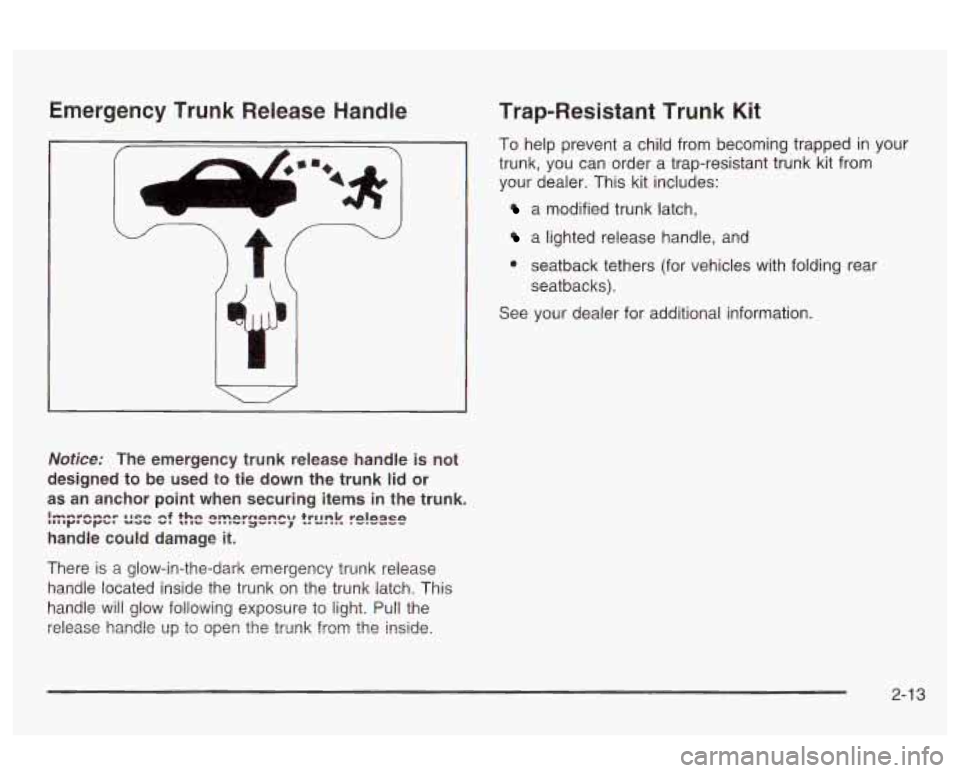
There is a glow-in-the-dark emergency trunk release
handle located inside the trunk on the trunk latch. This
handle will glow following exposure to light. Pull the
rzlease handle up te open the trur~k frm the inside.
Trap-Resistant Trunk Kit
To help prevent a child from becoming trapped in your
trunk, you can order a trap-resistant trunk kit from
your dealer. This kit includes:
a modified trunk latch,
a lighted release handle, and
@ seatback tethers (for vehicles with folding rear
seat backs).
See your dealer for additional information.
2-1 3
Page 85 of 354
Theft-Deterrent Systems
Vehicle theft is big business, especially in some cities.
Although your vehicle has a number of theft-deterrent
features, we know that nothing we put on it can make
it
impossible to steal.
Passlock@
Your vehicle has the Passlock@ theft-deterrent system.
Passlock@ is a passive theft-deterrent system.
Passlock@ enables fuel
if the ignition lock cylinder has
not been tampered with.
During normal operation, the SECURITY light will go
off
approximately five seconds after the ignition key is
turned to
ON and the engine is started.
After attempting to start the engine,
if the SECURITY
light flashes or stays on, wait ten minutes with the key in
ON until the light goes off. Then turn the ignition to
OFF before attempting to start the engine again.
See
Roadside Assistance Program on page 7-5 for
more information.
2-1 6
Page 106 of 354
Section 3 Instrument Panel
Instrument Panel Overview ............................... 3.4
Hazard Warning Flashers
.......... .............. 3.6
Other Warning Devices
................................... 3.6
Horn
............................................................. 3.6
Tilt Wheel
..................................................... 3.7
Turn SignaVMultifunction Lever
......................... 3.7
Exterior Lamps
............................................. 3.13
Interior Lamps
.............................................. 3.16
Accessory Power Outlets
............................... 3.17
Ashtrays and Cigarette Lighter
........................ 3.18
Climate Controls
........................................... -3-1 9
Climate Control System
................................. 3.19
Outlet Adjustment
......................................... 3.22
Warning Lights, Gages and Indicators
............. 3.23
Instrument Panel Cluster
................................ 3.24
Speedometer and Odometer
........................... 3.25
Tachometer
................................................. 3.25
Safety Belt Reminder Light
............................. 3.26
Air
Eag Reauiness iighi 3-LW
Charging System Light .................................. 3.27
fi cln ................................
Up-Shift Light .............................. .......... 3-28
Brake System Warning Light
........, .......... 3-28
Anti-Lock Brake System
Enhanced Traction System
Enhanced Traction System
Warning
bight
........................................ 3-29
Warning Light
........................................... 3-29
Active Light
.............................................. 3-30
Engine Coolant Temperature Gage
.................. 3-31
Low Coolant Warning Light
............................ 3-31
Malfunction Indicator Lamp
............................. 3-31
Oil Pressure Light
......................................... 3-34
Low Oil Level Light
....................................... 3-35
Security Light
............................................... 3-36
Cruise Control Light
...................................... 3-36
%??:ice ‘!ehic!n see!? Light ........................... ._ 2-36
Fuel Gage ................................................... 3-37
Change Engine
Oil Light
................................ 3-35
Low Washer Fluid Warning Light
..................... 3-36
3-
1