Page 26 of 3066

AT-20
OVERALL SYSTEM
l*1: Operates when overdrive control switch is set in “OFF” position.
l*2: Oil pressure is applied to both 2nd “apply” side and 3rd “release” side of band servo piston. However, brake band does not con-
tract because oil pressure area on the “release” side is greater than that on the “apply” side.
l*3: Oil pressure is applied to 4th “apply” side in condition *2 above, and brake band contracts.
l*4: A/T will not shift to 4th when overdrive control switch is set in “OFF” position.
l*5: Operates when overdrive control switch is “OFF”.
l:Operates.
lA: Operates when throttle opening is less than 3/16, activating engine brake.
lB: Operates during “progressive” acceleration.
lC: Operates but does not affect power transmission.
lD: Operates when throttle opening is less than 3/16, but does not affect engine brake.
POWER TRANSMISSION
“N” and “P” Positions
l“N” position
Power from the input shaft is not transmitted to the output shaft because the clutches do not operate.
l“P” position
NNEUTRAL
POSITION
D*41st *1D B B
Automatic
shift
1Û2Û3Û
4 2nd *1A B
3rd *1A *2C C B
*5
4th C *3C C
21st D B BAutomatic
shift
1Û2 2nd A B
11stBLocks (held
stationary) in
1st speed
1Ü2 2ndB Shift positionRever
se
clutch
5High
clutch
6For-
ward
clutch
15Over-
run
clutch
17Band servo
Forward
one-way
clutch
16Low
one-
way
clutch
18Low &
revers
e
brake
19Lock-
upRemarks
2nd
apply3rd
releas
e4th
apply
Page 28 of 3066
AT-22
OVERALL SYSTEM
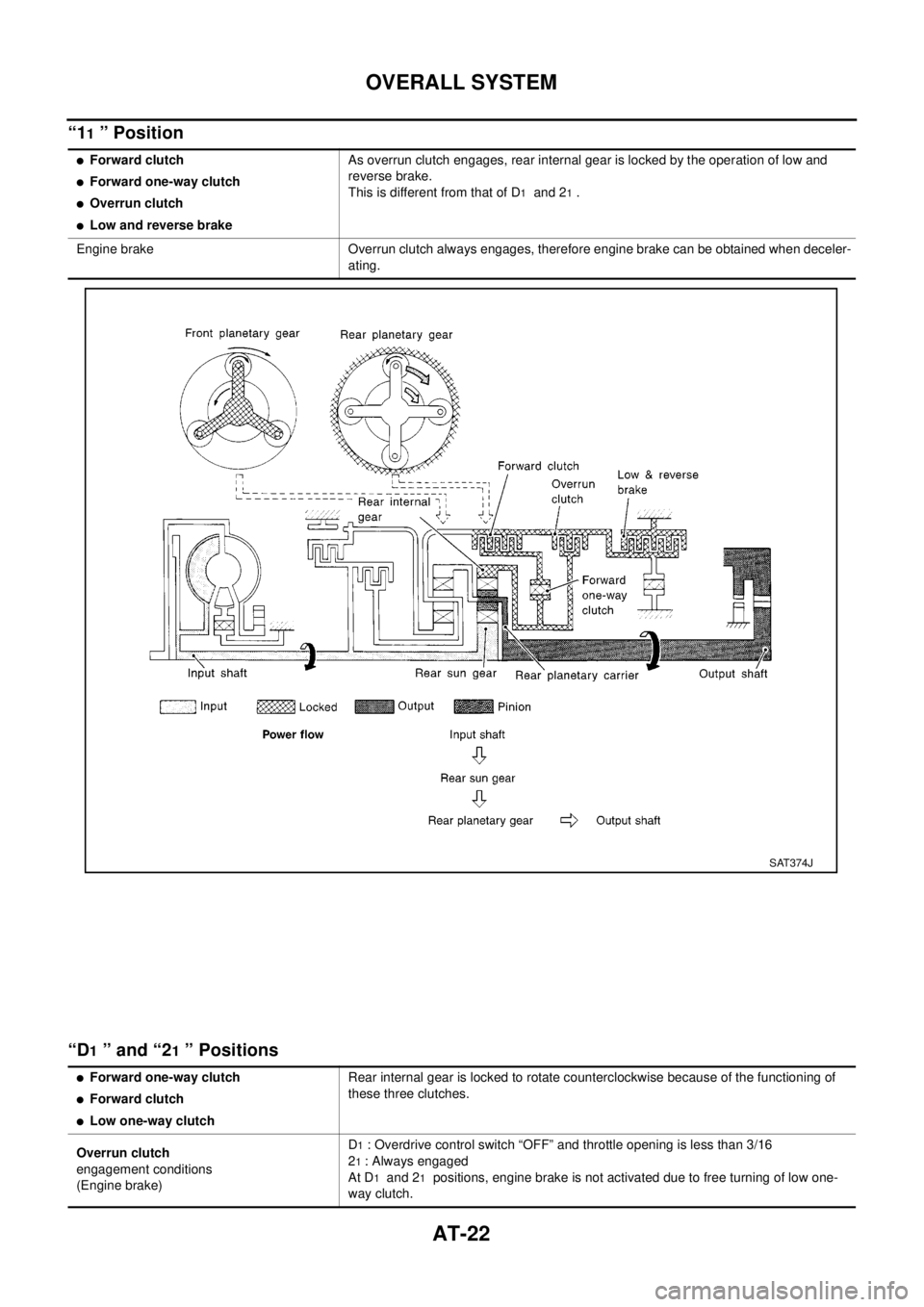
“11”Position
“D
1”and“21” Positions
lForward clutch
lForward one-way clutch
lOverrun clutch
lLow and reverse brakeAs overrun clutch engages, rear internal gear is locked by the operation of low and
reverse brake.
This is different from that of D
1and 21.
Engine brake Overrun clutch always engages, therefore engine brake can be obtained when deceler-
ating.
SAT374J
lForward one-way clutch
lForward clutch
lLow one-way clutchRear internal gear is locked to rotate counterclockwise because of the functioning of
these three clutches.
Overrun clutch
engagement conditions
(Engine brake)D
1: Overdrive control switch “OFF” and throttle opening is less than 3/16
2
1: Always engaged
At D
1and 21positions, engine brake is not activated due to free turning of low one-
way clutch.
Page 29 of 3066
OVERALL SYSTEM
AT-23
D
E
F
G
H
I
J
K
L
MA
B
AT
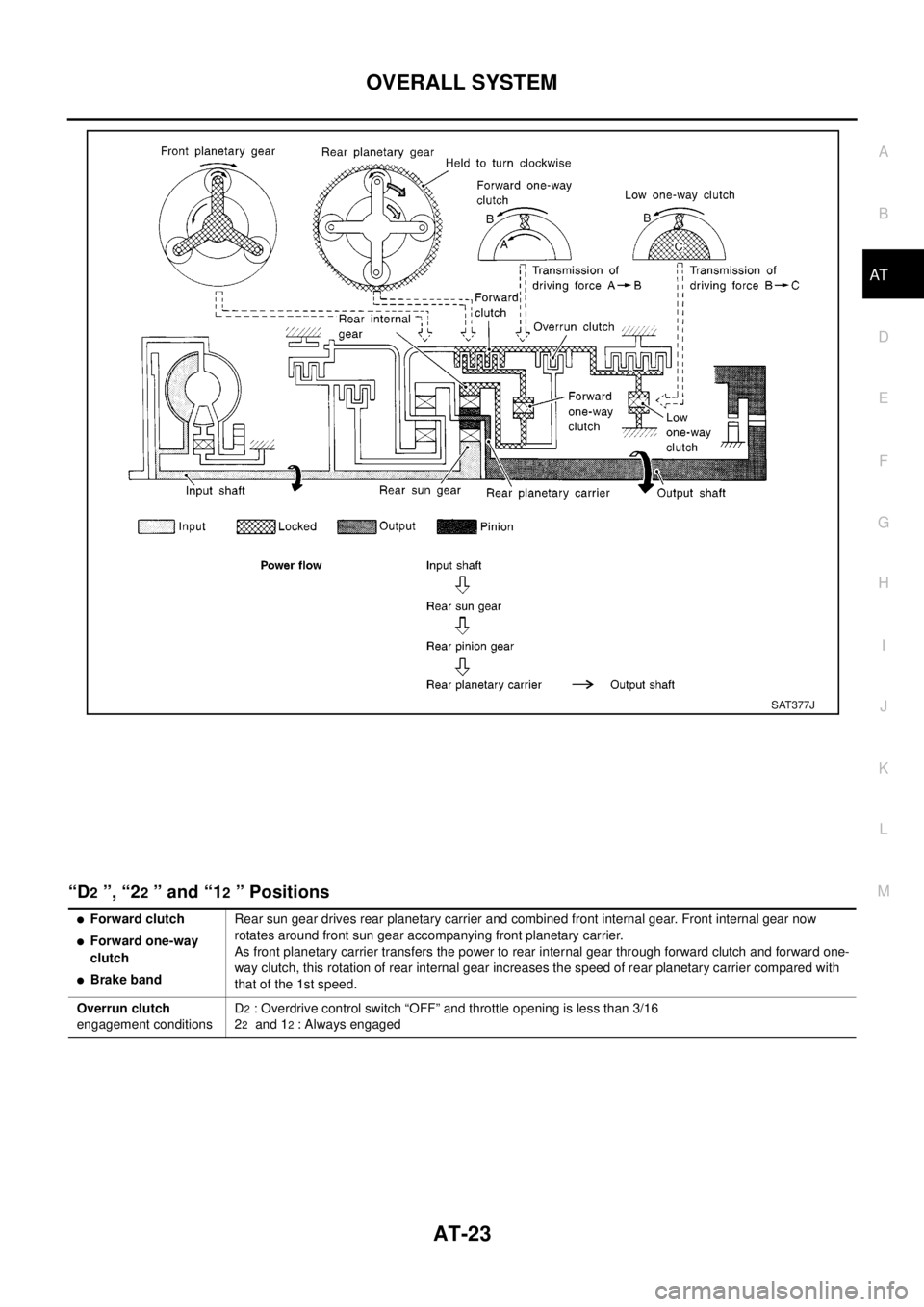
“D2”, “22”and“12” Positions
SAT377J
lForward clutch
lForward one-way
clutch
lBrake bandRear sun gear drives rear planetary carrier and combined front internal gear. Front internal gear now
rotates around front sun gear accompanying front planetary carrier.
As front planetary carrier transfers the power to rear internal gear through forward clutch and forward one-
way clutch, this rotation of rear internal gear increases the speed of rear planetary carrier compared with
that of the 1st speed.
Overrun clutch
engagement conditionsD
2: Overdrive control switch “OFF” and throttle opening is less than 3/16
2
2and 12: Always engaged
Page 31 of 3066
OVERALL SYSTEM
AT-25
D
E
F
G
H
I
J
K
L
MA
B
AT
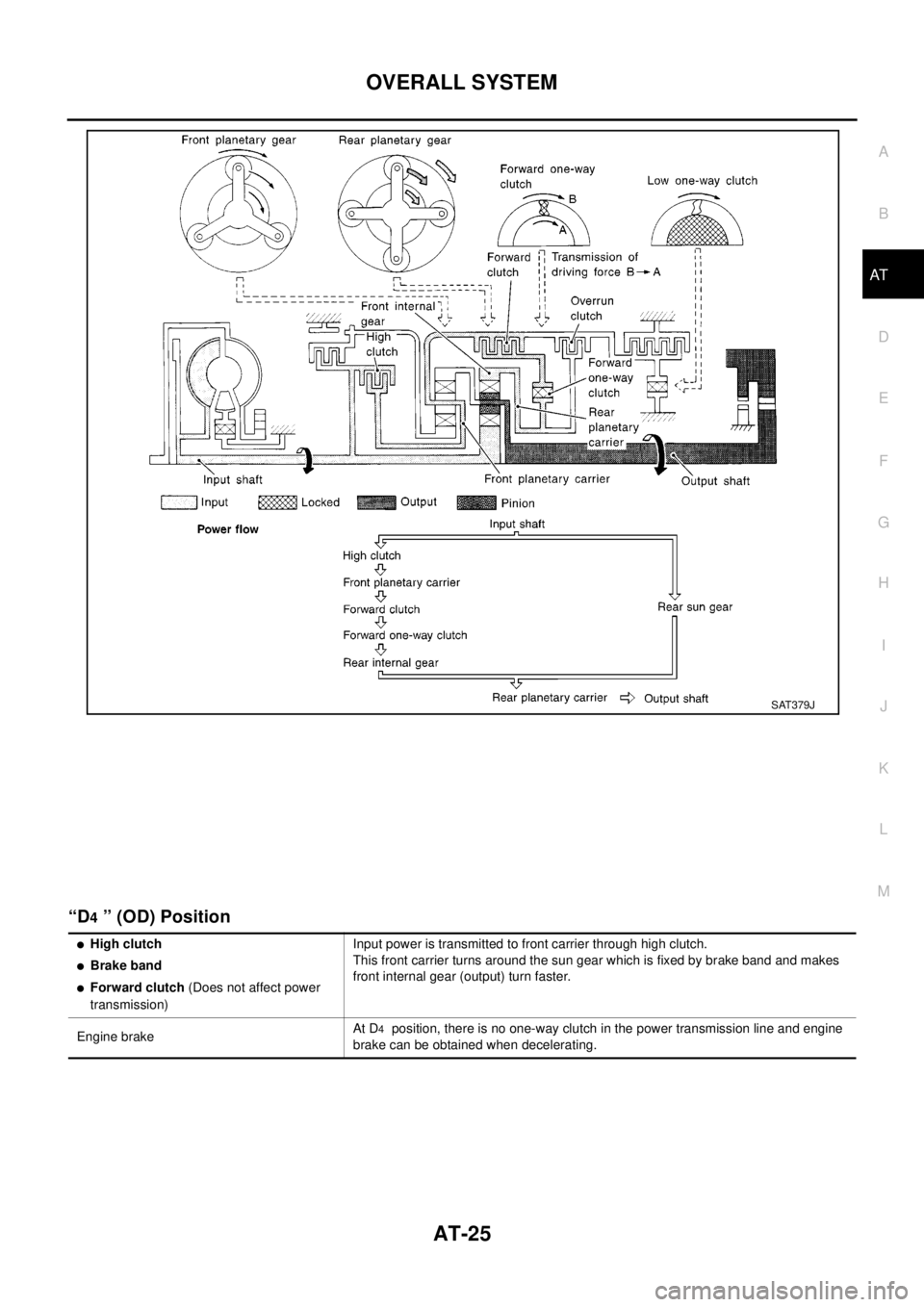
“D4” (OD) Position
SAT379J
lHigh clutch
lBrake band
lForward clutch(Does not affect power
transmission)Input power is transmitted to front carrier through high clutch.
This front carrier turns around the sun gear which is fixed by brake band and makes
front internal gear (output) turn faster.
Engine brakeAt D
4position, there is no one-way clutch in the power transmission line and engine
brake can be obtained when decelerating.
Page 32 of 3066
AT-26
OVERALL SYSTEM
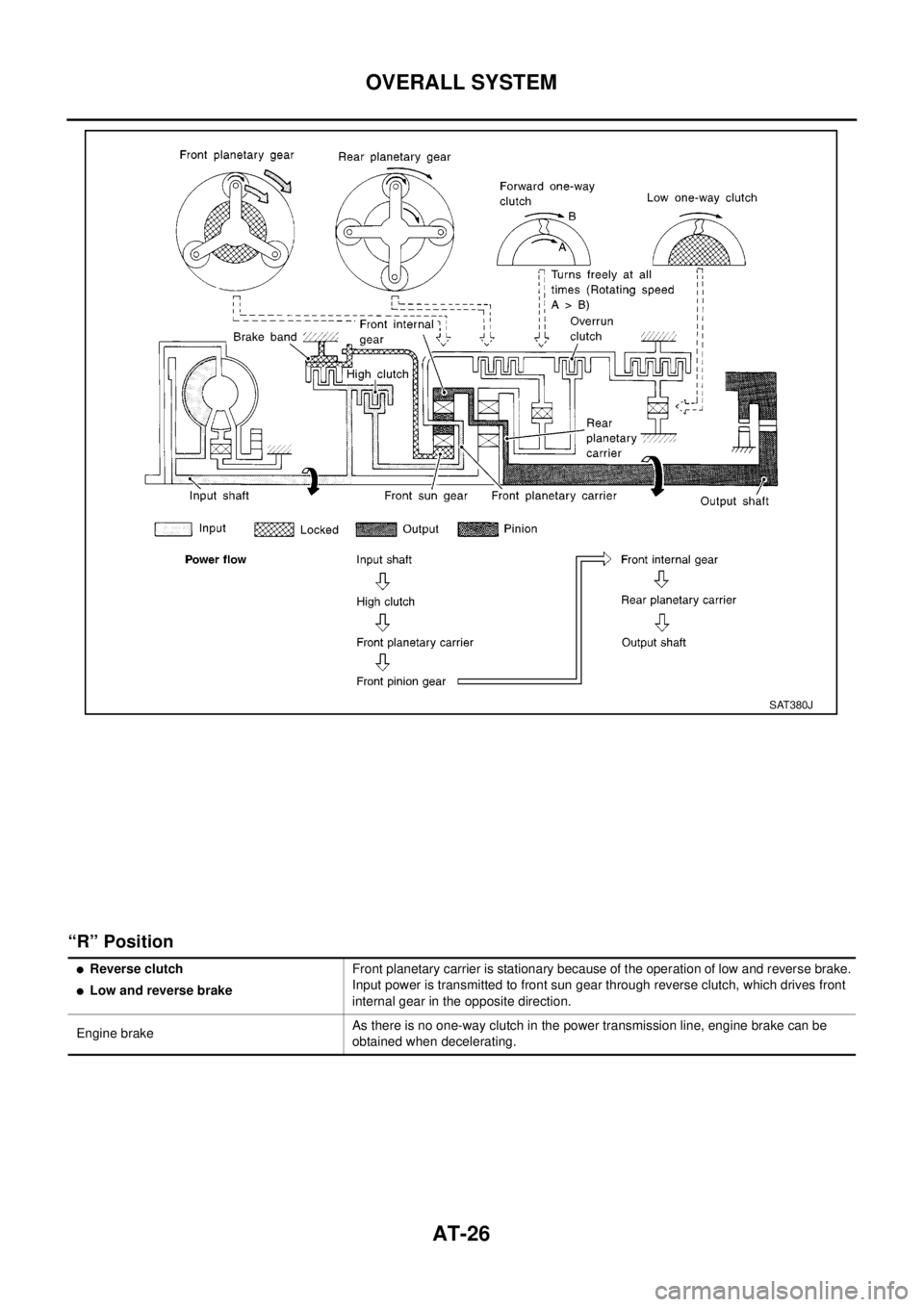
“R” Position
SAT380J
lReverse clutch
lLow and reverse brakeFront planetary carrier is stationary because of the operation of low and reverse brake.
Input power is transmitted to front sun gear through reverse clutch, which drives front
internal gear in the opposite direction.
Engine brakeAs there is no one-way clutch in the power transmission line, engine brake can be
obtained when decelerating.
Page 34 of 3066
AT-28
OVERALL SYSTEM
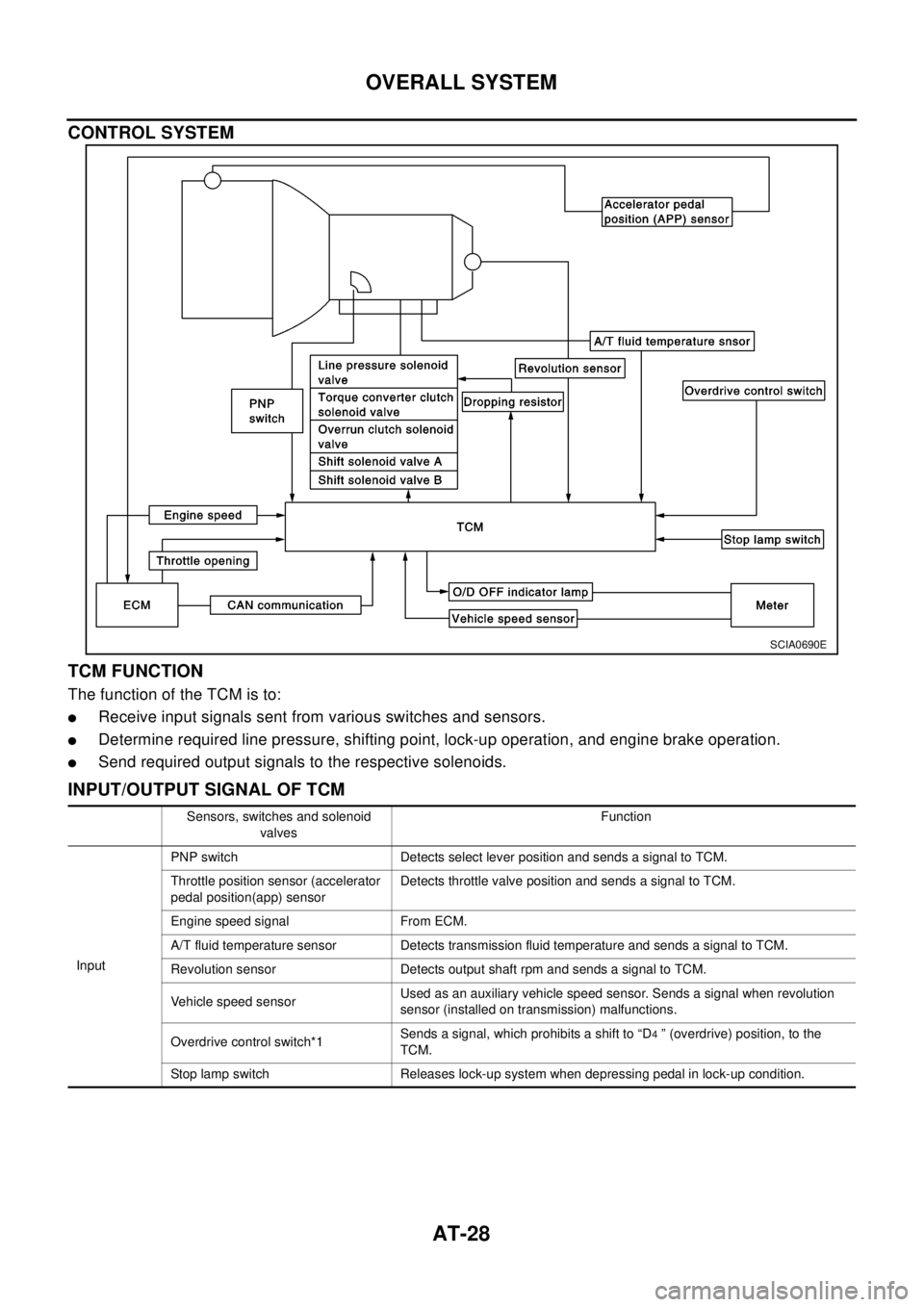
CONTROL SYSTEM
TCM FUNCTION
ThefunctionoftheTCMisto:
lReceive input signals sent from various switches and sensors.
lDetermine required line pressure, shifting point, lock-up operation, and engine brake operation.
lSend required output signals to the respective solenoids.
INPUT/OUTPUT SIGNAL OF TCM
SCIA0690E
Sensors, switches and solenoid
valvesFunction
InputPNP switch Detects select lever position and sends a signal to TCM.
Throttle position sensor (accelerator
pedal position(app) sensorDetects throttle valve position and sends a signal to TCM.
Engine speed signal From ECM.
A/T fluid temperature sensor Detects transmission fluid temperature and sends a signal to TCM.
Revolution sensor Detects output shaft rpm and sends a signal to TCM.
Vehicle speed sensorUsed as an auxiliary vehicle speed sensor. Sends a signal when revolution
sensor (installed on transmission) malfunctions.
Overdrive control switch*1Sends a signal, which prohibits a shift to “D
4” (overdrive) position, to the
TCM.
Stop lamp switch Releases lock-up system when depressing pedal in lock-up condition.
Page 35 of 3066
OVERALL SYSTEM
AT-29
D
E
F
G
H
I
J
K
L
MA
B
AT
Control MechanismECS004QF
LINE PRESSURE CONTROL
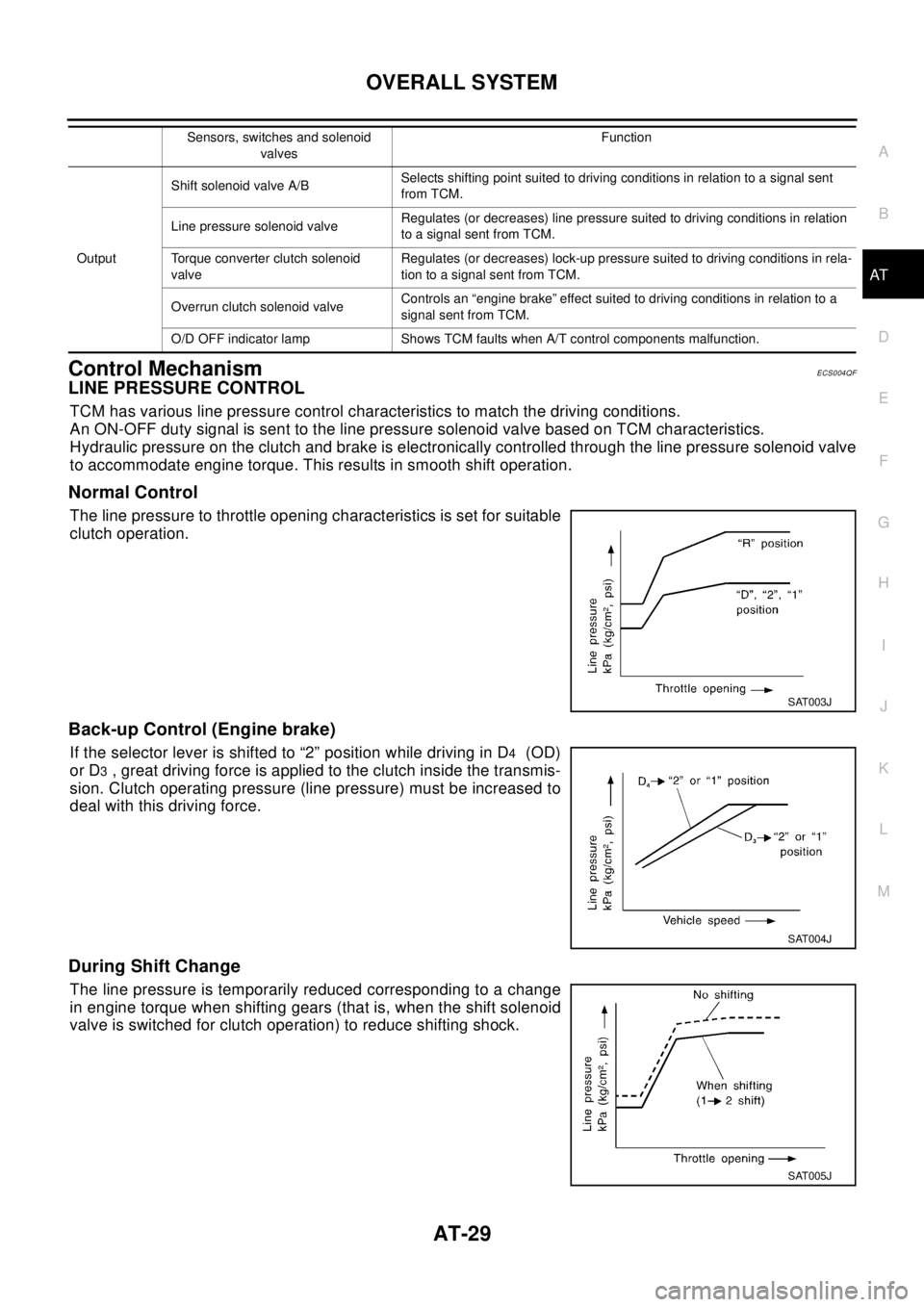
TCM has various line pressure control characteristics to match the driving conditions.
An ON-OFF duty signal is sent to the line pressure solenoid valve based on TCM characteristics.
Hydraulic pressure on the clutch and brake is electronically controlled through the line pressure solenoid valve
to accommodate engine torque. This results in smooth shift operation.
Normal Control
The line pressure to throttle opening characteristics is set for suitable
clutch operation.
Back-up Control (Engine brake)
If the selector lever is shifted to “2” position while driving in D4(OD)
or D
3, great driving force is applied to the clutch inside the transmis-
sion. Clutch operating pressure (line pressure) must be increased to
deal with this driving force.
During Shift Change
The line pressure is temporarily reduced corresponding to a change
in engine torque when shifting gears (that is, when the shift solenoid
valve is switched for clutch operation) to reduce shifting shock.
OutputShift solenoid valve A/BSelects shifting point suited to driving conditions in relation to a signal sent
from TCM.
Line pressure solenoid valveRegulates (or decreases) line pressure suited to driving conditions in relation
to a signal sent from TCM.
Torque converter clutch solenoid
valveRegulates (or decreases) lock-up pressure suited to driving conditions in rela-
tion to a signal sent from TCM.
Overrun clutch solenoid valveControls an “engine brake” effect suited to driving conditions in relation to a
signal sent from TCM.
O/D OFF indicator lamp Shows TCM faults when A/T control components malfunction.Sensors, switches and solenoid
valvesFunction
SAT003J
SAT004J
SAT005J
Page 36 of 3066
AT-30
OVERALL SYSTEM
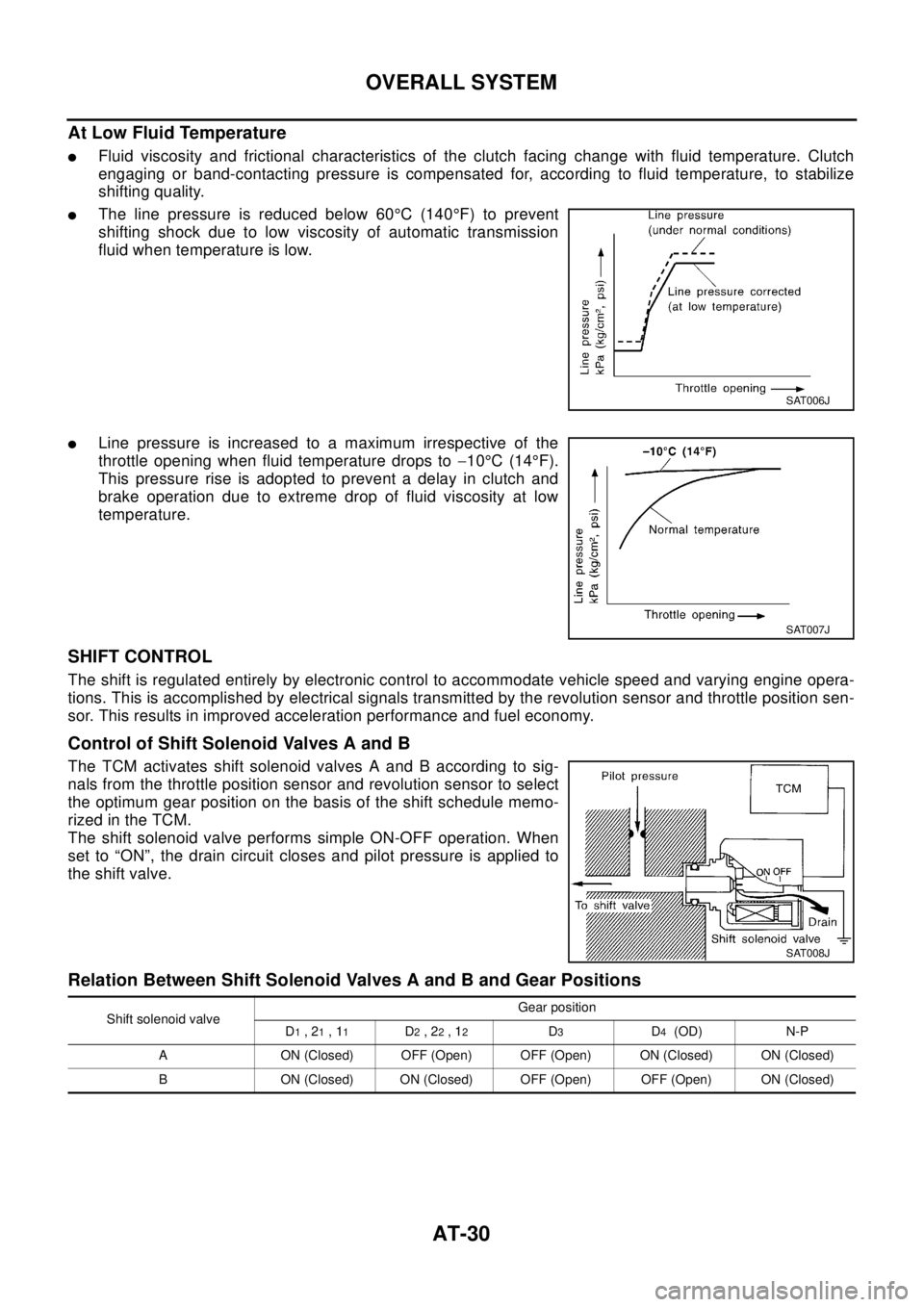
At Low Fluid Temperature
lFluid viscosity and frictional characteristics of the clutch facing change with fluid temperature. Clutch
engaging or band-contacting pressure is compensated for, according to fluid temperature, to stabilize
shifting quality.
lThe line pressure is reduced below 60°C(140°F) to prevent
shifting shock due to low viscosity of automatic transmission
fluid when temperature is low.
lLine pressure is increased to a maximum irrespective of the
throttle opening when fluid temperature drops to-10°C(14°F).
This pressure rise is adopted to prevent a delay in clutch and
brake operation due to extreme drop of fluid viscosity at low
temperature.
SHIFT CONTROL
The shift is regulated entirely by electronic control to accommodate vehicle speed and varying engine opera-
tions. This is accomplished by electrical signals transmitted by the revolution sensor and throttle position sen-
sor. This results in improved acceleration performance and fuel economy.
Control of Shift Solenoid Valves A and B
The TCM activates shift solenoid valves A and B according to sig-
nals from the throttle position sensor and revolution sensor to select
the optimum gear position on the basis of the shift schedule memo-
rizedintheTCM.
The shift solenoid valve performs simple ON-OFF operation. When
set to “ON”, the drain circuit closes and pilot pressure is applied to
the shift valve.
Relation Between Shift Solenoid Valves A and B and Gear Positions
SAT006J
SAT007J
SAT008J
Shift solenoid valveGear position
D1,21,11D2,22,12D3D4(OD) N-P
A ON (Closed) OFF (Open) OFF (Open) ON (Closed) ON (Closed)
B ON (Closed) ON (Closed) OFF (Open) OFF (Open) ON (Closed)