FUEL SYSTEM
FL-3
C
D
E
F
G
H
I
J
K
L
MA
FL
FUEL SYSTEMPFP:17503
Checking Fuel LinesBBS005AE
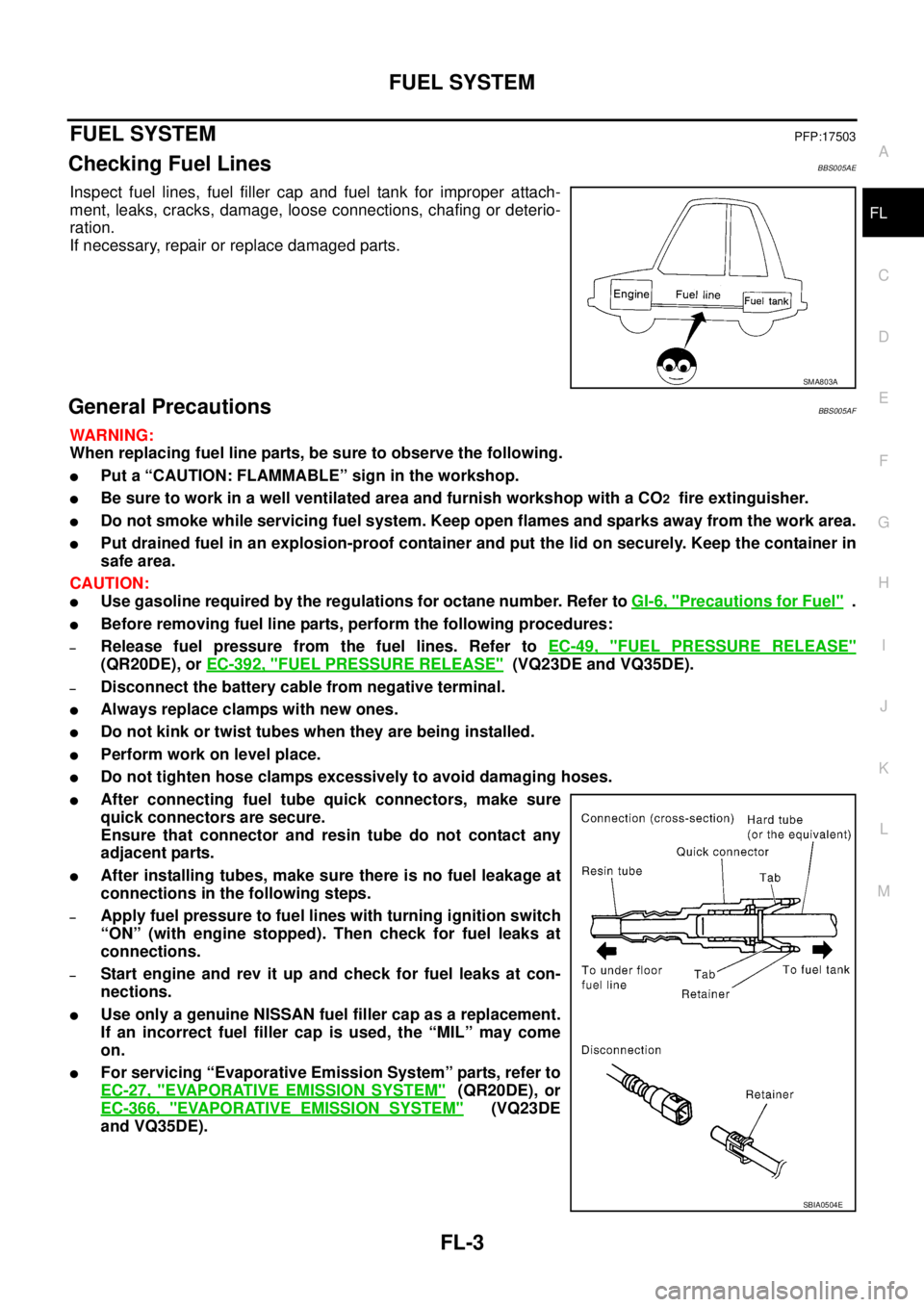
Inspect fuel lines, fuel filler cap and fuel tank for improper attach-
ment, leaks, cracks, damage, loose connections, chafing or deterio-
ration.
If necessary, repair or replace damaged parts.
General PrecautionsBBS005AF
WARNING:
When replacing fuel line parts, be sure to observe the following.
�Put a “CAUTION: FLAMMABLE” sign in the workshop.
�Be sure to work in a well ventilated area and furnish workshop with a CO2 fire extinguisher.
�Do not smoke while servicing fuel system. Keep open flames and sparks away from the work area.
�Put drained fuel in an explosion-proof container and put the lid on securely. Keep the container in
safe area.
CAUTION:
�Use gasoline required by the regulations for octane number. Refer to GI-6, "Precautions for Fuel" .
�Before removing fuel line parts, perform the following procedures:
–Release fuel pressure from the fuel lines. Refer to EC-49, "FUEL PRESSURE RELEASE"
(QR20DE), or EC-392, "FUEL PRESSURE RELEASE" (VQ23DE and VQ35DE).
–Disconnect the battery cable from negative terminal.
�Always replace clamps with new ones.
�Do not kink or twist tubes when they are being installed.
�Perform work on level place.
�Do not tighten hose clamps excessively to avoid damaging hoses.
�After connecting fuel tube quick connectors, make sure
quick connectors are secure.
Ensure that connector and resin tube do not contact any
adjacent parts.
�After installing tubes, make sure there is no fuel leakage at
connections in the following steps.
–Apply fuel pressure to fuel lines with turning ignition switch
“ON” (with engine stopped). Then check for fuel leaks at
connections.
–Start engine and rev it up and check for fuel leaks at con-
nections.
�Use only a genuine NISSAN fuel filler cap as a replacement.
If an incorrect fuel filler cap is used, the “MIL” may come
on.
�For servicing “Evaporative Emission System” parts, refer to
EC-27, "
EVAPORATIVE EMISSION SYSTEM" (QR20DE), or
EC-366, "
EVAPORATIVE EMISSION SYSTEM" (VQ23DE
and VQ35DE).
SMA803A
SBIA0504E
FL-4
FUEL LEVEL SENSOR UNIT, FUEL FILTER AND FUEL PUMP ASSEMBLY
FUEL LEVEL SENSOR UNIT, FUEL FILTER AND FUEL PUMP ASSEMBLYPFP:17042
Removal and InstallationBBS005AG
REMOVAL
WARNING:
Be sure to read “General Precautions” before working on the fuel system. Refer to FL-3, "
General Pre-
cautions" .
1. Check fuel level on fuel gauge. If fuel gauge indicates more than
the level as shown in the figure (full or almost full), drain fuel
from fuel tank until fuel gauge indicates level as shown in the fig-
ure or below.
NOTE:
Because fuel will be spilled when removing fuel level sensor unit
for the top of fuel is above the fuel level sensor unit installation
surface.
�As a guide, fuel level becomes the position as shown in the
figure or below when approximately 10 (2-1/4 Imp gal) of
fuel are drained from fuel tank.
�In a case that fuel pump does not operate, perform the follow-
ing procedure.
a. Insert hose of less than 25 mm (0.98 in) in diameter into fuel filler tube through fuel filler opening to draw
fuel from fuel filler tube.
b. Disconnect fuel filler hose from fuel filler tube. Refer to FL-8, "
FUEL TANK" .
c. Insert hose into fuel tank through fuel filler hose to draw fuel from fuel tank.
2. Release the fuel pressure from the fuel lines. Refer to EC-49, "
FUEL PRESSURE RELEASE" (QR20DE
), or EC-392, "
FUEL PRESSURE RELEASE" (VQ23DE and VQ35DE).
3. Open fuel filler lid.
4. Open fuel filler cap and release the pressure inside fuel tank.
5. Remove rear seat cushion. Refer to SE-112, "
REAR SEAT" .
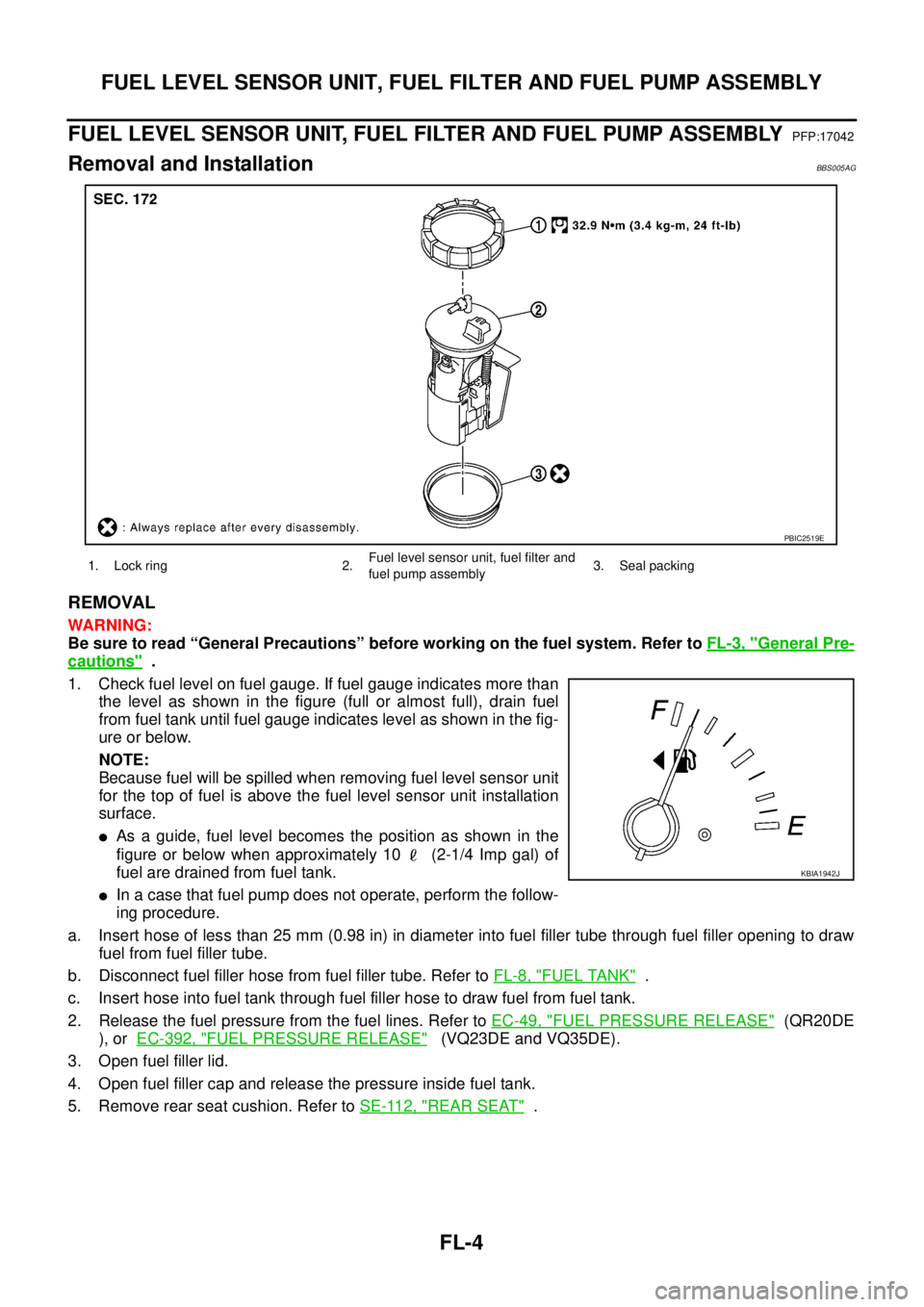
1. Lock ring 2.Fuel level sensor unit, fuel filter and
fuel pump assembly3. Seal packing
PBIC2519E
KBIA1942J