2003 NISSAN 350Z ECU
[x] Cancel search: ECUPage 149 of 227
For models equipped with the low tire
pressure warning system:
After adjusting tire pressure to the COLD tire
pressure, the display of the tire pressure infor-
mation may show higher pressure than the
COLD tire pressure after the vehicle has been
driven more than 1 mile (1.6 km). This is because
the tire pressurizes as the tire temperature rises.
This does not indicate a system malfunction.
WARNING
Retighten the wheel nuts when the ve-
hicle has been driven for 600 miles
(1,000 km) (also in cases of a flat tire,
etc.).Stowing the tire and toolsSecurely store the spare tire and jacking equip-
ment in the vehicle.
WARNING
IAlways make sure that the spare tire
and jacking equipment are properly
secured after use. Such items canbecome dangerous projectiles in an
accident or sudden stop.
IThe T-type spare tire and small size
spare tire are designed for emer-
gency use. See ªWheels and tiresº in
the ª8. Maintenance and do-it-
yourselfº section.To start your engine with a booster battery, the
instructions and precautions below must be
followed.
WARNING
IIf done incorrectly, jump starting can
lead to a battery explosion, resulting
in severe injury or death. It could also
damage your vehicle.
IExplosive hydrogen gas is always
present in the vicinity of the battery.
Keep all sparks and flames away
from the battery.
IDo not allow battery fluid to come
into contact with eyes, skin, cloth or
painted surfaces. Battery fluid is a
corrosive sulphuric acid solution
which can cause severe burns. If the
fluid should come into contact with
anything, immediately flush the con-
tacted area with water.
IKeep battery out of the reach of chil-
dren.
IThe booster battery must be rated atJUMP STARTING
6-6
In case of emergency
Z
02.9.13/Z33-D/V5.0
X
Page 154 of 227
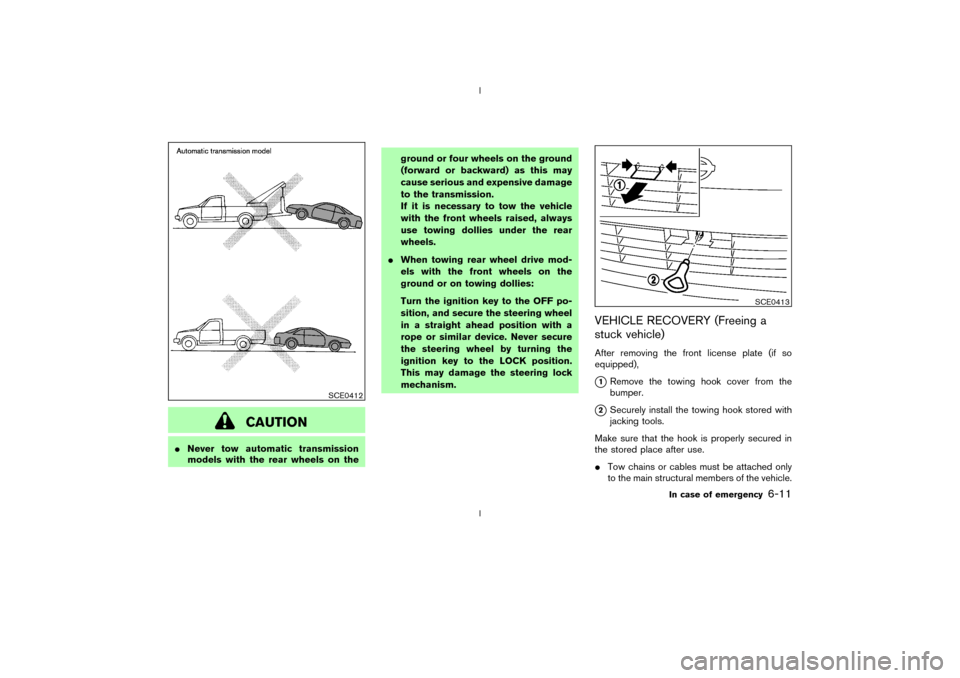
CAUTION
INever tow automatic transmission
models with the rear wheels on theground or four wheels on the ground
(forward or backward) as this may
cause serious and expensive damage
to the transmission.
If it is necessary to tow the vehicle
with the front wheels raised, always
use towing dollies under the rear
wheels.
IWhen towing rear wheel drive mod-
els with the front wheels on the
ground or on towing dollies:
Turn the ignition key to the OFF po-
sition, and secure the steering wheel
in a straight ahead position with a
rope or similar device. Never secure
the steering wheel by turning the
ignition key to the LOCK position.
This may damage the steering lock
mechanism.
VEHICLE RECOVERY (Freeing a
stuck vehicle)After removing the front license plate (if so
equipped),q1Remove the towing hook cover from the
bumper.
q2Securely install the towing hook stored with
jacking tools.
Make sure that the hook is properly secured in
the stored place after use.
ITow chains or cables must be attached only
to the main structural members of the vehicle.
SCE0412
SCE0413
In case of emergency
6-11
Z
02.9.13/Z33-D/V5.0
X
Page 164 of 227

Tire rotation*:Tires cannot be rotated in this
vehicle.
Wheel alignment and balance:If the vehicle
pulls to either side while driving on a straight and
level road, or if you detect uneven or abnormal
tire wear, there may be a need for wheel align-
ment.
If the steering wheel or seat vibrates at normal
highway speeds, wheel balancing may be
needed.
For additional information regarding tires, refer to
ªImportant Tire Safety Informationº (US) or ªTire
Safety Informationº (Canada) in the Warranty
Information booklet.
Windshield:Clean the windshield on a regular
basis. Check the windshield at least every six
months for cracks or other damage. Have a
damaged windshield repaired by a qualified re-
pair facility.
Windshield wiper blades*:Check for cracks
or wear if they do not wipe properly.
Doors and engine hood:Check that all doors
and the engine hood operate smoothly as well as
the trunk lid or back hatch. Also make sure that
all latches lock securely. Lubricate if necessary.
Make sure that the secondary latch keeps the
hood from opening when the primary latch is
released.When driving in areas using road salt or other
corrosive materials, check lubrication frequently.
Lights*:Clean the headlights on a regular basis.
Make sure that the headlights, stop lights, tail
lights, turn signal lights, and other lights are all
operating properly and installed securely. Also
check headlight aim.
Inside the vehicleThe maintenance items listed here should be
checked on a regular basis, such as when
performing periodic maintenance, cleaning the
vehicle, etc.
Warning lights and chimes:Make sure that all
warning lights and chimes are operating prop-
erly.
Windshield wiper and washer*:Check that
the wipers and washer operate properly and that
the wipers do not streak.
Windshield defroster:Check that the air
comes out of the defroster outlets properly and
in good quantity when operating the heater or air
conditioner.
Steering wheel:Check for changes in the
steering conditions, such as excessive free play,
hard steering or strange noises.
Seats:Check seat position controls such as
seat adjusters, seatback recliner, etc. to ensurethey operate smoothly and that all latches lock
securely in every position. Check that the head
restraints move up and down smoothly and that
the locks (if equipped) hold securely in all
latched positions.
Seat belts:Check that all parts of the seat belt
system (for example, buckles, anchors, adjusters
and retractors) operate properly and smoothly,
and are installed securely. Check the belt web-
bing for cuts, fraying, wear or damage.
Accelerator pedal:Check the pedal for
smooth operation and make sure the pedal does
not catch or require uneven effort. Keep the floor
mat away from the pedal.
Clutch pedal*:Make sure the pedal operates
smoothly and check that it has the proper free
play.
Brakes:Check that the brakes do not pull the
vehicle to one side when applied.
Brake pedal and booster*:Check the pedal
for smooth operation and make sure it has the
proper distance under it when depressed fully.
Check the brake booster function. Be sure to
keep floor mat away from the pedal.
Parking brake*:Check that the lever has the
proper travel and make sure that the vehicle is
held securely on a fairly steep hill when only the
parking brake is applied.
Maintenance and do-it-yourself
8-3
Z
02.9.13/Z33-D/V5.0
X
Page 165 of 227

Automatic transmission P (Park) position
mechanism:On a fairly steep hill check that the
vehicle is held securely with the selector lever in
the P (Park) position without applying any
brakes.Under the hood and the vehicleThe maintenance items listed here should be
checked periodically (for example, each time you
check the engine oil or refuel).
Windshield washer fluid*:Check that there is
adequate fluid in the tank.
Engine coolant level*:Check the coolant level
when the engine is cold.
Radiator and hoses:Check the front of the
radiator and clean off any dirt, insects, leaves,
etc., that may have accumulated. Make sure the
hoses have no cracks, deformation, deterioration
or loose connections.
Brake and clutch fluid levels*:Make sure that
the brake and clutch fluid levels are between the
MAX and MIN lines on the reservoir.
Battery*:Check the fluid level in each cell. It
should be between the MAX and MIN lines.
Vehicles operated in high temperatures or under
severe conditions require frequent checks of the
battery fluid level.
Engine drive belts*:Make sure that no belt isfrayed, worn, cracked or oily.
Engine oil level*:Check the level on the
dipstick after parking the vehicle on a level spot,
turning off the engine and waiting 10 minutes.
Power steering fluid level* and lines:Check
the level in the reservoir tank with the engine off.
Check the lines for proper attachment, leaks,
cracks, etc.
Exhaust system:Make sure there are no loose
supports, cracks or holes. If the sound of the
exhaust seems unusual or there is a smell of
exhaust fumes, immediately locate the trouble
and correct it. (See ªPrecautions when starting
and drivingº in the ª5. Starting and drivingº
section for exhaust gas (carbon monoxide).)
Underbody:The underbody is frequently ex-
posed to corrosive substances such as those
used on icy roads or to control dust. It is very
important to remove these substances, other-
wise rust will form on the floor pan, frame, fuel
lines and around the exhaust system. At the end
of winter, the underbody should be thoroughly
flushed with plain water, being careful to clean
those areas where mud and dirt may accumu-
late. For additional information, see ªCleaning
exteriorº in the ª7. Appearance and careº sec-
tion.
Fluid leaks:Check under the vehicle for fuel,oil, water or other fluid leaks after the vehicle has
been parked for a while. Water dripping from the
air conditioner after use is normal. If you should
notice any leaks or if gasoline fumes are evident,
check for the cause and have it corrected imme-
diately.8-4
Maintenance and do-it-yourself
Z
02.9.13/Z33-D/V5.0
X
Page 166 of 227
When performing any inspection or maintenance
work on your vehicle, always take care to prevent
serious accidental injury to yourself or damage to
the vehicle. The following are general precau-
tions which should be closely observed.
WARNING
IPark the vehicle on a level surface,
apply the parking brake securely and
block the wheels to prevent the ve-
hicle from moving. For a manual
transmission, move the shift lever to
N (Neutral) position. For an auto-
matic transmission, move the selec-
tor lever to P (Park) position.
IBe sure the ignition key is OFF or
LOCK when performing any parts re-
placement or repairs.
IIf you must work with the engine
running, keep your hands, clothing,
hair and tools away from moving
fans, belts and any other moving
parts.
IIt is advised to secure or remove any
loose clothing and any jewelry, suchas rings, watches, etc. before work-
ing on your vehicle.
IAlways wear eye protection when-
ever you work on your vehicle.
IIf you must run the engine in an
enclosed space such as a garage, be
sure there is proper ventilation for
exhaust gases to escape.
INever get under the vehicle while it is
supported only by a jack. If it is nec-
essary to work under the vehicle,
support it with safety stands.
IKeep smoking materials, flame and
sparks away from fuel and the bat-
tery.
IOn gasoline engine models with the
Multiport Fuel Injection (MFI) Sys-
tem, the fuel filter or fuel lines should
be serviced by a NISSAN dealer be-
cause the fuel lines are under high
pressure even when the engine is off.
CAUTION
IDo not work under the hood while
the engine is hot. Turn off the engine
and wait until it cools down.
INever connect or disconnect either
the battery or any transistorized
component connector while the igni-
tion key is on.
INever leave the engine or the auto-
matic transmission related compo-
nent harness connector discon-
nected while the ignition key is on.
IAvoid direct contact with used engine
oil and coolant. Improperly disposed
engine oil, engine coolant and/or
other vehicle fluids can hurt the envi-
ronment. Always conform to local
regulations for disposal of vehicle
fluid.
This ª8. Maintenance and do-it-yourselfº section
gives instructions regarding only those items
which are relatively easy for an owner to perform.
A genuine NISSAN Service Manual is also avail-
MAINTENANCE PRECAUTIONS
Maintenance and do-it-yourself
8-5
Z
02.9.13/Z33-D/V5.0
X
Page 170 of 227
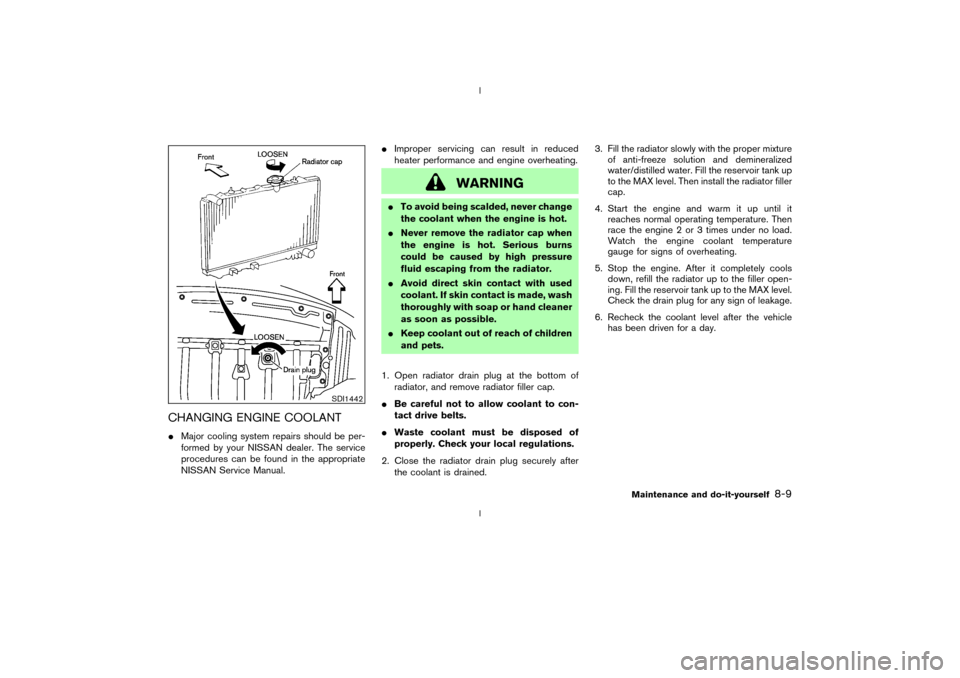
CHANGING ENGINE COOLANTIMajor cooling system repairs should be per-
formed by your NISSAN dealer. The service
procedures can be found in the appropriate
NISSAN Service Manual.IImproper servicing can result in reduced
heater performance and engine overheating.
WARNING
ITo avoid being scalded, never change
the coolant when the engine is hot.
INever remove the radiator cap when
the engine is hot. Serious burns
could be caused by high pressure
fluid escaping from the radiator.
IAvoid direct skin contact with used
coolant. If skin contact is made, wash
thoroughly with soap or hand cleaner
as soon as possible.
IKeep coolant out of reach of children
and pets.
1. Open radiator drain plug at the bottom of
radiator, and remove radiator filler cap.
IBe careful not to allow coolant to con-
tact drive belts.
IWaste coolant must be disposed of
properly. Check your local regulations.
2. Close the radiator drain plug securely after
the coolant is drained.3. Fill the radiator slowly with the proper mixture
of anti-freeze solution and demineralized
water/distilled water. Fill the reservoir tank up
to the MAX level. Then install the radiator filler
cap.
4. Start the engine and warm it up until it
reaches normal operating temperature. Then
race the engine 2 or 3 times under no load.
Watch the engine coolant temperature
gauge for signs of overheating.
5. Stop the engine. After it completely cools
down, refill the radiator up to the filler open-
ing. Fill the reservoir tank up to the MAX level.
Check the drain plug for any sign of leakage.
6. Recheck the coolant level after the vehicle
has been driven for a day.
SDI1442
Maintenance and do-it-yourself
8-9
Z
02.9.13/Z33-D/V5.0
X
Page 172 of 227
IA suitable adapter should be attached to the
jack stand saddle.
5. Remove the plastic engine undercover.
a. Remove the small plastic clip at the center
point of the undercover.
b. Then remove the other bolts that hold the
undercover in place.
CAUTION
Make sure the correct lifting and sup-
port points are used to avoid vehicle
damage.
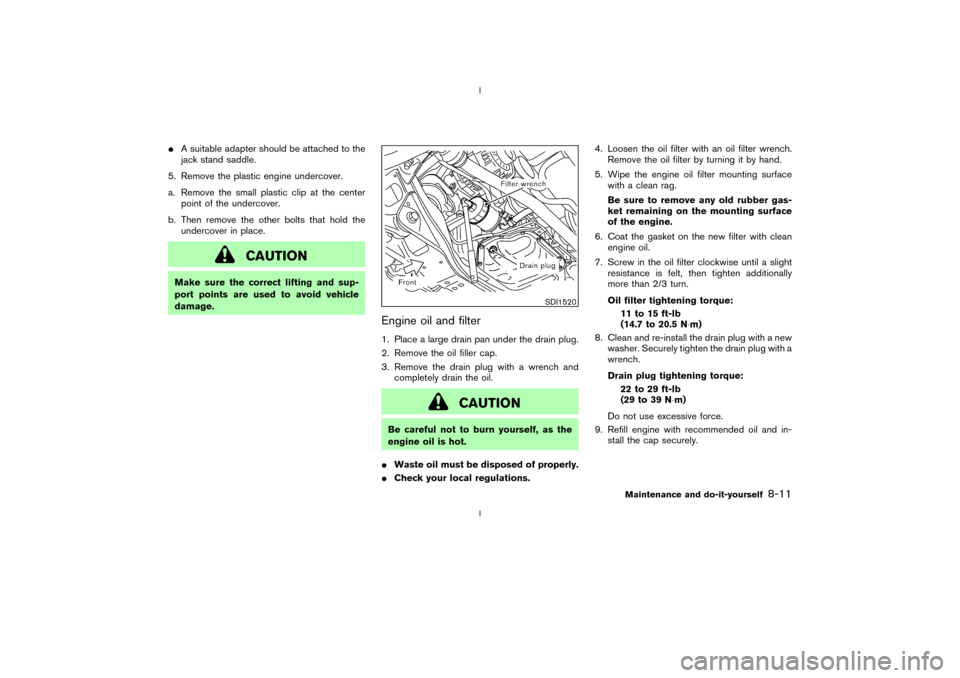
Engine oil and filter1. Place a large drain pan under the drain plug.
2. Remove the oil filler cap.
3. Remove the drain plug with a wrench and
completely drain the oil.
CAUTION
Be careful not to burn yourself, as the
engine oil is hot.
IWaste oil must be disposed of properly.
ICheck your local regulations.4. Loosen the oil filter with an oil filter wrench.
Remove the oil filter by turning it by hand.
5. Wipe the engine oil filter mounting surface
with a clean rag.
Be sure to remove any old rubber gas-
ket remaining on the mounting surface
of the engine.
6. Coat the gasket on the new filter with clean
engine oil.
7. Screw in the oil filter clockwise until a slight
resistance is felt, then tighten additionally
more than 2/3 turn.
Oil filter tightening torque:
11 to 15 ft-lb
(14.7 to 20.5 N×m)
8. Clean and re-install the drain plug with a new
washer. Securely tighten the drain plug with a
wrench.
Drain plug tightening torque:
22 to 29 ft-lb
(29 to 39 N×m)
Do not use excessive force.
9. Refill engine with recommended oil and in-
stall the cap securely.
SDI1520
Maintenance and do-it-yourself
8-11
Z
02.9.13/Z33-D/V5.0
X
Page 176 of 227
WARNING
Anti-freeze is poisonous and should be
stored carefully in marked containers
out of the reach of children.
CAUTION
Do not substitute engine anti-freeze
coolant for window washer solution.
This may result in damage to the paint.IKeep the battery surface clean and dry. Any
corrosion should be washed off with a solu-
tion of baking soda and water.
IMake certain the terminal connections are
clean and securely tightened.
IIf the vehicle is not to be used for 30 days or
longer, disconnect the (Ð) negative battery
terminal to prevent discharging it.
CAUTION
When the battery cable is removed from
the battery terminal, do not close either
of front doors. The automatic window
adjusting function will not work, and the
side roof panel may be damaged.
To disconnect the negative (þ) battery ter-
minal, perform the procedure in the follow-
ing order.
Otherwise, the window and the side roof
panel may contact and be damaged.
1. Close the windows.
2. Open the hood.
3. Close and lock all the doors.4. Disconnect the negative (þ) battery ter-
minal.
5. Securely close the hood.
To connect the negative (þ) battery termi-
nal, perform the procedure in the following
order. Otherwise, the window and the side
roof panel may contact and be damaged.
1. Unlock and open the driver side door.
Do not close the door.
2. Open the hood.
3. Connect the negative (þ) battery termi-
nal. Then close the hood.
4. Fully open the driver side door window.
5. Close the driver side door and the win-
dow.
WARNING
IDo not expose the battery to flames
or electrical sparks. Hydrogen gas
generated by battery action is explo-
sive. Do not allow battery fluid to
contact your skin, eyes, fabrics, or
painted surfaces. After touching a
battery or battery cap, do not touch
BATTERY
Maintenance and do-it-yourself
8-15
Z
02.9.13/Z33-D/V5.0
X