2003 NISSAN 350Z tires
[x] Cancel search: tiresPage 191 of 227
parked for 3 or more hours, or driven less than 1
mile (1.6 km) at moderate speeds. COLD tire
pressures are shown on the tire placard affixed
to the inside of the console box lid.Low tire pressure warning system (if
so equipped)The low tire pressure warning system displays
the tire pressure of all tires (except the spare tire)
on the trip computer by sending a signal from a
sensor that is installed in each wheel. For more
details, refer to ªTrip computerº and ªLow tire
pressure warning lightº in the ª2. Instruments
and controlsº section, ªLow tire pressure warn-
ing systemº in the ª5. Starting and drivingº
section, and ªFlat tireº in the ª6. In case of
emergencyº section. If the tire pressure dis-
played on the trip computer is lower than the
COLD tire pressure shown on the tire placard,
check the pressure of all four tires and adjust
them to the COLD tire pressure as indicated
above. The low tire pressure warning system will
activate only when the vehicle is driven at
speeds above 20 MPH (32 km/h).
WARNING
IImproperly inflated tires can fail sud-
denly and cause an accident.IThe vehicle capacity weight is indi-
cated on the tire placard. Do not load
your vehicle beyond this capacity.
Overloading your vehicle may result
in reduced tire life, unsafe operating
conditions due to premature tire fail-
ure, or unfavorable handling charac-
teristics and could also lead to a
serious accident. Loading beyond the
specified capacity may also result in
failure of other vehicle components.
IBefore taking a long trip, or when-
ever you have loaded your vehicle
heavily, use a tire pressure gauge to
ensure that the tire pressure is at the
specified level.
IDo not drive your vehicle over 85
MPH (140 km/h) unless it is equipped
with high speed capability tires. Driv-
ing faster than 85 MPH (140 km/h)
may result in tire failure, loss of con-
trol and possible injury.
IFor additional information regarding
tires, refer to ªImportant Tire Safety
Informationº (US) or ªTire Safety In-formationº (Canada) in the Warranty
Information booklet.
TYPES OF TIRES
WARNING
IWhen changing or replacing tires, be
sure all four tires are of the same
type (for example, summer, all sea-
son or snow) and construction. Your
NISSAN dealer may be able to help
you with information about tire type,
size, speed rating and availability.
Replacement tires may have a lower
speed rating than the factory
equipped tires, and may not match
the potential maximum vehicle
speed. Never exceed the maximum
speed rating of the tire.
IFor additional information regarding
tires, refer to ªImportant Tire Safety
Informationº (US) or ªTire Safety In-
formationº (Canada) in the Warranty
Information booklet.
8-30
Maintenance and do-it-yourself
Z
02.9.13/Z33-D/V5.0
X
Page 192 of 227

All season tiresNISSAN specifies all season tires on some
models to provide good performance for use all
year around, including snowy and icy road con-
ditions. All season tires are identified by ALL
SEASON and/or M&S on the tire sidewall. Snow
tires have better snow traction than all season
tires and may be more appropriate in some
areas.Summer tiresNISSAN specifies summer tires on some models
to provide superior performance on dry roads.
Summer tire performance in snow and ice will be
substantially reduced. Summer tires do not have
the tire traction rating M&S on the tire sidewall.
If you operate your vehicle in snowy or icy
conditions, NISSAN recommends the use of
snow or all season tires on all four wheels.Snow tiresIf snow tires are needed, it is necessary to select
tires equivalent in size and load rating to the
original equipment tires. If you do not, it can
adversely affect the safety and handling of your
vehicle.
Generally, snow tires will have lower speed
ratings than factory equipped tires and may not
match the potential maximum vehicle speed.Never exceed the maximum speed rating of the
tire.
If you operate your vehicle in snowy or icy
conditions, NISSAN recommends the use of
snow or all season tires on all four wheels.
For additional traction on icy roads, studded tires
may be used. However, some provinces and
states prohibit their use. Check local, state and
provincial laws before installing studded tires.
Skid and traction capabilities of studded snow
tires, on wet or dry surfaces, may be poorer than
that of non-studded snow tires.
TIRE CHAINSUse of tire chains may be prohibited according
to location. Check the local laws before installing
tire chains. When installing tire chains, make
sure they are of proper size for the tires on your
vehicle and are installed according to the chain
manufacturer's suggestions.Use only SAE
class S chains.Class ªSº chains are used on
vehicles with restricted tire to vehicle clearance.
Vehicles that can use Class ªSº chains are
designed to meet the SAE standard minimum
clearances between the tire and the closest
vehicle suspension or body component required
to accommodate the use of a winter traction
device (tire chains or cables). The minimum
clearances are determined using the factory
equipped tire size. Other types may damageyour vehicle. Use chain tensioners when recom-
mended by the tire chain manufacturer to ensure
a tight fit. Loose end links of the tire chain must
be secured or removed to prevent the possibility
of whipping action damage to the fenders or
undercarriage. If possible, avoid fully loading
your vehicle when using tire chains. In addition,
drive at a reduced speed. Otherwise, your ve-
hicle may be damaged and/or vehicle handling
and performance may be adversely affected.
INever install tire chains on a T-type
spare tire.
IDo not use the chains on dry roads.
ITire chains must be installed only on the
rear wheels and not on the front wheels.
CHANGING WHEELS AND TIRES
Tire rotationTires cannot be rotated in this vehicle, as front
tires are different size from rear tires and the
direction of wheel rotation is fixed in each tire.
A pin is on the front brake rotor to prevent the
rear wheels from being installed in place of the
front wheels. The spare tire can be installed in
place of the front and rear wheels. When install-
ing the spare tire in the front wheel, the hole in
the spare tire wheel must be aligned with the pin
on the brake rotor.
Maintenance and do-it-yourself
8-31
Z
02.9.13/Z33-D/V5.0
X
Page 193 of 227
Tire wear and damage
WARNING
ITires should be periodically in-
spected for wear, cracking, bulging,
or objects caught in the tread. If ex-
cessive wear, cracks, bulging, or
deep cuts are found, the tire should
be replaced.
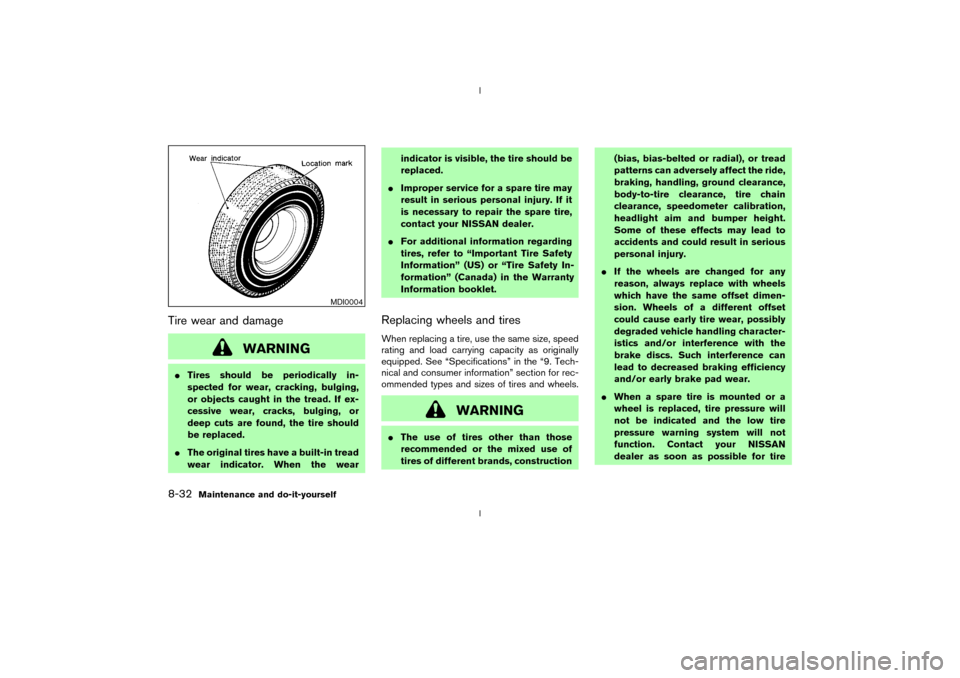
IThe original tires have a built-in tread
wear indicator. When the wearindicator is visible, the tire should be
replaced.
IImproper service for a spare tire may
result in serious personal injury. If it
is necessary to repair the spare tire,
contact your NISSAN dealer.
IFor additional information regarding
tires, refer to ªImportant Tire Safety
Informationº (US) or ªTire Safety In-
formationº (Canada) in the Warranty
Information booklet.
Replacing wheels and tiresWhen replacing a tire, use the same size, speed
rating and load carrying capacity as originally
equipped. See ªSpecificationsº in the ª9. Tech-
nical and consumer informationº section for rec-
ommended types and sizes of tires and wheels.
WARNING
IThe use of tires other than those
recommended or the mixed use of
tires of different brands, construction(bias, bias-belted or radial), or tread
patterns can adversely affect the ride,
braking, handling, ground clearance,
body-to-tire clearance, tire chain
clearance, speedometer calibration,
headlight aim and bumper height.
Some of these effects may lead to
accidents and could result in serious
personal injury.
IIf the wheels are changed for any
reason, always replace with wheels
which have the same offset dimen-
sion. Wheels of a different offset
could cause early tire wear, possibly
degraded vehicle handling character-
istics and/or interference with the
brake discs. Such interference can
lead to decreased braking efficiency
and/or early brake pad wear.
IWhen a spare tire is mounted or a
wheel is replaced, tire pressure will
not be indicated and the low tire
pressure warning system will not
function. Contact your NISSAN
dealer as soon as possible for tire
MDI0004
8-32
Maintenance and do-it-yourself
Z
02.9.13/Z33-D/V5.0
X
Page 194 of 227
replacement and/or system reset-
ting. (For models with the low tire
pressure warning system)
IDo not install a deformed wheel or
tire even if it has been repaired. Such
wheels or tires could have structural
damage and could fail without warn-
ing.
IThe use of retread tire is not recom-
mended.
IFor additional information regarding
tires, refer to ªImportant Tire Safety
Informationº (US) or ªTire Safety In-
formationº (Canada) in the Warranty
Information booklet.
Wheel balanceUnbalanced wheels may affect vehicle handling
and tire life. Even with regular use, wheels can
get out of balance. Therefore, they should be
balanced as required.
Wheel balance service should be performed
with the wheels off the vehicle. Spin balancing
the front wheels on the vehicle could lead to
transmission damage.For additional information regarding tires, refer to
ªImportant Tire Safety Informationº (US) or ªTire
Safety Informationº (Canada) in the Warranty
Information booklet.
Care of wheelsIWash the wheels when washing the vehicle
to maintain their appearance.
IClean the inner side of the wheels when the
wheel is changed or the underside of the
vehicle is washed.
IDo not use abrasive cleaners when washing
the wheels.
IInspect wheel rims regularly for dents or
corrosion. Such damage may cause loss of
pressure or poor seal at the tire bead.
INISSAN recommends that the road wheels
be waxed to protect against road salt in areas
where it is used during winter.Spare tire (T-type spare tire)Observe the following precautions if the T-type
spare tire must be used, otherwise your vehicle
could be damaged or involved in an accident.
CAUTION
IThe T-type spare tire should be used
only for emergency. It should be re-
placed by the standard tire at the first
opportunity.
IDrive carefully while the T-type spare
tire is installed.
Avoid sharp turns and abrupt braking
while driving.
IPeriodically check the T-type spare
tire inflation pressure, and always
keep it at 60 psi (420 kPa, 4.2 bar).
IAlways keep the pressure of the full
size spare tire (if so equipped) at the
recommended pressure for standard
tires, as indicated on the tire placard.
For tire placard location, see ªTire
placardº in the ª9. Technical and con-
sumer informationº.
IDo not drive your vehicle at speeds
faster than 50 MPH (80 km/h).
IDo not use tire chains on a T-type
Maintenance and do-it-yourself
8-33
Z
02.9.13/Z33-D/V5.0
X
Page 196 of 227

9 Technical and consumer informationCapacities and recommended fuel/lubricants ................ 9-2
Fuel recommendation...................................................... 9-3
Engine oil and oil filter recommendation.................... 9-5
Recommended SAE viscosity number ....................... 9-6
Air conditioning system refrigerant and lubricant
recommendations ............................................................. 9-6
Specifications.......................................................................... 9-8
Engine ................................................................................. 9-8
Wheels and tires .............................................................. 9-9
Dimensions and weights ................................................ 9-9
When traveling or registering your vehicle in another
country.................................................................................... 9-10
Vehicle identification ........................................................... 9-10
Vehicle identification number (VIN) plate ................ 9-10
Vehicle identification number (Chassis number) ... 9-10
Engine serial number .................................................... 9-11
F.M.V.S.S. certification label ....................................... 9-11
Emission control information label ............................ 9-11Tire placard ..................................................................... 9-12
Air conditioner specification label ............................. 9-12
Installing front license plate .............................................. 9-13
Vehicle loading information ............................................... 9-14
Terms ................................................................................ 9-14
Determining vehicle load capacity ............................ 9-14
Loading tips .................................................................... 9-15
Towing a trailer .................................................................... 9-15
Maximum load limits ...................................................... 9-16
Towing safety.................................................................. 9-17
Uniform tire quality grading............................................... 9-19
Emission control system warranty ................................... 9-20
Reporting safety defects (US only) ................................ 9-20
Readiness for inspection/maintenance (I/M) test
(US only)................................................................................ 9-21
Owner's manual/service manual order information ... 9-22
In the event of a collision ............................................ 9-22
Z
02.9.13/Z33-D/V5.0
X
Page 204 of 227

WHEELS AND TIRESRoad wheelType Size Offset in (mm)
AluminumFront17 x 7-1/2JJ
1.18 (30)
18 x 8JJ*
Rear17 x 8JJ 1.30 (33)
18 x 8JJ* 1.18 (30)
18 x 8-1/2JJ* 1.30 (33)
TireConventionalFront225/50R17 94W
225/45R18 91W*
Rear235/50R17 96W
245/45R18 96W*
SpareT145/90D16
T155/80R17*
*: For option
DIMENSIONS AND WEIGHTS
Coupe
Overall length in (mm) 169.6 (4,309)
Overall width in (mm) 71.5 (1,815)
Overall height in (mm) 51.9 (1,319)
Front tread in (mm) 60.4 (1,535)
Rear tread in (mm)60.6 (1,539)*1
60.8 (1,545)*2
Wheelbase in (mm) 104.3 (2,649)
Gross vehicle weight rating lb (kg)
See the F.M.V.S.S. certifica-
tion label on the driver's side
lock pillar. Gross axle weight rating
Front lb (kg)
Rear lb (kg)
*1: The wheel offset is 1.30 in (33 mm).
*2: The wheel offset is 1.18 in (30 mm).
Technical and consumer information
9-9
Z
02.9.13/Z33-D/V5.0
X
Page 212 of 227
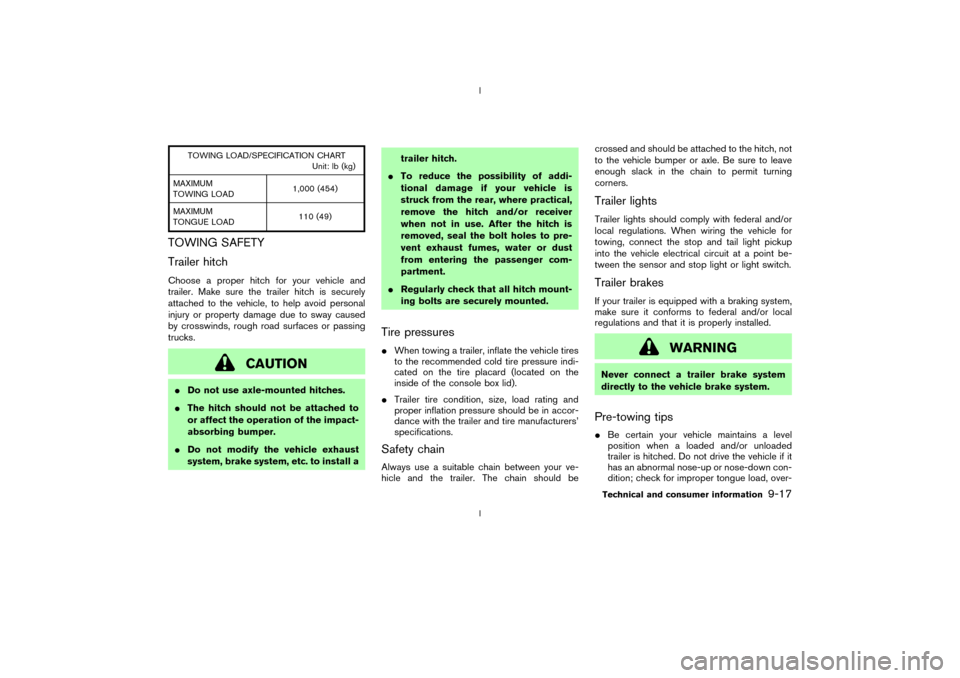
TOWING LOAD/SPECIFICATION CHART
Unit: lb (kg)
MAXIMUM
TOWING LOAD1,000 (454)
MAXIMUM
TONGUE LOAD110 (49)
TOWING SAFETY
Trailer hitchChoose a proper hitch for your vehicle and
trailer. Make sure the trailer hitch is securely
attached to the vehicle, to help avoid personal
injury or property damage due to sway caused
by crosswinds, rough road surfaces or passing
trucks.
CAUTION
IDo not use axle-mounted hitches.
IThe hitch should not be attached to
or affect the operation of the impact-
absorbing bumper.
IDo not modify the vehicle exhaust
system, brake system, etc. to install atrailer hitch.
ITo reduce the possibility of addi-
tional damage if your vehicle is
struck from the rear, where practical,
remove the hitch and/or receiver
when not in use. After the hitch is
removed, seal the bolt holes to pre-
vent exhaust fumes, water or dust
from entering the passenger com-
partment.
IRegularly check that all hitch mount-
ing bolts are securely mounted.
Tire pressuresIWhen towing a trailer, inflate the vehicle tires
to the recommended cold tire pressure indi-
cated on the tire placard (located on the
inside of the console box lid).
ITrailer tire condition, size, load rating and
proper inflation pressure should be in accor-
dance with the trailer and tire manufacturers'
specifications.Safety chainAlways use a suitable chain between your ve-
hicle and the trailer. The chain should becrossed and should be attached to the hitch, not
to the vehicle bumper or axle. Be sure to leave
enough slack in the chain to permit turning
corners.
Trailer lightsTrailer lights should comply with federal and/or
local regulations. When wiring the vehicle for
towing, connect the stop and tail light pickup
into the vehicle electrical circuit at a point be-
tween the sensor and stop light or light switch.Trailer brakesIf your trailer is equipped with a braking system,
make sure it conforms to federal and/or local
regulations and that it is properly installed.
WARNING
Never connect a trailer brake system
directly to the vehicle brake system.Pre-towing tipsIBe certain your vehicle maintains a level
position when a loaded and/or unloaded
trailer is hitched. Do not drive the vehicle if it
has an abnormal nose-up or nose-down con-
dition; check for improper tongue load, over-Technical and consumer information
9-17
Z
02.9.13/Z33-D/V5.0
X
Page 214 of 227
sion oil more frequently. See the Service
and Maintenance Guide.DOT (Department Of Transportation) Quality
Grades: All passenger car tires must conform to
federal safety requirements in addition to these
grades.
Quality grades can be found where applicable
on the tire sidewall between tread shoulder and
maximum section width. For example:
Treadwear 200 Traction AA Temperature A
TreadwearTreadwear grade is a comparative rating based
on tire wear rate when tested under controlled
conditions on specified government test
courses. For example, a tire graded 150 would
wear one and a half (1-1/2) times as well on the
government course as a tire graded 100. How-
ever, relative tire performance depends on actual
driving conditions, and may vary significantly
from the norm due to variations in driving habits,
service practices and differences in road char-
acteristics and climate.Traction AA, A, B and CThe traction grades, from highest to lowest, are
AA, A, B, and C. Those grades represent the
tire's ability to stop on wet pavement as mea-
sured under controlled conditions on specified
government test surfaces of asphalt and con-crete. A tire marked C may have poor traction
performance.
WARNING
The traction grade assigned to your ve-
hicle tires is based on straight-ahead
braking traction tests, and does not in-
clude acceleration, cornering, hydro-
planing, or peak traction characteristics.Temperature A, B and CTemperature grades are A (the highest), B, and
C. They represent a tire's resistance to heat
build-up, and its ability to dissipate heat when
tested under controlled conditions on a speci-
fied indoor laboratory test wheel. Sustained high
temperature can cause tire material to degener-
ate, reducing tire life. Excessive temperatures
can lead to sudden tire failure. Grade C corre-
sponds to a performance level which all passen-
ger car tires must meet under the Federal Motor
Vehicle Safety Standard No. 109. Grades A and
B represent higher levels of performance on
laboratory test wheels than the minimum re-
quired by law.
UNIFORM TIRE QUALITY
GRADING
Technical and consumer information
9-19
Z
02.9.13/Z33-D/V5.0
X