2003 MITSUBISHI SHOGUN child restraint
[x] Cancel search: child restraintPage 33 of 392

Seat and seat belts
Seat arrangement.......................................... 3- 3
Seat adjustment ............................................ 3- 5
Front seat....................................................... 3- 6
Rear seat (3-door models)/
Second seat (5-door models) ................... 3-12
Armrest .......................................................... 3-13
Third seat (5-door models) .......................... 3-14
Making a luggage area ................................. 3-14
Making a flat seat .......................................... 3-26
Head restraints ............................................. 3-28
Seat belts ....................................................... 3-30
Child restraint................................................ 3-33
Pregnant women restraint............................ 3-41
Seat belt inspection ...................................... 3-41
Supplemental restraint system
(SRS)-air bag ............................................. 3-42
Div:
Out put date:
Page 37 of 392

Seat adjustment
EG21A-Ud
Adjust the driver’s seat so that you are
comfortable and that you can reach the
pedals, steering wheel, switches etc. while
retaining a clear field of vision.
WARNING
(1) If required, always adjust the
seating before the vehicle is in
motion. After adjustments are
made, ensure the seating is
locked in position by attempt-
ing to move the seat and seat-
back forward and rearward
without using the adjusting
mechanism.
WARNING
(2) It is extremely dangerous to ride
in the luggage area (inside or
outside) of a vehicle. Also, the
luggage area and rear seats
should never be used as a play
area by children. In a collision,
people or children riding unre-
strained in these areas are more
likely to be seriously injured or
killed.
Do not allow people or children
to ride in any area of your
vehicle that is not equipped with
seats and seat belts, and make
sure that everyone travelling in
your vehicle is in a seat and
wearing a seat belt, or in the
case of a child is strapped in a
child restraint.
In the interest of their safety,
children should not be allowed
to adjust the seats.
WARNING
(3) To minimize the risk of per-
sonal injury in the event of a col-
lision or sudden braking, the
seatbacks should always be in
the almost upright position while
the vehicle is in motion. The pro-
tection provided by the seat
belts may be reduced signifi-
cantly when the seatback is
reclined. There is greater risk
that the passenger will slide
under the seat belt, resulting in
serious injury, when the seat-
back is reclined.
Seat and seat belts
3-5
Div:
Out put date:
Page 38 of 392

CAUTION
(1) Make sure that the seat is
adjusted by an adult.
If it is adjusted by a child, an
unexpected accident might
occur.
(2) Do not place a cushion or the
like between your back and the
seatback while driving. The
effectiveness of the head
restraints will be reduced in the
event of an accident.
(3) When sliding or reclining the
seat rearward, pay careful atten-
tion to the rear seat passen-
gers.
G21B047A
Front seat
EG21BAA
To adjust forward or backwardExcept for power seat
Pull the seat adjusting lever and adjust the
seat forward or backward to the desired
position. After adjustment, release the
adjusting lever to lock the seat in posi-
tion.
WARNING
To ensure the seat is locked securely,
try to move the seat forward or back-
ward without using the lever.
G21B065A
Power seat
Adjust the seat by operating the switch as
indicated by the arrows.
1- Adjustment forward
2- Adjustment backward
Seat and seat belts
3-6Div:
Out put date:
Page 58 of 392

G24E048A
5. Push the knob (B) forward, raise the
seatback until it locks securely into
place.
After the operation, push the seatback
lightly to confirm that it has actually been
secured.
Making a flat seat
EG05COI
By removing the head restraints and fully
reclining the seatbacks of the seats, one
large flat seat is achieved.
WARNING
Never drive with luggage or passen-
gers on the flat seat. This is highly
dangerous.
In a collision, people or children
riding unrestrained in these areas are
more likely to be seriously injured or
killed.
Do not allow people or children to
ride in any area of your vehicle that
is not equipped with seats and seat
belts, and make sure that everyone
travelling in your vehicle is in a seat
and wearing a seat belt, or in the
case of a child is strapped in a child
restraint.
In the interest of their safety, chil-
dren should not be allowed to adjust
the seats.
CAUTION
(1) To make a flat seat, stop the
vehicle in a safe place.
(2) Make sure that the seat is
adjusted by an adult.
If it is adjusted by a child, an
unexpected accident might
occur.
(3) When sliding the seat, be sure
not to trap your hand or leg.
(4) Do not walk around on top of the
seats after they have been laid
flat.
(5) To ensure the seats are locked
securely, attempt to move them
back and forth.
(6) Do not jump on, or impact the
seatbacks heavily.
(7) To raise the seatback, sit on the
seat and put a hand on the seat-
back and raise slowly. Never
have a child do this operation, or
an unexpected accident may
result.
Seat and seat belts
3-26Div:
Out put date:
Page 65 of 392
G28E067A
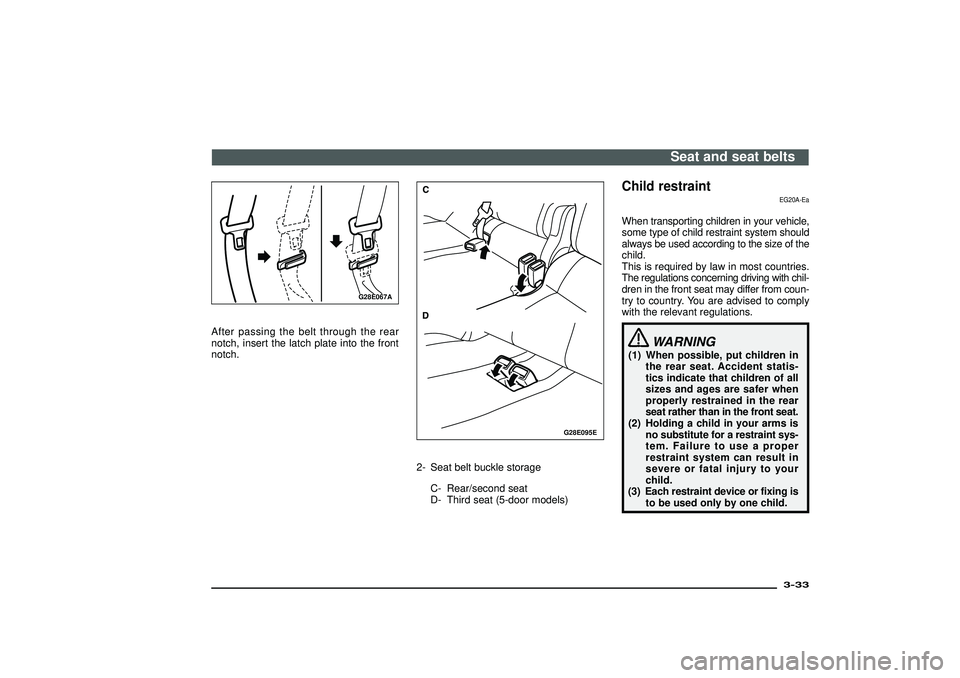
After passing the belt through the rear
notch, insert the latch plate into the front
notch.
G28E095E
2- Seat belt buckle storage
C- Rear/second seat
D- Third seat (5-door models)
Child restraint
EG20A-Ea
When transporting children in your vehicle,
some type of child restraint system should
always be used according to the size of the
child.
This is required by law in most countries.
The regulations concerning driving with chil-
dren in the front seat may differ from coun-
try to country. You are advised to comply
with the relevant regulations.
WARNING
(1) When possible, put children in
the rear seat. Accident statis-
tics indicate that children of all
sizes and ages are safer when
properly restrained in the rear
seat rather than in the front seat.
(2) Holding a child in your arms is
no substitute for a restraint sys-
tem. Failure to use a proper
restraint system can result in
severe or fatal injury to your
child.
(3) Each restraint device or fixing is
to be used only by one child.
Seat and seat belts
3-33
Div:
Out put date:
Page 66 of 392

G28G267A
Caution for installing the child
restraint on vehicle with front pas-
senger air bagThe label shown here is attached on
vehicles with front passenger air bag.
If this label is attached, never install the
rear-facing child restraint on the front pas-
senger’s seat.
G28G 436A
WARNING
(1) Extreme Hazard!
REAR-FACING CHILD
RESTRAINTS must NOT be used
in the front passenger seat as it
places an infant too close to the
passenger air bag. The force of
an inflating air bag could kill or
cause serious injuries to the
child. Rear-facing child restraints
must only be used in the rear
seat (3-door models)/second
seat (5-door models).
G28G 439A
WARNING
(2) FRONT-FACING CHILD
RESTRAINTS should be used in
the rear seat (3-door models)/
second seat (5-door models)
whenever possible; if used in the
front seat, adjust the seat to the
fully backward position.
Seat and seat belts
3-34Div:
Out put date:
Page 67 of 392
G28B005A
Infants and small children
EG20B-Ba
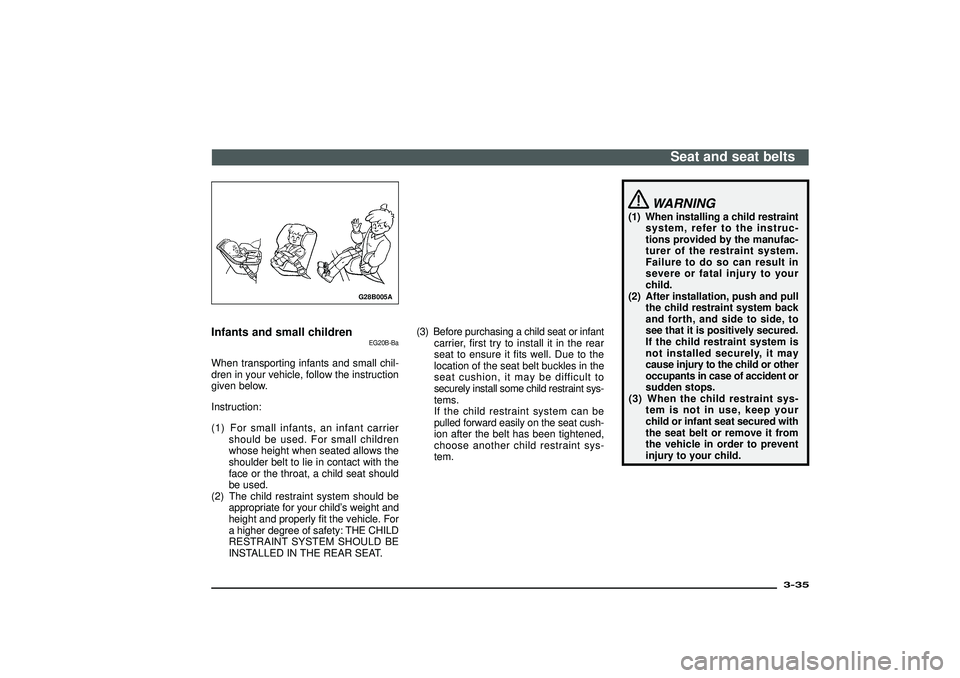
When transporting infants and small chil-
dren in your vehicle, follow the instruction
given below.
Instruction:
(1) For small infants, an infant carrier
should be used. For small children
whose height when seated allows the
shoulder belt to lie in contact with the
face or the throat, a child seat should
be used.
(2) The child restraint system should be
appropriate for your child’s weight and
height and properly fit the vehicle. For
a higher degree of safety: THE CHILD
RESTRAINT SYSTEM SHOULD BE
INSTALLED IN THE REAR SEAT.(3) Before purchasing a child seat or infant
carrier, first try to install it in the rear
seat to ensure it fits well. Due to the
location of the seat belt buckles in the
seat cushion, it may be difficult to
securely install some child restraint sys-
tems.
If the child restraint system can be
pulled forward easily on the seat cush-
ion after the belt has been tightened,
choose another child restraint sys-
tem.
WARNING
(1) When installing a child restraint
system, refer to the instruc-
tions provided by the manufac-
turer of the restraint system.
Failure to do so can result in
severe or fatal injury to your
child.
(2) After installation, push and pull
the child restraint system back
and forth, and side to side, to
see that it is positively secured.
If the child restraint system is
not installed securely, it may
cause injury to the child or other
occupants in case of accident or
sudden stops.
(3) When the child restraint sys-
tem is not in use, keep your
child or infant seat secured with
the seat belt or remove it from
the vehicle in order to prevent
injury to your child.
Seat and seat belts
3-35
Div:
Out put date:
Page 68 of 392

Suitability for various seating positions
EG20COIa
3-door models
Mass GroupSeating position
Front Passenger Rear Outboard Rear Centre
With Air Bag Without Air Bag Left side Right side
0- - Up to 10 kg (0-9 months) UF U, L*
1
U, L*
1
L*1
U, L *
1
0+ - Up to 13 kg (0-2 years) UF U U X U
I - 9 to 18 kg (9 months-4 years) UF U U, L*
2
L*2
U, L*
2
II & III - 15 to 36 kg (4-12 years) UF, L*
3
U, L*
3
U, L*
3
L*3
U, L*
3
Key of letters to be inserted in the above table:
U - Suitable for “universal” category restraints approved for use in this mass group.
UF - Suitable for forward-facing “universal” category restraints approved for use in this mass group.
L - Suitable for particular child restraints (MITSUBISHI genuine parts).
B - Built-in restraint approved for this mass group.
X - Seat position not suitable for children in this mass group.
L (Genuine part information)
Genuine parts No. ECE No.
*1 MZ311097 E1-03301063
*2 MZ312745 E1-03301136
*3 MZ311099 E1-03301061
NOTE
There is no applicable MITSUBISHI Genuine Parts to the Mass Group “0+-Up to 13 kg (0-2 years)”.
MITSUBISH IMO TO R S Europ eB. V. reserve sth e righ tto change swithou tan yprio rannouncement.
For detail information, please consult your authorized MITSUBISHI dealer.
Seat and seat belts
3-36Div:
Out put date: