2003 MITSUBISHI SHOGUN warning
[x] Cancel search: warningPage 63 of 392

WARNING
(4) Seat belts should always be
worn by every adult who drives
or rides in this vehicle, and by all
children who are large enough
to wear seat belts properly.
(5) Remove any twists when using
the belt.
(6) No modifications or additions
should be made by the user
which will either prevent the seat
belt adjusting devices from oper-
ating to remove slack, or pre-
vent the seat belt assembly from
being adjusted to remove slack.
(7) To reduce risk of serious or fatal
injury in an accident, including
from a deploying driver air bag,
the driver should adjust the driv-
er’s seat to the most rear posi-
tion that still allows good
visibility and good control of the
steering wheel, the brake and
accelerator, and vehicle con-
trols.
G28A089A
WARNING
(8) Never hold a child in your arms
or on your lap when riding in
this vehicle even if you are wear-
ing your seat belt. To do so risks
severe or fatal injury to the child
in a collision or sudden stop.
(9) Always adjust the belt to a snug
fit.3-point type seat belt (with emer-
gency locking mechanism)This type of belt requires no length adjust-
ment. Once worn, the belt adjusts itself to
the movement of the wearer, but in the
event of a sudden or strong shock, the belt
automatically locks to hold the wearer’s
body.
G28A050A
To fasten
Pull the seat belt out slowly while holding
the latch plate.
NOTE
When the seat belts cannot be pulled out
in a locked condition, pull the belts once
forcefully and then return them. After that,
pull the belts out slowly once again.
Insert the latch plate into the buckle until a
“click”is heard.
CAUTION
(1) Never wear the lap portion of the
belt across your abdomen. Dur-
ing accidents it can press
sharply against your abdomen
and increase the risk of injury.
(2) The seat belts must not be
twisted when worn.
Pull the belt slightly to adjust looseness as
desired.
Seat and seat belts
3-31
Div:
Out put date:
Page 65 of 392
G28E067A
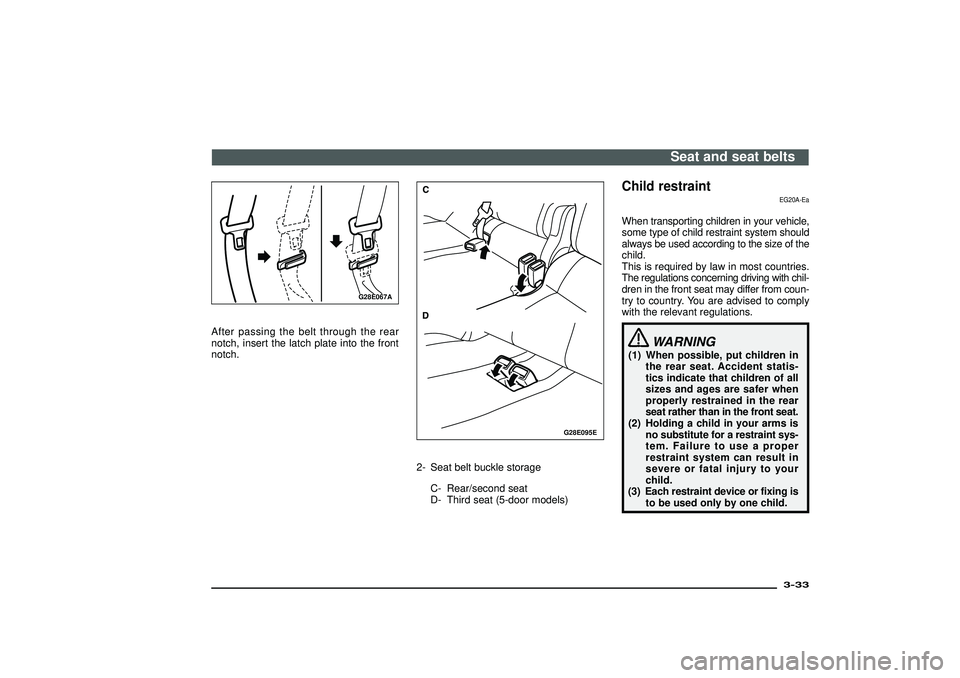
After passing the belt through the rear
notch, insert the latch plate into the front
notch.
G28E095E
2- Seat belt buckle storage
C- Rear/second seat
D- Third seat (5-door models)
Child restraint
EG20A-Ea
When transporting children in your vehicle,
some type of child restraint system should
always be used according to the size of the
child.
This is required by law in most countries.
The regulations concerning driving with chil-
dren in the front seat may differ from coun-
try to country. You are advised to comply
with the relevant regulations.
WARNING
(1) When possible, put children in
the rear seat. Accident statis-
tics indicate that children of all
sizes and ages are safer when
properly restrained in the rear
seat rather than in the front seat.
(2) Holding a child in your arms is
no substitute for a restraint sys-
tem. Failure to use a proper
restraint system can result in
severe or fatal injury to your
child.
(3) Each restraint device or fixing is
to be used only by one child.
Seat and seat belts
3-33
Div:
Out put date:
Page 66 of 392

G28G267A
Caution for installing the child
restraint on vehicle with front pas-
senger air bagThe label shown here is attached on
vehicles with front passenger air bag.
If this label is attached, never install the
rear-facing child restraint on the front pas-
senger’s seat.
G28G 436A
WARNING
(1) Extreme Hazard!
REAR-FACING CHILD
RESTRAINTS must NOT be used
in the front passenger seat as it
places an infant too close to the
passenger air bag. The force of
an inflating air bag could kill or
cause serious injuries to the
child. Rear-facing child restraints
must only be used in the rear
seat (3-door models)/second
seat (5-door models).
G28G 439A
WARNING
(2) FRONT-FACING CHILD
RESTRAINTS should be used in
the rear seat (3-door models)/
second seat (5-door models)
whenever possible; if used in the
front seat, adjust the seat to the
fully backward position.
Seat and seat belts
3-34Div:
Out put date:
Page 67 of 392
G28B005A
Infants and small children
EG20B-Ba
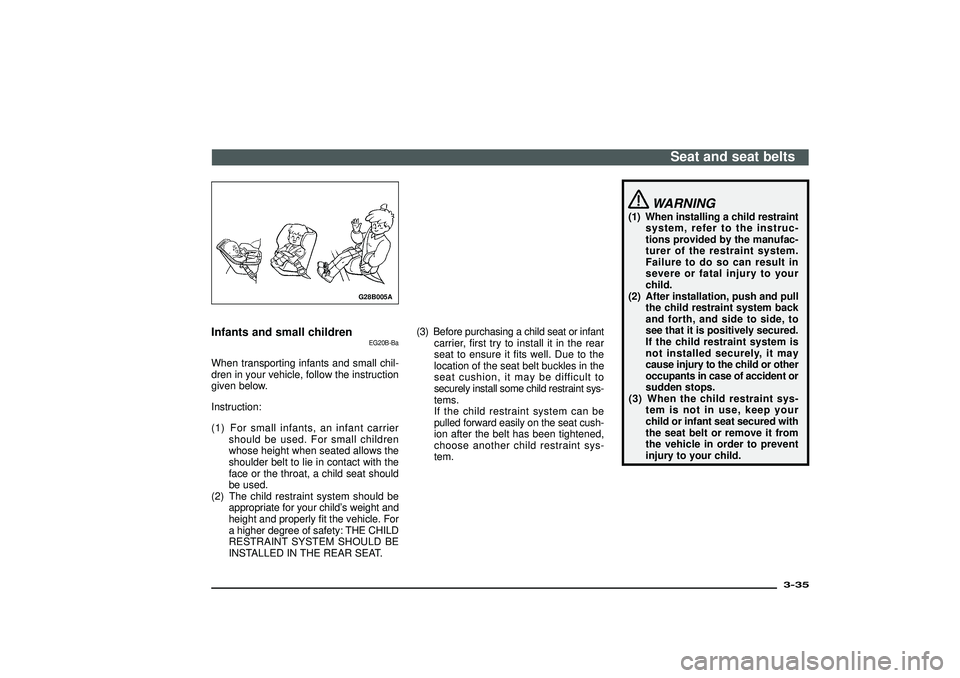
When transporting infants and small chil-
dren in your vehicle, follow the instruction
given below.
Instruction:
(1) For small infants, an infant carrier
should be used. For small children
whose height when seated allows the
shoulder belt to lie in contact with the
face or the throat, a child seat should
be used.
(2) The child restraint system should be
appropriate for your child’s weight and
height and properly fit the vehicle. For
a higher degree of safety: THE CHILD
RESTRAINT SYSTEM SHOULD BE
INSTALLED IN THE REAR SEAT.(3) Before purchasing a child seat or infant
carrier, first try to install it in the rear
seat to ensure it fits well. Due to the
location of the seat belt buckles in the
seat cushion, it may be difficult to
securely install some child restraint sys-
tems.
If the child restraint system can be
pulled forward easily on the seat cush-
ion after the belt has been tightened,
choose another child restraint sys-
tem.
WARNING
(1) When installing a child restraint
system, refer to the instruc-
tions provided by the manufac-
turer of the restraint system.
Failure to do so can result in
severe or fatal injury to your
child.
(2) After installation, push and pull
the child restraint system back
and forth, and side to side, to
see that it is positively secured.
If the child restraint system is
not installed securely, it may
cause injury to the child or other
occupants in case of accident or
sudden stops.
(3) When the child restraint sys-
tem is not in use, keep your
child or infant seat secured with
the seat belt or remove it from
the vehicle in order to prevent
injury to your child.
Seat and seat belts
3-35
Div:
Out put date:
Page 71 of 392
G18C055A
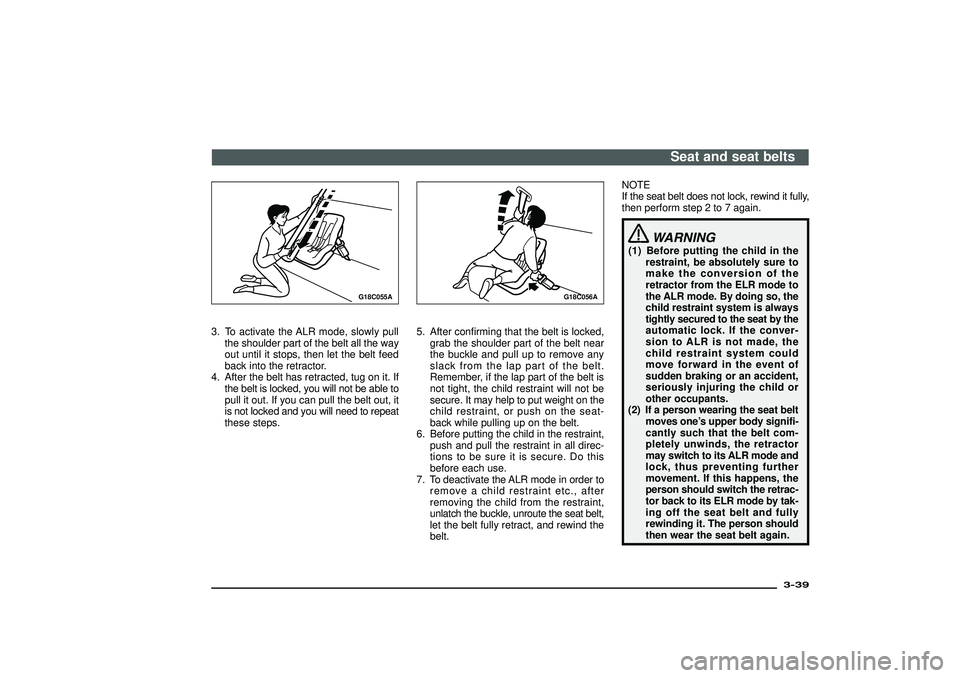
3. To activate the ALR mode, slowly pullthe shoulder part of the belt all the way
out until it stops, then let the belt feed
back into the retractor.
4. After the belt has retracted, tug on it. If the belt is locked, you will not be able to
pull it out. If you can pull the belt out, it
is not locked and you will need to repeat
these steps.
G18C056A
5. After confirming that the belt is locked,grab the shoulder part of the belt near
the buckle and pull up to remove any
slack from the lap part of the belt.
Remember, if the lap part of the belt is
not tight, the child restraint will not be
secure. It may help to put weight on the
child restraint, or push on the seat-
back while pulling up on the belt.
6. Before putting the child in the restraint, push and pull the restraint in all direc-
tions to be sure it is secure. Do this
before each use.
7. To deactivate the ALR mode in order to remove a child restraint etc., after
removing the child from the restraint,
unlatch the buckle, unroute the seat belt,
let the belt fully retract, and rewind the
belt. NOTE
I
f th e sea tbel tdoe sno tlock ,rewin dit full y,
then perform step 2 to 7 again.
WARNING
(1) Before putting the child in the restraint, be absolutely sure to
make the conversion of the
retractor from the ELR mode to
the ALR mode. By doing so, the
child restraint system is always
tightly secured to the seat by the
automatic lock. If the conver-
sion to ALR is not made, the
child restraint system could
move forward in the event of
sudden braking or an accident,
seriously injuring the child or
other occupants.
(2) If a person wearing the seat belt moves one ’s upper body signifi-
cantly such that the belt com-
pletely unwinds, the retractor
may switch to its ALR mode and
lock, thus preventing further
movement. If this happens, the
person should switch the retrac-
tor back to its ELR mode by tak-
ing off the seat belt and fully
rewinding it. The person should
then wear the seat belt again.
Seat and seat belts
3-39
Div:
Out put date:
Page 73 of 392

Older children
EG20F-Aa
Children who have outgrown child restraint
system should be seated in the rear seat
and wear combination lap shoulder belt.
The lap belt should be snug and posi-
tioned low on the abdomen so that it is
below the top of the hip-bone. Otherwise,
the belt could intrude into the child’s abdo-
men during an accident and cause injury.
CAUTION
(1) Children who are not buckled up
can be thrown out of the vehicle
in an accident.
(2) Children who are not buckled up
can strike other people.
(3) A child should never be left unat-
tended in your vehicle. When
you leave the vehicle, take the
child with you.
Pregnant women restraint
EG28C-Ad
WARNING
Seat belts work for everyone, includ-
ing pregnant women. Pregnant
women should use the available seat
belts. This will reduce the likeli-
hood of injury to both the woman and
the unborn child. The lap belt should
be worn across the thighs and as
snug against the hips as possible,
but not across the waist. The wom-
an’s doctor should be consulted if
there are any questions.Seat belt inspection
EG28D-Da
(1) Check the belts for cuts, worn or frayed
webbing and for cracked or deformed
metallic parts. Replace the belt assem-
bly if defective.
(2) A dirty belt should be cleaned with neu-
tral detergent in warm water. After rins-
ing in water, let it dry in the shade. Do
not attempt to bleach or re-dye the
belts because this affects their char-
acteristics.
WARNING
(1) All seat belt assemblies includ-
ing retractors and attaching
hardware should be inspected
by an authorized MITSUBISHI
dealer after any collision. We
recommend that seat belt
assemblies in use during a col-
lision be replaced unless the col-
lision was minor and the belts
show no damage and continue
to operate properly.
(2) Do not attempt to repair or
replace any part of the seat belt
assemblies; this work should be
done by an authorized MITSUB-
ISHI dealer. Failure to have an
authorized MITSUBISHI dealer
perform the work could reduce
the effectiveness of the belts and
could result in serious injury in
the event of a collision.
(3) Once the pre-tensioner has been
activated, it cannot be re-used. It
must be replaced together with
the retractor.
(4) The entire pre-tensioner seat belt
system must be inspected by an
authorized MITSUBISHI dealer.
Seat and seat belts
3-41
Div:
Out put date:
Page 74 of 392

Supplemental restraint
system (SRS)-air bag
EG29A-Ea
The information written in this supplemen-
tal restraint system (SRS) section con-
tains important points concerning the driver
and front passenger air bags, side air bags
and pre-tensioner seat belts.
The SRS air bags are designed to supple-
ment the primary protection of the driver
and front passenger side seat belt sys-
tems by providing those occupants with
protection against head and chest inju-
ries in certain moderate-to-severe frontal
collisions.
The SRS side air bag is designed to
supplement the seat belts and provide the
driver and front passenger with protec-
tion against chest injury in certain
moderate- to-severe side impact colli-
sions.
The SRS is NOT a substitute for the seat
belts; for maximum protection in all types
of crashes and accidents, seat belts should
ALWAYS be worn by everyone who drives
or rides in this vehicle. (With infants and
small children in child restraints and older
children buckled in the rear seat).
WARNING
IT IS VERY IMPORTANT TO ALWAYS
PROPERLY WEAR YOUR SEAT BELT,
EVEN WITH AN AIR BAG:
(1) Seat belts help keep the driver
and front passenger properly
positioned which reduces injury
risk in all collisions, and reduces
the risk of serious or fatal inju-
ries when the air bags inflate.
During sudden braking just
before a collision, an unre-
strained or improperly restrained
driver or front passenger can
move forward into direct con-
tact with or within close proxim-
ity to the air bag which may then
deploy during the collision.
The initial stage of air bag infla-
tion is the most forceful which
could cause serious or fatal inju-
ries if the occupant contacts it at
this stage.
WARNING
(2) Seat belts reduce the risk of
injury in roll-overs, side or rear
impact collisions, and in
lower-speed frontal collisions,
because driver’s and passen-
ger’s air bags are not designed to
inflate in those situations.
(3) Seat belts reduce the risk of
being thrown from your vehicle in
a collision or roll-over.
Seat and seat belts
3-42Div:
Out put date:
Page 75 of 392

WARNING
IT IS VERY IMPORTANT TO BE
PROPERLY SEATED.
A driver or front passenger too close
to the steering wheel or instrument
panel during air bag deployment can
be killed or seriously injured.
Air bags inflate very fast, and with
great force.
If the driver and front passenger are
not properly seated and restrained
the air bags may not protect you
properly, and could cause serious or
fatal injuries when it inflates.
(1) Before driving, adjust the driv-
er’s seat as far back as pos-
sible while still maintaining
complete control of the vehicle.
(2) Before driving, adjust the front
passenger seat as far back as
possible.
(3) Make sure all vehicle occupants
are always properly restrained
using the available seat belts.
(4) With seat belts properly fas-
tened the driver and front pas-
senger should sit well back and
upright without leaning against
the window or door.
G28G157A
WARNING
(5) Do not sit on the edge of the
seat, or lean head or chest close
to the steering wheel or instru-
ment panel. Do not put feet or
legs on or against the instru-
ment panel.
(6) Place all infants and small chil-
dren in the rear seat and prop-
erly restrained using an
appropriate child restraint sys-
tem.
The rear seat is the safest for
infants and children.
G28G176A
WARNING
(7) Infants and small children should
never be unrestrained, stand up
against the instrument panel or
held in your arms or on your lap.
They could be seriously injured
or killed in a collision, includ-
ing when the air bag inflates.
They should be properly seated
in the rear seat in an appropri-
ate child restraint system. See
the“Child restraint”section of
this owner’s manual.
Seat and seat belts
3-43
Div:
Out put date: