Page 202 of 288
The fuel pump shut-off switch is
located in the passenger’s foot well,
by the kick panel.
Use the following procedure to reset the fuel pump shut-off switch.
1. Turn the ignition to the OFF position.
2. Check the fuel system for leaks.
3. If no fuel leak is apparent, reset the fuel pump shut-off switch by
pushing in on the reset button.
4. Turn the ignition to the ON position. Pause for a few seconds and
return the key to the OFF position.
5. Make a further check for leaks in the fuel system.
FUSES AND RELAYS
Fuses
If electrical components in the
vehicle are not working, a fuse may
have blown. Blown fuses are
identified by a broken wire within
the fuse. Check the appropriate
fuses before replacing any electrical
components.
15
Roadside Emergencies
202
Page 204 of 288
The fuses are coded as follows:
Fuse/Relay
LocationFuse Amp
RatingPassenger Compartment Fuse
Panel Description
1 30A Moonroof, Driver seat switch
2 10A VAPS module, Memory seat
module, Body security module
3 20A Radio, Navigation, Telematics
4 5A Front wiper module
5 15A Flasher relay (turn/hazards)
6 5A Power antenna, Radio, Moonroof
motor, Driver window motor,
Navigation
7 15A Heated mirrors, DEATC module
8 5A Daytime Running Lamps (DRL)
module
9 10A Back-uplamps (DTRS)
Roadside Emergencies
204
Page 205 of 288

Fuse/Relay
LocationFuse Amp
RatingPassenger Compartment Fuse
Panel Description
10 10A Heated backlight relay coil,
Climate seat modules, Auxiliary
A/C temperature blend/mode
actuator, A/C clutch relay contact
11 20A Not used (spare)
12 15A Restraints module
13 10A Brake shift interlock
14 5A Cornering lamps
15 5A Instrument cluster, Rear wiper
module, Telematics
16 15A Cigar lighter, OBD II, Liftgate
release relay coil and contacts
17 15A Delayed accessory relay coil,
Battery saver relay coil and
contacts
18 5A Not used (spare)
19 15A Washer pump
20 5A Shifter, Clock, Power mirror
switch, DVD
21 10A Brake pressure switch (ABS), IVD
switch, Flasher relay
22 10A ABS module
23 5A Sunload/Autolampsensor
(SecuriLock�transceiver LED)
24 20A Subwoofer, Navigation
25 5A Puddle lamprelay coil, Trailer tow
battery charge relay coil
26 5A SecuriLock�transceiver
27 5A Rear park assist, VAPS module,
Telematics
28 5A Radio, Navigation
29 10A DTRS, Feed to Fuse 28
Roadside Emergencies
205
Page 207 of 288
Always disconnect the battery before servicing high current
fuses.
Always replace the cover to the power distribution box before
reconnecting the battery or refilling fluid reservoirs
If the battery has been disconnected and reconnected, refer to the
Batterysection of theMaintenance and specificationschapter.
The high-current fuses are coded as follows:
Fuse/Relay
LocationFuse Amp
RatingPower Distribution Box
Description
1 60A** PJB
2 30A** Door locks (BSM)
3 — Not used
4 40A** Heated backlight/mirrors
5 40A** Anti-lock Brake System (ABS)
module (pump)
6 60A** Delayed accessory
7 20A** DRL
8 20A** Electric cooling fan
9 20A** Headlampswitch, Foglampswitch
10 30A** ABS module (valves)
11 40A** PTEC relay contacts
Roadside Emergencies
207
Page 208 of 288
Fuse/Relay
LocationFuse Amp
RatingPower Distribution Box
Description
12 50A** Ignition/Starter relay
13 40A** Trailer tow relays
14 15A* Brake lampfeed
15 10A* Keepalive power
(PTEC/cluster/DEATC)
16 20A* Power point #3
17 20A* Rear wiper module
18 20A* 4x4 module
19 30A** Driver window motor
20 30A** Electric trailer brakes
21 30A** Memory seat module
22 20A** High beam relays fuse
23 30A** Ignition switch
24 20A* Horn relay
25 20A* Power point #1
26 20A* Fuel pump relay contacts
27 20A* Trailer tow lamps
28 20A* Power point #2
29 60A** PJB
30 30A** Front wiper module
31 30A** Climate-controlled seats
32 30A** Passenger seat switch
33 30A** Auxiliary blower motor
34 20A** Right HID relay
35 20A** Left HID relay
36 40A** Blower motor
37 15A* A/C clutch relay, TXV,
Transmission, Speed control
38 15A* HEGO, VMV, Canister vent,
IMCC-LSRC, Heated PCV, EGR
module
39 15A* Injectors
Roadside Emergencies
208
Page 209 of 288
Fuse/Relay
LocationFuse Amp
RatingPower Distribution Box
Description
40 15A* PTEC, Mass Air Flow (MAF)
Sensor, Fuel pump relay
41 25A* Coil on plug, PTEC relay
42 10A* Right low beam (halogen)
43 10A* Left low beam (halogen)
44 15A* Fog lamprelay
45 2A* Brake Pressure Switch
46 20A* High beam
47 — Horn relay
48 — Fuel pump relay
49 — High beam relay
50 — Fog lamprelay
51 — DRL relay
52 — A/C clutch relay
53 — Trailer tow right turn relay
54 — Trailer tow left turn relay
55 — Blower motor relay
56 — Starter motor relay
57 — PTEC relay
58 — Ignition relay
59 — Driver brake applied relay
60 — PCM diode
61 — A/C clutch diode
62 30A*** Power windows
* Mini Fuses ** Maxi Cartridge Fuses *** Circuit breaker
Roadside Emergencies
209
Page 254 of 288
•Extreme cold:increase the coolant concentration above 50%.
NEVER increase the coolant concentration above 60%.
•Extreme hot:it is acceptable to decrease the coolant concentration
below 50%.NEVER decrease the coolant concentration below
40%.
The coolant concentration in severe climates must always be
between 40% and 60%.Coolant concentrations not within the
40%-60% range may cause engine damage.
Refer to the chart on the coolant container to ensure the coolant
concentration in your vehicle will provide adequate protection at the
temperatures in which you drive.
What you should know about fail-safe cooling
If the engine coolant supply is depleted, this feature allows the vehicle to
be driven temporarily before incremental component damage is incurred.
The “fail-safe” distance depends on ambient temperatures, vehicle load
and terrain.
How fail-safe cooling works
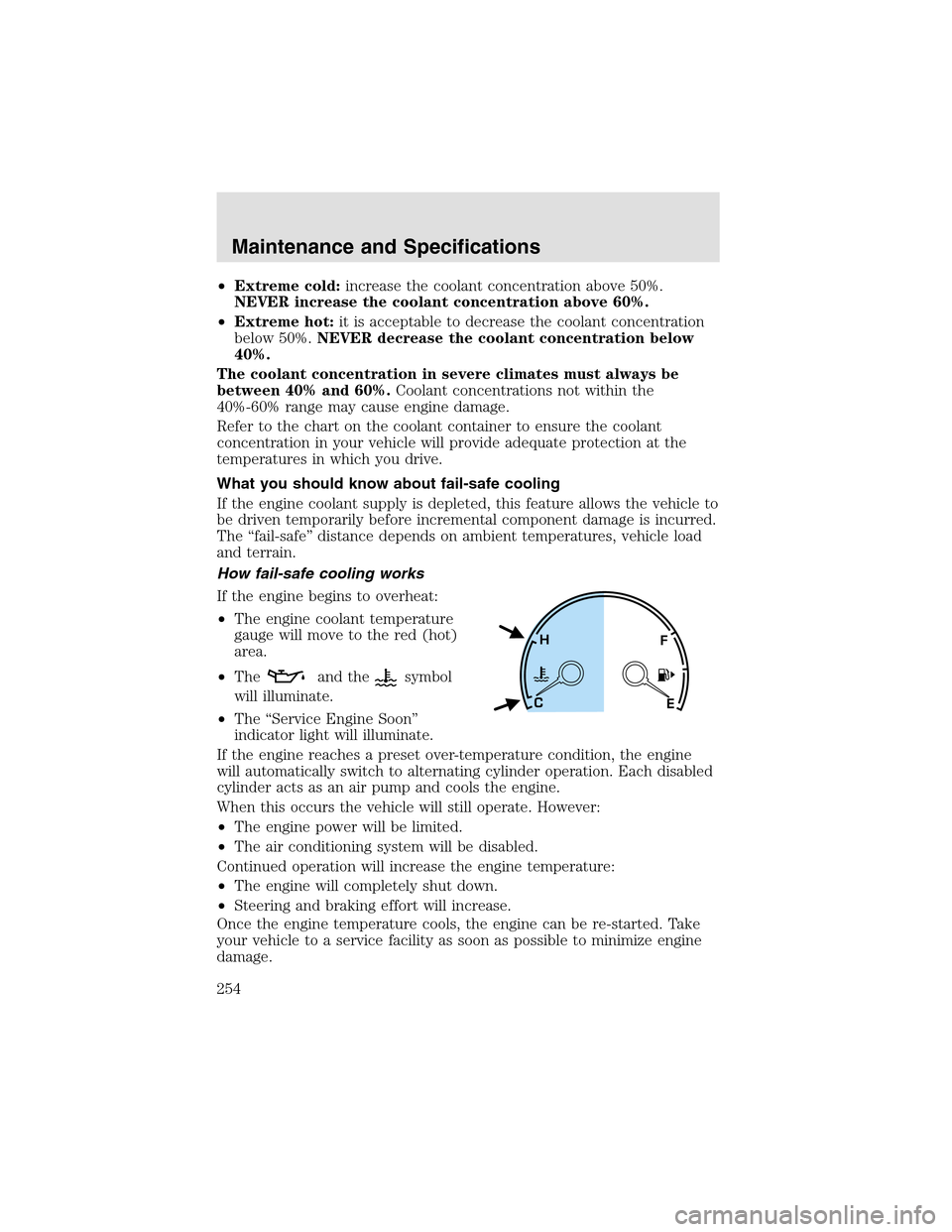
If the engine begins to overheat:
•The engine coolant temperature
gauge will move to the red (hot)
area.
•The
and thesymbol
will illuminate.
•The “Service Engine Soon”
indicator light will illuminate.
If the engine reaches a preset over-temperature condition, the engine
will automatically switch to alternating cylinder operation. Each disabled
cylinder acts as an air pump and cools the engine.
When this occurs the vehicle will still operate. However:
•The engine power will be limited.
•The air conditioning system will be disabled.
Continued operation will increase the engine temperature:
•The engine will completely shut down.
•Steering and braking effort will increase.
Once the engine temperature cools, the engine can be re-started. Take
your vehicle to a service facility as soon as possible to minimize engine
damage.
Maintenance and Specifications
254
Page 260 of 288
ESSENTIALS OF GOOD FUEL ECONOMY
Measuring techniques
Your best source of information about actual fuel economy is you, the
driver. You must gather information as accurately and consistently as
possible. Fuel expense, frequency of fill-ups or fuel gauge readings are
NOT accurate as a measure of fuel economy. We do not recommend
taking fuel economy measurements during the first 1,600 km (1,000
miles) of driving (engine break-in period). You will get a more accurate
measurement after 3,000 km–5,000 km (2,000 miles-3,000 miles).
Filling the tank
The advertised fuel capacity of the fuel tank on your vehicle is equal to
the rated refill capacity of the fuel tank as listed in theRefill capacities
section of this chapter.
The advertised capacity is the amount of the indicated capacity and the
empty reserve combined. Indicated capacity is the difference in the
amount of fuel in a full tank and a tank when the fuel gauge indicates
empty. Empty reserve is the small amount of fuel remaining in the fuel
tank after the fuel gauge indicates empty.
The amount of usable fuel in the empty reserve varies and should
not be relied upon to increase driving range. When refueling your
vehicle after the fuel gauge indicates empty, you might not be
able to refuel the full amount of the advertised capacity of the
fuel tank due to the empty reserve still present in the tank.
For consistent results when filling the fuel tank:
•Turn the engine/ignition switch to the off position prior to refueling,
an error in the reading will result if the engine is left running.
•Use the same filling rate setting (low — medium — high) each time
the tank is filled.
•Allow no more than 2 automatic click-offs when filling.
•Always use fuel with the recommended octane rating.
•Use a known quality gasoline, preferably a national brand.
•Use the same side of the same pump and have the vehicle facing the
same direction each time you fill up.
•Have the vehicle loading and distribution the same every time.
Your results will be most accurate if your filling method is consistent.
Calculating fuel economy
1. Fill the fuel tank completely and record the initial odometer reading
(in kilometers or miles).
Maintenance and Specifications
260


