2003 INFINITI G35 steering
[x] Cancel search: steeringPage 156 of 256
slippery surface. The brake LSD system
brakes the spinning wheel which distributes
the driving power to the other drive wheel. If
the vehicle is operated with the vehicle dynam-
ics control system turned off, all VDC and TCS
functions will be turned off. The brake LSD
system and ABS will still operate with the VDC
system off. If the brake LSD system or the ABS
is activated, the slip indicator light will blink and
you may hear a clunk noise and/or feel a
pulsation in the brake pedal. This is normal.
While the VDC system is operating, you may
feel a pulsation in the brake pedal and hear a
noise or vibration from under the hood. This is
normal and indicates that the VDC system is
working properly.
The computer has a built in diagnostic feature
that tests the system each time you start the
engine and move the vehicle forward or in
reverse at a slow speed. When the self-test
occurs, you may hear a clunk noise and/or feel
a pulsation in the brake pedal. This is normal
and is not an indication of a malfunction.
WARNINGO The vehicle dynamics control system
is designed to help improve driving stability but does not prevent acci-
dents due to abrupt steering opera-
tion at high speeds or by careless or
dangerous driving techniques. Re-
duce vehicle speed and be especially
careful when driving and cornering
on slippery surfaces and always drive
carefully.
O If suspension parts such as shock
absorbers, struts, springs and bush-
ings are not standard equipment or
are extremely deteriorated, the ve-
hicle dynamics control off indicator
light may come on.
O When driving on extremely inclined
surfaces such as higher banked cor-
ners, the vehicle dynamics control
system may not operate properly or
the vehicle dynamics control off indi-
cator light may come on. Do not drive
on these types of roads.
O If the tires other than the recom-
mended ones are used, the vehicle
dynamics control system may not op-
erate properly or the vehicle dynam- ics control off indicator light may
come on.
O The vehicle dynamics control system
is not a substitute for winter tires or
tire chains on a snow covered road.
5-22 Starting and driving
Z 02.7.29/V35-D/V5.0
X
Page 158 of 256

carried in the vehicle during winter:
O a scraper and stiff-bristled brush to remove
ice and snow from the windows and wiper
blades.
O a sturdy, flat board to be placed under the
jack to give it firm support.
O a shovel to dig the vehicle out of snow-
drifts.
O extra window washer fluid to refill the res-
ervoir tank.
DRIVING ON SNOW OR ICE
WARNINGO Wet ice (32ÉF, 0ÉC and freezing rain),
very cold snow or ice can be slick and
very hard to drive on. The vehicle will
have a lot less traction or grip under
these conditions. Try to avoid driving
on wet ice until the road is salted or
sanded.
O Whatever the condition, drive with
caution. Accelerate and slow down
with care. If accelerating or down-
shifting too fast, the drive wheels will lose even more traction.
O Allow more stopping distance under
these conditions. Braking should be
started sooner than on dry pavement.
O Allow greater following distances on
slippery roads.
O Watch for slippery spots (glare ice).
These may appear on an otherwise
clear road in shaded areas. If a patch
of ice is seen ahead, brake before
reaching it. Try not to brake while
actually on the ice, and avoid any
sudden steering maneuvers.
O Do not use cruise control on slippery
roads.
O Snow can trap dangerous exhaust
gases under your vehicle. Keep snow
clear of the exhaust pipe and from
around your vehicle.
ENGINE BLOCK HEATER (if so
equipped) An engine block heater to assist extreme cold
temperature starting is available through your
INFINITI retailer. WARNING Do not use your heater with an un-
grounded electrical system or two-
pronged (cheater) adapters. You can be
injured by an electrical shock if you use
an ungrounded connection.
5-24 Starting and driving
Z 02.7.29/V35-D/V5.0
X
Page 169 of 256
When towing your vehicle, all State (Provincial
in Canada) and local regulations for towing
must be followed. Incorrect towing equipment
could damage your vehicle. Towing instruc-
tions are available from an authorized INFINITI
retailer. Local service operators are generally
familiar with the applicable laws and proce-
dures for towing. To assure proper towing and
to prevent accidental damage to your vehicle,
INFINITI recommends having a service opera-
tor tow your vehicle. It is advisable to have the
service operator carefully read the following
precautions.
WARNINGO Never ride in a vehicle that is being
towed.
O Never get under your vehicle after it
has been lifted by a tow truck.
CAUTIONO When towing, make sure that the
transmission, axles, steering system and powertrain are in working condi-
tion. If any unit is damaged, dollies
must be used.
O Always attach safety chains before
towing.
If needed, Roadside Assistance is available.
Please see your Warranty Information Booklet
or Roadside Assistance I.D. Card for the toll-
free number to call (U.S.) or Warranty & Road-
side assistance information booklet (Canada).
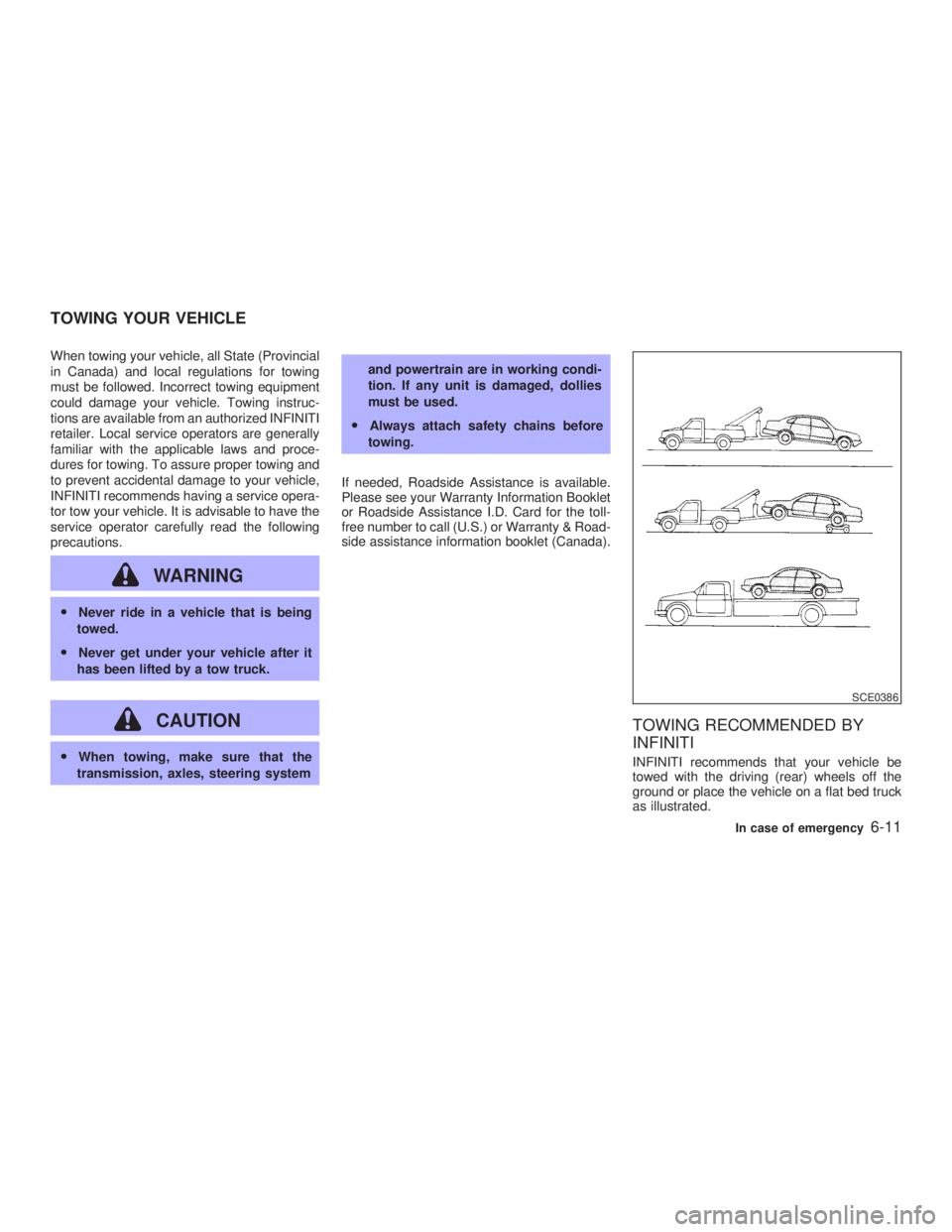
TOWING RECOMMENDED BY
INFINITI INFINITI recommends that your vehicle be
towed with the driving (rear) wheels off the
ground or place the vehicle on a flat bed truck
as illustrated. SCE0386TOWING YOUR VEHICLE
In case of emergency
6-11
Z 02.7.29/V35-D/V5.0
X
Page 170 of 256
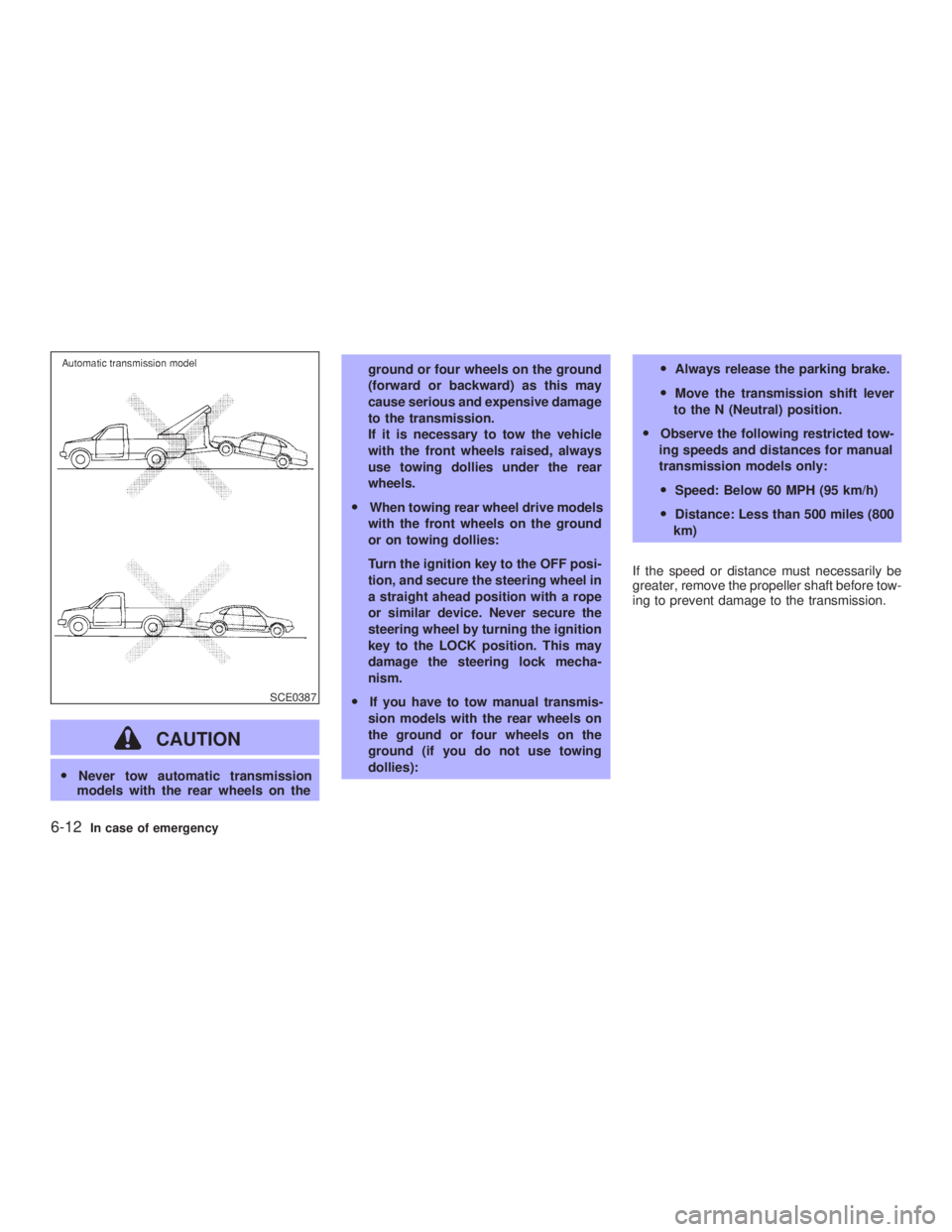
CAUTIONO Never tow automatic transmission
models with the rear wheels on the ground or four wheels on the ground
(forward or backward) as this may
cause serious and expensive damage
to the transmission.
If it is necessary to tow the vehicle
with the front wheels raised, always
use towing dollies under the rear
wheels.
O When towing rear wheel drive models
with the front wheels on the ground
or on towing dollies:
Turn the ignition key to the OFF posi-
tion, and secure the steering wheel in
a straight ahead position with a rope
or similar device. Never secure the
steering wheel by turning the ignition
key to the LOCK position. This may
damage the steering lock mecha-
nism.
O If you have to tow manual transmis-
sion models with the rear wheels on
the ground or four wheels on the
ground (if you do not use towing
dollies): O Always release the parking brake.
O Move the transmission shift lever
to the N (Neutral) position.
O Observe the following restricted tow-
ing speeds and distances for manual
transmission models only:
O Speed: Below 60 MPH (95 km/h)
O Distance: Less than 500 miles (800
km)
If the speed or distance must necessarily be
greater, remove the propeller shaft before tow-
ing to prevent damage to the transmission.SCE0387
6-12 In case of emergency
Z 02.7.29/V35-D/V5.0
X
Page 171 of 256
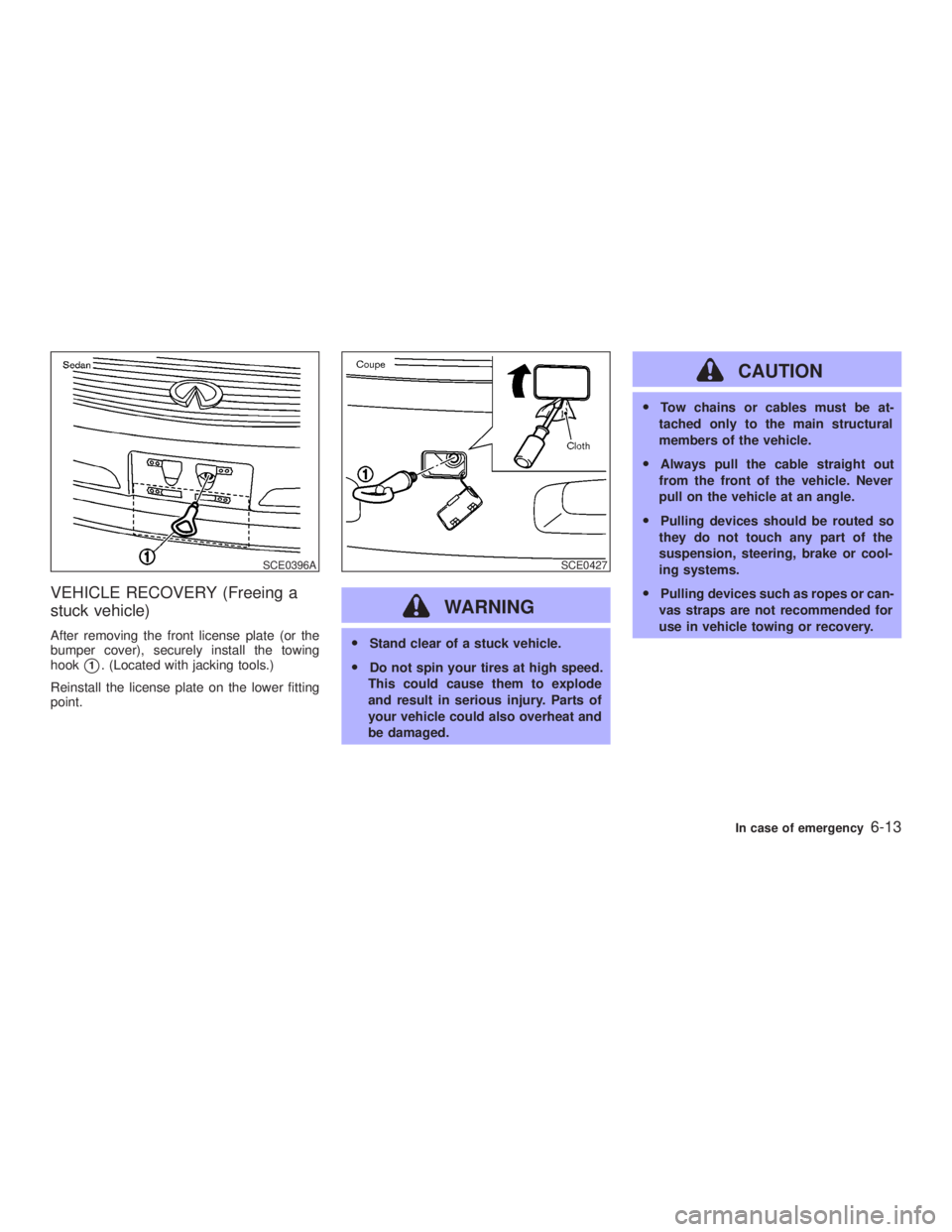
VEHICLE RECOVERY (Freeing a
stuck vehicle) After removing the front license plate (or the
bumper cover), securely install the towing
hook
j 1
. (Located with jacking tools.)
Reinstall the license plate on the lower fitting
point.
WARNING O Stand clear of a stuck vehicle.
O Do not spin your tires at high speed.
This could cause them to explode
and result in serious injury. Parts of
your vehicle could also overheat and
be damaged. CAUTION O Tow chains or cables must be at-
tached only to the main structural
members of the vehicle.
O Always pull the cable straight out
from the front of the vehicle. Never
pull on the vehicle at an angle.
O Pulling devices should be routed so
they do not touch any part of the
suspension, steering, brake or cool-
ing systems.
O Pulling devices such as ropes or can-
vas straps are not recommended for
use in vehicle towing or recovery.SCE0396A SCE0427
In case of emergency
6-13
Z 02.7.29/V35-D/V5.0
X
Page 179 of 256

8 Do-it-yourself Maintenance precautions .......................................... 8-2
Engine compartment check locations ....................... 8-4
Engine cooling system .............................................. 8-5
Checking engine coolant level ............................. 8-5
Changing engine coolant ..................................... 8-6
Engine oil .................................................................. 8-7
Checking engine oil level ..................................... 8-7
Changing engine oil and filter .............................. 8-8
Automatic transmission fluid ................................... 8-10
Power steering fluid ................................................ 8-10
Brake and clutch fluid ............................................. 8-11
Brake fluid .......................................................... 8-11
Clutch fluid.......................................................... 8-11
Window washer fluid ............................................... 8-12
Battery ..................................................................... 8-13
Jump starting ...................................................... 8-14
Drive belts ............................................................... 8-14
Spark plugs ............................................................. 8-15
Replacing spark plugs ........................................ 8-15
Air cleaner ............................................................... 8-16
Windshield wiper blades ......................................... 8-16
Cleaning ............................................................. 8-16
Replacing............................................................ 8-17 Parking brake and brake pedal ............................... 8-18
Checking parking brake ..................................... 8-18
Checking brake pedal ........................................ 8-18
Brake booster ..................................................... 8-19
Fuses....................................................................... 8-20
Engine compartment .......................................... 8-20
Passenger compartment .................................... 8-21
Keyfob battery replacement .................................... 8-21
Lights ....................................................................... 8-23
Headlights........................................................... 8-25
Exterior and interior lights .................................. 8-26
Wheels and tires ..................................................... 8-30
Tire pressure ...................................................... 8-30
Types of tires...................................................... 8-30
Tire chains .......................................................... 8-31
Changing wheels and tires ................................. 8-32
Z 02.7.29/V35-D/V5.0
X
Page 182 of 256

1. Fuse/fusible link holder
2. Battery
3. Engine oil filler cap
4. Brake fluid reservoir
5. Clutch fluid reservoir
6. Power steering fluid reservoir
7. Engine coolant reservoir
8. Windshield washer fluid reservoir
9. Radiator filler cap
10. Engine oil dipstick
11. Air cleaner
SDI1485ENGINE COMPARTMENT CHECK
LOCATIONS
8-4 Do-it-yourself
Z 02.7.29/V35-D/V5.0
X
Page 188 of 256

O Keep used engine oil out of reach of
children. If checking or replacement is required, we
recommend your INFINITI retailer for servic-
ing.
CAUTION O Use only Genuine Nissan ATF Matic
Fluid J. Do not mix with other fluids.
O Using automatic transmission fluid
other than Genuine Nissan ATF Matic
Fluid J will cause deterioration in
driveability and automatic transmis-
sion durability, and may damage the
automatic transmission, which is not
covered by the INFINITI new vehicle
limited warranty.
The specified automatic transmission fluid is
also described on caution labels located in the
engine compartment. Check the fluid level in the reservoir tank.
The fluid level should be checked using the
HOT range at fluid temperatures of 122 to
176ÉF (50 to 80ÉC) or using the COLD range at
fluid temperatures of 32 to 86ÉF (0 to 30ÉC).
CAUTION O Do not overfill.
O Use Genuine Nissan PSF II or equiva-
lent. SDI1408
AUTOMATIC TRANSMISSION
FLUID POWER STEERING FLUID
8-10 Do-it-yourself
Z 02.7.29/V35-D/V5.0
X