Page 233 of 280

Look f or any obvious coolant leaks,
such as a split radiator hose.
Everything is still extremely hot,
so use caution. If you f ind a leak, it
must be repaired bef ore you
continue driving (seeon page ). If you don’t f ind an obvious leak,
check the coolant level in the
radiator reserve tank (see page
). If the level is below the
MIN mark, add coolant to halfway
between the MIN and MAX marks. Using gloves or a large heavy
cloth, turn the radiator cap
counterclockwise, without pushing
down, to the f irst stop. This
releases any remaining pressure in
the cooling system. After the
pressure releases, push down on
the cap and turn it until it comes
of f .
If there was no coolant in the
reserve tank, you may also have to
add coolant to the radiator. Let the
engine cool down until the reading
reaches the middle of the
temperature gauge, or lower,
bef ore checking the radiator.
6.
7.9.
8.
245 124
Emergency
Towing
If Your Engine Overheats
T aking Care of t he Unexpect ed230
Removing the radiator cap
while the engine is hot can
cause the coolant to spray out,
seriously scalding you.
Always let the engine and
radiator cool down before
removing the radiator cap.
Page 234 of 280
Start the engine and set the
temperature control dial to
maximum. Add coolant to the
radiator up to the base of the f iller
neck. If you do not have the
proper coolant mixture available,
you can add plain water.
Remember to have the cooling
system drained and ref illed with
the proper mixture as soon as you
can.Put the radiator cap back on
tightly. Run the engine and watch
the temperature gauge. If it goes
back to the red mark, the engine
needs repair. (See
on page .) If the temperature stays normal,
check the coolant level in the
radiator reserve tank. If it has
gone down, add coolant to the
MAX mark. Put the cap back on
tightly.
10.
12.
11.
245Emergency
Towing
If Your Engine Overheats
T aking Care of t he Unexpect ed231
Page 235 of 280

This indicator should light when the
ignition switch is ON (II), and go out
af ter the engine starts. It should
never come on when the engine is
running. If it starts f lashing, it
indicates that the oil pressure
dropped very low f or a moment, then
recovered. If the indicator stays on
with the engine running, it shows
that the engine has lost oil pressure
and serious engine damage is
possible. In either case, you should
take immediate action.Start the engine and watch the oil
pressure indicator. If the light
does not go out within ten seconds,
turn of f the engine. There is a
mechanical problem that needs to
be repaired bef ore you can
continue driving. (See
on page .)
Saf ely pull of f the road and shut
of f the engine. Turn on the hazard
warning indicators.
If necessary, add oil to bring the
level back to the full mark on the
dipstick (see page ). Letthecarsitforaminute.Open
the hood and check the oil level
(see page ). Although oil level
and oil pressure are not directly
connected, an engine that is very
low on oil can lose pressure during
cornering and other driving
maneuvers.
1.
2.
3. 4.
123 161 245
Emergency
Towing
L ow Oil Pressure Indicator
T aking Care of t he Unexpect ed232
LOW OIL PRESSURE INDICATOR
Running the engine with low oil
pressure can cause serious mechanical
damage almost immediately. Turn of f
the engine as soon as you can saf ely get
the car stopped.
Page 239 of 280

If it comes on at any other time, it
indicates a problem with the car’s
brake system. In most cases, the
problem is a low f luid level in the
brake f luid reservoir. Press lightly on
the brake pedal to see if it f eels
normal. If it does, check the brake
f luid level the next time you stop at a
service station (see page ). If the
fluid level is low, take the car to your
dealer and have the brake system
inspected f or leaks or worn brake
pads.
However, if the brake pedal does not
f eel normal, you should take
immediate action. Because of the
brake system’s dual-circuit design, a
problem in one part of the system
will still give you braking at two
wheels. You will f eel the brake pedal
go down much f arther bef ore the car
begins to slow down, and you will
have to press harder on the pedal.
The distance needed to stop will be
much longer.
The Brake System Indicator
normallycomesonwhenyouturn
the ignition switch ON (II). It is a
reminder to check the parking brake.
It comes on and stays lit if you do not
f ully release the parking brake. Slow down by shif ting to a lower
gear, and pull to the side of the road
when it is saf e. Because of the
longer distance needed to stop, it is
hazardous to drive the car. You
should have it towed, and repaired as
soon as possible. (See
on page .)
If you must drive the car a short
distance in this condition, drive
slowly and cautiously.
174
245
Brake System Indicator
T aking Care of t he Unexpect ed
Emergency
Towing
236
BRAKE SYSTEM INDICATOR
Page 246 of 280
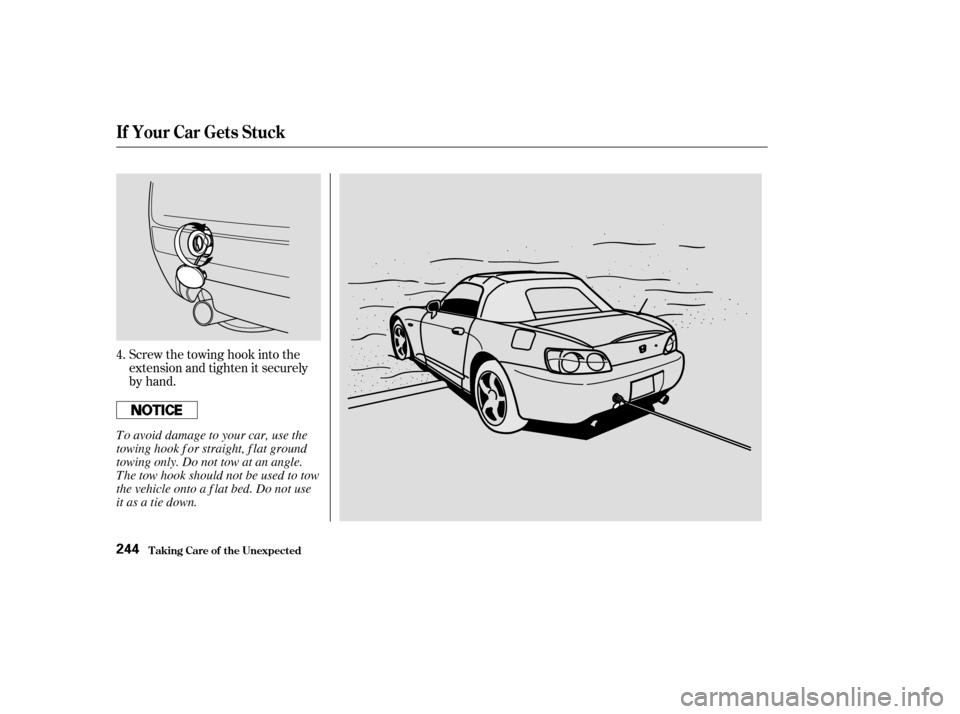
For very short distances, such as
freeing the car, you can use the
detachable towing hook that mounts
on the anchors in the front and rear
bumpers.Remove the cover f rom the
bumper.
To use the towing hook: Remove the towing hook, hook
extension, and wheel wrench f rom
the tool box.
Using the wheel wrench, f asten
the extension into the bolt hole in
the anchor.
If your car gets stuck in sand, mud,
or snow, call a towing service to pull
it out (see page ).
1.2.
3.
245
CONT INUED
If Your Car Gets Stuck
T aking Care of t he Unexpect ed243
Page 247 of 280
Screw the towing hook into the
extension and tighten it securely
by hand.
4.
If Your Car Gets Stuck
T aking Care of t he Unexpect ed244
To avoid damage to your car, use the
towing hook f or straight, f lat ground
towing only. Do not tow at an angle.
The tow hook should not be used to tow
the vehicle onto a f lat bed. Do not use
it as a tie down.
Page 248 of 280
�µ
�µ
If your car needs to be towed, call a
prof essional towing service or, if you
belong to one, an organization that
provides roadside assistance. Never
tow your car behind another vehicle
with just a rope or chain. It is very
dangerous.
There are three popular types of
prof essional towing equipment. The tow
truck uses two pivoting arms that go
under the tires (f ront or rear) and lif t
them of f the ground. The other two
tires remain on the ground. Because
the S2000 sits so low, the body could
come in contact with the ground and
be damaged.
The operator
loads your vehicle on the back of a
truck.
When you contact the towing agency,
inf orm them that you have an S2000
and that a f lat-bed is required.Wheel L if t Equipment
Flat -bed Equipment
T his method of
towing is unacceptable.
T his is the only way your
S2000 should be transported.
Emergency T owing
T aking Care of t he Unexpect ed245
Page 249 of 280
�µThe tow
truck uses metal cables with hooks
on the ends. These hooks go around
parts of the f rame or suspension and
the cables lif t that end of the car of f
the ground. Your car’s suspension
and body can be seriously damaged.Sling-t ype Equipment
T his method of towing is
unacceptable.
Emergency T owing
T aking Care of t he Unexpect ed246