Page 299 of 392
The f luid level should be between
theMINandMAXmarksontheside
of the reservoir. If the level is at or
below the MIN mark, your brake
system needs attention. Have the
brake system inspected f or leaks or
worn brake pads.
Always use Honda Heavy Duty
Brake Fluid DOT 3. If it is not
available, you should use only DOT 3
or DOT 4 f luid, f rom a sealed
container, as a temporary
replacement. However, the use of
any non-Honda brake fluid can cause
corrosion and decrease the lif e of the
system. Have the brake system
f lushed and ref illed with Honda
Heavy Duty Brake Fluid DOT 3 as
soon as possible.
Check the f luid level in the brake
f luid reservoir monthly.
Brake f luid marked DOT 5 is not
compatible with your vehicle’s
braking system and can cause
extensive damage.
The brake f luid should be replaced
according to the time recommenda-
tion in the maintenance schedule.
Brake System
Brake Fluid
Maint enance295
MAX
MIN
Page 318 of 392

When installing cables, f ollow the
manuf acturer’s instructions and
mount them as tightly as you can.
Drive slowly with them installed. If
youhearthemcomingincontact
with the body or chassis, stop and
investigate. Make sure the cables are
installed tightly, and that they are
not contacting the brake lines or
suspension. Remove them as soon asyou begin driving on cleared roads.
Metal link-type ‘‘chains’’ should not
be used. No matter how tight they
seem to be installed, they can come
into contact with the body and
suspension, causing serious damage.
If you mount snow tires on your
Honda, make sure they are radial
tires of the same size and load range
as the original tires. Mount snow
tiresonallfourwheelstobalance
your vehicle’s handling in all weather
conditions. Keep in mind the traction
provided by snow tires on dry roads
may not be as high as your vehicle’s
original equipment tires. You should
drive cautiously even when the roads
areclear.Checkwiththetiredealer
f or maximum speed recommenda-
tions. Because your Honda has limited tire
clearance, mount only SAE Class ‘‘S’’
cable-type traction devices, with
rubber chain tensioners, on the f ront
tires. Use traction devices only when
required by driving conditions or
local laws. Make sure they are the
correct size f or your tires.
Snow T ires
T ire Chains
Tires
Maint enance314
Traction devices that are the wrong
size or improperly installed can
damage your vehicle’s brake lines,
suspension, body, and wheels. Stop
driving if they are hitting any part of
the vehicle.
Page 320 of 392
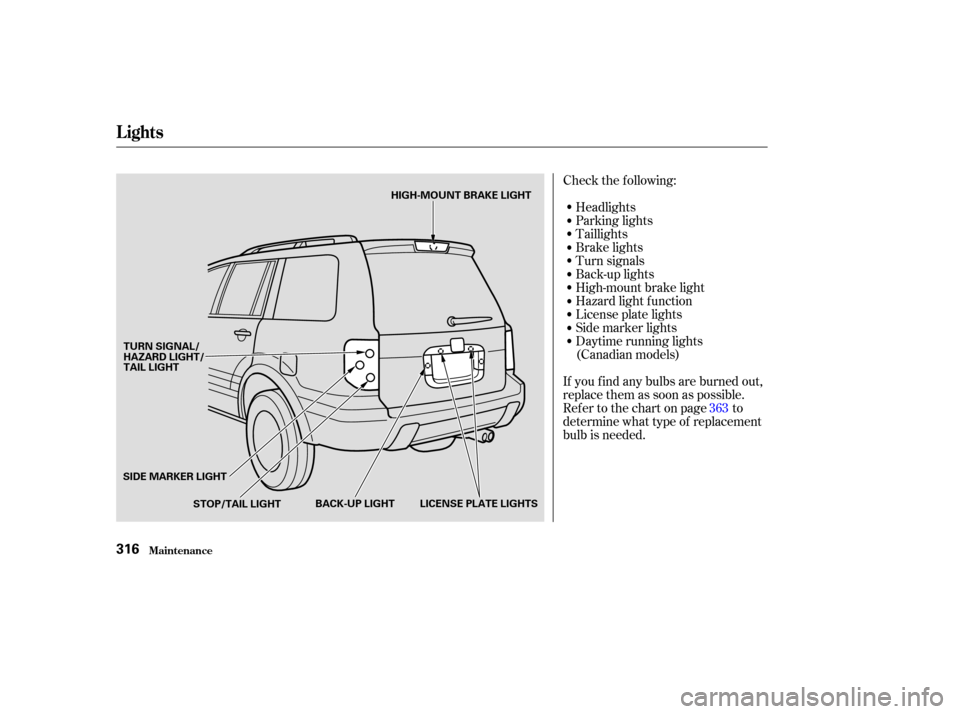
Check the f ollowing:Headlights
Parking lights
Taillights
Brake lights
Turn signals
Back-up lights
High-mount brake light
Hazard light f unction
License plate lights
Side marker lights
Daytime running lights
(Canadian models)
If you f ind any bulbs are burned out,
replace them as soon as possible.
Refer to the chart on page to
determine what type of replacement
bulb is needed. 363
Lights
Maint enance316
SIDE MARKER LIGHT
LICENSE PLATE LIGHTS
BACK-UP LIGHT
TURN SIGNAL/
HAZARD LIGHT/
TAIL LIGHT
STOP/TAIL LIGHT HIGH-MOUNT BRAKE LIGHT
Page 326 of 392
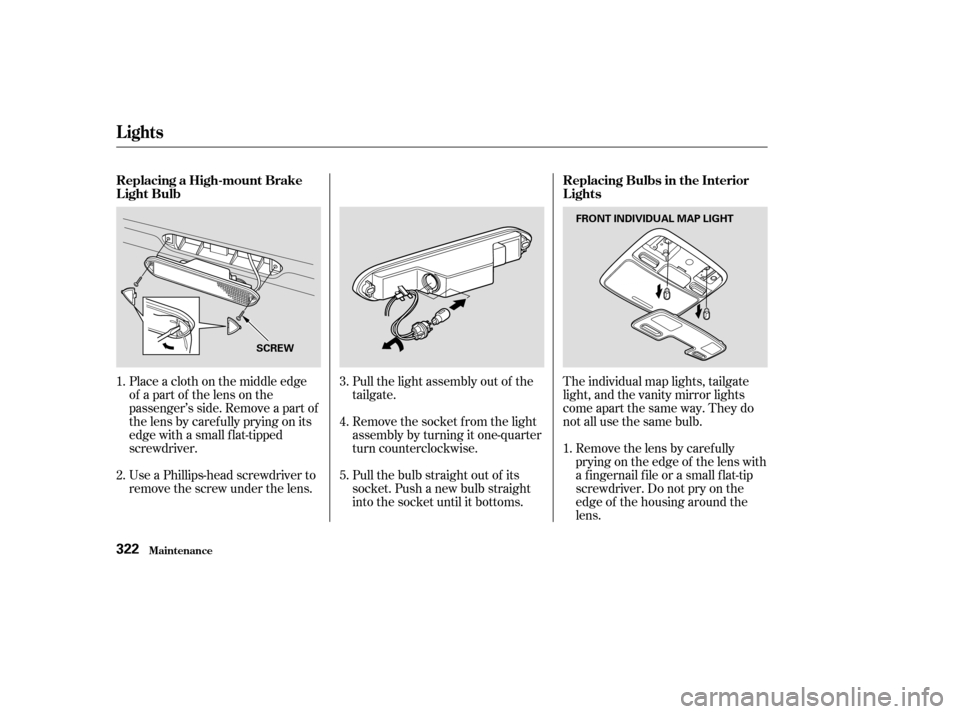
The individual map lights, tailgate
light, and the vanity mirror lights
come apart the same way. They do
not all use the same bulb.Removethelensbycarefully
prying on the edge of the lens with
a f ingernail f ile or a small f lat-tip
screwdriver. Do not pry on the
edge of the housing around the
lens.
Pull the light assembly out of the
tailgate.
Remove the socket f rom the light
assembly by turning it one-quarter
turn counterclockwise.
Pull the bulb straight out of its
socket. Push a new bulb straight
into the socket until it bottoms.
Place a cloth on the middle edge
of a part of the lens on the
passenger’s side. Remove a part of
the lens by caref ully prying on its
edge with a small f lat-tipped
screwdriver.
Use a Phillips-head screwdriver to
remove the screw under the lens.
1.
1.
2. 3.
4.
5.
Lights
Maint enance
Replacing Bulbs in the Interior
Lights
Replacing a High-mount Brake
Light Bulb
322
FRONT INDIVIDUAL MAP LIGHT
SCREW
Page 328 of 392

If you need to park your vehicle f or
an extended period (more than one
month), there are several things you
should do to prepare it f or storage.
Proper preparation helps prevent
deterioration and makes it easier to
get your vehicle back on the road. If
possible, store your vehicle indoors.Block the rear wheels.
If the vehicle is to be stored f or a
longer period, it should be
supported on jackstands so the
tires are of f the ground.
Leave one window open slightly (if
the vehicle is being stored
indoors).
Fill the f uel tank.
Change the engine oil and f ilter
(see page ).
Wash and dry the exterior
completely.
Cleantheinterior.Makesurethe
carpeting, floor mats, etc. are
completely dry.
Leave the parking brake off. Put
the transmission in Park. Support the f ront and rear wiper
blade arms with a f olded towel or
ragsotheydonottouchthe
windshield. Disconnect the battery.
To minimize sticking, apply a
silicone spray lubricant to all door
and tailgate seals. Also, apply a
vehiclebodywaxtothepainted
surfaces that mate with the door
and tailgate seals.Cover the vehicle with a
‘‘breathable’’ cover, one made
f rom a porous material such as
cotton. Nonporous materials, such
as plastic sheeting, trap moisture,
which can damage the paint.
If possible, run the engine f or a
while periodically (pref erably once
amonth).
If you store your vehicle f or 12
months or longer, have your Honda
dealer perf orm the inspections called
f or in the 24 months/30,000 miles
(48,000 km) maintenance schedule
(Normal Conditions) as soon as you
take it out of storage (see page ).
The replacements called f or in the
maintenance schedule are not
needed unless the vehicle has
actually reached that time or mileage.
285
274
St oring Your Vehicle
Maint enance324
Page 337 of 392

This section covers the more-
common problems that motorists
experience with their vehicles. It
gives you inf ormation about how to
safely evaluate the problem and what
to do to correct it. If the problem has
stranded you on the side of the road,
you may be able to get going again.
If not, you will also f ind instructions
on getting your vehicle towed.......................
Compact Spare Tire .334
....................
Changing a Flat Tire .335
..........
If Your Engine Won’t Start . 342
Nothing Happens or the Starter Motor Operates ........................
Very Slowly .342
The Starter Operates ................................
Normally .342
................................
Jump Starting .343
............
If Your Engine Overheats . 345
.........
Low Oil Pressure Indicator . 347
..........
Charging System Indicator . 348
.......
Malf unction Indicator Lamp . 349
...............
Brake System Indicator . 351
..............................................
Fuses .352
..........
Checking and Replacing . 353
......................
Emergency Towing .358
Taking Care of the Unexpected
T aking Care of t he Unexpect ed333
Page 339 of 392
If you have a f lat tire while driving,
stop in a saf e place to change it.
Stopping in traf f ic or on the shoulder
of a busy road is dangerous. Drive
slowly along the shoulder until you
gettoanexitoranareatostopthat
is far away from the traffic lanes.Turn on the hazard warning lights,
and turn the ignition switch to
LOCK (0). Have all the
passengers get out of the vehicle
while you change the tire.
Park the vehicle on f irm, level, and
non-slippery ground away f rom
traffic. Put the transmission in
Park. Apply the parking brake.
2.
1.
CONT INUED
Changing a Flat T ire
T aking Care of t he Unexpect ed335
JACK
SPARE TIRE
TOOLS
The vehicle can easily roll off
the jack, seriously injuring
anyone underneath.
Follow the directions for
changing a tire exactly, and
never get under the vehicle
when it is supported only by the
jack.
Page 343 of 392
CONT INUED
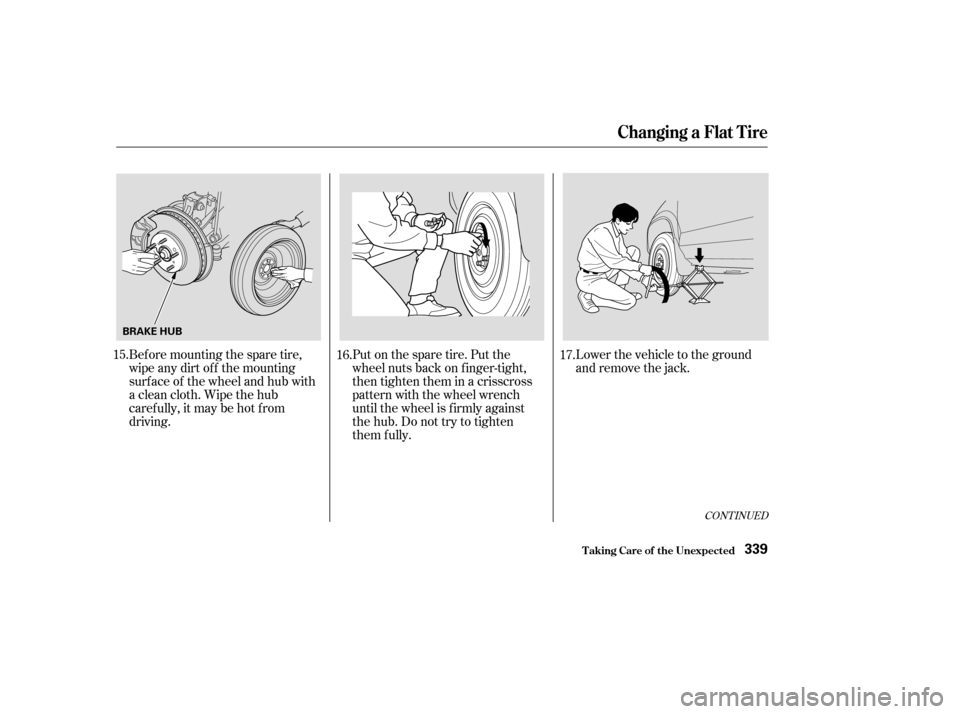
Bef ore mounting the spare tire,
wipeanydirtoff themounting
surface of the wheel and hub with
a clean cloth. Wipe the hub
carefully,itmaybehotfrom
driving.Put on the spare tire. Put the
wheel nuts back on f inger-tight,
then tighten them in a crisscross
pattern with the wheel wrench
until the wheel is f irmly against
the hub. Do not try to tighten
them f ully.Lower the vehicle to the ground
and remove the jack.
15.
16.17.
Changing a Flat T ire
T aking Care of t he Unexpect ed339
BRAKE HUB