Page 245 of 392

When the brake pads need replacing,
you will hear a distinctive metallic
‘‘screeching’’ sound when you apply
the brakes. If you do not have the
brake pads replaced, they will begin
screeching all the time.
Constant application of the brakes
when going down a long hill builds
up heat and reduces their ef f ective-
ness. Use the engine to assist the
brakes by downshif ting to a lower
gear and taking your f oot of f the
accelerator pedal.
Check your brakes af ter driving
through deep water. Apply the
brakes moderately to see if they f eel
normal. If not, apply them gently and
f requently until they do. Since a
longer distance is needed to stop
with wet brakes, be extra cautious
and alert in your driving.
Put your f oot on the brake pedal only
when you intend to brake. Resting
your f oot on the pedal keeps the
brakes applied lightly, causing them
to build up heat. Heat build-up can
reduce how well your brakes work. It
also keeps your brake lights on all
the time, conf using drivers behind
you. All f our brakes have audible brake
wear indicators.
Your Honda is equipped with disc
brakes at all f our wheels. A power
assist helps reduce the ef f ort needed
on the brake pedal. The ABS helps
you retain steering control when
braking very hard.
Your brakes may sometimes squeal
or squeak when you apply them
lightly. Do not conf use this with the
brake wear indicators. The
indicators make a very audible
‘‘screeching.’’ Brake Wear Indicators
The Braking System
Driving241
Page 246 of 392

You will f eel a pulsation in the brake
pedal when the ABS activates, and
you may hear some noise. This is
normal; it is the ABS rapidly
pumping the brakes.this defeats the
purpose of the ABS. Let the ABS
work f or you by always keeping f irm,
steady pressure on the brake pedal
as you steer away from the hazard.
This is sometimes ref erred to as
Activation varies with the amount of
traction your tires have. On dry
pavement, you will need to press on
thebrakepedalveryhardbeforeyou
activate the ABS. However, you may
feel the ABS activate immediately if
you are trying to stop on snow or ice.
Your vehicle has an Anti-lock Brake
System (ABS) as standard
equipment. ABS helps to prevent the
wheels f rom locking up and skidding
during hard braking, allowing you to
retain steering control.
When the f ront tires skid, you lose
steering control; the vehicle
continues straight ahead even
though you turn the steering wheel.
The ABS helps to prevent lock-up
and helps you retain steering control
by pumping the brakes rapidly; much
f aster than a person can do it.
The hydraulic system that operates
the brakes has two separate circuits.
Each circuit works diagonally across
the vehicle (the lef t-f ront brake is
connected with the right-rear brake,
etc.). If one circuit should develop a
problem, you will still have braking
at two wheels.
The ABS also balances the f ront-to
rear braking distribution according
to vehicle loading.
‘‘stomp and steer.’’
You should never pump the
brake pedal;
Anti-lock Brakes
Brake System Design
The Braking System
Driving242
Front
Page 247 of 392
�Î
�Îon loose or
uneven surf aces, such as gravel or
snow, than a vehicle without anti-
lock. Slow down and allow a greater
distance between vehicles under
those conditions.
Always steer moderately
when you are braking hard. Severe
or sharp steering wheel movement
can still cause your vehicle to veer
into oncoming traffic or off the road. such as trying to take a
corner too f ast or making a sudden
lane change. Always drive at a safe,
prudent speed f or the road and
weather conditions. it only helps with steering
control during braking. You should
always maintain a saf e f ollowing
distance f rom other vehicles.
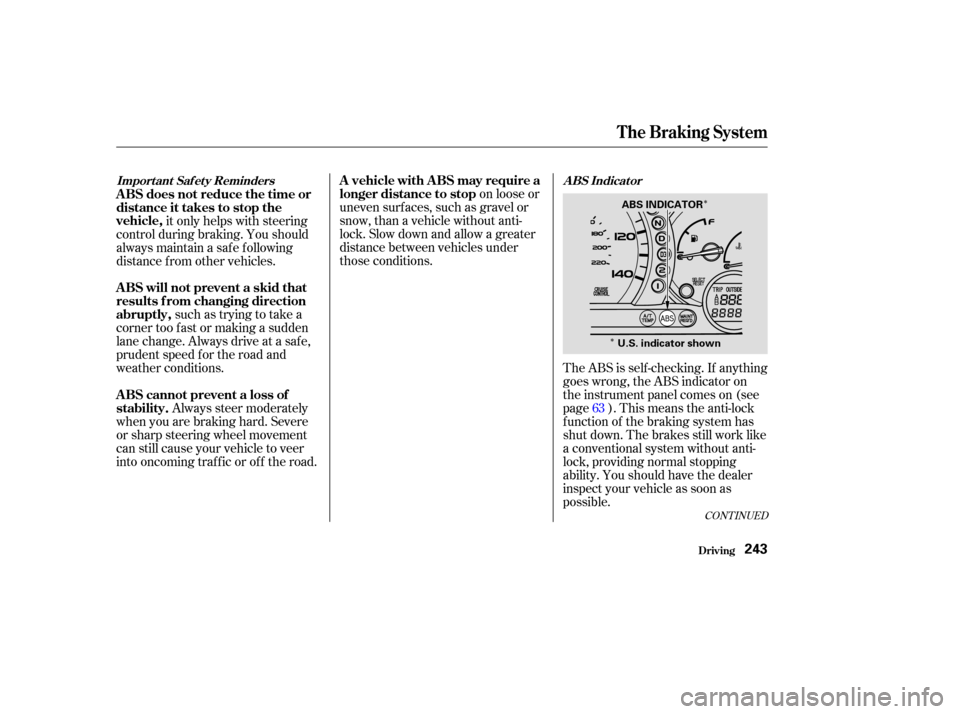
The ABS is self -checking. If anything
goes wrong, the ABS indicator on
the instrument panel comes on (see
page ). This means the anti-lock
f unction of the braking system has
shut down. The brakes still work like
a conventional system without anti-
lock, providing normal stopping
ability. You should have the dealer
inspect your vehicle as soon as
possible.63
CONT INUED
A BS Indicat or
Import ant Saf et y RemindersA vehicle with A BS may require a
longer distance to stop
A BS cannot prevent a loss of
stability. A BS will not prevent a skid that
results f rom changing direction
abruptly, A BS does not reduce the time or
distance it takes to stop the
vehicle,
The Braking System
Driving243
ABS INDICATOR
U.S. indicator shown
Page 248 of 392
If the ABS indicator and the brake
system indicator come on together,
and the parking brake is f ully
released, the front-to-rear braking
distribution system may also shut
down.
Test your brakes as instructed on
page . If the brakes f eel normal,
drive slowly and have your vehicle
repaired by your dealer as soon as
possible. Avoid sudden hard braking
which could cause the rear wheels to
lock up and possibly lead to a loss of
control.351
The Braking System
Driving244
Page 249 of 392

�µ�µAlways drive
slower than you would in dry
weather. It takes your vehicle longer
to react, even in conditions that may
seem just barely damp. Apply
smooth, even pressure to all the
controls. Abrupt steering wheel
movements or sudden, hard appli-
cation of the brakes can cause loss of
control in wet weather. Be extra
cautious f or the f irst f ew miles
(kilometers) of driving while you
adjust to the change in driving
conditions. This is especially true in
snow. A person can f orget some
snow-driving techniques during the
summer months. Practice is needed
to relearn those skills.
Exercise extra caution when driving
in rain af ter a long dry spell. Af ter
months of dry weather, the f irst
rains bring oil to the surf ace of the
roadway, making it slippery.
Rain, f og, and snow conditions re-
quire a dif f erent driving technique
because of reduced traction and
visibility. Keep your vehicle well-
maintained and exercise greater
caution when you need to drive in
bad weather. The cruise control
should not be used in these condi-
tions. Being able to see
clearly in all directions and being
visible to other drivers are important
in all weather conditions. This is
more dif f icult in bad weather. To be
seen more clearly during daylight
hours, turn on your headlights.
Inspect your windshield wipers and
washers f requently. Keep the wind-
shield washer reservoir f ull of the
proper f luid. Have the windshield
wiper blades replaced if they start to
streak the windshield or leave parts
unwiped. Use the def rosters and air
conditioning to keep the windows
f rom f ogging up on the inside (see
page ). 125
CONT INUED
Driving T echnique Visibility
Driving in Bad Weather
Driving245
Page 258 of 392
There are two common types of
trailer brakes: surge and electric.
Surge brakes are common f or boat
trailers, since the brakes will get wet.
Electric brakes must be
electronically actuated. Do not
attempt to tap into your vehicle’s
hydraulic system. Any attempt to
attach trailer brakes to your vehicle’s
hydraulic system will lower braking
ef f ectiveness and create a potential
hazard. Honda requires that any trailer with
a total trailer weight of 1000 lbs (455
kg) or more have its own brakes.
See your brake manuf acturer f or
more inf ormation on installing
electric brakes.
Trailer Brakes
Towing a Trailer
Driving254
Page 259 of 392
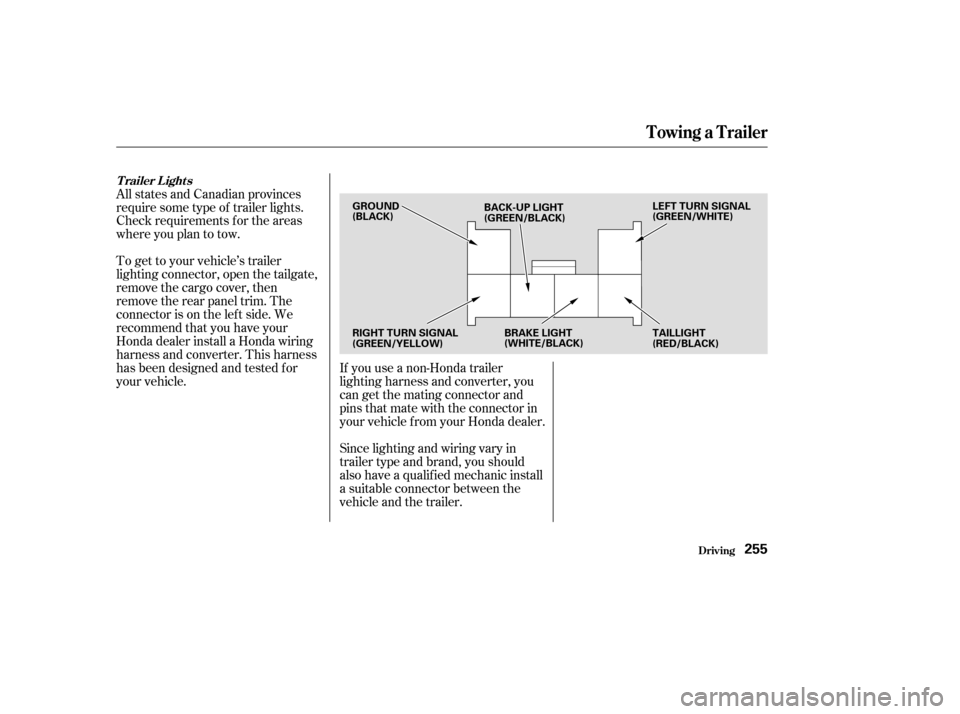
Since lighting and wiring vary in
trailer type and brand, you should
also have a qualif ied mechanic install
a suitable connector between the
vehicleandthetrailer.
All states and Canadian provinces
require some type of trailer lights.
Check requirements f or the areas
where you plan to tow.
To get to your vehicle’s trailer
lighting connector, open the tailgate,
remove the cargo cover, then
remove the rear panel trim. The
connector is on the lef t side. We
recommend that you have your
Honda dealer install a Honda wiring
harness and converter. This harness
has been designed and tested f or
your vehicle.
If you use a non-Honda trailer
lighting harness and converter, you
cangetthematingconnectorand
pins that mate with the connector in
your vehicle f rom your Honda dealer.
T railer L ights
Towing a Trailer
Driving255
GROUND
(BLACK)
BACK-UP LIGHT
(GREEN/BLACK) LEFT TURN SIGNAL
(GREEN/WHITE)
RIGHT TURN SIGNAL
(GREEN/YELLOW) BRAKE LIGHT
(WHITE/BLACK)
TAILLIGHT
(RED/BLACK)
Page 260 of 392

Many states and provinces require
special exterior mirrors when towing
a trailer. Even if they don’t, you
should install special mirrors if you
cannot clearly see behind you, or if
the trailer creates a blind spot.
We also recommend that you carry a
f ull-size spare wheel and tire f or your
trailer. Ask your trailer sales or
rental agency where and how to
store the spare. See page f or proper tire size,
page f or how to store a f ull-sized
wheel and tire, and page for
inf ormation on changing a f lat tire.
Remember to unhitch the trailer
bef ore changing a f lat.When preparing to tow, and bef ore
driving away, be sure to check the
f ollowing:
The vehicle has been properly
serviced, and the brakes,
suspension, and cooling system
are in good operating condition. If
you tow f requently, f ollow the
Severe Conditions maintenance
schedule. The lights and brakes on your
vehicle and the trailer are working
properly.
Your vehicle tires and spare are in
good condition and properly
inf lated (see page ).
The trailer tires and spare are in
good condition and inf lated as
recommended by the trailer
maker.
When towing a trailer, we
recommend that you carry a f ull-size
spare wheel and tire f or your vehicle.
Using the compact spare that came
with the Pilot may adversely affect
vehicle handling.
Allitemsonandinthetrailerare
properly secured and cannot shif t
while you drive. Thehitch,safetychains,andany
other attachments are secure. All weights and loads are within
limits (see pages and ). The trailer has been properly
serviced and is in good condition.Towing perf ormance can be
af f ected by high altitude, high
temperature, or climbing steep
grades. Theref ore, premium
f uel is recommended when
towing more than 3,500 lbs
(1,590 kg).
313
340 335 308
247 249
Trailer Mirrors Spare TiresPre-T ow Checklist
Towing a Trailer
Driving256