Page 264 of 392
Replace the transmission fluid every
two years or 30,000 miles (48,000
km), whichever comes f irst.
Towing Your Vehicle Behind a Motorhome
Driving260
The steering system can be damaged if
the steering wheel is locked. Leave the
ignition switch in Accessory (I), and
make sure the steering wheel turns
f reely bef ore you begin towing.
Improper towing preparation will
damage the transmission. Follow the
above procedure exactly. If you cannot
shif t the transmission or start the
engine, your vehicle must be
transported on a f lat-bed or trailer.
Page 267 of 392

The f ollowing pages contain practical
tips on basic of f -highway operation.
Driving of f -highway can be hard on a
vehicle. Bef ore you leave the
pavement, be sure all scheduled
maintenance and service has been
done, and that you have inspected
your vehicle. Pay special attention to
the condition of the tires, and use a
gauge to check the tire pressures.Of f -highway, the general rule is to
keep your speed low. Of course,
you’ll need enough speed to keep
moving forward. But at higher
speeds, you have less time to assess
conditions and make good decisions.
There’s also a greater chance of
sliding if you brake or turn too
quickly on wet soil, gravel, or ice. In
any situation, never go f aster than
conditions allow.Generally, the best of f -pavement
braking technique is to gently
depress the brake pedal, then
increase pressure as more braking is
needed. Avoid hard braking. Keep in
mind that you will usually need more
time and distance to brake to a stop
on unpaved surf aces.
After you return to the pavement,
caref ully inspect your vehicle to
make sure there is no damage that
could make driving it unsaf e. Check
the tires for damage and for proper
pressure. If you need to brake hard because of
an emergency, apply steady, even
pressure to the brake pedal. Do not
pump the brakes; let the anti-lock
braking system pump them f or you.
If you pump the brakes, the anti-lock
cannot work as ef f iciently, and your
stopping distance may be increased.
Forbettertractiononallsurfaces,
accelerate slowly and gradually build
up speed. If you try to start too fast
on wet soil, mud, snow, or ice, you
might not have enough traction to
get underway. You may even dig
yourself into a hole. Starting with the
shif t lever in second gear (2) will
help get you to a smooth start on
snow and ice.
CONT INUED
Cont rolling Speed
Check Out Your Vehicle
A ccelerat ing and BrakingDriving T ips
Off-Highway Guidelines
Driving263
Page 269 of 392
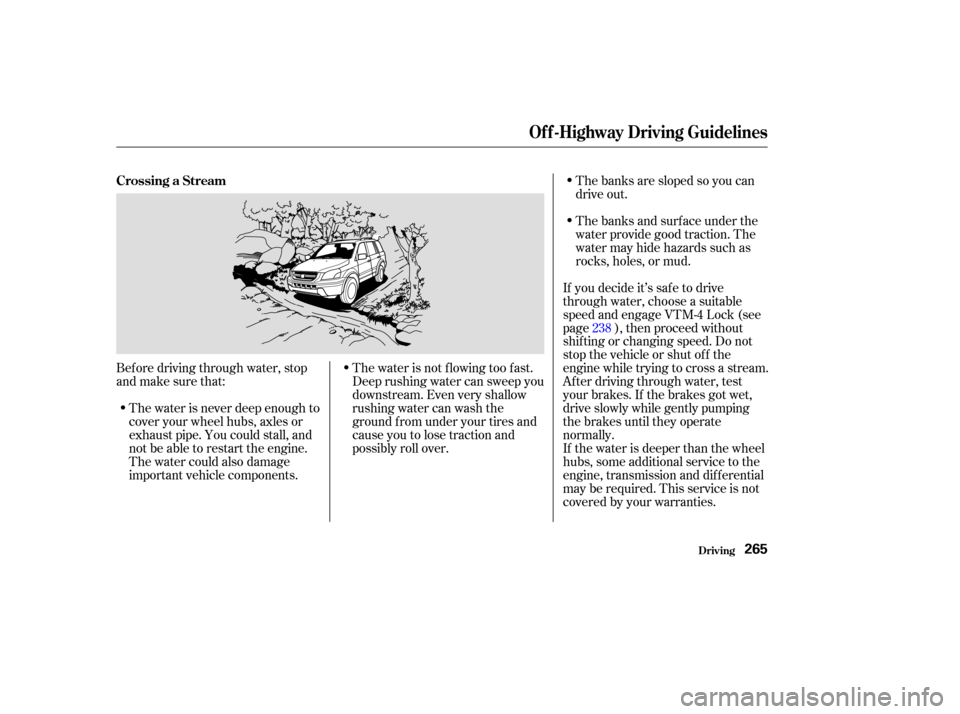
Bef ore driving through water, stop
and make sure that:The water is never deep enough to
cover your wheel hubs, axles or
exhaust pipe. You could stall, and
not be able to restart the engine.
The water could also damage
important vehicle components. The water is not f lowing too f ast.
Deep rushing water can sweep you
downstream. Even very shallow
rushingwatercanwashthe
ground f rom under your tires and
cause you to lose traction and
possibly roll over.The banks are sloped so you can
drive out.
The banks and surf ace under the
water provide good traction. The
water may hide hazards such as
rocks, holes, or mud.
If you decide it’s saf e to drive
through water, choose a suitable
speed and engage VTM-4 Lock (see
page ), then proceed without
shif ting or changing speed. Do not
stop the vehicle or shut of f the
engine while trying to cross a stream.
After driving through water, test
your brakes. If the brakes got wet,
drive slowly while gently pumping
the brakes until they operate
normally.
If the water is deeper than the wheel
hubs, some additional service to the
engine, transmission and dif f erential
mayberequired.Thisserviceisnot
covered by your warranties. 238
Crossing a Stream
Of f -Highway Driving Guidelines
Driving265
Page 270 of 392
If you get stuck, engage the VTM-4
Lock mode (see page ).
Caref ully try to go in the direction
(f orward or reverse) that you think
will give you the best chance of
getting unstuck.
Donotspinthetiresathighspeeds.
It will not help you get out and may
cause damage to the transmission or
the VTM-4 system.You should never use a jack to try
getting unstuck. A jack only works
on f irm, level ground. Also, your
vehicle could easily slip of f the jack
and hurt you or someone else.
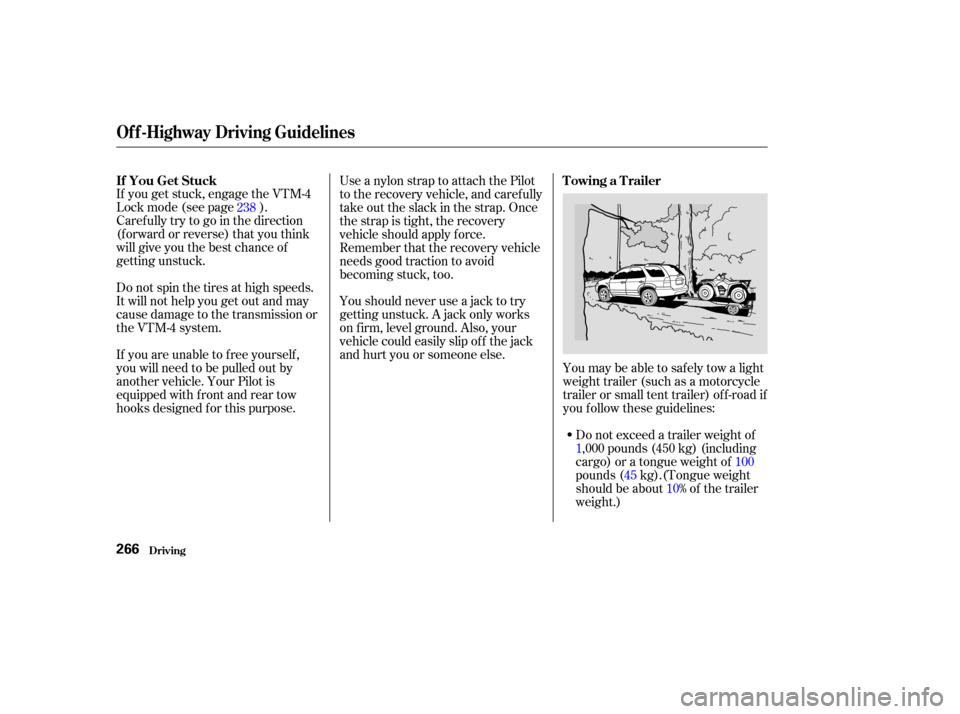
You may be able to saf ely tow a light
weight trailer (such as a motorcycle
trailer or small tent trailer) of f -road if
you f ollow these guidelines:
Do not exceed a trailer weight of
1,000 pounds (450 kg) (including
cargo) or a tongue weight of 100
pounds ( 45kg).(Tongue weight
should be about 10% of the trailer
weight.)
If you are unable to f ree yourself ,
you will need to be pulled out by
another vehicle. Your Pilot is
equipped with f ront and rear tow
hooks designed f or this purpose. Use a nylon strap to attach the Pilot
to the recovery vehicle, and caref ully
take out the slack in the strap. Once
the strap is tight, the recovery
vehicle should apply f orce.
Remember that the recovery vehicle
needs good traction to avoid
becoming stuck, too.
238
If You Get Stuck
T owing a T railer
Of f -Highway Driving Guidelines
Driving266
Page 280 of 392

�µ
�µ
�Î
�Î
�Î�Ì
�Ì �Ì
�Ì�Î
�Ì
�Î
�Î
Follow the Maintenance
Schedule f or Severe Conditions.
Driving less than 5 miles (8 km)
per trip or, in f reezing
temperatures, driving less than
10 miles (16 km) per trip.
Driving in extremely hot [over
90°F (32°C)] conditions.
Extensive idling or long periods
of stop-and-go driving.
Trailer towing, driving with a
roof top carrier, or driving in
mountainous conditions.
Driving on muddy, dusty, or de-
iced roads.
Follow the Severe Conditions
Maintenance Schedule if you drive
your vehicle
MAINLYunder one or
more of the f ollowing conditions:
Maint enance
U.S. Owners
Canadian Owners
276
Visually inspect the following items: Replace every 3,750 miles (6,000 km) or 6 months
Service at the indicated
distance or time whichever
comes first.
miles x 1,000
km x 1,000
months
Inspect every 7,500 miles (12,000 km) or 6 monthsCheck oil and coolant at each fuel stop
Rotate tires every 7,500 miles (12,000 km)
Tie rod ends, steering gear box, and boots
Suspension components
Driveshaft boots
Brake hoses and lines (including ABS)
All fluid levels and conditions of fluids
Cooling system hoses and connections
Exhaust system
Fuel lines and connections
Lights and controls
Vehicle underbody Every 7,500 miles (12,000 km) or 6 months
15
24
12
30
48
2445
72
3660
96
4875
120 60 90
144 72 105
168
84 120
192
96
Follow this schedule for rear differential
fluid replacement if you use your vehicle
for off-highway driving, trailer towing,
or mainly in stop-and go driving.
Otherwise, use the fluid replacement
schedule in the Maintenance Schedule
for Normal Conditions.
Every 3 years (independent of mileage)
120,000 miles (192,000 km) or 10 years, then every
60,000 miles (96,000 km) or 5 years
Replace engine oil and oil filter
Check engine oil and coolant
Replace air cleaner element
Use normal schedule except in dusty
conditions
Inspect valve clearance
Replace spark plugs
Replace timing belt and inspect water pump
Inspect and adjust drive belts
Inspect idle speed
Replace engine coolant
Replace transmission fluid
Replace VTM-4 rear differential fluid
Inspect front and rear brakes
Replace brake fluid
Check parking brake adjustment
Replace dust and pollen filter
Lubricate all hinges, locks and latches
Rotate tires (Check tire inflation and condition at
least once per month) 7.5
12 6
Adjust only if noisy
Refer to page308for replacement
information under special driving
conditions.
Refer to page 307for replacement
information under special driving
conditions.
1:
2:
3:
: See page 273.
,1
3
2
Maintenance Schedule for Severe Conditions
Page 281 of 392
�µ�Ø
�µ
�Ø
�Ø
�Ø
�Ø
�Ø
�Ø
�Ø
�Ø
�Ø
�Ø
�Ø
�Ø
�Ø
�Ø
�Ø
�Ø
�Ø
�Ø
�Ø
�Ø
�Î
�Ì�Ì
�Î
�Î
CONT INUED
Maint enance277
A, B, C, D, E
Canadian Owners U.S. Owners
B
C A
D
E
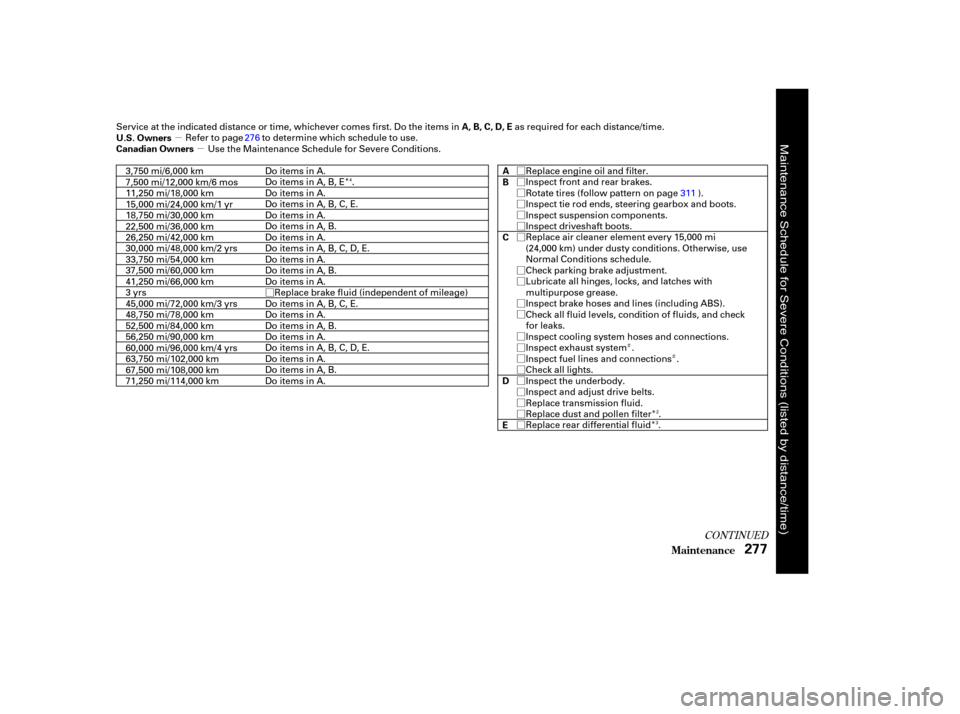
Service at the indicated distance or time, whichever comes first. Do the items in
as required for each distance/time.
Use the Maintenance Schedule for Severe Conditions.
3,750 mi/6,000 km
7,500 mi/12,000 km/6 mos
11,250 mi/18,000 km
15,000 mi/24,000 km/1 yr
18,750 mi/30,000 km
22,500 mi/36,000 km
26,250 mi/42,000 km
30,000 mi/48,000 km/2 yrs
33,750 mi/54,000 km
37,500 mi/60,000 km
41,250 mi/66,000 km
3yrs
45,000 mi/72,000 km/3 yrs
48,750 mi/78,000 km
52,500 mi/84,000 km
56,250 mi/90,000 km
60,000 mi/96,000 km/4 yrs
63,750 mi/102,000 km
67,500 mi/108,000 km
71,250 mi/114,000 km Do items in A.
DoitemsinA,B,E .
Do items in A.
DoitemsinA,B,C,E.
Do items in A.
Do items in A, B.
Do items in A.
DoitemsinA,B,C,D,E.
Do items in A.
Do items in A, B.
Do items in A.
Replace brake fluid (independent of mileage)
DoitemsinA,B,C,E.
Do items in A.
Do items in A, B.
Do items in A.
DoitemsinA,B,C,D,E.
Do items in A.
Do items in A, B.
Do items in A.
Refer to page to determine which schedule to use.
Replace engine oil and filter.
Inspect front and rear brakes.
Rotate tires (follow pattern on page311).
Inspect tie rod ends, steering gearbox and boots.
Inspect suspension components.
Inspect driveshaft boots.
Replace air cleaner element every 15,000 mi
(24,000 km) under dusty conditions. Otherwise, use
Normal Conditions schedule.
Check parking brake adjustment.
Lubricate all hinges, locks, and latches with
multipurpose grease.
Inspect brake hoses and lines (including ABS).
Check all fluid levels, condition of fluids, and check
for leaks.
Inspect cooling system hoses and connections.
Inspect exhaust system .
Inspect fuel lines and connections .
Check all lights.
Inspect the underbody.
Inspect and adjust drive belts.
Replace transmission fluid.
Replace dust and pollen filter .
Replace rear differential fluid .
276
4
2
3
Maintenance Schedule for Severe Conditions (listed by distance/time)
Page 292 of 392
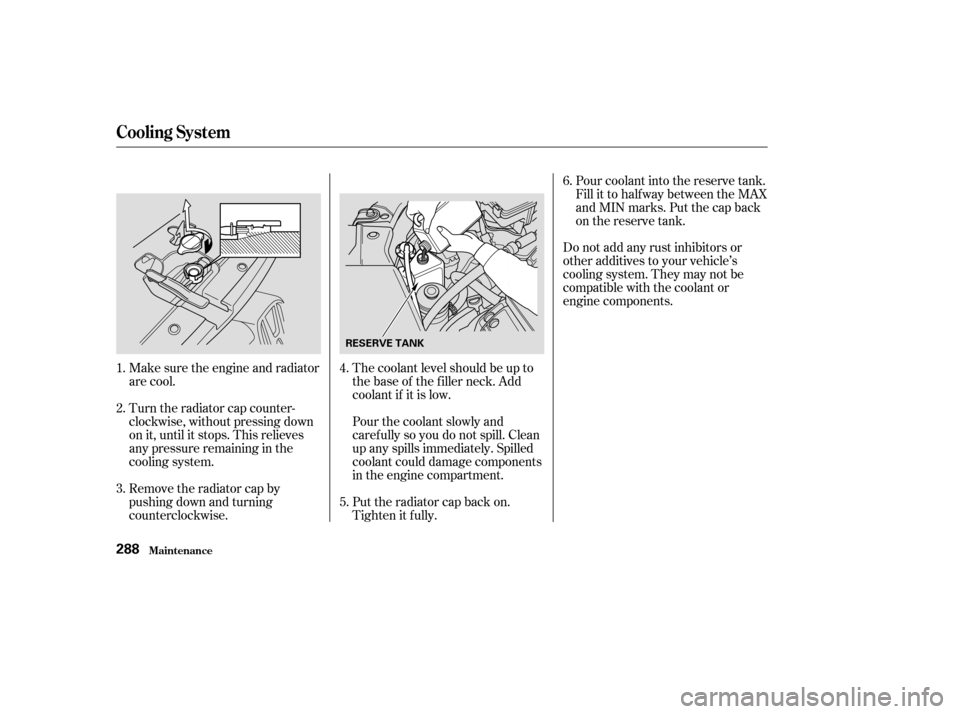
Make sure the engine and radiator
are cool.
Turn the radiator cap counter-
clockwise, without pressing down
on it, until it stops. This relieves
any pressure remaining in the
cooling system.
Remove the radiator cap by
pushing down and turning
counterclockwise.The coolant level should be up to
the base of the f iller neck. Add
coolant if it is low.Do not add any rust inhibitors or
other additives to your vehicle’s
cooling system. They may not be
compatible with the coolant or
engine components.
Pour coolant into the reserve tank.
Fill it to half way between the MAX
and MIN marks. Put the cap back
on the reserve tank.
Pourthecoolantslowlyand
caref ully so you do not spill. Clean
up any spills immediately. Spilled
coolant could damage components
in the engine compartment.
Put the radiator cap back on.
Tighten it f ully.
3. 4.
5.6.
1.
2.
Cooling Syst em
Maint enance288
RESERVE TANK
Page 294 of 392
When the coolant stops draining,
tightenthedrainplugatthe
bottom of the radiator.
Tighten the drain bolt at the rear
of the engine cylinder block
securely.
Tightening torque:
Remove the reserve tank f rom its
holder by pulling it straight up.
Drain the coolant, then put the
tank back in its holder.
Install a rubber hose on the drain
bolt in the back of the engine
block. Loosen the drain bolt. 6.
4. 5. 7.
Cooling Syst em
Maint enance290
DRAIN BOLT
RESERVE TANK
HOLDER RESERVE
TANK CAP
7 lbf·ft (10 N·m , 1.0 kgf·m)