Page 303 of 415
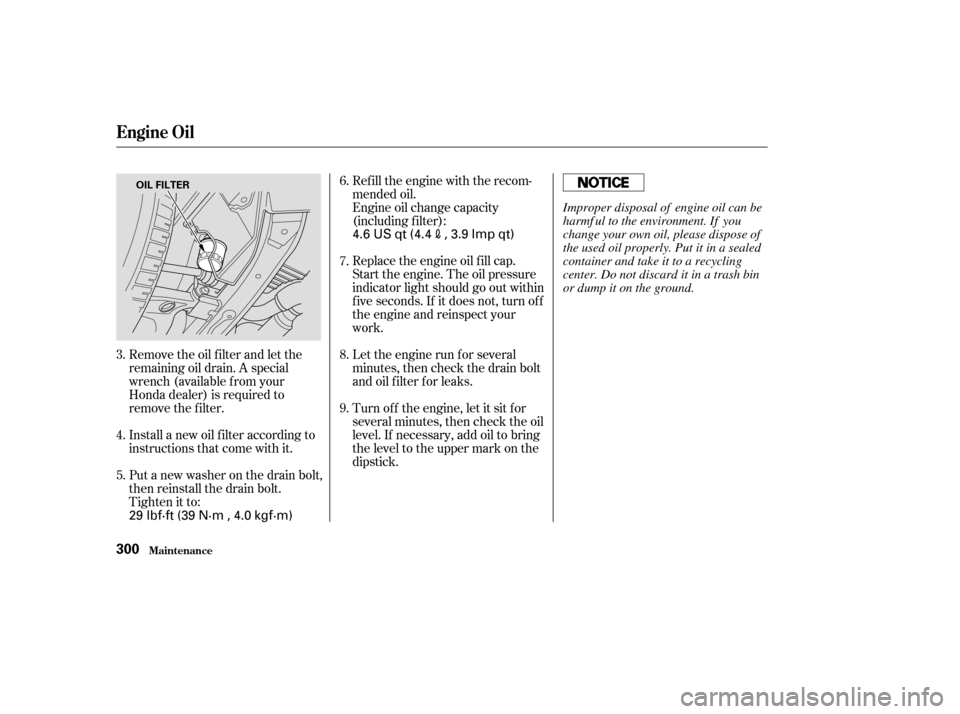
Remove the oil f ilter and let the
remaining oil drain. A special
wrench (available from your
Honda dealer) is required to
remove the f ilter.
Install a new oil f ilter according to
instructions that come with it.
Put a new washer on the drain bolt,
then reinstall the drain bolt.
Tighten it to:Refill the engine with the recom-
mended oil.
Engine oil change capacity
(including f ilter):
Replace the engine oil f ill cap.
Start the engine. The oil pressure
indicator light should go out within
f ive seconds. If it does not, turn of f
the engine and reinspect your
work.
Let the engine run f or several
minutes, then check the drain bolt
and oil f ilter f or leaks.
Turn of f the engine, let it sit f or
several minutes, then check the oil
level. If necessary, add oil to bring
the level to the upper mark on the
dipstick.
9. 8. 7. 6.
4.
5. 3.
Engine Oil
Maint enance300
OIL FILTER
29 lbf·ft (39 N·m , 4.0 kgf·m) 4.6 US qt (4.4
, 3.9 Imp qt)
Improper disposal of engine oil can be
harmf ul to the environment. If you
change your own oil, please dispose of
the used oil properly. Put it in a sealed
container and take it to a recycling
center. Do not discard it in a trash bin
or dump it on the ground.
Page 309 of 415
Fill the reservoir with a good-quality
windshield washer f luid. This
increases the cleaning capability and
prevents f reezing in cold weather.
When you ref ill the reservoir, clean
the edges of the windshield wiper
blades with windshield washer f luid
on a clean cloth. This will help to
condition the blade edges.
Check the level in the windshield
washer reservoir at least monthly
duringnormaluse.Inbadweather,
when you use the washers of ten,
check the level every time you stop
f or f uel. This reservoir supplies the
windshield and rear window washers.
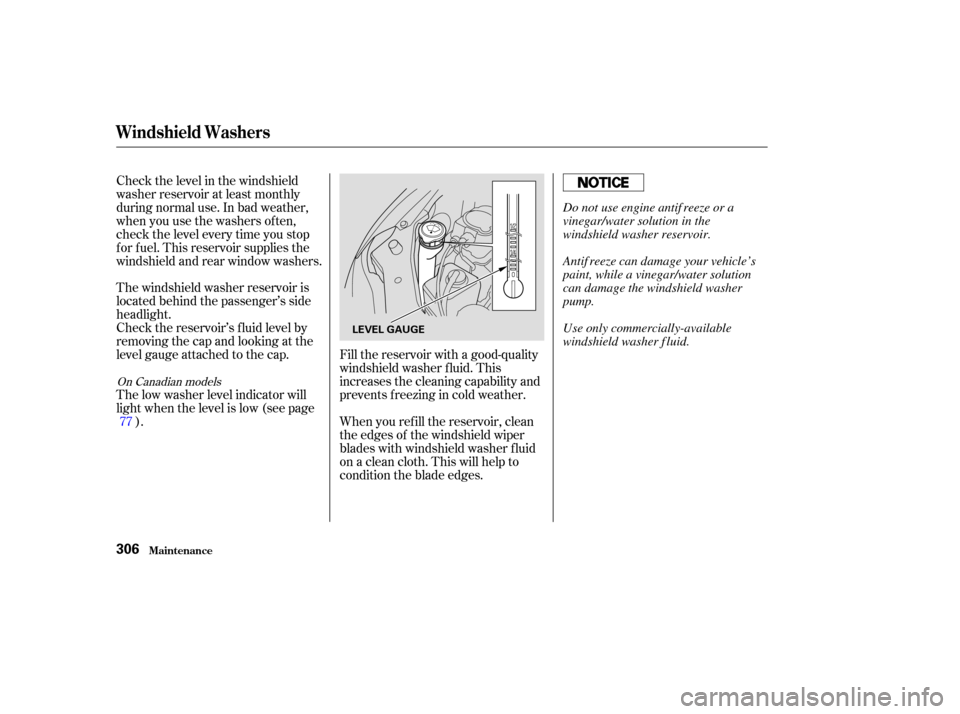
The windshield washer reservoir is
located behind the passenger’s side
headlight.
Check the reservoir’s f luid level by
removing the cap and looking at the
level gauge attached to the cap.
The low washer level indicator will
light when the level is low (see page
).
77
On Canadian models
Windshield Washers
Maint enance306
LEVEL GAUGE
Do not use engine antif reeze or a
vinegar/water solution in the
windshield washer reservoir.
Antif reeze can damage your vehicle’s
paint, while a vinegar/water solution
can damage the windshield washer
pump.
Use only commercially-available
windshield washer f luid.
Page 320 of 415
�µ
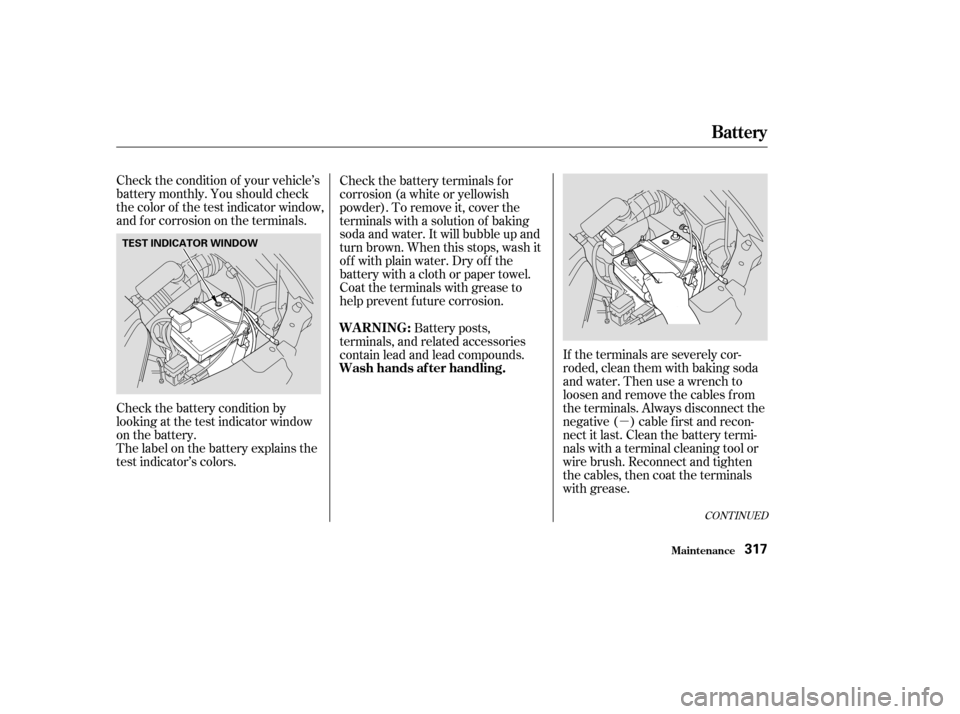
Check the condition of your vehicle’s
battery monthly. You should check
the color of the test indicator window,
and f or corrosion on the terminals.
Check the battery terminals for
corrosion (a white or yellowish
powder). To remove it, cover the
terminals with a solution of baking
soda and water. It will bubble up and
turn brown. When this stops, wash it
of f with plain water. Dry of f the
battery with a cloth or paper towel.
Coat the terminals with grease to
help prevent f uture corrosion.
If the terminals are severely cor-
roded, clean them with baking soda
and water. Then use a wrench to
loosen and remove the cables f rom
the terminals. Always disconnect the
negative ( ) cable f irst and recon-
nect it last. Clean the battery termi-
nals with a terminal cleaning tool or
wire brush. Reconnect and tighten
the cables, then coat the terminals
with grease.
Check the battery condition by
looking at the test indicator window
on the battery.
The label on the battery explains the
test indicator’s colors. Battery posts,
terminals, and related accessories
contain lead and lead compounds.
CONT INUED
Battery
Maint enance
WARNING:
Wash hands af ter handling.
317
TEST INDICATOR WINDOW
Page 328 of 415
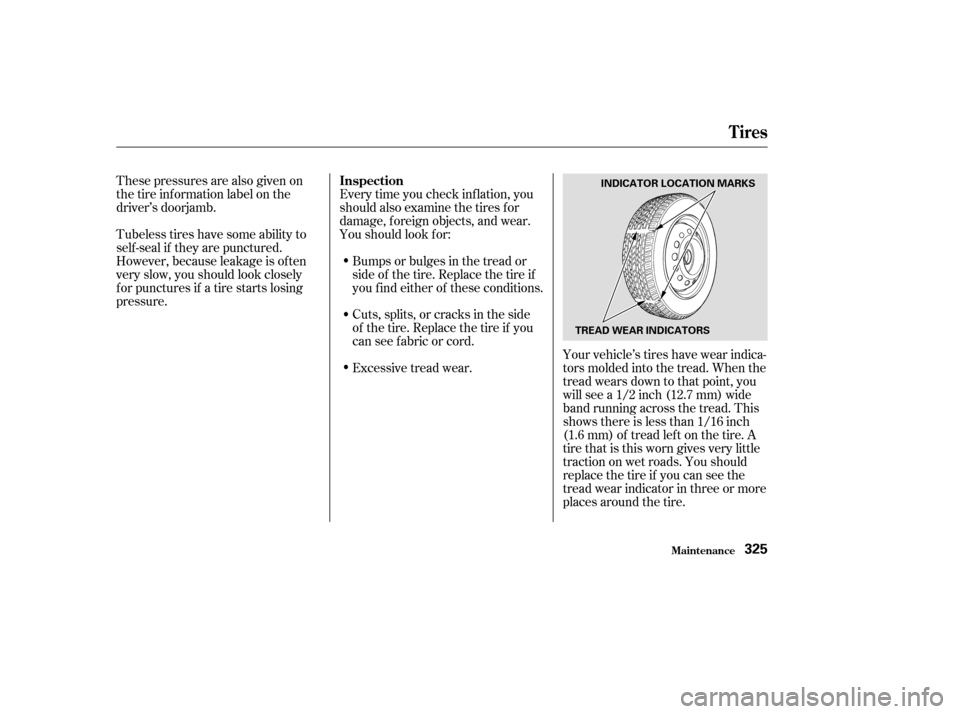
Your vehicle’s tires have wear indica-
tors molded into the tread. When the
tread wears down to that point, you
will see a 1/2 inch (12.7 mm) wide
band running across the tread. This
shows there is less than 1/16 inch
(1.6 mm) of tread lef t on the tire. A
tire that is this worn gives very little
traction on wet roads. You should
replace the tire if you can see the
tread wear indicator in three or more
places around the tire.
Every time you check inf lation, you
should also examine the tires f or
damage, f oreign objects, and wear.
Youshouldlookfor:
Bumps or bulges in the tread or
side of the tire. Replace the tire if
youfindeitherof theseconditions.
Cuts, splits, or cracks in the side
of the tire. Replace the tire if you
can see f abric or cord.
Excessive tread wear.
These pressures are also given on
thetireinformationlabelonthe
driver’s doorjamb.
Tubeless tires have some ability to
self -seal if they are punctured.
However, because leakage is of ten
very slow, you should look closely
for punctures if a tire starts losing
pressure.
Inspection
Tires
Maint enance325
INDICATOR LOCATION MARKS
TREAD WEAR INDICATORS
Page 354 of 415

This section covers the more-
common problems that motorists
experience with their vehicles. It
gives you inf ormation about how to
safely evaluate the problem and what
to do to correct it. If the problem has
stranded you on the side of the road,
you may be able to get going again.
If not, you will also f ind instructions
on getting your vehicle towed.......................
Compact Spare Tire .352
....................
Changing a Flat Tire .353
..........
If Your Engine Won’t Start . 362
Nothing Happens or the Starter Motor Operates ........................
Very Slowly .362
The Starter Operates ................................
Normally .363
................................
Jump Starting .364
............
If Your Engine Overheats . 366
.........
Low Oil Pressure Indicator . 369
..........
Charging System Indicator . 370
.......
Malf unction Indicator Lamp . 371
.......................
Readiness Codes .372
...............
Brake System Indicator . 373
..............................................
Fuses .374
..........
Checking and Replacing . 375
......................
Emergency Towing .380
Taking Care of the Unexpected
T aking Care of t he Unexpect ed351
Page 355 of 415
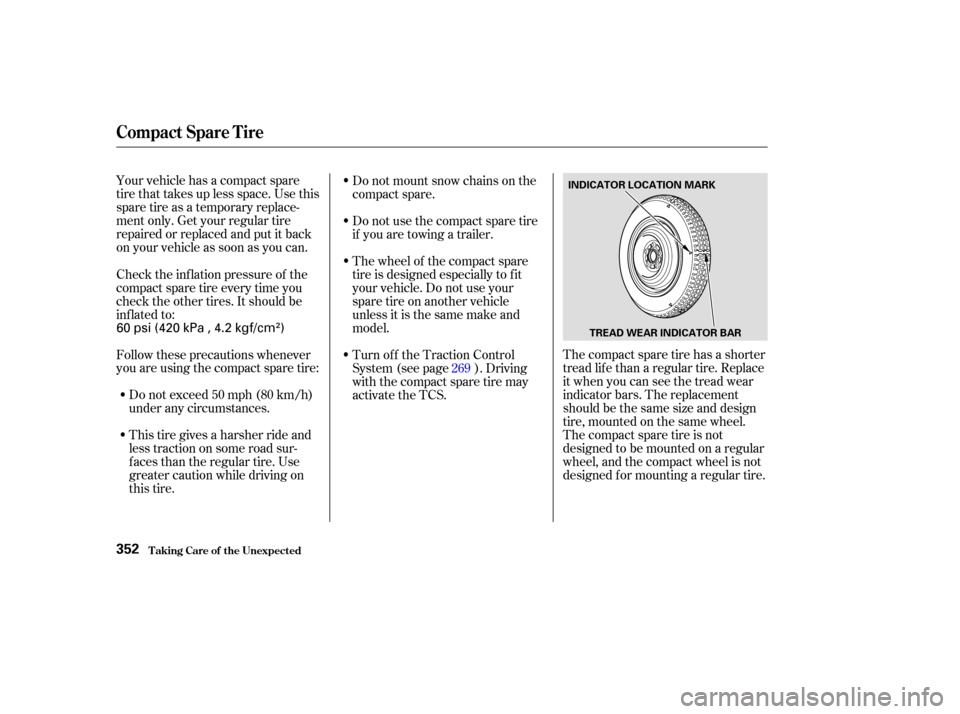
Your vehicle has a compact spare
tire that takes up less space. Use this
sparetireasatemporaryreplace-
ment only. Get your regular tire
repaired or replaced and put it back
on your vehicle as soon as you can.Thecompactsparetirehasashorter
tread lif e than a regular tire. Replace
it when you can see the tread wear
indicator bars. The replacement
should be the same size and design
tire, mounted on the same wheel.
Thecompactsparetireisnot
designed to be mounted on a regular
wheel, and the compact wheel is not
designed f or mounting a regular tire.
Check the inf lation pressure of the
compact spare tire every time you
check the other tires. It should be
inf lated to:
This tire gives a harsher ride and
less traction on some road sur-
f aces than the regular tire. Use
greater caution while driving on
this tire. Do not exceed 50 mph (80 km/h)
under any circumstances.
Follow these precautions whenever
you are using the compact spare tire: Do not mount snow chains on the
compact spare.
Do not use the compact spare tire
if you are towing a trailer.
The wheel of the compact spare
tire is designed especially to f it
your vehicle. Do not use your
sparetireonanothervehicle
unlessitisthesamemakeand
model.
Turn off the Traction Control
System (see page ). Driving
withthecompactsparetiremay
activate the TCS.
269
Compact Spare Tire
T aking Care of t he Unexpect ed352
INDICATOR LOCATION MARK
TREAD WEAR INDICATOR BAR
60 psi (420 kPa , 4.2 kgf/cm)
Page 366 of 415

If the headlights dim noticeably or
go out when you try to start the
engine, either the battery is dis-
charged or the connections are
corroded. Check the condition of the
battery and terminal connections
(see page ). You can then try
jump starting the vehicle from a
booster battery (see page ).In this case, the starter motor’s
speed sounds normal, or even f aster
than normal, when you turn the
ignition switch to START (III), but
the engine does not run.
Are you using the proper starting
procedure? Ref er to on page . There may be an electrical
problem, such as no power to the
f uel pump. Check all the f uses
(see page ).
If youfindnothingwrong,youwill
need a qualif ied technician to f ind
the problem. See on page .
Your vehicle has the Immobilizer
System. You should use a
properly-coded master or valet key
to start the engine (see page ).
A key that is not properly coded
will cause the immobilizer system
indicator in the dash panel to blink
rapidly. Do you have f uel? Turn the
ignition switch to ON (II) for a
minute and watch the f uel gauge.
The low f uel level warning light
may not be working, so you were
not reminded to f ill the tank.
317
364
259 374
380
90
T he Starter Operates Normally
Starting the
Engine Emergency
Towing
If Your Engine Won’t Start
T aking Care of t he Unexpect ed363
Page 369 of 415
Your vehicle can overheat for several
reasons, such as lack of coolant or a
mechanical problem. The only
indication may be the temperature
gauge climbing to or above the red
mark. Or you may see steam or
spray coming f rom under the hood.
In either case, you should take
immediate action.Saf ely pull to the side of the road.
Put the transmission in Neutral or
Park and set the parking brake.
Turn of f the heating and cooling/
climate control system and all
otheraccessories.Turnonthe
hazard warning indicators.
If you see steam and/or spray
coming f rom under the hood, turn
of f the engine.
The pointer of your vehicle’s
temperature gauge should stay in
the midrange under most conditions.
Itmaygohigherif youaredrivingup
a long steep hill on a very hot day. If
it climbs to the red mark, you should
determine the reason.
1.
2.
If Your Engine Overheats
T aking Care of t he Unexpect ed366
Steam and spray from an
overheated engine can
seriously scald you.
Do not open the hood if steam
is coming out.
Driving with the temperature gauge
pointer at the red mark can cause
serious damage to your engine.