2003 HONDA ODYSSEY ect
[x] Cancel search: ectPage 64 of 415

If a small-statured adult leans
sideways, or larger adult slouches
and leans sideways into the
deployment path of the side airbag,
the system may also shut of f the side
airbag.A f ront seat passenger should not
use a cushion or other object as a
backrest. It may prevent the cutof f
system f rom working properly.
When you turn the ignition switch to
ON (II), the indicator should light
brief ly and go out (see page ). If it
doesn’t light, stays on, or comes on
while driving without a passenger in
the front seat, have the system
checked.
If the side airbag cutof f indicator
light comes on, you should have the
passenger sit upright. Once the
passenger is out of the deployment
path of the side airbag, the system
will turn the airbag back on and the
light will go out. 73
Additional Inf ormation About Your Airbags
Driver and Passenger Saf ety61
Page 65 of 415

This light alerts you that the f ront
passenger’s airbag is shut of f .If the light is on, it does not mean
there is a problem with the f ront
passenger’s airbag. If there is a
problem in the weight sensors, the
SRS indicator in the instrument
panel comes on. In this case, the
passenger airbag cutof f indicator
turns of f , and the f ront passenger’s
airbag will inflate during a crash.
To reduce the chance of airbag-
caused injuries, the system shuts of f
the f ront passenger’s airbag when
the total weight on the f ront
passenger’s seat is about 65 lbs
(30 kg) or less. The passenger
airbag cutoff indicator comes on to
remind you the f ront passenger’s
airbag will not inf late during a crash.If there is no passenger in the f ront
passenger’s seat, this indicator does
not come on, however the system
shuts of f the f ront passenger’s
airbag.
If this indicator comes on with no
passenger in the f ront passenger’s
seat,orwithanadultintheseat,
there may be a problem in the
advanced airbag system. Have the
vehicle checked by the dealer as
soon as possible.
This indicator may come on or of f
repeatedly, if some objects are put
on the f ront passenger’s seat, or if
the temperature of the vehicle’s
interior changes suddenly when a
door is opened.
Additional Inf ormation About Your Airbags
Driver and Passenger Saf ety
How the Passenger Airbag Cutof f
Indicator Works
62
PASSENGER AIRBAG CUTOFF
INDICATOR
Page 68 of 415

Together, airbags and
seat belts provide the best
protection.
Tampering could cause
the airbags to deploy, possibly
causing very serious injury.
If rain or spilled water
soaks into a seat-back, it can
prevent the side airbag system
f rom working properly.
This could make the
driver’s seat position sensor and
the f ront passenger’s weight
sensors inef f ective. Improperly
replacing or covering f ront seat-
back covers can prevent your side
airbags f rom inf lating during a
collision.
This could make the driver’s seat
position sensor and the f ront
passenger’s weight sensors
inef f ective. See page f or f urther inf ormation
and precautions relating to your
airbags.
first contact American
Honda at 800-999-1009. 252
Additional Saf ety Precautions
Donotattempttodeactivateyour
airbags.
Do not t amper wit h airbagcomponent s or wiring f or anyreason.
Do not expose t he f ront seat -backsto water.
Do not place any it ems under t hefront seats. Do not cover or replace f ront seat -
back covers wit hout consult ing aHonda dealer.
Do not modif y t he f ront seat s.If it is necessary t o modif y anadvanced f ront airbag syst em t oaccommodat e a person wit hdisabilities,
Additional Inf ormation About Your Airbags
Driver and Passenger Saf ety65
Page 69 of 415

Your vehicle’s exhaust contains
carbon monoxide gas. You should
have no problem with carbon
monoxide entering the vehicle in
normal driving if you maintain your
vehicle properly.
Have the exhaust system inspected
f or leaks whenever:The vehicle is raised f or an oil
change.
You notice a change in the sound
of the exhaust.
The vehicle was in an accident
that may have damaged the under-
side. High levels of carbon monoxide can
collect rapidly in enclosed areas,
such as a garage. Do not run the
engine with the garage door closed.
Even with the door open, run the
engine only long enough to move the
vehicle out of the garage. With the tailgate open, air flow can
pull exhaust gas into your vehicle’s
interior and create a hazardous
condition. If you must drive with the
tailgate open, open all the windows
and set the heating and cooling
system/climate control system as
shown below.
Select the Fresh Air mode.
Select the mode.
Turn the f an on high speed.
Set the temperature control to a
comfortable setting.
If you must sit in your parked vehicle,
even in an unconf ined area, with the
engine running, adjust the heating
and cooling system/climate control
system as f ollows:
1.
2.
3.
4.
Carbon Monoxide Hazard
Driver and Passenger Saf ety66
Carbon monoxide gas is toxic.
Breathing it can cause
unconsciousness and even kill
you.
Avoid any enclosed areas or
activities that expose you to
carbon monoxide.
Page 72 of 415

This section gives inf ormation about
the controls and displays that
contribute to the daily operation of
your Honda. All the essential
controls are within easy reach............................
Control Locations .70
...............................
Indicator Lights .71
.............................................
Gauges .78
Controls Near the Steering .......................................
Wheel .81
...................................
Headlights .82
Automatic Lighting Off .....................................
Feature .83
............
Daytime Running Lights . 83
....
Instrument Panel Brightness . 83
................................
Turn Signals .84 .....................
Windshield Wipers .84
..................
Windshield Washers . 86
Rear Window Wiper and .....................................
Washer .86
..........................
Hazard Warning .87
.............
Rear Window Def ogger . 87
......
Steering Wheel Adjustment . 88
...............................
Keys and Locks .89
..............................................
Keys .89
....................
Immobilizer System . 90
............................
Ignition Switch .91
......................
Power Door Locks .92
...................
Remote Transmitter . 94
..............
Childproof Door Locks . 98
........................................
Tailgate .98
..................................
Glove Box .100
...................
Manual Sliding Doors . 101
.....................
Power Sliding Doors .103
...............................................
Seats .109
....................
Passenger Seating .109
......................
Seat Adjustments .110
Driver’s Seat Manual Height ............................
Adjustment .112
Driver’s Seat Power ..........................
Adjustments .113
.........
Driver’s Lumbar Support . 114....................................
Armrests .115
........................
Head Restraints .115
.....................
Third Seat Access .116
Moving the Second Row ...........................
Bucket Seat .117
Removing the Bucket Seats ................
in the Second Row . 119
Folding the Third Row .........................
‘‘Magic Seat’’ .120
..................................
Seat Heaters .123
............................
Power Windows .124
...........................................
Mirrors .128
...............................
Parking Brake .129
..................................
Digital Clock .130
..................................
Center Table .130
.........................
Beverage Holders .132
........................
Sunglasses Holder .134
........................................
Sun Visor .134
................................
Vanity Mirror .135
.......................
Rear Compartment .135
...............................
Center Pocket .136
...................................
Coin Holder .136
...................................
Storage Box .137
......................................
Coat Hook .137
............
Accessory Power Sockets . 138
...............................
Interior Lights .139
Instruments and Controls
Inst rument s and Cont rols69
Page 76 of 415

This indicator lights when you turn
the ignition switch ON (II). It is a
reminder to you and your passengers
to protect yourselves by f astening
the seat belts. A beeper also sounds
if you have not fastened your seat
belt.
If you do not f asten your seat belt,
the beeper will stop af ter a f ew
seconds but the light stays on until
you do. Both the light and the beeper
stay of f if you f asten your seat belt
bef ore turning on the ignition.This indicator lights when you turn
the ignition switch ON (II). If it
comes on at any other time, it
indicates a potential problem with
your f ront airbags or automatic seat
belt tensioners. This light will also
alert you to a potential problem with
your side airbags, passenger’s side
airbag automatic cutoff system,
driver’s seat position sensor, or f ront
passenger’s weight sensors. For
complete inf ormation, see page .
This indicator lights when you turn
the ignition switch ON (II). If it
comes on at any other time, it
indicates that the passenger’s side
airbag has automatically shut off.
For complete inf ormation, see page
.
60
59
Indicator L ights
Inst rument s and Cont rols
Supplemental Restraint
System Indicator Side A irbag Cutof f
Indicator
Seat Belt Reminder L ight
73
Page 81 of 415
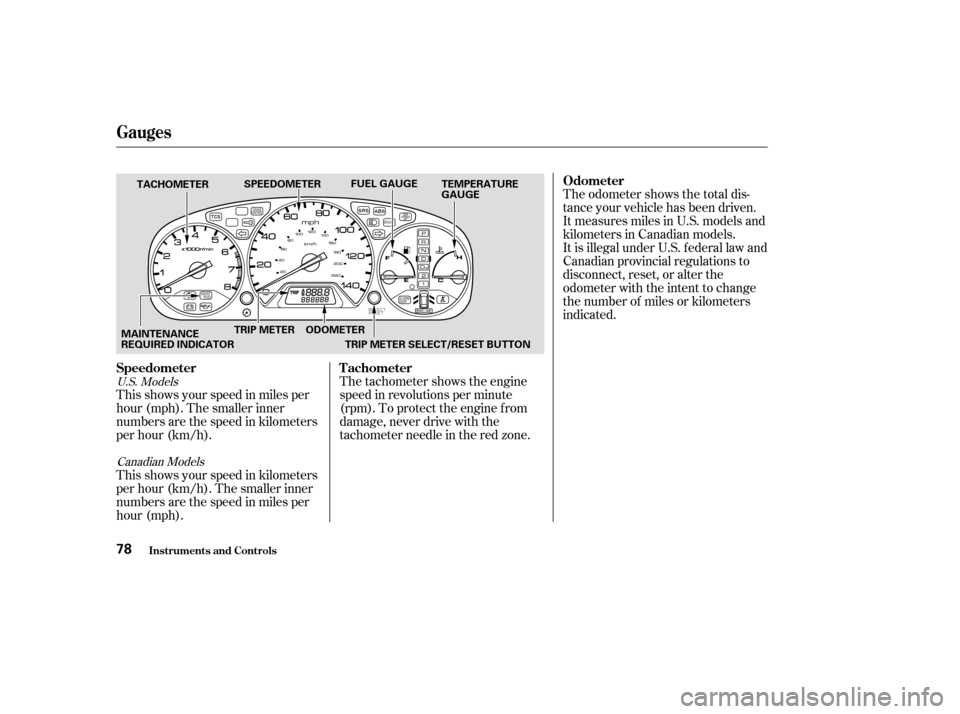
U.S. ModelsCanadian Models
This shows your speed in miles per
hour (mph). The smaller inner
numbers are the speed in kilometers
per hour (km/h).
This shows your speed in kilometers
per hour (km/h). The smaller inner
numbers are the speed in miles per
hour (mph). The tachometer shows the engine
speed in revolutions per minute
(rpm). To protect the engine f rom
damage, never drive with the
tachometer needle in the red zone.The odometer shows the total dis-
tance your vehicle has been driven.
It measures miles in U.S. models and
kilometers in Canadian models.
It is illegal under U.S. f ederal law and
Canadian provincial regulations to
disconnect, reset, or alter the
odometer with the intent to change
the number of miles or kilometers
indicated.
Speedometer Odometer
T achometer
Gauges
Inst rument s and Cont rols78
TACHOMETER SPEEDOMETERFUEL GAUGE
TEMPERATURE
GAUGE
TRIP METER SELECT/RESET BUTTON
TRIP METER
MAINTENANCE
REQUIRED INDICATOR ODOMETER
Page 82 of 415

This shows how much f uel you have.
It is most accurate when the vehicle
is on level ground. It may show
slightly more or less than the actual
amount when you are driving on
curvy or hilly roads.
This shows the temperature of the
engine’s coolant. During normal
operation, the pointer should rise
from the bottom white mark to about
the middle of the gauge. In severe
driving conditions, such as very hot
weather or a long period of uphill
driving, the pointer may rise to near
the upper white mark. If it reaches
the red (Hot) mark, pull safely to the
side of the road. Turn to page f or
instructions and precautions on
checking the engine’s cooling
system.
This meter shows the number of
miles (U.S.) or kilometers (Canada)
driven since you last reset it.
There are two trip meters: Trip A
and Trip B. Switch between these
displays by pressing the Select/
Reset button repeatedly. Each trip
meter works independently, so you
can keep track of two dif f erent
distances.
To reset a trip meter, display it, and
then press and hold the Select/Reset
button until the number resets to
‘‘0.0’’.
The needle returns to the bottom
after you turn off the ignition. The
gauge shows the f uel level reading
immediately af ter you turn the
ignition switch back ON (II).
366
Gauges
Inst rument s and Cont rols
Trip Meter
Temperature GaugeFuel Gauge
79
Avoid driving with an extremely low
f uel level. Running out of f uel could
cause the engine to misf ire, damaging
the catalytic converter.