Page 268 of 317
To jump start your car, f ollow these
directions closely:Open the hood and check the
physical condition of the battery
(see page ). In very cold
weather, check the condition of
the electrolyte. If it seems slushy
or like ice, do not try jump starting
until it thaws. Turn of f all the electrical acces-
sories: heater, A/C, stereo system,
lights, etc.
Put the transmission in Neutral or
Park, and set the parking brake.
If your car’s 12 volt battery has run
down,youmaybeabletostartthe
engine by using a booster battery.
Although this seems like a simple
procedure, you should take several
precautions.
You cannot start a Honda with an
automatic transmission (CVT) by
pushing or pulling it. 1.
2.
216
CONT INUED
Jump Starting
T aking Care of t he Unexpect ed265
A battery can explode if you do
not follow the correct procedure,
seriously injuring anyone
nearby.
Keep all sparks, open flames,
and smoking materials away
from the battery. If a battery sits in extreme cold, the
electrolyte inside can f reeze.
Attempting to jump start with a f rozen
battery can cause it to rupture.
Page 269 of 317
�´�´ �µ
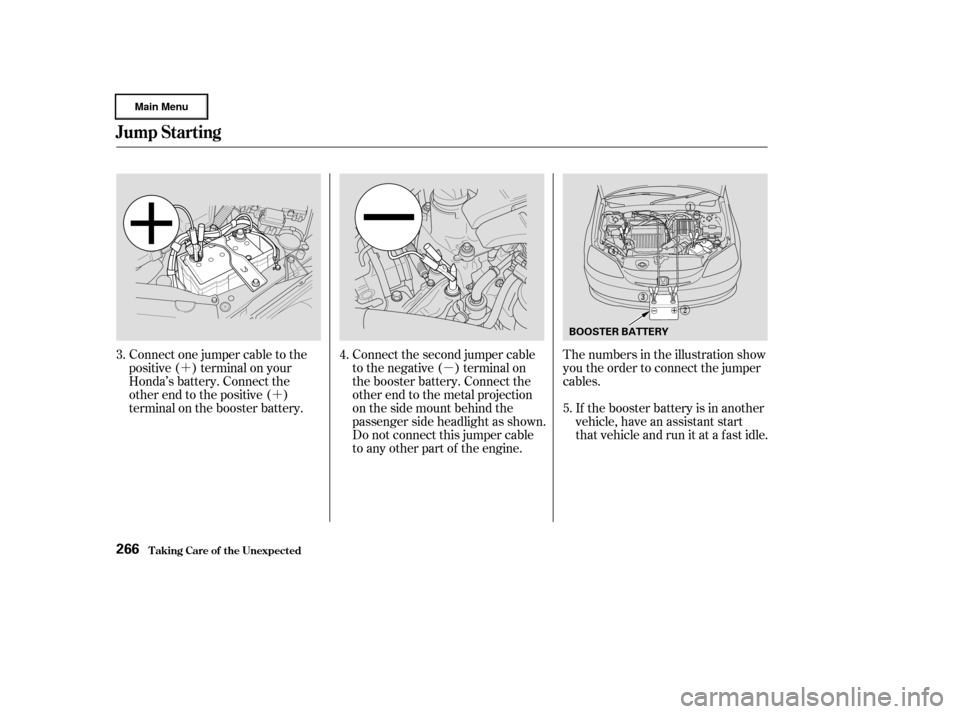
Connect one jumper cable to the
positive ( ) terminal on your
Honda’s battery. Connect the
other end to the positive ( )
terminal on the booster battery.
If the booster battery is in another
vehicle, have an assistant start
that vehicle and run it at a fast idle.
The numbers in the illustration show
you the order to connect the jumper
cables.
Connect the second jumper cable
to the negative ( ) terminal on
the booster battery. Connect the
other end to the metal projection
on the side mount behind the
passenger side headlight as shown.
Do not connect this jumper cable
to any other part of the engine.
3.
4.
5.
Jump Starting
T aking Care of t he Unexpect ed266
BOOSTER BATTERY
Page 270 of 317
Keep the ends of the jumper cables
away from each other and any metal
on the car until all are disconnected.
Otherwise, you may cause an
electrical short.Once your car is running, discon-
nectthenegativecablefromyour
car, then from the booster battery.
Disconnect the positive cable f rom
your car, then the booster battery. Start your car. If the starter motor
still operates slowly, check the
jumper cable connections to make
sure they have good metal-to-
metal contact.
If your car’s 12 volt battery is
disconnected or goes dead, the IMA
battery level gauge reading may not
be correct the next time you turn the
ignition switch to ON (II). It may
show less than the actual level
temporarily. It will show the correct
level af ter you drive f or at least 30
minutes.
7. 6.
Jump Starting
T aking Care of t he Unexpect ed267
Page 275 of 317

�µ
�µ
This indicator should come on when
the ignition switch is ON (II), and go
out af ter the engine starts. If it
comes on brightly when the engine
is running, it indicates that the
charging system has stopped
charging the battery. Immediately turn of f all electrical
accessories: radio, heater, A/C, rear
def ogger, cruise control, etc. Try not
to use other electrically-operated
controls such as the power windows.
Keep the engine running and take
extra care not to stall it. Starting the
engine will discharge the battery
rapidly.
By eliminating as much of the
electrical load as possible, you can
drive several miles (kilometers)
before the battery is too discharged
to keep the engine running. Drive to
a service station or garage where
you can get technical assistance.
If the Auto Idle Stop is active f or an
extended period, the charging
system indicator may come on. If it
happens, start the engine.
The charging system indicator may
also come on if the Integrated Motor
Assist (IMA) battery charge drops
below a desired level and the engine
starts to recharge the battery.
This indicator may blink af ter you
start the car in the morning when
the temperature is below 20°F
( 30°C). It will stop blinking when
the IMA battery warms up.
T aking Care of t he Unexpect ed
Charging System Indicator
272
CHARGING SYSTEM INDICATOR
Page 277 of 317
Your car has certain ‘‘readiness
codes’’ that are part of the on-board
diagnostics f or the emissions
systems. In some states, part of the
emissions testing is to make sure
these codes are set. If they are not
set, the test cannot be completed.
If your car’s battery has been
disconnected or gone dead, these
codes are erased. It takes several
days of driving under various
conditions to set the codes again.If possible, do not take your car f or a
state emissions test until the
readiness codes are set. Ref er to
State Emissions Testing f or more
inf ormation. (See page .)
To check if they are set, turn the
ignition ON (II), but do not start the
engine. The Malf unction Indicator
Lamp will come on f or 20 seconds. If
it then goes of f , the readiness codes
are set. If it blinks 5 times, the
readiness codes are not set.
297
Malf unction Indicator L amp
T aking Care of t he Unexpect ed
Readiness Codes
274
Page 283 of 317
�µ�µ
No.Circuits Protected
Amps.
Circuits Protected
Amps.
No.
1
2
3
4
5
6
7
8
9
10
11
12
13
14
15
16
17
18
19
20 Condenser Fan
IMA
Small Light
Cooling Fan
Hazard
FI ECU
Horn, Stop
ABS F/S
Back Up
ABS Motor
Rear Defroster
Heater Motor
Power Window
Option
Lef t Headlight
Door Lock
Right Headlight
EPS
Battery
Ignition 1
Spare Fuses
20 A
10 A
10 A
20 A
10 A
15 A
15 A
20 A
10 A
40 A
30 A
40 A
40 A
40 A
15 A
20 A
15 A
60 A
80 A
50 A
Cooling Fan
20 A1
21 257.5A 30A
T aking Care of t he Unexpect ed
Fuses
280
UNDER-HOOD AND SECONDARY FUSE BOXES
Page 286 of 317
If you decide to tow your car with all
f our wheels on the ground, make
sure you use a properly-designed and
attached tow bar. Prepare the car for
towing as described above, and leave
the ignition switch in Accessory (I)
so the steering wheel does not lock.
Make sure the radio and any items
plugged into the accessory power
socket are turned of f so they do not
rundownthebattery.
With the f ront wheels on the ground,
it is best to tow the car no farther
than 50 miles (80 km), and keep the
speedbelow35mph(55km/h).
If your car is equipped with a f ront
spoiler, remove it bef ore towing so it
is not damaged.
Emergency T owing
T aking Care of t he Unexpect ed283
Trying to lif t or tow your car by the
bumpers will cause serious damage.
The bumpers are not designed to
support the car’s weight.
The steering system can be damaged if
the steering wheel is locked. Leave the
ignition switch in Accessory (I), and
make sure the steering wheel turns
f reely bef ore you begin towing.
Page 292 of 317

�µ�µ�µ
�µ
�µ
�µ
�µ
�µ
�µ
�µ
�µ
�µ
�µ
�µ
�µ
�µ
�µ
�Î
�Î
�Î
�Î
Specif ications
T echnical Inf ormation289
Fuses
Alignment
Air Conditioning
Lights
Battery
Tires
HFC-134a (R-134a)
17.6 19.4 oz (500 550 g) SP-10
12 V
12 V 60/55 W (HB2)
21/5 W
12 V 8 W 12 V 3 CP
12 V 21 W
12 V 3 CP
12 V 21 W 12 V 21/5 W 12 V 21 W
12 V 3 CP Interior
Under-hood
Toe-in
Camber
Caster
2°20’1°
0°12’
0.00 in (0.0 mm)
P185/70R14 87S
Refrigerant type
Charge quantity
Lubricant oil type
0.08 in (2.0 mm)
12 V
12 V 8W
5W
Headlights (HI/LO)
Front turn signal/side marker
lights
Front parking light
Rear turn signal lights
Stop/Taillights/Rear side
marker lights
Back-up lights
Taillights
High-mount brake light
License plate lights
Ceiling light
Spotlights
Trunk light
Capacity
12 V 35 AH/20 HR See page
281or the fuse label
attached to the inside of the fuse
box door under the steering
column.
See page 280or the fuse box
cover.
T115/70D14 88M
30 psi (210 kPa , 2.1 kgf/cm
)
60 psi (420 kPa , 4.2 kgf/cm)
Size
Pressure
T125/70D15 95M
Front
Rear
Front
Rear
Front
Front/Rear
Spare
Front/Rear
Spare
1 : Without ABS
2 : With ABS
1
2