Page 57 of 317
High levels of carbon monoxide can
collect rapidly in enclosed areas,
such as a garage. Do not run the
engine with the garage door closed.
Even with the door open, run the
engine only long enough to move the
vehicle out of the garage.
Your car’s exhaust contains carbon
monoxide gas. You should have no
problem with carbon monoxide
entering the car in normal driving if
you maintain your car properly.
Have the exhaust system inspected
f or leaks whenever:
The car is raised f or an oil change.
You notice a change in the sound
of the exhaust.
Thecarwasinanaccidentthat
may have damaged the underside. If you must sit in your parked car,
even in an unconf ined area, with the
engine running, adjust the heating
and cooling system as f ollows: With the trunk lid open, air f low can
pull exhaust gas into your car’s
interior and create a hazardous
condition. If you must drive with the
trunk lid open, open all the windows
and set the heating and cooling
system as shown below.
Select the Fresh Air mode.
Select the mode.
Turn the f an on high speed.
Set the temperature control to a
comfortable setting.
1.
2.
3.
4.
Carbon Monoxide Hazard
Driver and Passenger Saf ety54
Carbon monoxide gas is toxic.
Breathing it can cause
unconsciousness and even kill
you.
Avoid any enclosed areas or
activities that expose you to
carbon monoxide.
Page 62 of 317
�Î
�Î
�Î
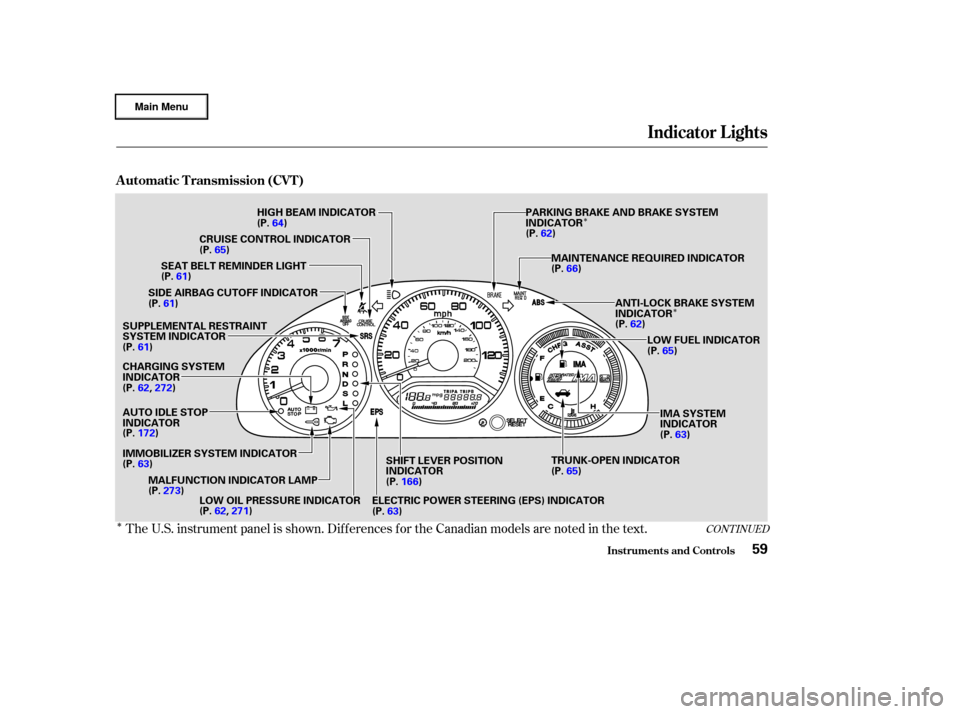
The U.S. instrument panel is shown. Dif f erences f or the Canadian models are noted in the text.CONT INUED
Indicator L ights
Inst rument s and Cont rols
Automatic Transmission (CVT)
59
HIGH BEAM INDICATOR
(P.
64)
CRUISE CONTROL INDICATOR
(P. 65)
SEAT BELT REMINDER LIGHT
(P. 61)
SIDE AIRBAG CUTOFF INDICATOR
(P. 61)
SUPPLEMENTAL RESTRAINT
SYSTEM INDICATOR
(P. 61)
CHARGING SYSTEM
INDICATOR
(P. 62, 272)
AUTO IDLE STOP
INDICATOR
(P. 172)
IMMOBILIZER SYSTEM INDICATOR
(P. 63)
MALFUNCTION INDICATOR LAMP
(P. 273)
LOW OIL PRESSURE INDICATOR
(P.62, 271)
(P.63)
ELECTRIC POWER STEERING (EPS) INDICATOR (P.
166)
SHIFT LEVER POSITION
INDICATOR
(P.
65)
TRUNK-OPEN INDICATOR (P.
63)
IMA SYSTEM
INDICATOR
(P.
65)
LOW FUEL INDICATOR
ANTI-LOCK BRAKE SYSTEM
INDICATOR
(P.
62)
(P.
66)
MAINTENANCE REQUIRED INDICATOR
(P.
62)
PARKING BRAKE AND BRAKE SYSTEM
INDICATOR
Page 63 of 317
�Î
�Î
�Î
�Î
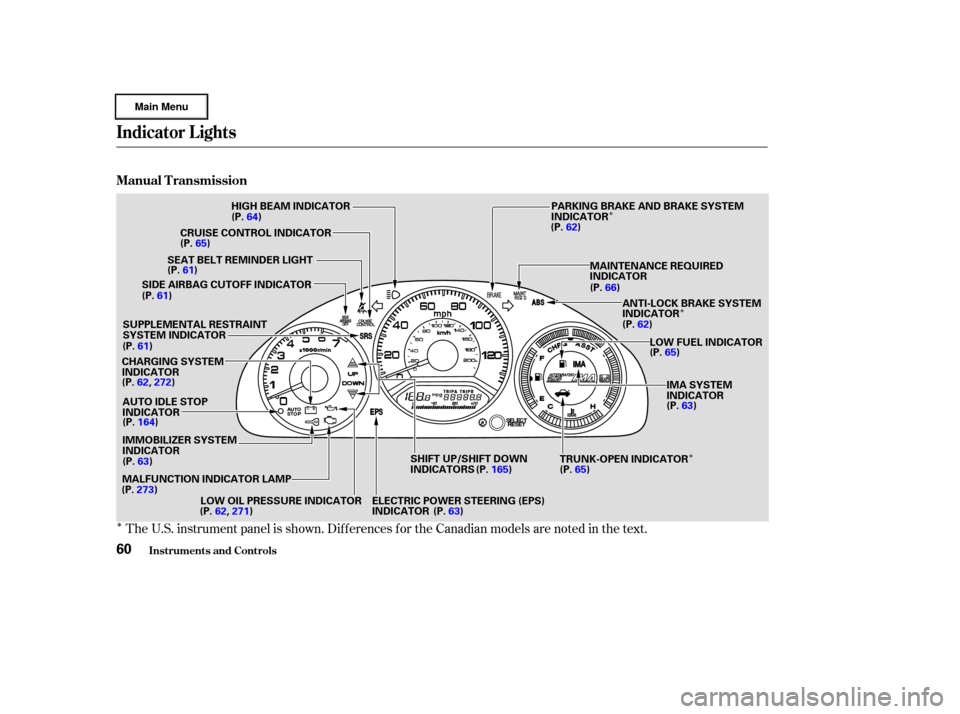
The U.S. instrument panel is shown. Dif f erences f or the Canadian models are noted in the text.
Indicator L ights
Inst rument s and Cont rols
Manual Transmission
60
HIGH BEAM INDICATOR
(P.
64)
(P. 65)
CRUISE CONTROL INDICATOR
SEAT BELT REMINDER LIGHT
(P. 61)
SIDE AIRBAG CUTOFF INDICATOR
(P. 61)
SUPPLEMENTAL RESTRAINT
SYSTEM INDICATOR
(P. 61)
CHARGING SYSTEM
INDICATOR
(P. 62, 272)
AUTO IDLE STOP
INDICATOR
(P. 164)
IMMOBILIZER SYSTEM
INDICATOR
(P. 63)
MALFUNCTION INDICATOR LAMP
(P. 273)
LOW OIL PRESSURE INDICATOR
(P. 62, 271)
(P.63)
ELECTRIC POWER STEERING (EPS)
INDICATOR SHIFT UP/SHIFT DOWN
INDICATORS
(P.165) TRUNK-OPEN INDICATOR
(P.
65) IMA SYSTEM
INDICATOR
(P.
63)
(P.
65)
LOW FUEL INDICATOR
ANTI-LOCK BRAKE SYSTEM
INDICATOR
(P.
62)
MAINTENANCE REQUIRED
INDICATOR
(P.
66)
(P.
62)
PARKING BRAKE AND BRAKE SYSTEM
INDICATOR
Page 65 of 317
This light has two f unctions:This light normally comes on f or a
f ew seconds when you turn the
ignition switch ON (II), and when
the ignition switch is turned to
START (III). If this light comes on at
any other time, there is a problem in
theABS.If thishappens,takethe
cartoyourdealertohaveitchecked.
With the light on, your car still has
normal braking ability but no anti-
lock. For complete inf ormation, see
page .
If this light comes on when the
engine is running, the battery is not
being charged. For complete
inf ormation, see page .
The engine can be severely damaged
if this light f lashes or stays on when
the engine is running. For complete
inf ormation, see page .
This indicator comes on when you
turn the ignition switch ON (II). It
is a reminder to check the parking
brake. Driving with the parking
brake not f ully released can
damage the brakes and tires.
If the indicator remains lit after
you have f ully released the
parking brake while the engine is
running, or if it comes on while
driving, it can indicate a problem
in the brake system. For complete
inf ormation, see page .
See page . 1.
2.
272
271 275177
273
Only on models equipped with ABS (see
page ) 175
Parking Brake
and Brake
System
Indicator Anti-lock Brake
System (A BS)
Indicator
Charging System
Indicator
L ow Oil Pressure
Indicator
Malf unction Indicator
Lamp
Indicator L ights
Inst rument s and Cont rols62
U.S. Canada
U.S. Canada
Page 146 of 317
Bef ore you begin driving your Honda,
youshouldknowwhatgasolineto
use, and how to check the levels of
important f luids. You also need to
know how to properly store luggage
or packages. The inf ormation in this
section will help you. If you plan to
add any accessories to your car,
please read the inf ormation in this
section f irst..............................
Break-in Period .144
.........................................
Gasoline .144
.........
Service Station Procedures . 145
................
Filling the Fuel Tank . 145
....................
Opening the Hood .146
...............................
Oil Check .148
.........
Engine Coolant Check . 149
...............................
Fuel Economy .150
.....................
Vehicle Condition .150
...........................
Driving Habits .150
...
Accessories and Modif ications . 152
.............................
Carrying Cargo .154
Bef ore Driving
Bef ore Driving143
Page 147 of 317

During this period:Avoid full-throttle starts and rapid
acceleration.
Avoidhardbraking.Newbrakes
need to be broken-in by moderate
use f or the f irst 200 miles (300
km). Your Honda is designed to operate
on unleaded gasoline with a pump
octane number of 86 or higher. Use
of a lower octane gasoline can cause
a persistent, heavy metallic rapping
noise in the engine that can lead to
mechanical damage.
We recommend gasolines containing
detergent additives that help prevent
f uel system and engine deposits.
In Canada, some gasolines contain
an octane-enhancing additive called
MMT. If you use such gasolines,
your emission control system
perf ormance may deteriorate and
the Malf unction Indicator Lamp on
your instrument panel may turn on.
If this happens, contact your
authorized Honda dealer f or service.
Help assure your car’s f uture
reliability and perf ormance by paying
extra attention to how you drive
during the f irst 600 miles (1,000 km).
Using gasoline containing lead will
damage your car’s emissions
controls. This contributes to air
pollution.
Youshouldfollowthesesamere-
commendations with an overhauled
or exchanged engine, or when the
brakes are relined. Do not change the oil until the
recommended time or mileage
intervalshowninthemaintenance
schedule.
Break-in Period, Gasoline
Bef ore Driving
Break-in Period
Gasoline
144
Page 151 of 317
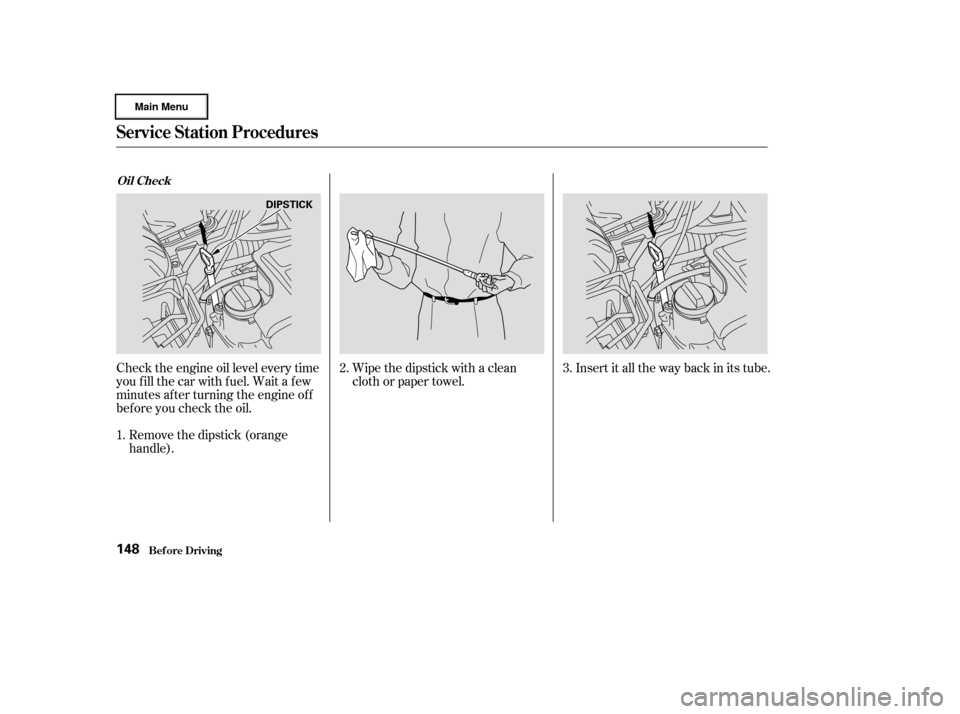
Wipe the dipstick with a clean
cloth or paper towel.Insert it all the way back in its tube.
Remove the dipstick (orange
handle).
Check the engine oil level every time
you f ill the car with f uel. Wait a f ew
minutes af ter turning the engine of f
bef ore you check the oil.
2.
3.
1.
Oil Check
Service Station Procedures
Bef ore Driving148
DIPSTICK
Page 152 of 317
Remove the dipstick again and
check the level. It should be
between the upper and lower
marks.Look at the coolant level in the
radiator reserve tank. Make sure it is
between the MAX and MIN lines. If
it is below the MIN line, see
on page f or
inf ormation on adding the proper
coolant.
If it is near or below the lower mark,
see
on page . Refer to
on page f or inf ormation
on checking other items in your
Honda.
4. 195 199193
A dding
Engine Coolant
A dding Oil Owner Maintenance
Checks
Engine Coolant Check
Service Station Procedures
Bef ore Driving149
UPPER MARK
LOWER MARK RESERVE TANK MAX
MIN